


For US commercial fleet operators and plant-hire companies, flexible premiums are genuinely useful — but only when actively managed. The core advantage is straightforward: you pay for the cover you need, when you need it, rather than carrying a fixed cost through slow periods.
Top benefits at a glance:
- Liquidity control: Reduce premiums during low-revenue months and top up during project surges.
- Pay-for-use cover: Align insurance spend with actual asset utilisation, cutting wasted premium.
- Coverage continuity: Keep long-term cover on valuable assets without a fixed monthly commitment.
Key risks to accept:
- Active management is non-negotiable. Industry analysts identify underfunding as the primary cause of silent policy lapse.
- Flexible-premium permanent policies often have higher lifetime costs than term-only alternatives.
- Truck & Plant On-Demand™ addresses the pay-for-use side directly; the management discipline is still yours to own.
Table of Contents
- What does “flexible premium” actually mean for commercial insurance?
- The practical benefits of flexible premium for fleet and plant-hire businesses
- What are the trade-offs and risks fleet managers must accept?
- How to implement flexible-premium cover inside a fleet operation
- What should you compare when evaluating flexible-premium policies?
- How Truck & Plant On-Demand™ maps these benefits to your workflow
- Key takeaways
- The case for flexibility — and the discipline it demands
- Truck & Plant On-Demand™: cover that moves with your fleet
- Useful sources and further reading
What does “flexible premium” actually mean for commercial insurance?
Flexible premium is the funding design used in permanent policy types — universal life (UL), indexed universal life (IUL), and variable universal life (VUL) — where you can raise, lower, or skip payments within insurer-set limits. It is not a feature of standard term insurance, which has fixed premiums and no cash value.
Each payment you make is split two ways: a portion covers the cost of insurance (COI) plus administrative charges, and the remainder funds a cash value account. That cash value grows on a tax-deferred basis and can be accessed through policy loans or withdrawals, subject to IRS rules. The IRS treats cash-value growth as tax-deferred, not tax-free — withdrawals above your cost basis are taxable, and unpaid loans reduce the death benefit. Consult a qualified tax advisor before accessing cash value for operational purposes.
Two premium levels matter here:
- Minimum required premium: Keeps the policy in force by covering COI and charges. Paying only this rarely builds meaningful cash value.
- Planned premium: The amount intended to accumulate reserves. Consistent over-minimum payments are what make cash value operationally useful.
Pro Tip: If your fleet revenue is seasonal — heavy in Q2 and Q3, quiet in winter — a flexible-premium structure lets you pay the minimum during slow months and top up aggressively after profitable contracts. That rhythm suits the product’s design.
The practical benefits of flexible premium for fleet and plant-hire businesses
Flexible-premium designs are recommended for business use-cases precisely because business cash flow is variable. For fleet operators, that maps to three concrete advantages.
Liquidity and cash-flow alignment
When a six-week civil project ends and your hired plant sits idle, your insurance cost should reflect that. Flexible premiums let you reduce outgoings during downtime and redirect cash to payroll, maintenance, or the next contract deposit. The cash value built during high-revenue periods can also serve as an operational buffer, accessed via a policy loan without triggering an immediate tax event — though any outstanding loan balance reduces your cover if the policy lapses.

Premium smoothing across asset life-cycles
Plant machinery and commercial trucks have long operational lives. Locking into a fixed annual premium for a 12-tonne excavator that works six months a year is a poor use of capital. Flexible premiums let you align cover with usage, paying more when the asset earns and less when it sits. That smoothing effect reduces the risk of forced cancellations during lean periods, which would leave assets uninsured at exactly the wrong time.
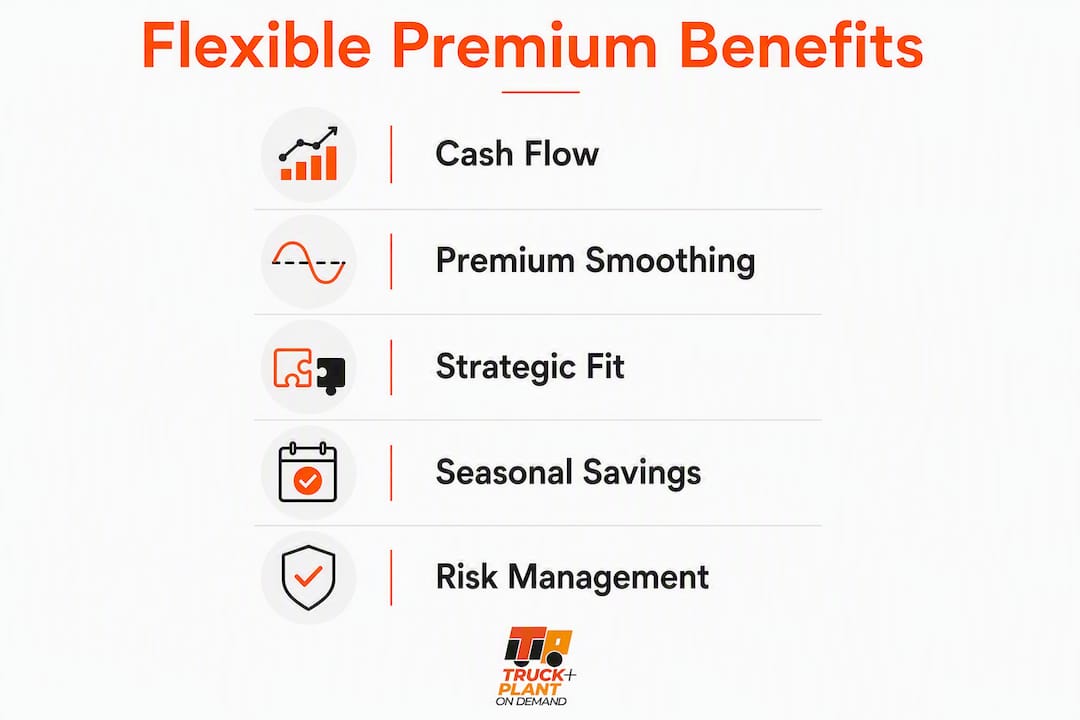
Strategic business fit
For fleet managers running variable hire volumes, short-term rental surges, or project-based contracts, that profile fits well. The interest-crediting method — fixed, indexed, or market-linked — materially affects how fast cash value grows, so it pays to understand which method your policy uses before committing.
| Scenario | Flexible premium advantage | Risk to manage |
|---|---|---|
| Seasonal fleet (Q2–Q3 peak) | Reduce premiums in off-season | COI still accrues; monitor cash value |
| Short-term project hire surge | Top up cover for contract duration | Over-premium payments need budget approval |
| Long-lived plant asset (10+ years) | Maintain cover without fixed annual cost | Rising COI with asset/policy age |
| Multi-asset fleet with variable utilisation | Pay-for-use alignment across assets | Administrative load increases with asset count |
Pro Tip: When negotiating with underwriters, ask specifically about indexed crediting-rate options. A floor guarantee protects cash value in down markets, which matters if you plan to use that value as a liquidity buffer.
What are the trade-offs and risks fleet managers must accept?
Flexibility is not free. The same design that gives you payment control also creates obligations that fixed-premium products do not.
- Silent lapse risk: Without active monitoring, a policy can lapse without warning if COI charges exceed the cash value. This is the primary trade-off analysts consistently flag.
- Rising COI: Insurance charges increase with the age of the insured. A policy that was affordable at inception can become expensive a decade later if cash value has not kept pace.
- Surrender charges: Early exit from a flexible-premium permanent policy often triggers surrender fees, which can be significant in the first 10–15 years.
- Interest-crediting variability: Market-linked or indexed crediting methods can produce lower-than-expected cash value growth in poor market years.
- Higher lifetime cost: Flexible-premium permanent policies typically cost more over a lifetime than equivalent term cover. The value depends on whether you actually use the flexibility and the cash value.
The management burden is real. Fleet finance controllers need to review cash value against projected COI at least quarterly, not annually. An underfunded policy discovered during a high-demand period is a coverage gap at the worst possible time.
How to implement flexible-premium cover inside a fleet operation
Getting the operational structure right from day one prevents the management failures that cause lapse.
- Assign policy ownership. Designate one person — typically the finance controller or fleet manager — as the policy monitor. Broker contact details should sit with that person, not in a shared inbox.
- Set a monitoring cadence. Review cash value against COI projections quarterly. Flag any quarter where cash value drops below three months of projected COI charges.
- Define top-up triggers. Agree in advance on the revenue thresholds that trigger an above-minimum payment. Post-contract reconciliation is a natural moment.
- Integrate with rental or fleet software. If your system tracks asset utilisation, set alerts for utilisation spikes that signal a need for coverage top-ups.
- Align with cash-flow forecasting. Include planned premium payments in your 12-month cash-flow model, not just the minimum. Budget the planned premium; treat the minimum as the floor.
- Keep an audit trail. Document every premium adjustment with date, amount, and business reason. This supports both tax treatment and internal audit.
Pro Tip: After a profitable contract closes, make a lump top-up payment before the next billing cycle. That single habit builds cash value faster than any other tactic and reduces lapse risk during the next slow period.
| Month | Cash value ($) | Projected COI ($) | Cushion (months) | Action |
|---|---|---|---|---|
| January | — | — | — | No action needed |
| April | — | — | — | Monitor; top-up if Q2 revenue allows |
| July | — | — | — | Post-project top-up successful |
| October | — | — | — | On track; review Q4 forecast |
Generic illustrative figures. Request a funded illustration from your insurer using your actual asset values and COI schedule.
A scheduled servicing programme for your fleet vehicles also reduces the risk profile underwriters price into your COI, which compounds the benefit of active premium management.
What should you compare when evaluating flexible-premium policies?
Not all flexible-premium products are structured the same. Use this checklist before signing.
Comparison checklist:
- Minimum required premium schedule (year 1 through year 20)
- COI formula and how it scales with age
- Administrative and rider fees (annual and per-transaction)
- Surrender charge schedule and exit windows
- Loan terms: interest rate, capitalisation frequency, impact on death benefit
- Withdrawal rules: basis-first vs. pro-rata treatment
- Interest-crediting method: fixed floor, indexed cap/participation rate, or market-linked
- Guaranteed minimum crediting rate
Questions to ask underwriters:
- Can you provide a 5-, 10-, and 20-year funded illustration at both minimum and planned premium levels?
- What is the earliest year I can access cash value without surrender charges?
- How does the COI formula change if I add or remove assets mid-term?
- What triggers a policy review notice, and how much notice do I receive before a lapse?
Red flags in policy wording:
- Crediting method described as “at the insurer’s discretion” with no stated floor.
- Surrender charges that extend beyond year 10 without a clear exit window.
- No lapse notification clause or a notification period shorter than 30 days.
For a structured comparison of flexible fleet coverage options, Truckplant’s resource library covers the key evaluation criteria in detail.
How Truck & Plant On-Demand™ maps these benefits to your workflow
Consider a plant-hire company running eight pieces of yellow machinery. From April through September, all eight are on active hire contracts. October through March, three sit in the yard. A fixed annual premium prices all eight as active for 12 months. Truck & Plant On-Demand™ prices cover to match what is actually working.
With Truck & Plant On-Demand™, the operator activates cover on the five working machines in October, reduces to three in November, and tops back up in March ahead of the spring season. No phone calls, no mid-term adjustment fees, no coverage gaps. The on-demand cover adjusts in real time through the platform dashboard.
Key features that deliver the flexible-premium benefits discussed in this article:
- Real-time adjustable cover: Add or remove assets as utilisation changes.
- Usage-based premiums: Pay only for the cover active on a given day.
- Digital claims management: Claims are logged and tracked through the platform, keeping the audit trail clean.
- Short-term top-ups: Activate additional cover for a specific project window without restructuring the whole policy.
Integration with rental software means utilisation data can trigger coverage reviews automatically, reducing the manual monitoring burden that makes traditional flexible-premium products operationally heavy.
Pro Tip: Every time you activate or deactivate cover on Truck & Plant On-Demand™, download the confirmation and file it with your monthly accounts. That record is your audit trail for tax purposes and supports any future claims query.
Key takeaways
Flexible-premium cover delivers real value for fleet and plant-hire operators, but only when the management discipline matches the product’s design.
| Point | Details |
|---|---|
| Pay-for-use is the core benefit | Align premium spend with actual asset utilisation to cut wasted cover costs. |
| Minimum premium is a floor, not a strategy | Paying only the minimum keeps cover active but builds no useful cash value reserve. |
| Active monitoring prevents lapse | Review cash value against COI projections at least quarterly to avoid coverage gaps. |
| Tax treatment needs professional advice | Cash-value growth is tax-deferred under IRS rules; consult a tax advisor before accessing funds. |
| Truck & Plant On-Demand™ | Delivers usage-based, real-time adjustable cover for fleets and plant-hire operators without fixed monthly commitments. |
The case for flexibility — and the discipline it demands
The conversation around flexible premiums in commercial insurance tends to focus on the upside: lower costs during quiet periods, cash value as a buffer, cover that moves with your business. Those benefits are real. What gets less attention is the operational discipline the product demands in return.
Most fleet managers I speak with underestimate how quickly a policy can drift toward lapse when minimum payments are treated as the norm rather than the exception. The cash value cushion that should protect you during a slow quarter gets eroded by COI charges that rise quietly year on year. By the time the problem is visible, the options are expensive.
The operators who get the most from flexible-premium structures are the ones who treat policy monitoring as a finance function, not an insurance admin task. They build top-up payments into their post-contract reconciliation process, they request annual funded illustrations from their insurers, and they know their COI schedule the way they know their fuel costs. That level of engagement turns a flexible product into a genuine financial tool. Without it, flexibility becomes a liability.
Truck & Plant On-Demand™: cover that moves with your fleet
Fixed premiums made sense when fleets ran at constant utilisation. They do not make sense for plant-hire companies with seasonal demand or construction fleets that scale up for a project and scale back down when it closes.
Truck & Plant On-Demand™ gives you real-time adjustable cover for commercial vehicles, trucks, trailers, and yellow plant machinery — with premiums that reflect what you are actually running, not what you ran last year. No fixed monthly commitment, no penalty for reducing cover during downtime, and digital claims management that keeps your records clean.
To see how on-demand cover fits your fleet’s utilisation pattern, visit the Truck & Plant On-Demand™ fleet insurance page and request a tailored quote for your asset list.
Useful sources and further reading
The following sources informed the factual claims in this article. For case-specific questions on tax treatment, policy structure, or coverage terms, consult a qualified insurance broker or tax advisor.
- Types of cash-value life insurance — Washington State Office of the Insurance Commissioner
- Adjustable life insurance: flexible coverage explained — Western & Southern Financial Group
- Flexible premiums: meaning, criticisms and real-world uses — Diversification.com
- Flexible premium life insurance: the catch nobody explains — InsureOmni
- What is adjustable life insurance? — Ethos
- Truck & Plant On-Demand™ — Truckplant
- Optimize fleet insurance premiums with flexible solutions — Truckplant blog
- Essential insurance strategies for fleet management — Truckplant blog