


Yes. When recorded and preserved correctly, dashcam footage materially strengthens commercial vehicle and plant insurance claims. South African fleets running proper video telematics report premium reductions in the 10–20% range, and one documented case saw a fleet avoid a R3.4 million liability after footage proved driver innocence. The upside depends entirely on how you preserve, document and submit that footage, which is exactly what the sections below walk through.
TL;DR:
- Properly preserved dashcam footage with clear license plates, accurate timestamps, and embedded GPS data significantly strengthens insurance claims and can prevent multi-million rand liabilities.
- Submitting footage within days, locking critical clips immediately, and maintaining a clear chain of custody are crucial to avoid claims disputes and ensure admissibility.
- Fleet dashcams should be professionally installed with features like automatic incident locking, cloud upload, dual cameras, and GPS integration to qualify for insurer discounts.
- Insurance premium reductions of 10-20% are common when fleets consistently use telematics-ready dashcams and track metrics such as incident frequency and claim cycle time.
- Proper legal and privacy controls, including clear signage, access restrictions, and retention schedules, ensure footage use remains compliant and supports claims effectively.
Table of Contents
- How insurers use dashcam footage in commercial vehicle claims
- What makes dashcam footage strong evidence?
- Preserve and submit footage: your claims workflow
- Legal and privacy essentials for fleet dashcams
- Choosing and installing fleet-grade dashcams
- Do insurers reward dashcams with lower premiums?
- What fleet operators get wrong about dashcam evidence
- How Truck & Plant On-Demand™ supports dashcam-enabled fleets
- Sources
- FAQ
How insurers use dashcam footage in commercial vehicle claims
Claims handlers reach for footage in a narrower set of situations than most fleet managers expect. It rarely settles a claim on its own, but it consistently tips the scales when the paper trail is thin.
The most common uses include:
- Proving third-party fault in collisions where liability would otherwise come down to two conflicting driver statements.
- Defending your own driver against a fraudulent or exaggerated “crash for cash” claim, a growing concern insurers now flag explicitly.
- Parked-vehicle incidents, where a car or truck is struck while stationary and there’s no driver account at all.
- Cargo and theft claims, where footage of a break-in, hijacking attempt or load tampering supports a goods-in-transit or theft claim.
What assessors actually check is the sequence of events, the clarity of the plate and road markings, and whether the clip lines up with other documents you submit, like the police case number or a witness statement. Footage that contradicts your own incident report gets flagged immediately, so accuracy in your paperwork matters as much as the video itself. Insurers still expect corroborating evidence such as repair quotes, photos of the damage and driver statements. Treat the clip as your strongest witness, not your only one.
What makes dashcam footage strong evidence?
Not all footage carries equal weight with an assessor or, if it comes to that, a court. The attributes that separate persuasive evidence from a clip that gets challenged are mostly technical and easy to control before an incident, not after one.
- A readable number plate and a clear road view. Blurred, low-resolution or badly angled footage weakens your case regardless of what it shows, according to guidance on dashcam evidence for insurance.
- An accurate, consistent device clock. A dashcam with drifting or unset time metadata makes it harder to match the clip to the police report or the insurer’s own incident log.
- GPS and speed data embedded in the file. This lets an assessor reconstruct the sequence of events independently of the visual footage, which matters when speed or right of way is disputed.
- A high enough frame rate to show motion clearly, particularly at intersections or in low light, where a slow frame rate can blur the exact moment of impact.
- Original, unedited files exported through a secure process. Any trimming, compression, or re-encoding done outside the device’s own export tool raises tampering questions and can undermine admissibility under South Africa’s ECTA and Civil Proceedings Evidence Act.
Get these five right at the point of installation, and you won’t be scrambling to explain a metadata gap during a live claim.
Preserve and submit footage: your claims workflow
The gap between footage that helps a claim and footage that gets challenged usually comes down to what happens in the first hour after an incident, not what happens weeks later when the insurer asks for it.
- Lock the clip immediately. Most fleet-grade cameras have an impact sensor that automatically protects the relevant footage from being overwritten by the loop recording, but confirm this happened rather than assuming it did.
- Back up to the cloud, not just the SD card. A memory card is a single point of failure and is far easier for the other party to dispute as tampered evidence, particularly for parked-vehicle claims where there’s no driver to corroborate the clip.
- Document the scene in parallel. Take photos, collect witness contact details and record the police case number as soon as it’s issued.
- Match timestamps precisely. Cross-reference the video clock against the police report and your own incident log so an assessor can verify the sequence without guesswork.
- Log every handover. Any time footage is copied, shared or exported, note who accessed it and when. This access log is what proves chain of custody if the claim is disputed later.
- Submit within days, not weeks. Insurers move faster on claims backed by footage submitted promptly, and delay invites questions about why the clip wasn’t produced sooner.
Pro Tip: Build a one-page incident checklist and laminate it for the cab. A driver who knows exactly what to photograph and note within the first ten minutes after a collision does more for your claim than any camera spec.
Legal and privacy essentials for fleet dashcams
POPIA does not prohibit dashcam use on commercial fleets. Processing footage for loss prevention and claims defense qualifies as a legitimate interest under the Act, provided you have security measures and a transparent policy in place, as confirmed in guidance on dashcam legal evidence for South African fleets.
Getting this right in practice means:
- Adding a clear dashcam clause to employment contracts so drivers are notified footage is being recorded and why.
- Displaying visible signage on vehicles where cameras are fitted.
- Restricting footage access to a named list of people, with logged retrieval.
- Setting a retention schedule, commonly 90 days for routine footage, with incident-related clips retained for the applicable legal or claims period.
- Anonymising or blurring faces and plates before using any clip for driver training or internal review.
Choosing and installing fleet-grade dashcams
A consumer dashcam bought off a shelf and a fleet-grade telematics camera solve different problems. Insurers increasingly favour the latter, and professional installation shapes whether you actually get the discount you were promised.
What separates an underwriter-ready setup from a consumer one:
- Automatic incident locking so critical footage survives the loop recording cycle without driver intervention.
- Immediate, automated cloud upload, removing the SD card as a single point of failure.
- Dual front-and-rear coverage with parking mode, essential for parked-vehicle and yard incidents that have no driver present.
- Direct linking of footage to vehicle and driver records, so a claims handler can pull the right clip without cross-referencing three systems.
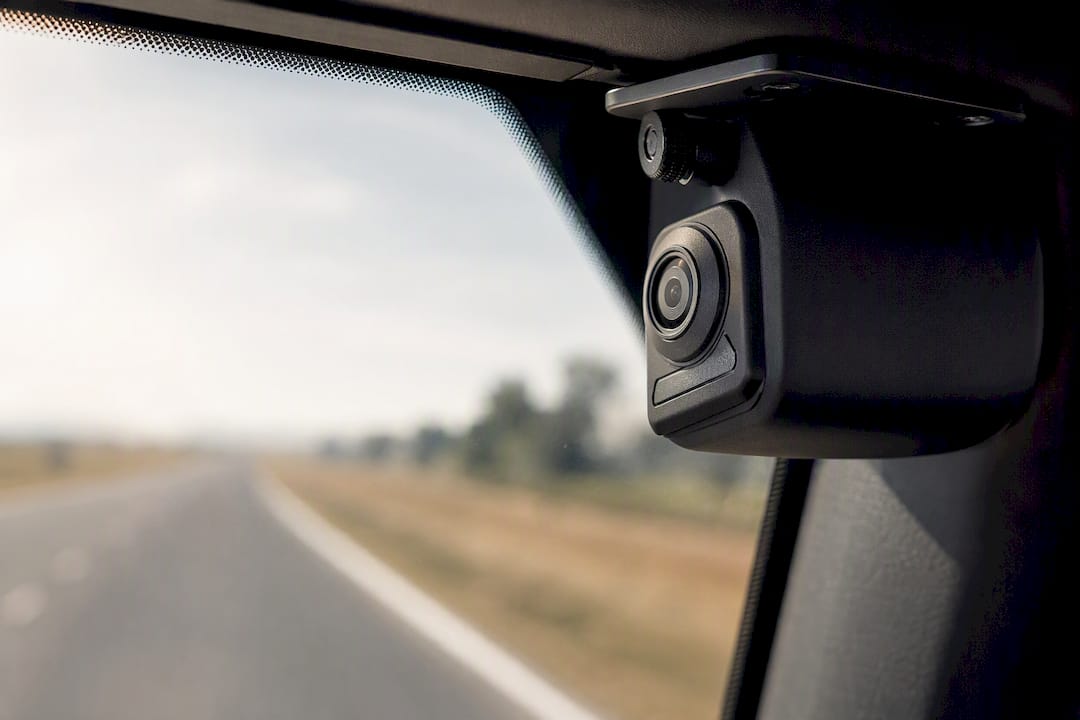
- Professional placement that captures the plate, the road ahead and, where relevant, the cab interior without obstructing the driver’s view.
Pairing a quality camera with continuous GPS tracking, through a provider like Moto Watchdog, adds the location and speed metadata that turns a video clip into a defensible timeline.
Pro Tip: If you cannot produce footage after telling your insurer you have cameras fitted, some insurers treat that gap as a risk flag and may apply a higher excess. Backup discipline protects the discount you’re paying for.
Do insurers reward dashcams with lower premiums?
Insurer recognition is conditional, not automatic. Discounts and faster claims handling typically depend on documented installation, operational controls and ongoing reporting, not simply having a camera fitted.
Fleets running comprehensive video telematics commonly report premium reductions of 10–20%, alongside measurably lower at-fault claim rates, according to industry data on AI dashcam fleet safety.
Track these metrics to build your own case with an insurer:
- Incident frequency per vehicle, month over month.
- Average claim value before and after camera deployment.
- Claims cycle time, from incident to settlement.
- Telematics uptime, since gaps in coverage undermine the whole case for a discount.
Read more on how telematics data feeds into fleet underwriting and how operators are learning to optimize fleet premiums with flexible cover.
What fleet operators get wrong about dashcam evidence
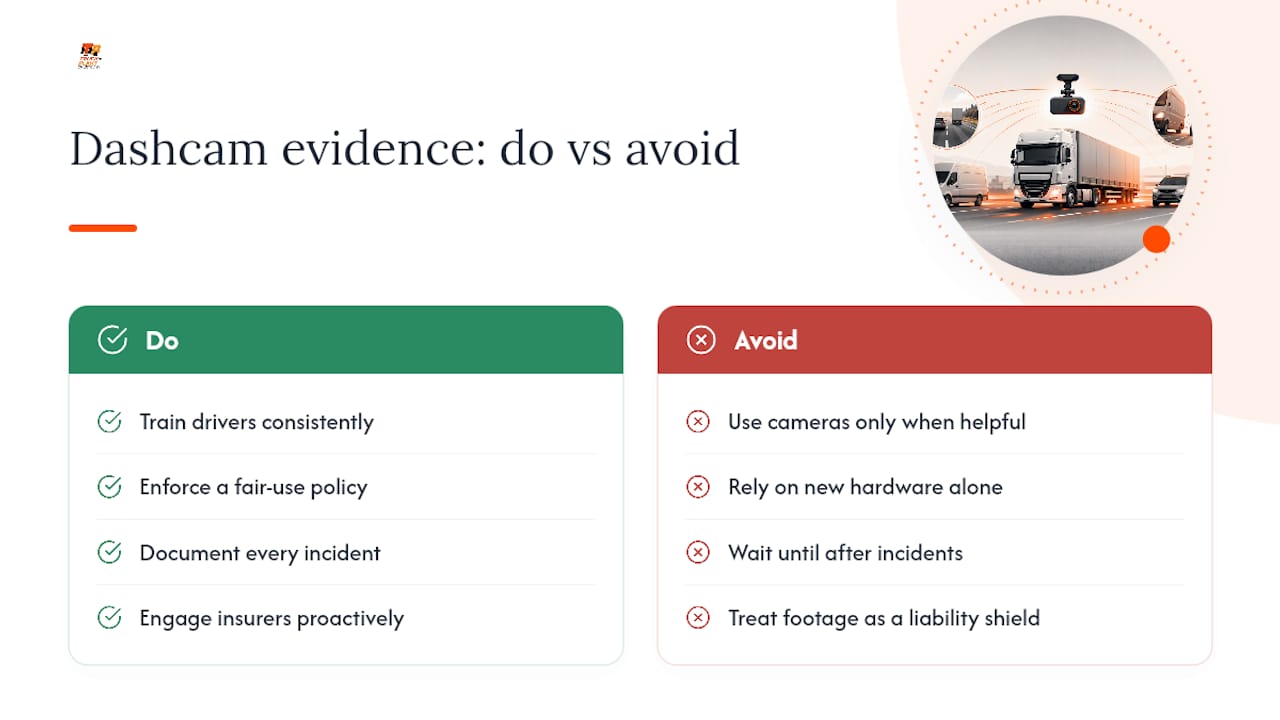
Footage cuts both ways. It clears your driver in one incident and confirms fault in the next, and that’s the point. A camera that only ever gets mentioned when it helps you isn’t a safety tool, it’s a liability shield, and insurers can tell the difference over time.
The fleets that get the most value aren’t the ones with the newest hardware. They’re the ones with disciplined driver training, a fair-usage policy everyone actually reads, and a documented procedure for every incident, big or small. Insurer engagement matters more than camera resolution. Review how Truck & Plant On-Demand’s claims process works for South African fleets before your next incident, not after it.
— Coert
How Truck & Plant On-Demand™ supports dashcam-enabled fleets
Some insurers offer alternatives to fixed annual cover for fleets and plant operators who invest in telematics but don’t want to pay a flat premium regardless of how much equipment is actually on the road. Certain insurance products let you adjust cover as vehicles and machinery go in and out of use, so operational discipline built with dashcams and access logs can translate into coverage that flexes with actual risk, rather than a one-size premium set months in advance.
Truckplant’s Fleet Insurance product is built for operators running telematics-ready vehicles, and claims are authorised within 48 hours once documentation, including your footage and access logs, is submitted. If your business also covers plant machinery, Plant All Risk cover sits alongside your fleet policy without duplicate admin. Speak to Truckplant’s team about a telematics-ready quote and see how on-demand cover fits your operation at Truckplant.
Sources
- Dashcam Footage Legal Evidence SA: Fleet Guide 2026 | T-ERP Insights
- Dashcams, dashcam evidence and insurance (guide)
FAQ
Does dashcam footage speed up an insurance claim?
Yes, in most cases. Footage that’s clear, timestamped and submitted promptly gives claims handlers less to investigate, which typically shortens the claims cycle compared to disputes relying only on witness statements.
Is dashcam footage legally admissible in South Africa?
Generally, yes, provided it’s authentic and handled with a documented chain of custody. Footage is commonly accepted as supporting evidence under the ECTA and Civil Proceedings Evidence Act, though admissibility always depends on how the clip was preserved.
How long should fleets keep dashcam footage?
A common approach is retaining routine footage for around 90 days and keeping incident-specific clips for the applicable legal or claims period, whichever is longer. Retention policy should be written down and applied consistently across the fleet.
Do dashcams actually lower insurance premiums?
Often, yes, but only when paired with professional installation and documented operational controls. Fleets with comprehensive video telematics report premium reductions of 10–20%, though the discount depends on the insurer verifying your setup, not just the camera being fitted.
What should I do if dashcam footage contradicts a witness statement?
Submit the footage to your insurer alongside the conflicting statement rather than withholding either. Insurers and assessors are trained to weigh corroborating metadata like timestamps and GPS data against verbal accounts, and a transparent submission protects your credibility even when the accounts don’t match.