


TL;DR:
- Business interruption insurance covers lost income and ongoing expenses when a covered physical event halts business operations. It is usually an endorsement attached to property or business owner’s policies, triggered by physical damage and supported by thorough financial records. Many businesses underestimate coverage gaps, including short indemnity periods and unprotected risks like pandemics or supplier disruptions, which can lead to costly claim disputes.
Business interruption insurance is coverage that replaces lost income and pays continuing operating expenses when your business cannot operate due to a covered physical loss. Known formally as Business Income Insurance, this cover is one of the most misunderstood products in commercial insurance. Approximately one-third of small businesses carry it, usually bundled within a Business Owner’s Policy or added as an endorsement to a commercial property policy. For South African business owners in transport, construction, or logistics, defining business interruption insurance correctly is the difference between surviving a major disruption and closing permanently.
What does business interruption insurance actually cover?
Business interruption coverage is not a standalone policy. It is typically an extension or endorsement added to your commercial property insurance or Business Owner’s Policy, which means the underlying property policy controls what triggers your claim.
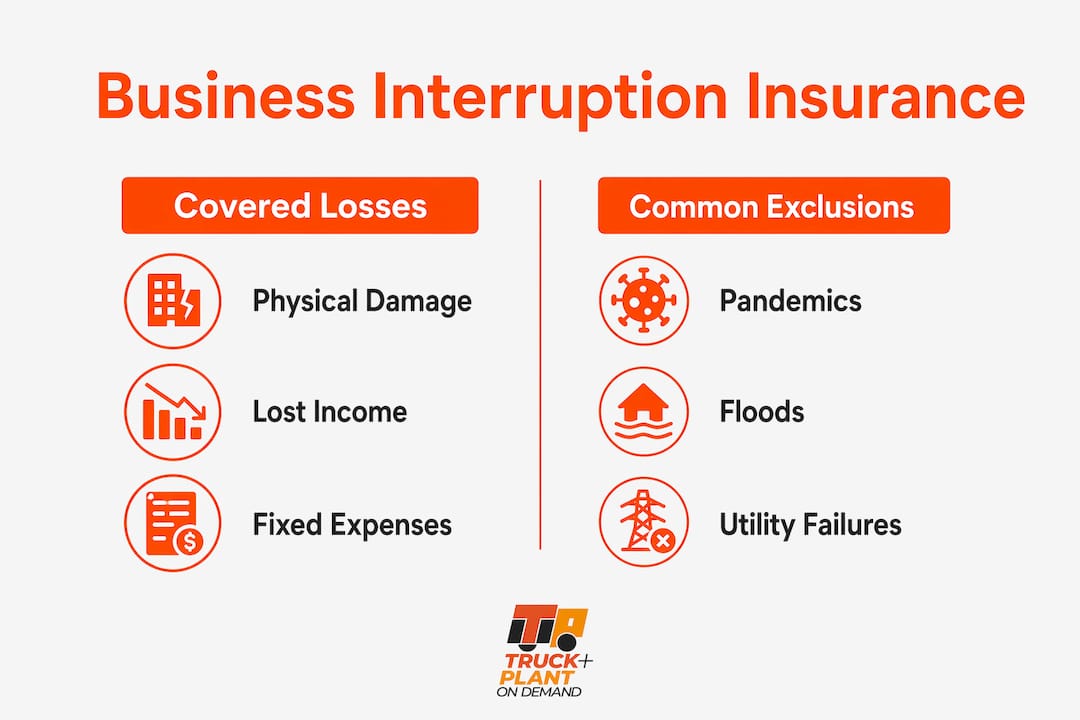
Coverage activates when a covered physical peril causes direct loss or damage to your insured property or adjacent premises. Common covered perils include fire, storm damage, and vandalism. Once the physical damage trigger is met, the policy typically covers:
- Lost business income: Revenue you would have earned during the shutdown period, calculated against your pre-loss financial performance.
- Continuing fixed expenses: Rent, loan repayments, salaries, and utilities that continue even when the business is not trading.
- Increased Cost of Working: Extra expenses you incur to keep operating, such as renting a temporary site or paying overtime to catch up on production.
- Civil authority cover: If a government authority prevents access to your premises due to damage at a neighbouring property, this endorsement can extend your cover. Strict proximity and cause requirements apply.
Several risks are excluded from standard policies. Losses from pandemics, floods, and earthquakes are excluded unless you purchase specific endorsements. Government-mandated closures without physical damage to property are also excluded. Routine maintenance shutdowns and voluntary closures fall outside the scope of cover entirely.
Off-premises utility failures or supplier disruptions are not covered under standard policies either. Businesses that depend heavily on a single supplier or utility provider need a contingent business interruption endorsement to close that gap. This is a common oversight for South African transport and construction operators.

How are business interruption claims documented and processed?
A successful claim depends almost entirely on the quality of your records before the loss occurs. Insurers measure your income shortfall by comparing your projected income against your actual income during the disruption, then adjusting for expenses you saved by not operating.
Here is the standard process for documenting and submitting a claim:
- Gather pre-loss financial records. Collect tax returns, monthly sales figures, payroll records, and management accounts for the 1–3 years before the loss. These establish your baseline performance.
- Define the period of restoration. This is the time required to repair or replace the damaged property and resume normal operations. Your indemnity period must cover this window fully.
- Apply the claim formula. Lost income equals projected income minus actual income during the disruption, adjusted for costs you did not incur because the business was not trading.
- Document mitigation efforts. Insureds are contractually required to show reasonable attempts to reduce downtime and losses. Keep records of every step you took to resume operations, including temporary arrangements, supplier substitutions, and staff redeployment.
- Submit repair estimates and invoices. Physical damage documentation supports the causal link between the loss event and your income shortfall.
- Record all increased costs. Temporary premises rental, overtime wages, and expedited delivery costs fall under the Increased Cost of Working provision. Failing to document these costs can result in denied reimbursements.
Pro Tip: Keep a dedicated claims folder updated quarterly with your latest financial statements, payroll summaries, and a brief operational overview. If a loss occurs, you will have everything an insurer needs within hours, not weeks.
Failure to show a direct correlation between the physical loss and your income shortfall is the most common reason for claim disputes. Contemporaneous records, meaning records created at the time of the event rather than reconstructed later, carry far more weight with insurers and in dispute resolution.
What are the most common business interruption misconceptions?
Business interruption insurance is a recovery tool, not a profit guarantee. Policyholders often misunderstand BI as general revenue protection, but it is indemnity for specific covered losses only. Understanding the gaps prevents costly surprises at claim stage.
These are the misconceptions that cost South African business owners the most:
- “Any income loss triggers a claim.” Cover only activates after direct physical damage to insured property. A power outage, a supplier failure, or a market downturn does not trigger a standard BI policy.
- “My indemnity period matches my policy term.” Many owners select a 12-month indemnity period because it matches their annual policy. Rebuilding a fire-damaged warehouse or replacing specialist plant machinery can take 18–24 months. Selecting too short an indemnity period leaves you unprotected during the final months of recovery.
- “Cyber incidents are covered.” Standard BI policies exclude cyber events unless a specific cyber endorsement is in place. For transport businesses relying on fleet management software or telematics, this gap is material.
- “The waiting period does not matter.” Most BI policies require a waiting period of 48–72 hours before benefits begin. Revenue lost during that window is unrecoverable under standard terms.
Pro Tip: When renewing your policy, ask your broker specifically: “What is my indemnity period, and does it reflect how long it would realistically take to rebuild and return to full trading?” Most brokers will not raise this question unless you do.
The Increased Cost of Working provision is one of the most overlooked components in BI cover. It covers extra expenses you incur specifically to reduce the impact of the shutdown. If you rent temporary office space or pay staff overtime to fulfil orders from a backup location, those costs are claimable. Document every rand spent on mitigation from day one.
How does business interruption insurance fit with your other commercial cover?
Business interruption coverage works as part of a broader insurance structure, not in isolation. The integration with commercial property and fleet insurance is especially relevant for South African transport and construction businesses where vehicles, plant, and premises all represent income-generating assets.
The table below shows how BI cover coordinates with other key commercial policies:
| Policy type | What it covers | How it links to BI cover |
|---|---|---|
| Commercial property insurance | Physical damage to buildings and contents | BI is typically an endorsement on this policy; the property trigger activates BI |
| Fleet insurance | Loss or damage to commercial vehicles | Vehicle downtime can reduce revenue; BI covers income lost if the whole operation halts |
| Contingent BI endorsement | Supplier or utility failures off-premises | Extends BI to cover disruptions caused by third-party failures |
| Cyber insurance | Data breaches, ransomware, system failures | Covers income loss from cyber events excluded under standard BI |
For transport and logistics operators, fleet insurance cover and BI cover are complementary. Fleet insurance replaces or repairs damaged vehicles. BI cover replaces the income lost while your operation is down. Without both, a serious accident or fire can leave you paying fixed costs with no revenue coming in.
Selecting the right indemnity period requires a realistic assessment of your operational recovery timeline. A step-by-step guide to transport company insurance can help you map your specific risks before you sit down with a broker. Review your policy endorsements and exclusions at every renewal. Business operations change, and cover that was adequate two years ago may have significant gaps today.
Key takeaways
Business interruption insurance replaces lost income and covers fixed expenses during a covered physical loss, but only when the right triggers, indemnity periods, and endorsements are in place.
| Point | Details |
|---|---|
| Physical damage triggers cover | BI claims require direct physical loss to insured property; income loss alone does not qualify. |
| Indemnity period must match reality | Select a period that reflects your actual rebuilding timeline, not just your policy term. |
| Documentation wins or loses claims | Maintain 1–3 years of financial records and log every mitigation step from the moment a loss occurs. |
| Exclusions are extensive by default | Pandemics, floods, cyber events, and supplier failures require specific endorsements to be covered. |
| BI works alongside other policies | Coordinate BI cover with commercial property and fleet insurance for complete operational protection. |
Why most businesses are underinsured and do not know it
I have reviewed a lot of commercial insurance structures for businesses in the transport and construction sectors. The single most consistent problem is not that owners lack BI cover. It is that the cover they have would not survive a serious claim.
The indemnity period is almost always too short. Owners pick 12 months because it is the default option and it sounds like a full year of protection. But if a fire destroys your depot, you need to demolish, get approvals, rebuild, restock, and retrain staff. That process rarely fits inside 12 months in South Africa, where supply chains for specialist materials and construction timelines are unpredictable.
The second problem is records. I have seen businesses with solid revenue and legitimate losses walk away from claims with partial payouts or outright denials because they could not produce clean financial records for the pre-loss period. Insurers do not take your word for what you were earning. They need proof.
The third problem is the exclusions. Most owners assume their BI policy covers whatever disrupts their business. It does not. The physical damage trigger is non-negotiable. If there is no qualifying damage to your property, there is no claim. That reality came into sharp focus during the COVID-19 pandemic, when thousands of businesses discovered their BI policies did not respond to government-mandated closures.
The fix is straightforward. Review your policy with your broker every year. Ask specific questions about triggers, exclusions, and indemnity periods. Keep your financial records current. And make sure your BI cover is coordinated with your property and fleet policies so there are no gaps between them.
— Coert
Protect your fleet and your income with Truckplant
Business interruption cover protects your income when operations stop. But your vehicles and plant machinery need their own layer of protection to keep that income flowing in the first place.
Truckplant’s Truck & Plant On-Demand™ fleet insurance is built for South African businesses in transport, construction, and civil contracting. You choose what to insure, when to insure it, and how. You only pay for cover when you need it. That flexibility means your insurance structure can match your actual operations, not a fixed schedule that ignores how your business really works. Speak to the Truckplant team to explore how fleet cover and business interruption insurance can work together to protect everything you have built.
FAQ
What is business interruption insurance in simple terms?
Business interruption insurance replaces income and covers fixed expenses when a covered physical event forces your business to stop trading. It is designed to restore your financial position, not generate profit.
What triggers a business interruption insurance claim?
A claim requires direct physical loss or damage to your insured property caused by a covered peril such as fire, storm, or vandalism. Government closures without physical damage are typically excluded under standard policies.
How long does business interruption insurance pay out?
Cover pays out for the duration of the indemnity period you selected, which should match your realistic recovery and rebuilding timeline. Industry experts advise choosing an indemnity period based on operational realities, not just the policy term length.
Does business interruption insurance cover supplier failures?
Standard BI policies exclude supplier or utility disruptions off your premises. A contingent business interruption endorsement must be purchased separately to cover those risks.
What records do I need to make a business interruption claim?
You need tax returns, sales history, payroll records, and management accounts for 1–3 years before the loss, plus documentation of all mitigation steps taken and any increased costs incurred during the disruption period.