


Driver negligence exclusions do limit or void cover, but usually only in narrow, defined circumstances: excluded drivers, unlicensed use, drink or drug convictions, unauthorised use, or misfuelling. The verdict for fleet managers is simple. Pull out your policy’s declarations and endorsement pages today, and ask your broker to confirm in writing exactly which driver situations are covered before you need to find out the hard way.
TL;DR:
- Exclusions mainly apply to unlisted drivers, unlicensed use, or conduct involving convictions and misconduct, but often only under specific circumstances.
- Regular checks of driver licenses, endorsements, and maintaining an up-to-date authorization log can prevent avoidable claim denials.
- Clarifying contract indemnities with written confirmations and adding targeted endorsements reduces the risk of coverage gaps for temporary or subcontractor drivers.
- On-demand insurance options provide flexible coverage for seasonal spikes or short-term hires, complementing static fleet policies.
- Understanding and managing these operational factors can significantly lower the chances of claims being denied due to driver negligence exclusions.
Table of Contents
- What driver negligence exclusions actually mean in your policy
- Common driver-related exclusions with clear examples
- How exclusions work in practice: claim scenarios and contractual pitfalls
- Operational checklist to reduce the chance exclusions will apply
- How to read the policy and the exact questions to ask your broker
- How on-demand cover can reduce exposure for variable driver use
- Treating exclusions as an operational risk, not a legal footnote
- How Truck & Plant On-Demand™ works alongside your main fleet policy
- Sources
- FAQ
What driver negligence exclusions actually mean in your policy
A driver negligence exclusion is a clause that removes cover when a loss results from how a specific driver behaved, rather than from the vehicle, the road, or a third party. The phrase itself isn’t a formal insurance term. It’s shorthand fleet operators use for a cluster of clauses scattered across three different parts of a policy: the main wording, the definitions section, and any endorsements attached later.
That distinction matters because each part does different work. The main policy form sets out what’s excluded by default. The definitions page tells you exactly what counts as a “permitted driver” or an “authorised use.” Endorsements then modify both, either narrowing cover further or restoring it for a specific situation, such as a temporary agency driver.
You’ll typically see three patterns in how insurers define who’s actually covered:
- Named-driver policies list specific individuals by name; anyone outside that list has no cover, regardless of how minor the incident.
- Permissive-use clauses extend cover to anyone driving with the owner’s consent, within stated limits.
- Excluded-driver endorsements name individuals who are never covered, often added after a poor claims history or a serious conviction.
Insurers write these exclusions to manage moral hazard. A policy that covers every driver under every circumstance invites careless hiring and lax supervision. Narrowing cover to vetted, authorised drivers gives the insurer a reason to price the risk lower, which is exactly why sloppy driver records cost fleets money long before a claim ever happens. Industry guidance from Lockton confirms that convictions, licence endorsements, excluded drivers, and unauthorised use are the standard categories insurers build into commercial policies.
Common driver-related exclusions with clear examples
Most commercial motor policies exclude driver conduct in five recognisable categories. Knowing them by name helps you spot the risk before a claim, not after.
- Excluded or named-driver clauses. If a driver isn’t on your schedule and the policy is written on a named basis, a claim involving that person can be denied outright, even for a minor bump in a yard.
- Licence and endorsement issues. A driver operating without the correct class of licence, or with an undisclosed endorsement, gives insurers grounds to reduce or refuse a payout.
- Convictions, alcohol, drugs, and wilful misconduct. Cover almost universally excludes losses linked to intoxication or deliberate acts, categories confirmed across standard exclusion sets described by The Zebra.
- Unauthorised use. Driving outside the scope of permission, whether that’s personal use of a company bakkie or crossing a territorial boundary the policy doesn’t cover.
- Vehicle misuse and misrepresentation. Incorrect fuel, towing beyond rated capacity, or inaccurate information given at inception can each trigger a denial.
Pro Tip: Keep a single, dated log of every driver’s licence class, endorsement history, and any conviction disclosure. Insurers weigh documented vetting heavily when deciding whether a denial is fair.
How exclusions work in practice: claim scenarios and contractual pitfalls
Consider three situations that play out often on real sites and roads. A relief driver reverses a rigid truck into a client’s fencing while unsupervised in a restricted yard; if that driver wasn’t on your authorised list, the insurer may deny the third-party claim entirely. A temporary agency driver, brought in during a busy season, causes a collision while driving a route outside the vehicle’s permitted use zone; cover can be reduced or refused depending on how the policy defines authorised use. A driver fills a diesel tank with petrol before a long haul, causing engine damage; most policies treat this as driver negligence rather than mechanical failure, and mechanical breakdown exclusions typically apply.
Contracts complicate this further. Many civil and construction contracts require you to indemnify a client for losses, sometimes including losses caused by the client’s own negligence. Standard policy forms treat much of this as uninsurable liability unless the arrangement fits the policy’s own definition of an “insured contract.”
Broad indemnities that force a contractor to answer for someone else’s negligence often can’t be insured at all. Negotiating caps, carve-outs for gross negligence, or a specific insurer endorsement is what actually restores insurability, not just signing the contract and hoping.
That’s why every high-risk contract clause needs a broker’s eyes, and often a lawyer’s, before you sign. Practical broker coordination on indemnity wording reduces the chance an underwriter adds a fresh exclusion mid-term.
- Reversing incidents involving unlisted drivers are among the most common denial triggers on yard sites.
- Agency and subcontractor drivers need explicit endorsement, not assumed permissive-use cover.
- Fuel mix-ups fall under driver error, not mechanical breakdown, in almost every standard wording.
Operational checklist to reduce the chance exclusions will apply
Treat exclusions as an operational problem you can manage, not a legal trap you discover after a loss.
- Keep a live driver-authorisation register. Record who may drive which vehicles, under what conditions, and update it the day a driver joins or leaves.
- Check licences and endorsements on a set schedule. Quarterly checks, logged with dates and outcomes, give you evidence if an insurer questions a driver’s status.
- Negotiate contract indemnities before signing. Push for caps and carve-outs, and get your broker’s confirmation that the clause is actually insurable.
- Add endorsements for known gaps. Temporary-driver cover, permissive-use clarifications, and excess-waiver options close the most common holes.
- Respond fast when incidents happen. Preserve photos, witness statements, and notify your insurer immediately rather than waiting for the full picture.
Pro Tip: Ask your broker to email written confirmation every time you add a temporary driver or subcontractor, not just a verbal “yes, you’re covered.” A written record is what actually protects you at claim stage.
How to read the policy and the exact questions to ask your broker
Start with four parts of the document, read together rather than in isolation: the declarations page (who and what is insured), the definitions section (what counts as an authorised driver or permitted use), the exclusions clause, and any endorsements attached since inception. Reading them together matters because exceptions within exclusions can restore cover for specific scenarios you might otherwise assume are excluded.
Bring these questions to your broker or underwriter, and ask for written answers:
- “Does this policy exclude drivers with a specific licence endorsement, and which ones?”
- “If our contract requires us to indemnify a client for their own negligence, does that remain covered, or does it fall outside the insured-contract definition?”
- “Can you add an endorsement for temporary or agency drivers before the next job starts, not after?”
- “What evidence would you need from us to accept a claim involving an unlisted driver?”
If the answer is vague or verbal only, escalate to the underwriter directly or bring in legal counsel before the contract is signed, not after a loss.
How on-demand cover can reduce exposure for variable driver use
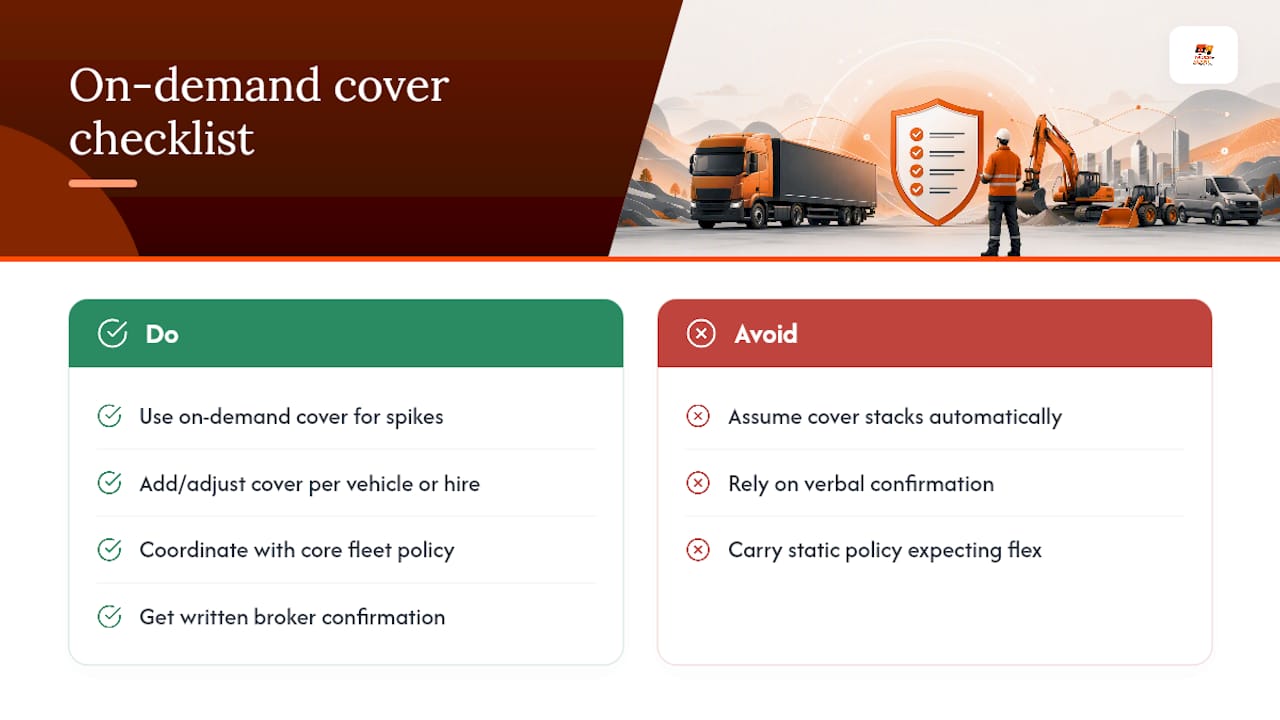
Fleets with seasonal spikes, short hires, or subcontractor drivers face a specific version of this problem: standing cover is built for your usual operation, not the three weeks a year you run extra trucks with unfamiliar drivers. An on-demand insurance product was built to address that gap, letting you add or adjust cover for specific vehicles or hire periods rather than carrying a static annual policy that doesn’t flex with your actual driver mix.
Coordinate any short-term cover with your core fleet policy rather than assuming it stacks automatically, and get written confirmation from your broker before relying on it for contractual obligations.
Treating exclusions as an operational risk, not a legal footnote
Fleet managers who treat exclusions purely as legal wording tend to discover the gap only at claim time. The clauses covered above are operational risks: who drives what, under what permission, with what paperwork behind them. That’s a checklist problem, not a courtroom problem, and it’s solvable long before a contract is signed.
The fleets that avoid denials aren’t the ones with the most expensive policies. They’re the ones where operations, contracts, and insurance actually talk to each other. Build a driver-authorisation register this month, and a pre-contract insurance checklist before your next tender. Both cost you an afternoon. A denied claim costs considerably more.
— Coert
How Truck & Plant On-Demand™ works alongside your main fleet policy
If your fleet’s driver mix shifts with the season, subcontractor jobs, or short-term hires, a static annual policy will always leave gaps that exclusions can exploit. Truck & Plant On-Demand™ gives you tailored, short-term cover for trucks, plant, and hire equipment that you switch on only when you actually need it, rather than paying year-round for risk you carry for a few weeks.

Compare what your current policy actually excludes against what an on-demand arrangement could cover for temporary and subcontractor drivers. Whether you run a handful of trucks or one of the country’s larger commercial fleets, it’s worth checking your options against Truckplant’s fleet insurance for commercial vehicles and asking your broker for a tailored quote before your next busy period starts.
Sources
For deeper policy language and contract guidance, see the public liability briefing for transport operators and the commercial contract guidance from Elamine Lawyers.
- Indemnification clause: Uninsurable liability (ConstructionRisk / Zurich briefing)
- Hold harmless and indemnity provisions: What did I agree to? (Cavignac briefing)
- Insurance explained: what is Drivers Negligence cover? (Lockton)
- Car insurance exclusions (The Zebra)
FAQ
What are the elements of negligent driving?
Negligent driving generally involves a duty of care owed to others on the road, a breach of that duty through careless or reckless action, a causal link between that breach and the harm, and actual damage or loss resulting from it.
What are exclusions in insurance?
Exclusions are specific situations, causes, or conditions a policy states it will not cover, such as intentional acts, unauthorised drivers, or losses arising from a contractual indemnity that falls outside the insured-contract definition.
What are the four elements of proving negligence?
Most negligence claims require proof of duty, breach, causation, and damages. All four generally need to be established before a court or insurer treats the conduct as negligent.
What are the three requirements for negligence?
Some frameworks simplify negligence to three core requirements: a duty owed, a breach of that duty, and resulting harm, with causation folded into the breach-to-harm link.
Does driver negligence always void a fleet insurance claim?
No. Driver negligence exclusions apply in defined circumstances like unlisted drivers, unauthorised use, or convictions; conduct outside those categories is typically still covered under the main policy.