


A high-performing driver safety training program delivers documented, scalable skills training, data-driven coaching, and measurable KPIs that lower crash exposure and support better insurance outcomes. For commercial fleet operators and plant-hire businesses, that means building a program around four non-negotiables: documented training modules, structured onboarding, a quarterly rotation cadence, and telematics-driven coaching. Regulators OSHA and FMCSA set the compliance floor; providers like Verizon Connect and DriveTeam show what best practice looks like above it. Truck & Plant On-Demand™ connects that training investment directly to flexible, usage-based cover.
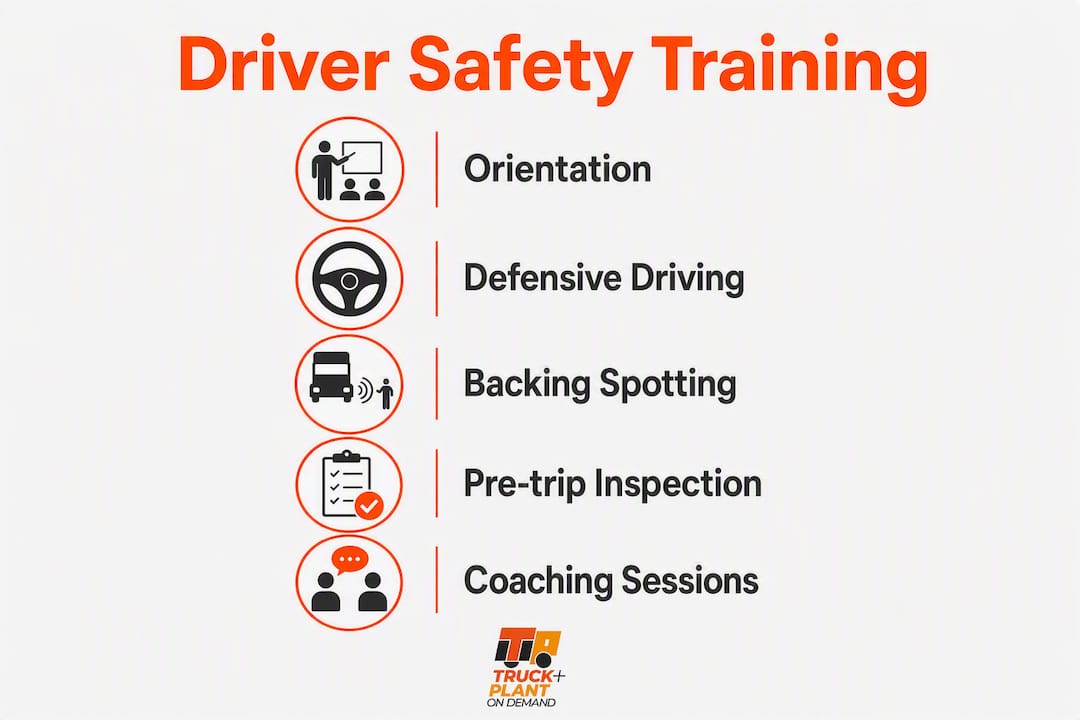
- Documented modules: vehicle characteristics, defensive driving, backing/spotting, pre-trip inspections
- Onboarding: completed before a driver operates any vehicle unsupervised
- Quarterly rotation: refreshes skills and addresses different learning styles across the year
- Telematics and video coaching: converts incidents into evidence-based improvement conversations
- KPI audits: crash rate, near-miss events, training completion, and claims frequency reviewed on a set schedule
Pro Tip: Get your leadership team through the program first. When managers complete the same modules as drivers, safety shifts from a policy to a culture, and driver buy-in follows.
Table of Contents
- What every fleet training program must cover
- How to scale your driver training program by driver type
- Training cadence, timelines, and what it costs
- How to run coaching sessions that actually change behaviour
- Which KPIs tell you whether your program is working
- U.S. compliance basics: OSHA, FMCSA, and record retention
- Practical templates and checklists you can use today
- How training connects to your insurance outcomes
- Managing fatigue, distraction, and stress behind the wheel
- Technology tools that make driver training more effective
- Legal liability beyond compliance: what fleet operators need to know
- Building a safety culture that drivers actually adopt
- Key takeaways
- Why documented training and flexible cover belong together
- Truckplant’s on-demand cover pairs directly with your safety program
- Useful sources and further reading
What every fleet training program must cover
OSHA outlines five core training areas that form the auditable backbone of any defensible program: vehicle characteristics and instruments, preventive maintenance checks, defensive driving, backing manoeuvres, and scalable refresher training. Each area needs its own documented module with a sign-off record.
Vehicle-specific orientation goes beyond a generic induction. Every time your fleet adds a new vehicle type, whether a rigid truck, a semi-trailer, or a telehandler, drivers need a formal orientation covering that asset’s blind spots, load limits, and control layout. This is a regulatory trigger, not just good practice.
Defensive driving is where the National Safety Council’s curriculum earns its place. Motor vehicle collisions remain a leading cause of workplace injuries, and a structured defensive-driving module teaches drivers a decision-making language they can apply consistently under pressure.

Backing and spotting deserves its own standalone module for plant-hire and trailer operations. Yard manoeuvres account for a disproportionate share of low-speed incidents. A written spotting procedure, practised in a controlled yard environment, reduces that exposure significantly.
Pre-trip inspections should follow a fixed checklist format. FMCSA guidance for CDL drivers requires pre-trip checks on tyres, brakes, lights, and load security before every trip. Standardising truck parts and inspection points across your fleet makes these checks faster and more consistent.
How to scale your driver training program by driver type
Not every driver in your fleet carries the same risk exposure. A scalable program assigns training intensity to driver categories rather than applying one-size-fits-all requirements.
- Full-time commercial drivers (CDL): Complete module set, formal onboarding, quarterly rotation, annual refresher. FMCSA compliance is mandatory. All records retained for the duration of employment plus three years.
- Occasional drivers using personal vehicles for work: Abbreviated module covering defensive driving and distraction policy. Documented sign-off required. Annual refresher sufficient.
- Plant equipment operators: Vehicle-specific orientation for each machine type, backing/spotting module, and site-yard safety rules. Hands-on assessment before solo operation.
- Temporary hires and contractors: Minimum documented induction covering your fleet’s golden rules, pre-trip procedure, and incident reporting. Completed on day one, before any vehicle access.
Pro Tip: For occasional drivers, a one-page training record with a dated signature and the module title is audit-ready. Keep it in the same system as your full-time records so insurers see a consistent documentation standard across your entire workforce.
Training cadence, timelines, and what it costs
Timing and budget are the two reasons most programs stall after launch. A practical cadence removes both barriers.
| Training event | Recommended frequency | Typical duration | Primary cost driver |
|---|---|---|---|
| New driver onboarding | On hire, before first solo drive | 4 hours | Trainer time + vehicle access |
| Weekly micro-brief | Every week | 5 minutes | Negligible (team meeting slot) |
| Quarterly rotation module | Every quarter | 1–2 hours | Trainer time or e-learning licence |
| Vehicle-specific orientation | On new asset addition | 1–3 hours | Trainer time + yard time |
| Full program refresh | Every 3–5 years | Half-day | Blended delivery cost |
DriveTeam recommends weekly five-minute safety briefs and micro-learning as the most effective tools for preventing skills fade between formal sessions. Blended delivery, combining e-learning modules for theory with hands-on sessions for practical skills, controls cost while preserving the efficacy that classroom-only programs often lose when scaled across large fleets.
How to run coaching sessions that actually change behaviour
The goal of a coaching session is a two-way improvement conversation, not a disciplinary hearing. Verizon Connect’s evidence-based model gives you a repeatable workflow.
- Prepare: Pull the driver’s telematics data and any relevant video clips from the review period. Identify two or three specific events, not a general pattern of “bad driving.”
- Open with facts: Share the data before sharing your interpretation. “On Tuesday at 14:20, the system recorded a hard-braking event on Route 9” is a neutral starting point.
- Invite the driver’s perspective: Ask what they remember about the event. This surfaces context you may not have, road conditions, a vehicle issue, a near-miss avoided.
- Set a SMART goal together: Agree on one measurable improvement. “Reduce hard-braking events from five per week to two over the next 30 days” is specific, trackable, and achievable.
- Schedule a follow-up: Book the next check-in before the driver leaves the room. It signals accountability without blame.
Pro Tip: Use a seven-day rolling safety-trend window rather than reacting to individual events. A single hard-braking incident may be unavoidable; five in a week is a behavioural signal worth addressing.
Which KPIs tell you whether your program is working
| KPI | Definition | Measurement frequency | Owner |
|---|---|---|---|
| Crash rate | Crashes per million miles driven | Monthly | Safety manager |
| Incident rate | Recordable incidents per 100 drivers | Monthly | Safety manager |
| Near-miss events | Self-reported + telematics-flagged events | Weekly | Ops manager |
| Hard-braking/cornering count | Telematics events per driver per week | Weekly | Safety manager |
| Training completion | % of drivers current on all modules | Monthly | HR / Training lead |
| Time-to-coaching | Days between incident and coaching session | Per event | Ops manager |
| Claims frequency | Number of claims per quarter | Quarterly | Fleet manager |
| Claims severity | Average cost per claim | Quarterly | Fleet manager |
DriveTeam’s research confirms that systems-based programs, where KPIs are tracked consistently and enforcement is paired with recognition, produce measurable reductions in claims. A quarterly audit where the safety manager, ops manager, and HR each review their owned metrics keeps accountability distributed and prevents the program from becoming one person’s responsibility.
U.S. compliance basics: OSHA, FMCSA, and record retention
OSHA expects employers to provide structured driver safety training for new hires, vehicle-specific orientation when new assets are added, and periodic refresher training. There is no single federal regulation that prescribes exact hours, but OSHA’s General Duty Clause requires employers to address known hazards, and motor vehicle operation is explicitly one of them.
For record retention, keep training records for the duration of employment plus a minimum of three years. Incident documentation, coaching notes, and corrective action records should be retained for at least five years to support claims defence and regulatory audits. Retraining is triggered by: a new vehicle type entering the fleet, a recordable incident, a change in operational routes or cargo, and any driver returning after an extended absence.
Practical templates and checklists you can use today
Pre-trip inspection checklist
- Tyres: pressure, tread depth, no visible damage
- Brakes: air pressure or fluid level, no warning lights
- Lights: headlights, indicators, brake lights, reverse lights
- Mirrors: adjusted, clean, no cracks
- Load: secured, within rated capacity, no overhang
- Cab: seatbelt functional, no obstructions, documents present
- Fluid levels: engine oil, coolant, windscreen wash
Backing and spotting checklist
- Spotter positioned at the rear corner, visible to the driver at all times
- Pre-agreed hand signals confirmed before reversing begins
- Area walked and cleared of personnel and obstacles
- Driver window open; radio off during manoeuvre
- Spotter calls a stop if line of sight is lost; driver stops immediately
Coaching script template
Opening: “I want to go through last week’s data with you. Here’s what the system recorded.” (Share specific event.)
Driver input: “What do you remember about that situation?”
Agreed action: “What’s one thing we can work on together over the next 30 days?”
Follow-up: “Let’s check in on [date] and see how it’s tracking.”
Adapt these templates for plant equipment by replacing road-specific items with site-yard equivalents. Store completed checklists in your fleet management system or LMS alongside the driver’s training record, so both are accessible during an insurer review. For guidance on codifying these into formal policy, see Truckplant’s fleet policy update guide.
How training connects to your insurance outcomes
Insurers reviewing a fleet’s risk profile look for evidence of a managed system, not a one-time event. The documents that carry the most weight are: a training matrix showing every driver’s current module status, dated coaching notes with corrective actions, telematics trend reports showing improvement over multiple quarters, and incident review logs with root-cause analysis.
Truck & Plant On-Demand™ pairs directly with this approach. Because cover is usage-based and adjustable in real time, fleets that document lower incident rates and sustained KPI improvement can align their premium exposure with their actual operational risk rather than paying a flat annual rate regardless of performance. For a practical view of how on-demand cover reduces costs for fleets, Truckplant’s resources cover the mechanics in detail.
Pro Tip: The single most persuasive item in a renewal conversation is a multi-quarter KPI trend showing declining crash rates and improving training completion. A single training event proves intent; sustained improvement proves a managed system.
Managing fatigue, distraction, and stress behind the wheel
Psychological factors cause a significant share of commercial vehicle incidents, and they are the hardest to address through skills training alone. Fatigue impairs reaction time and decision-making in ways that mirror alcohol impairment. FMCSA guidance is direct: drivers should not operate a CMV when fatigued, ill, or using medications that cause drowsiness.
Your training program needs a dedicated module on fatigue recognition, covering the peak sleepiness windows (midnight to 6 AM and mid-afternoon), the warning signs drivers should self-report, and your fleet’s policy on rest breaks. Distraction policy should address mobile phone use explicitly. FMCSA prohibits CMV drivers from texting while driving and requires hands-free operation with no more than one button to dial.
Stress management is less regulated but equally important. Drivers under deadline pressure make riskier decisions. Building realistic scheduling buffers and training managers to recognise stress signals in driver behaviour reduces exposure without requiring a clinical programme.
Technology tools that make driver training more effective
Simulators and VR training platforms allow drivers to practise high-risk manoeuvres, backing a trailer into a tight yard, navigating a work zone, managing a tyre blowout, without real-world consequences. For plant-hire operators, equipment simulators reduce the time needed for vehicle-specific orientations and lower the risk of damage during initial familiarisation.
E-learning platforms make it practical to deliver the theory component of your driver training program at scale. Drivers complete modules on their own schedule, and completion is logged automatically, which solves the documentation problem for large or geographically dispersed fleets. The NSC Professional Truck Driver Online Course is a four-hour programme that addresses the most common causes of truck-related crashes and adapts content to the driver’s vehicle type and risk profile.
Telematics platforms like Verizon Connect provide the real-time data layer that makes coaching evidence-based rather than anecdotal. In-cab alerts give drivers immediate feedback on hard braking, speeding, and sharp cornering, which reinforces training between formal sessions.
Legal liability beyond compliance: what fleet operators need to know
Compliance with OSHA and FMCSA sets the regulatory floor, but it does not cap your legal exposure. Courts in negligent entrustment cases ask whether the employer knew, or should have known, that a driver posed a risk. A documented training program with completion records and coaching notes is your primary defence against that claim.
Negligent supervision claims arise when an employer fails to act on known risk signals. If your telematics data shows a pattern of hard-braking events and you have no coaching record addressing it, that gap becomes evidence of inaction. The coaching workflow in Section 5 is not just good practice; it is a legal paper trail.
For temporary hires and contractors, the liability question is whether you exercised reasonable care in their induction. A signed induction record covering your golden rules and pre-trip procedure is the minimum standard. Anything less leaves you exposed in a third-party claim. Truckplant’s fleet risk management guide covers how to structure that documentation for both owned and contracted drivers.
Building a safety culture that drivers actually adopt
Rules and policies produce compliance. Culture produces behaviour change. The difference is whether drivers internalise safety as a professional standard or treat it as an external constraint.
DriveTeam’s research identifies leadership participation as the primary differentiator between programs that achieve low crash rates and those that plateau at compliance. When managers complete the same hands-on training as drivers, the message shifts from “we require this of you” to “we do this together.”
Recognition matters as much as enforcement. Publicly acknowledging drivers who maintain clean telematics records or complete all quarterly modules on time reinforces the behaviours you want to see. Pair that with a clear, consistently enforced consequence for policy breaches, and you create a system where safety is both rewarded and expected.
Key takeaways
A documented, scalable driver safety program combining hands-on skills, telematics coaching, and consistent KPI tracking is the most reliable way to reduce crash exposure and support better insurance outcomes for commercial fleets.
| Point | Details |
|---|---|
| Document every module | Signed training records for all driver categories are your primary defence in audits and claims. |
| Use a quarterly rotation | Rotating modules quarterly maintains skills and addresses different learning styles across the year. |
| Coach with data, not opinion | Telematics and video evidence makes coaching collaborative and reduces driver defensiveness. |
| Track KPIs consistently | Crash rate, training completion, and claims frequency reviewed monthly prove a managed system to insurers. |
| Pair training with Truck & Plant On-Demand™ | Flexible, usage-based cover aligns your premium with actual operational risk as your safety record improves. |
Why documented training and flexible cover belong together
Most fleet operators treat safety training and insurance as separate problems. They are not. A documented training program is the evidence base that justifies better cover terms, and flexible cover is what lets you act on that evidence without being locked into a premium that ignores your improvement.
The conventional wisdom says “train your drivers and your insurer will reward you at renewal.” That is partially true, but it misses the operational reality. Fleets add vehicles, lose drivers, take on seasonal contracts, and change routes throughout the year. A fixed annual premium cannot reflect that variability. On-demand, usage-based cover can.
The most underrated move in fleet risk management is combining a rigorous, documented training program with cover that adjusts as your operations change. When your telematics data shows a sustained decline in hard-braking events and your training matrix shows 100% completion, that is the moment to have a direct conversation with your insurer about what your premium should actually reflect.
Truckplant’s on-demand cover pairs directly with your safety program
When your fleet’s training program is documented and your KPIs are trending in the right direction, your insurance cover should reflect that. Truckplant’s Truck & Plant On-Demand™ gives you exactly that control: pay for cover when you need it, adjust it as your operations change, and manage everything digitally without fixed monthly premiums that ignore your actual risk profile.
For commercial fleet operators and plant-hire businesses, the combination of a documented safety program and usage-based cover is the most direct route to lower claims costs and operational resilience. You choose what to insure, when to insure it, and how, with digital claims management and cover options that include group personal accident, machinery breakdown, and environmental liability. Get your fleet covered on your terms: explore Truck & Plant On-Demand™ fleet insurance and see how flexible cover works alongside your safety investment.
Useful sources and further reading
- OSHA Motor Vehicle Safety: Driver Safety Training — primary regulatory guidance on training components, retraining triggers, and recordkeeping expectations
- FMCSA Tips for Truck and Bus Drivers — CDL-specific operational safety guidance and pre-trip inspection requirements
- FMCSA Model Training Curriculum for Motorcoach Drivers — structured module framework adaptable for fleet training programs
- DriveTeam: How to Build an Effective Driver Safety Program in 2026 — program design, quarterly rotation cadence, and leadership participation best practice
- Verizon Connect: Fleet Driver Coaching Tips — telematics-based coaching workflow and rolling safety-trend methodology
- NSC Professional Truck and Van Driver Safety Training — defensive driving curricula for truck fleets, available online and classroom
- Truckplant: Fleet Risk Management Guide — documentation and risk management framework for commercial fleets
- Truckplant: Renewal Tips for Fleet Operators — how to present training evidence in insurer renewal conversations
- Truckplant: Truck & Plant On-Demand™ Fleet Insurance — on-demand, usage-based cover for commercial vehicles and plant machinery
This article provides general information for fleet operators and does not constitute legal, regulatory, or professional insurance advice. Confirm current OSHA and FMCSA requirements with the relevant primary sources or a qualified compliance professional for your specific operations.