


TL;DR:
- Plant machinery includes heavy equipment used for construction tasks that manual labor cannot perform efficiently. Proper selection and management of machinery, including operator certification and maintenance, are essential for project success and safety. Matching equipment to specific tasks and site conditions reduces costs, increases efficiency, and minimizes operational risks.
Plant machinery is defined as heavy-duty mechanical equipment used to perform large-scale construction, earthmoving, and material handling tasks that manual labor cannot achieve efficiently. The five core categories of plant machinery are earthmoving, material handling, transport vehicles, concrete and road construction, and lifting and hoisting equipment. Each category serves a distinct operational role on site. Understanding these categories is the starting point for every construction professional and civil engineer who needs to match the right machine to the right task. This guide covers the most practical examples of plant machinery across all five categories, with guidance on selection, specifications, and operational fit.
1. Examples of earthmoving machinery and their applications
Earthmoving equipment forms the foundation of most construction projects. Fifteen machine types cover the full range of construction needs, and earthmoving machines make up the largest share of that list.
The most common examples include:
- Excavators: Hydraulic arm machines used for digging foundations, trenching, and demolition. They work on most terrain types and accept multiple attachments.
- Bulldozers: Track-mounted machines that push large volumes of soil or debris across flat or sloped ground. Best suited for site clearing and rough grading.
- Wheel loaders: Front-bucket machines that scoop and transport loose material. They move faster than bulldozers on flat ground and suit stockpile management.
- Backhoe loaders: Dual-function machines with a front loader bucket and a rear digging arm. They suit medium-scale projects where space is limited.
- Motor graders: Long-blade machines used to create flat, precise surfaces for road bases and drainage channels.
- Scrapers: Self-loading machines that cut, carry, and deposit soil over long distances. They lower fuel consumption on large earthworks compared to using excavators and trucks together.
- Trenchers: Chain or wheel-driven machines that cut narrow trenches for pipes and cables with far greater speed than excavator-based trenching.
Treating machines as interchangeable is a major efficiency shortfall. Using a loader for stockpile management and a backhoe for trenching, rather than swapping them, keeps each machine in its productive zone.
Pro Tip: Match your excavator bucket size to the trench width specification before mobilizing. Oversized buckets create excess spoil and slow backfill operations.
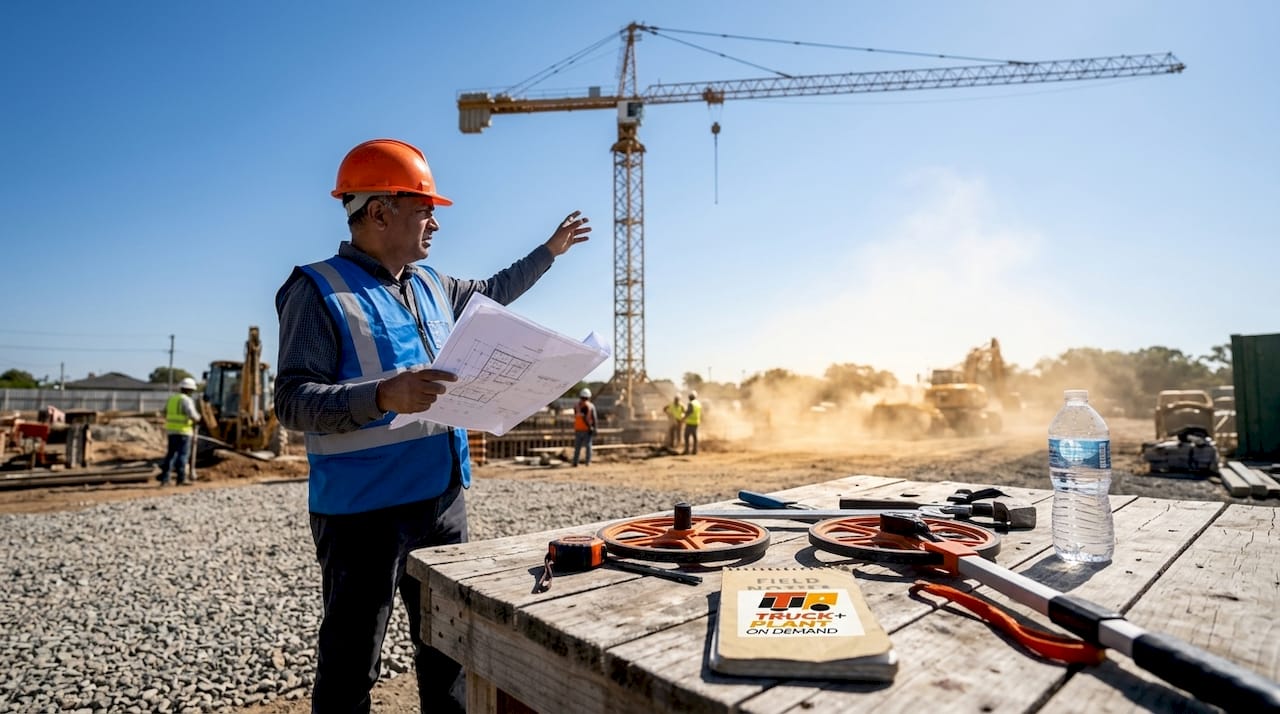
2. Material handling and transport equipment in construction workflows
Material handling equipment moves goods, aggregates, and components around the site. These machines reduce manual labor and keep project timelines on track.
- Identify the material type. Loose aggregates suit wheel loaders and conveyor systems. Palletized materials suit forklifts. Liquid concrete suits pump trucks.
- Assess the travel distance. Short hauls within the site suit forklifts and wheel loaders. Long hauls between stockpiles and pour locations suit dump trucks.
- Check ground conditions. Soft or uneven ground limits wheeled forklifts. Rough-terrain forklifts or telehandlers handle those conditions better.
- Confirm load capacity requirements. Match the machine’s rated capacity to the heaviest single load you will move. Operating above rated capacity is a safety and legal violation.
- Evaluate site access. Narrow urban sites limit large dump trucks. Articulated dump trucks or smaller conveyor systems work better in constrained layouts.
Modern machinery’s attachment compatibility means a single machine model can fulfill multiple roles. A telehandler fitted with a fork attachment handles pallets; fitted with a bucket, it handles loose material. That versatility reduces the number of machines you need to mobilize.
Pro Tip: On urban or constrained sites, prioritize a smaller machine with a higher cycle rate over a large machine that cannot maneuver. Cycle time, not bucket size, drives productivity in tight spaces.
3. Concrete and road construction machinery: essential examples and uses
Concrete and road construction machines handle surface preparation, material placement, and compaction. Precision matters here. An uneven road base or a poorly compacted layer creates structural failure within years, not decades.
| Machine type | Typical capacity | Mobility | Primary use |
|---|---|---|---|
| Concrete mixer truck | 6–9 cubic meters | Road-mobile | Transporting and mixing ready-mix concrete to pour sites |
| Concrete pump truck | Up to 200 m³/hour | Road-mobile | Pumping concrete to elevated or distant pour locations |
| Asphalt paver | 2.5–9 m paving width | Self-propelled | Laying asphalt on road surfaces with controlled thickness |
| Vibratory roller | 1–12 tonnes | Self-propelled | Compacting soil, asphalt, or granular base layers |
| Plate compactor | 50–200 kg | Walk-behind | Compacting granular material in confined or small areas |
Concrete pump trucks are often underused on mid-size projects because site managers assume they are only for high-rise work. A pump truck eliminates wheelbarrow chains and reduces pour time significantly on any project where the pour point is more than 30 meters from truck access.
Vibratory rollers require the operator to match drum frequency and amplitude to the material being compacted. Asphalt compaction uses different settings than granular base compaction. Running the wrong settings produces a surface that passes visual inspection but fails under load.
4. Lifting and hoisting equipment examples: cranes and aerial lifts
Lifting equipment carries loads vertically and positions them with accuracy. Selecting the wrong crane type for a project is one of the most expensive mistakes a site manager can make.
Key examples and their operational profiles:
- Tower cranes: Fixed to the ground or a building structure, they offer high lift height and large radius coverage. They suit multi-story construction but require significant setup time and a stable foundation.
- Mobile cranes: Truck-mounted or crawler-mounted, they move between sites and set up quickly. They offer less height than tower cranes but far greater mobility.
- Crawler cranes: Track-mounted for soft or uneven ground. They carry very heavy loads and suit civil infrastructure projects like bridge construction.
- Aerial work platforms (AWPs): Scissor lifts and boom lifts position workers and light materials at height. They do not replace cranes for heavy lifts but are essential for maintenance, cladding, and finishing work.
- Chain hoists and electric hoists: Used inside structures for precise vertical placement of mechanical or electrical components.
Selecting lifting equipment requires balancing vertical capacity with site mobility. Tower cranes offer height but less mobility compared to mobile cranes. The decision comes down to project duration, height requirements, and whether the crane needs to relocate during the project.
Safety and operational features to confirm before mobilizing any lifting machine:
- Rated load capacity with a current certification certificate
- Outrigger or anchor point suitability for the ground conditions
- Operator license class matching the specific crane type
- Proximity to overhead power lines and exclusion zone compliance
- Wind speed operating limits and on-site anemometer availability
5. Concrete and road construction machinery: essential examples and uses
Matching plant machinery to project requirements is the single most important decision a civil engineer makes before mobilization. Assigning the right machine for specific tasks is the key driver of efficiency and site safety.
| Operational factor | Earthmoving | Material handling | Lifting |
|---|---|---|---|
| Terrain type | Tracked machines for soft ground; wheeled for hard surfaces | Rough-terrain variants for uneven sites | Crawler cranes for soft ground; mobile cranes for hard surfaces |
| Project scale | Large excavators for bulk earthworks; backhoes for medium scale | Larger dump trucks for high-volume haul; forklifts for on-site logistics | Tower cranes for long-duration high-rise; mobile cranes for short-duration lifts |
| Operator certification | OSHA or national equivalent certification required per machine class | Forklift and telehandler licenses required | Crane operator license mandatory; class varies by crane type |
| Maintenance frequency | Daily pre-start checks; track tension and hydraulic fluid critical | Tire pressure, hydraulic systems, and load sensors | Wire rope inspection, slew ring lubrication, and load cell calibration |
Operator credentials and site-specific certifications are vital. Lack of them causes work stoppages and financial penalties. Hiring a certified operator costs more per day but eliminates the legal and downtime risk of an unlicensed incident.
Maintenance and logistical overhead, including safety inspections and transport logistics for oversized equipment, impacts project timelines significantly. Build inspection time into your daily schedule, not as an afterthought.
Pro Tip: Create a machine-to-task assignment matrix at the project planning stage. List each work package, the machine type required, the operator certification needed, and the maintenance interval. This single document prevents most mobilization errors.
6. Matching plant machinery to project requirements
High ROI from plant machinery comes from effective maintenance protocols and employing certified operators. Experienced operators and routine maintenance reduce downtime and liability. That is not a general observation. It is the difference between a project that finishes on schedule and one that absorbs cost overruns in the final weeks.
Matching machinery to work packages rather than overall project capacity reduces operating costs and fuel consumption. A scraper moving earth over 500 meters burns less fuel than an excavator loading dump trucks for the same haul. The machine-to-task fit is a cost decision, not just a technical one.
Operational efficiency also depends on mobility and site constraints when selecting machinery. A powerful machine that cannot access the work face delivers zero productivity. Civil engineers who prioritize raw power over maneuverability consistently underperform on constrained sites.
Planning for machinery maintenance, transport logistics, and inspection protocols avoids unforeseen operational delays. Schedule maintenance windows into the program, not around it.
Key takeaways
Plant machinery selection drives project outcomes. The right machine matched to the right task determines cost, safety, and schedule performance across every construction stage.
| Point | Details |
|---|---|
| Five core categories | Earthmoving, material handling, transport, concrete and road, and lifting cover all major construction needs. |
| Task-specific matching | Assigning machines to specific work packages reduces fuel costs and prevents efficiency losses. |
| Operator certification | Certified operators are legally required for most machine classes and prevent costly work stoppages. |
| Maintenance planning | Daily inspections and scheduled maintenance intervals must be built into the project program from day one. |
| Mobility over power | Site constraints often matter more than machine capacity when selecting equipment for urban or confined projects. |
My honest take on plant machinery selection
The most common mistake I see on construction sites is not choosing the wrong machine. It is choosing the right machine and then assigning it to the wrong task because it happens to be available. An excavator sitting idle gets pressed into service as a loading tool when a wheel loader would do the job in half the time. That decision costs money every single shift.
Operator training is the second area where projects consistently underinvest. A certified operator on a motor grader produces a surface that passes compaction testing first time. An uncertified operator on the same machine produces a surface that fails, gets reworked, and delays the paving crew behind it. The cost of operator certification is recovered on the first pour or the first grading pass.
Civil engineers who treat plant machinery as a logistics chain component, rather than just a line item in the preliminaries, consistently deliver better project outcomes. That means planning maintenance windows, confirming operator licenses before mobilization, and building machine-to-task assignments into the program at tender stage. The professionals who do this do not scramble at the end of a project. The ones who skip it always do.
— Coert
Protecting your plant machinery fleet with Truckplant
Running a mixed fleet of excavators, cranes, dump trucks, and pavers means your insurance exposure changes every week. A machine sitting in the yard carries different risk than one operating on a live site.
Truckplant’s on-demand fleet insurance is built for exactly this reality. With Truck & Plant On-Demand™, you choose what to insure, when to insure it, and at what level of cover. You only pay for the cover you need, when you need it. Whether you manage a single excavator or a large mixed fleet, Truckplant gives you the control to match your cover to your operations. Read more about why insuring plant machinery protects your business from the risks that most standard policies miss.
FAQ
What are the main examples of plant machinery used in construction?
The main examples include excavators, bulldozers, wheel loaders, motor graders, dump trucks, forklifts, concrete mixer trucks, asphalt pavers, vibratory rollers, tower cranes, and mobile cranes. These machines cover the five core operational categories: earthmoving, material handling, transport, concrete and road construction, and lifting.
What is the difference between plant machinery and construction equipment?
Plant machinery is the industry term for heavy-duty mechanical equipment used on construction and civil engineering sites. Construction equipment is a broader label that includes both plant machinery and lighter tools. The terms are often used interchangeably in practice.
How do I choose the right plant machinery for a project?
Match the machine to the specific work package, not the overall project size. Key factors are terrain type, haul distance, load capacity, operator certification requirements, and site access constraints.
Why does operator certification matter for plant machinery?
Operator certification is legally required for most machine classes, including cranes, forklifts, and earthmoving equipment. Operating without the correct license can cause work stoppages, financial penalties, and increased liability in the event of an incident.
How does maintenance affect plant machinery performance?
Routine maintenance, including daily pre-start checks, fluid inspections, and scheduled service intervals, directly reduces unplanned downtime. Deferred maintenance is the leading cause of mid-project equipment failures that delay program delivery.