


TL;DR:
- Effective fleet risk management involves systematically identifying, assessing, and controlling operational risks to protect assets and reduce costs. Utilizing telematics, regular reviews, and disciplined documentation helps fleets control claims, insurance premiums, and theft losses. Leadership commitment and continuous improvement are essential for long-term safety and cost savings.
Fleet risk management is the systematic process of identifying, assessing, controlling, and reducing risks in commercial fleet operations to protect people, assets, and profit margins. For fleet managers and safety officers in transportation and construction, unmanaged risk translates directly into accidents, regulatory penalties, equipment theft, and rising insurance premiums. Construction equipment idles approximately 40% of the time, burning fuel and eroding margins with no productive output. Equipment theft alone costs the industry over $400 million annually, with recovery rates below 25% for untracked assets. A structured fleet risk management program, supported by telematics, compliance frameworks like FMCSA 49 CFR Part 395, and disciplined insurance practices, is the most direct path to controlling these losses.
What does a fleet risk management guide actually cover?
Fleet risk management covers four core activities: identifying risks, assessing their likelihood and severity, implementing controls, and reviewing outcomes on a regular cycle. The industry term for this process is fleet risk management, and it applies equally to on-road transport fleets and mixed construction fleets operating yellow plant machinery. Risk categories include driver safety, regulatory compliance, financial exposure from claims and theft, and operational continuity when vehicles or equipment go offline.
Fleet risk in construction goes beyond driver error. Long shifts, scheduling pressures, and poor communication compound risk across an entire operation. That means your risk analysis guide must account for fatigue patterns, shift handovers, and site communication failures, not just crash history.
Technology and data sit at the center of any effective program. GPS tracking, telematics, and maintenance logs give you the visibility to spot problems before they become claims. Without that data, you are managing risk by instinct rather than evidence.
How to identify and assess key risks in your fleet operations
Risk identification starts with gathering the right data. Pull from five sources: crash history, roadside inspection results, insurance claims records, maintenance logs, and driver credential files. Each source reveals a different layer of exposure. Crash history shows where controls have already failed. Inspection results flag compliance gaps before regulators do.
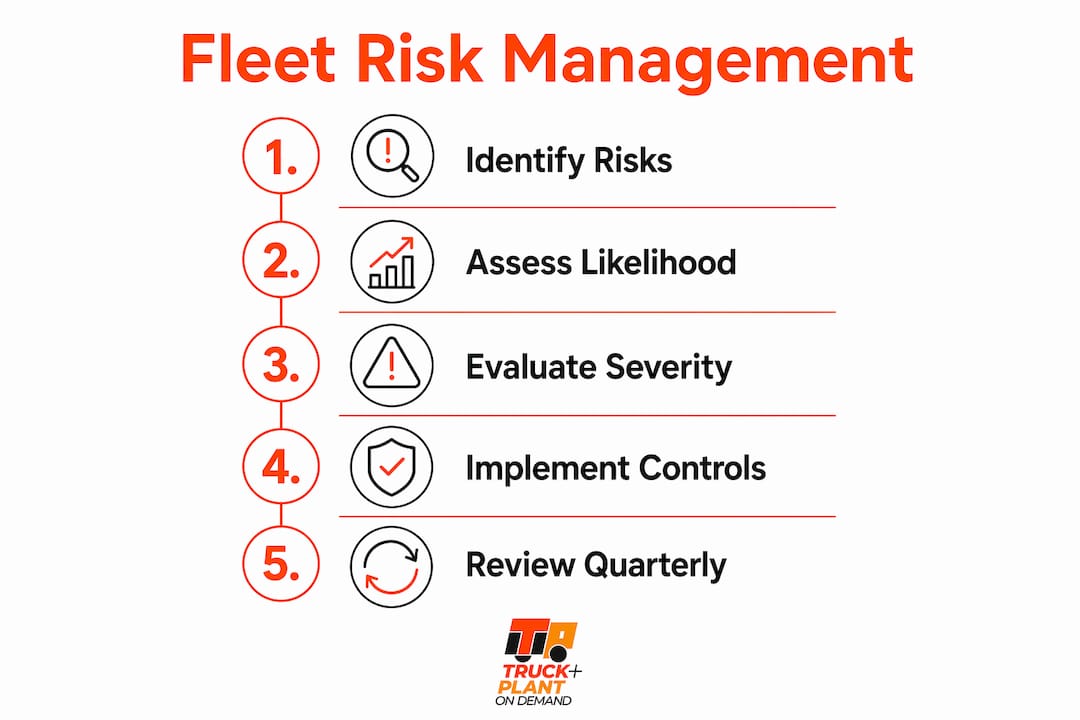
Once you have the data, score each risk using a risk assessment matrix. Rate likelihood (how often the event occurs) and severity (what it costs when it does) on a scale of 1–5. Multiply the scores to get a risk priority number. High-priority risks get immediate controls. Lower-priority risks go on a monitoring schedule.
Construction and transport fleets face distinct operational risks:
- Driver fatigue from extended shifts and back-to-back site visits
- Equipment left running unattended, burning fuel at 0.8 gallons per hour
- Untracked plant machinery exposed to theft on open sites
- Lapsed driver credentials triggering compliance violations and policy voids
- Inadequate pre-trip inspections missing mechanical defects before they cause incidents
After scoring, map each risk to an existing control. Where no control exists, you have a gap. Assign an owner to every gap, set a resolution deadline, and schedule a review date. Ownership without a deadline produces no action.
Pro Tip: Build your risk register in a shared spreadsheet with columns for risk description, likelihood score, severity score, priority number, assigned owner, control action, and next review date. Review it every quarter without exception.
A structured fleet risk assessment checklist gives you a repeatable starting point and prevents gaps from slipping through between review cycles.
What are the most effective risk controls for fleet operations?
Effective risk controls fall into three categories: driver management, equipment utilization, and safety technology. Each category addresses a different source of loss, and the strongest programs use all three together.
Driver management
Driver hiring standards set the baseline. Check driving records, verify credentials, and confirm medical certificate validity before any driver operates a vehicle. Lapsed medical certificates cause immediate Driver Fitness violations under FMCSA rules and can void your insurance policy outright. A shared credential expiration calendar, updated in real time, prevents this.

Written driver policies matter as much as hiring standards. Policies covering speeding limits, phone use, fatigue reporting, and incident notification give you a documented standard to enforce. Without written policies, you cannot demonstrate due diligence to an insurer or regulator.
Telematics takes driver management from reactive to proactive. Monitoring speeding, harsh braking, and late-night driving gives you the data to coach drivers before a crash occurs. Telematics metrics like these also demonstrate disciplined fleet management to insurers, which directly influences your premium.
Equipment utilization and theft prevention
GPS tracking and geofencing are the two most cost-effective theft deterrents available. Untracked assets recover at less than 25% of the time after theft. GPS-tracked equipment recovers at substantially higher rates and deters theft in the first place through visible deterrence.
Geofencing automates boundary monitoring. Set a virtual perimeter around your site, and the system alerts you the moment a machine moves outside it after hours. That alert window is the difference between recovery and a total loss.
Maintenance scheduling for mixed fleets requires two triggers, not one. On-road vehicles use mileage-based intervals. Off-road plant machinery uses engine-hour-based intervals because kilometres driven do not reflect actual mechanical wear on excavators, graders, or loaders. Running both triggers prevents premature failures and unplanned downtime.
Pro Tip: Reducing idle time by 30% on a five-truck fleet saves approximately 750 gallons of fuel per year. Set geofence alerts for engines running outside designated work zones to catch unnecessary idling automatically.
Safety technology
Dashcams, fatigue detection systems, and collision warning tools reduce crash frequency when the data is actively reviewed and used for driver coaching. Technology only reduces risk if it drives intervention. Cameras that record incidents but whose footage is never reviewed provide no safety benefit. Assign a weekly review task to a specific person, not a team.
How does risk management in fleet insurance affect your premiums?
Insurers calculate fleet premiums using your claims history over a 3–5 year window. A single serious claim can elevate your loss ratio and push premiums up for years. That makes claims prevention the single highest-return activity in your risk program.
Your documentation directly affects what an insurer will offer you. Written driver policies, credential records, telematics reports, and maintenance logs all demonstrate that your fleet operates to a defined standard. Insurers reward that evidence with better terms. Fleets with no documentation get priced as unknown risks.
Key insurance risk controls to maintain:
- Keep a written driver policy signed by every driver
- Maintain a live credential expiration calendar for CDL and medical certificates
- Use telematics data in driver reviews and retain reports for insurer submission
- Disclose all material facts at renewal; non-disclosure voids cover
- Review your excess levels annually. Balancing excess with claim frequency is a judgment call. Frequent small claims may cost less when self-insured than when claimed, because each claim affects your loss ratio
Pro Tip: Before renewal, prepare a one-page fleet risk summary for your broker. Include your telematics compliance rate, incident frequency trend, and any new controls implemented. Brokers use this to negotiate on your behalf.
For a detailed breakdown of how claims history and proactive measures affect your costs, the Truckplant guide on optimizing fleet insurance premiums covers the mechanics in practical terms.
How do you build a continuous improvement cycle in fleet risk management?
A fleet risk program without a review cycle degrades over time. Operations change, regulations update, and new risks emerge. The program must adapt or it becomes a compliance document that no one reads.
- Set a quarterly review cadence. Review your risk register every quarter. Update scores based on new incident data, inspection results, and claims. Remove resolved risks and add new ones identified from operational changes.
- Assign named owners to every risk. A risk without an owner is a risk no one manages. Each item on your register needs a person responsible for the control action and the review date.
- Use telematics data for ongoing monitoring. Weekly telematics reports give you a leading indicator of risk before incidents occur. A spike in harsh braking events signals a driver coaching need, not a future claim.
- Integrate safety culture from the top down. Fleet risk rarely stems from a single event. It accumulates through operational pressures, fatigue, and poor communication. Leadership must model the behavior they expect from drivers and operators.
- Document every review. Dated records of risk reviews, control changes, and incident investigations demonstrate due diligence to regulators and insurers alike.
Pro Tip: Tie your quarterly risk review to your insurance renewal preparation. The review produces the documentation your broker needs, and the renewal deadline creates a hard deadline for the review.
Maintaining consistent fleet insurance documentation across your operation makes both regulatory audits and insurer negotiations significantly more straightforward.
Key takeaways
Effective fleet risk management requires a structured cycle of identification, assessment, controls, and quarterly review, supported by telematics data and disciplined insurance documentation.
| Point | Details |
|---|---|
| Risk identification needs real data | Pull from crash history, inspection results, claims records, and maintenance logs before scoring any risk. |
| Equipment idle time is a measurable loss | Construction equipment idles at 0.8 gallons per hour; geofencing and alerts reduce this directly. |
| Telematics must drive action | Data collection without weekly review and driver coaching produces no safety or cost benefit. |
| Insurance premiums reflect your controls | Written policies, credential records, and telematics reports lower your loss ratio and improve renewal terms. |
| Quarterly reviews keep the program alive | Assign named owners and review dates to every risk; programs without cadence become inactive documents. |
What I have learned managing fleet risk in practice
Fleet risk management looks straightforward on paper. In practice, the hardest part is not identifying risks. It is getting the organization to act on them consistently.
The fleets I have seen manage risk well share one trait: they treat the risk register as a live operational tool, not an annual compliance exercise. They review it in the same meeting where they discuss utilization rates and maintenance schedules. Risk becomes part of the operational conversation, not a separate safety department activity.
Technology is genuinely useful, but only when someone owns the review process. I have seen operations spend significantly on dashcams and telematics, then leave the data unreviewed for months. The cameras recorded incidents that could have been coached away. Instead, they became evidence in claims. The investment produced no safety return because no one closed the loop.
The insurance angle surprises most fleet managers. Your claims history follows you for 3–5 years. Every claim you prevent today is a premium saving for the next half-decade. That math changes how you think about investing in driver training, maintenance scheduling, and credential tracking. The return is real and it compounds.
Leadership buy-in determines whether a risk program survives beyond its launch. When senior management reviews telematics data and asks questions about driver performance, the entire organization takes the program seriously. When they do not, drivers and supervisors learn quickly that the program is optional.
— Coert
Truckplant’s fleet insurance cover for commercial fleets
Managing operational risk reduces your exposure. Pairing that with the right insurance cover protects your business when controls are not enough.
Truckplant offers fleet insurance cover tailored for commercial vehicles and yellow plant machinery across the civil, construction, and transport sectors. With Truck & Plant On-Demand™, you pay for cover when you need it and adjust it as your operations change. You choose what to insure, when to insure it, and how. Whether you run a single truck or a large mixed fleet, Truckplant structures cover around your actual risk profile, not a generic policy that charges the same premium regardless of use. Explore your options and get cover that matches how your fleet actually operates.
FAQ
What is fleet risk management?
Fleet risk management is the systematic process of identifying, assessing, controlling, and reviewing risks in commercial fleet operations. It covers driver safety, equipment utilization, regulatory compliance, and financial exposure from claims and theft.
How does telematics reduce fleet insurance premiums?
Telematics monitors speeding, harsh braking, and late-night driving, giving insurers evidence of disciplined fleet management. Fleets that submit telematics reports at renewal typically achieve better premium terms because the data demonstrates lower loss probability.
What causes the most risk in construction fleets?
Construction fleet risk accumulates through long shifts, fatigue, poor site communication, and untracked equipment rather than from single driver errors. Equipment theft and idle fuel waste are also major financial risks, with theft losses exceeding $400 million annually across the industry.
How often should a fleet risk register be reviewed?
A quarterly review cadence is the recommended standard. Each review should update risk scores based on new incident data, assign owners to unresolved items, and document all changes for regulatory and insurer purposes.
Can a lapsed driver credential void my fleet insurance?
Yes. Non-disclosure of lapsed medical certificates or CDL credentials can void your policy outright. Maintaining a shared credential expiration calendar and conducting 60-day advance checks prevents this exposure.