


The general rule is simple: on dry hire, the hirer taking possession of the equipment insures it; on wet hire, the owner supplying the operator usually keeps operational liability on its own policy. Whichever applies, your next move is the same. Ask for a certificate of insurance (COI) plus the specific endorsements the contract requires, and if you can’t verify real cover, treat a damage waiver as a limited backup, not a substitute.
TL;DR:
- Verifying the actual insurance coverage requires reviewing endorsed policies, not just certificates of insurance, to ensure the coverage is valid and comprehensive.
- Damage waivers often exclude theft, water damage, vandalism, and misuse, so relying solely on them does not eliminate exposure to major risks.
- On wet hire arrangements, the equipment owner retains operational liability, while dry hire shifts full responsibility to the hirer, making clear contractual boundaries essential.
- Sub-limits within insurance policies can leave significant gaps, especially for hired-in plant and equipment in custody, which must match contract values to avoid uncovered losses.
- On-demand cover options can optimize insurance expenses for irregular or seasonal hires by activating policies only during active periods, avoiding unnecessary costs.
Table of Contents
- What hire agreement insurance clauses actually say
- Sample clause wording you can bring to a negotiation
- How to verify cover instead of just collecting paperwork
- Where damage waivers stop protecting you
- Wet hire, dry hire, and who insures what
- Setting limits and understanding sub-limits
- Your pre-hire checklist before equipment leaves the yard
- Where on-demand cover fits into hire timing problems
- Negotiating priorities: what actually matters most
- A different way to cover irregular hire periods
- Sources
- FAQ
What hire agreement insurance clauses actually say
Hire agreement insurance clauses are the paragraphs in a rental contract that decide who pays when equipment gets damaged, stolen, or causes injury. They come in a small, recognizable set. Once you can spot each one, reading any hire contract gets a lot faster.
The insurance covenant is the anchor clause. It states who must insure the equipment, for what value, and for how long. A typical dry hire contract puts this obligation on the hirer for the full replacement value of the plant, running from the moment of delivery until the equipment is returned. Some agreements go further and specify occurrence-based cover rather than claims-made, which matters because occurrence policies respond based on when the damage happened, not when the claim was filed.
Next comes the indemnity or hold-harmless clause. This is a promise, not a policy. It says the hirer will cover the owner for losses arising from the hire, regardless of fault in some drafting. The catch is that an indemnity is only as good as the insurance standing behind it. Without matching cover, the promise becomes what industry commentators call an unfunded backstop, a contractual obligation with no insurance funding it when a real claim lands.
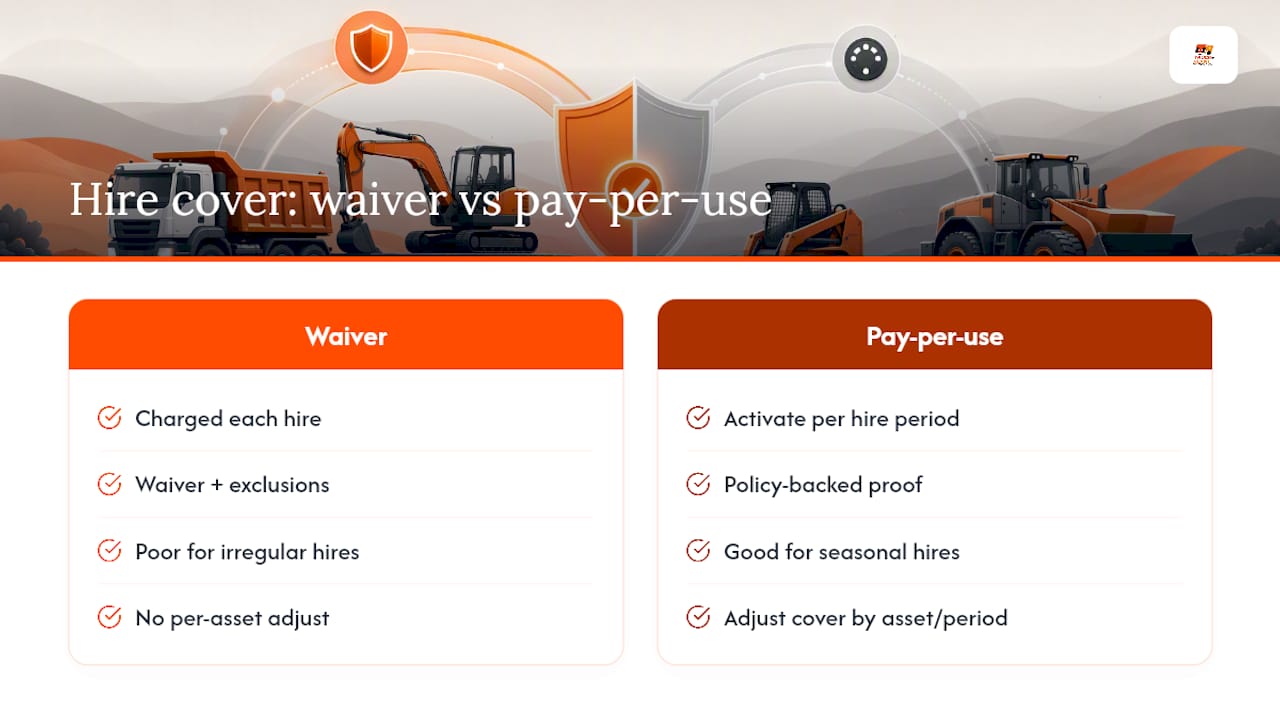
The damage waiver (sometimes called an excess buy-down) is a fee the hirer pays to reduce their liability exposure for accidental damage. It is popular because it is fast and cheap at the point of hire, but it is not insurance, and it carries its own list of exclusions covered further down.
Then there are the endorsements, the technical add-ons that make an insurance policy actually respond the way a contract expects:
- Additional insured adds the equipment owner as a named party on the hirer’s liability policy.
- Waiver of subrogation stops the hirer’s insurer from chasing the owner after paying a claim.
- Primary and non-contributory wording confirms the hirer’s policy pays first, without pulling in the owner’s own cover.
Finally, most solid contracts include a notice-of-cancellation clause, requiring the insurer or broker to notify the contracting party if cover lapses, and set a timeframe for supplying a fresh COI before hire begins. Skip this clause and you may only discover a lapsed policy after something has already gone wrong.
Sample clause wording you can bring to a negotiation
Seeing the actual language helps more than any description. Here is balanced wording for the four clauses that matter most, along with what to watch for.
Insurance covenant (balanced version):
Indemnity clause:
Watch the phrase “including but not limited to.” It signals that the listed examples are illustrative, not exhaustive, which broadens the hirer’s exposure well beyond the named scenarios. A hirer negotiating this clause might push to narrow it to “arising solely from the Hirer’s negligence” to cap the scope.
Damage waiver clause:
COI requirement clause:
Negotiation usually comes down to a handful of levers: the dollar limit required, whether the named insured on the policy exactly matches the contracting entity, which endorsements are mandatory versus optional, and how much notice a cancellation clause demands. Push hard on the named insured detail specifically. A mismatch here is one of the most common reasons a policy that looks fine on paper doesn’t actually respond to a claim.
How to verify cover instead of just collecting paperwork
A COI is a summary document, nothing more. It lists the insurer, policy number, coverage type, and limits, but it does not reproduce the actual policy wording. That distinction causes real problems, because a COI can state that “additional insured” status has been granted without the underlying endorsement actually supporting it. Reviewing the policy endorsement itself, not just the certificate summarizing it, is the only way to know a requirement genuinely binds the insurer.
Here’s a practical order of operations for verification:
- Request the COI first, as your baseline confirmation that a policy exists and is active.
- Ask for copies of the specific endorsements referenced on the COI, particularly additional insured, waiver of subrogation, and primary and non-contributory wording.
- Confirm the named insured on the policy matches the exact legal entity signing your hire agreement, not a parent company or a trading name.
- Check the policy form, occurrence versus claims-made, since this affects when the policy responds relative to when damage occurred.
- Verify hired-in plant and road risk extensions exist if the equipment will be transported or used off the primary site.
- Log the expiry date in your own system and set a reminder well before renewal, since a lapsed policy mid-hire is a common and avoidable gap.
Pro Tip: Keep a shared folder per hire, containing the signed contract, the COI, every endorsement copy, and your broker’s direct contact. When a claim happens, the difference between a same-day resolution and a six-week argument is usually how fast you can produce that folder.
Where damage waivers stop protecting you
Paying a damage waiver feels like buying peace of mind, and for accidental, ordinary wear-related damage it usually is. But the waiver has a defined perimeter, and outside that perimeter the hiree remains fully exposed even after paying the fee.
Common exclusions include:
- Theft when equipment was not properly secured or locked
- Water immersion or flood damage
- Glass breakage
- Overloading beyond rated capacity
- Damage occurring during transport, loading, or unloading
- Vandalism
Beyond these listed exclusions, waivers also collapse entirely in a few situations: contract breaches, unauthorized operators using the equipment, or damage arising from clear negligence. A damage waiver was never designed to rescue you from those scenarios. It is priced for the ordinary bumps and scrapes of daily use, not for misuse.
The commercial math matters here too. Damage waivers typically run as a percentage of the hire fee, so on a business hiring equipment frequently, that fee compounds fast across a year. For companies hiring the same category of plant repeatedly, scheduling a hired-in equipment endorsement on their own policy can end up cheaper than paying waiver fees on every single hire.
Wet hire, dry hire, and who insures what
The single biggest factor in figuring out your obligations is whether you’re on wet hire or dry hire. Get this distinction wrong and every other clause in the contract gets read incorrectly.
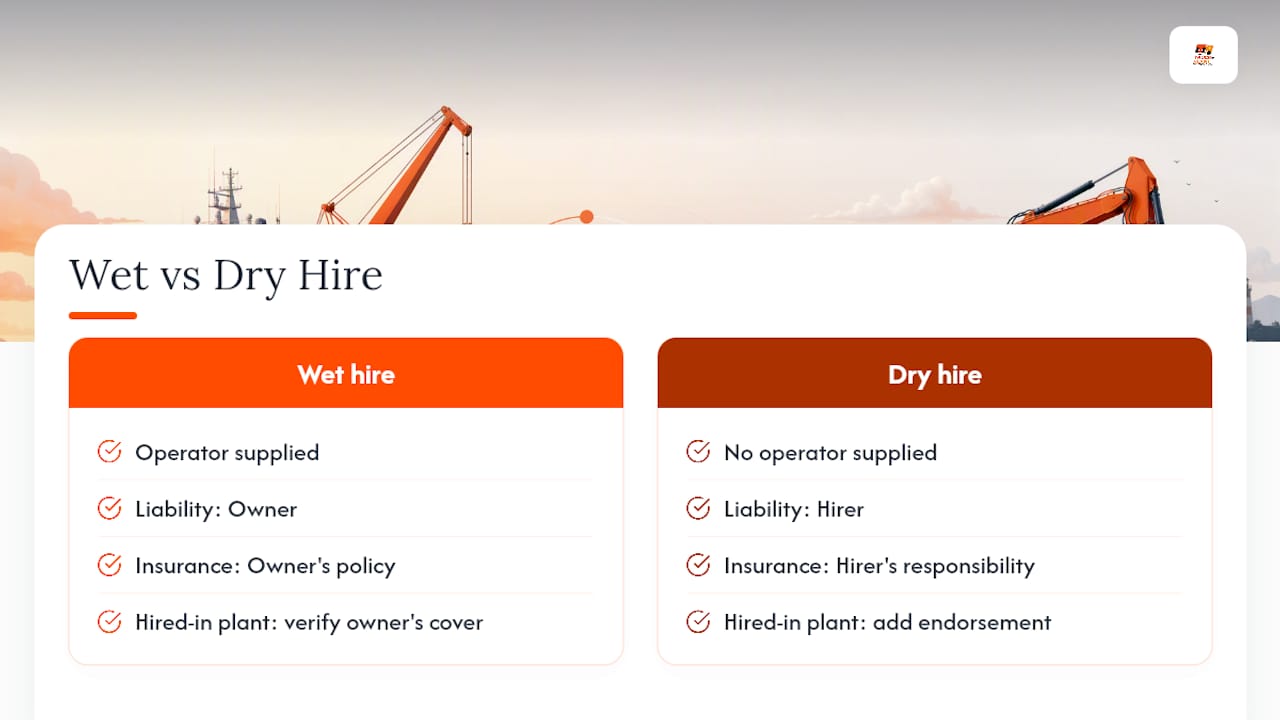
Wet hire means the equipment arrives with an operator supplied by the owner. In this arrangement, the owner typically retains operational liability, and the operator usually stays on the owner’s own policy for liability arising from how the equipment is used. This shifts materially with dry hire: operator liability generally remains with the owner on wet hire, but moves to the hiree once dry hire begins. If you’re hiring wet, your main job is confirming the owner’s policy actually covers third-party liability for the operator’s work, not insuring the machine yourself.
Dry hire means you take the bare equipment with no operator. Here, the hirer assumes full operational responsibility, including insuring it. This is where checking for a hired-in plant endorsement on your own policy becomes essential. Without it, your general liability or asset policy may exclude equipment you don’t own outright.
Risk also shifts during handover, transport, and storage, points where disputes commonly arise over exactly when responsibility passed from one party to the other. Defining these moments contractually, with clear language on when custody transfers, removes a lot of ambiguity later. If you’re arranging pickup or delivery through a third party, confirm who carries responsibility while the equipment is in transit, since transport liability for rented equipment often falls into a coverage gap between the hire contract and a separate transport arrangement. If equipment sits on site overnight or over a weekend, a caretaker or security obligation in the contract closes another common gap.
Setting limits and understanding sub-limits
A policy with a headline limit that sounds generous can still leave you exposed if the sub-limits underneath it are thin. This is where a lot of hire agreements quietly fail their purpose.
Three figures deserve specific attention:
- Per-occurrence and aggregate limits, which cap what the policy pays for a single incident and across the whole policy period.
- Care, custody and control sub-limits, which govern payouts specifically for equipment in your possession but not owned by you, and these sub-limits are frequently set well below the main liability limit.
- Hired-in plant limits, a separate sub-limit that some general liability policies apply specifically to rented equipment, sometimes low enough to leave a meaningful gap against the replacement cost of an excavator or a boom lift.
How much cover is enough depends on the replacement value of what you’re hiring, but a mismatch between contract requirements and policy sub-limits is one of the most frequent, avoidable gaps in equipment hire. The way a claim resolves, including whether an insurer even pursues recovery, comes down to how tightly the hire agreement’s wording aligns with the actual policy behind it, including how lost hire income or new-for-old replacement is calculated.
Endorsements change how these limits function in practice. A primary and non-contributory endorsement means the hirer’s policy pays out first, in full, before the owner’s own cover is even touched. Without it, insurers can end up disputing contribution between two policies while your claim sits unresolved.
Your pre-hire checklist before equipment leaves the yard
Get this sequence right once and it becomes routine. Skip a step and you find out the hard way, usually mid-claim.
- Draft or review the insurance covenant, confirming who insures, at what value, and for how long.
- Require a COI and named endorsements before delivery, not after, with a firm deadline written into the contract.
- Set your limits explicitly, including any hired-in plant or care, custody and control sub-limit you need.
- Add a notice-of-cancellation clause so you’re informed if the counterparty’s cover lapses mid-hire.
- Confirm damage waiver terms and exclusions in writing, if a waiver is part of the deal.
- Include maintenance obligations, since damage from poor upkeep is one of the fastest ways to void cover.
- Collect and store your documents: signed contract, COI, endorsement copies, and broker contact details, all in one place.
- Check operational conditions: secure storage, permitted use cases, and basic operator training, since these reduce loss risk before insurance is ever needed.
Pro Tip: Build this checklist into a standard template you reuse for every hire above a set value threshold. The businesses that get burned are almost always the ones treating each contract as a one-off rather than repeating a known process.
Where on-demand cover fits into hire timing problems
Hire work rarely runs on a neat annual schedule. Equipment goes out for three days, then sits idle for six weeks, then gets needed again for a rushed job with two days’ notice. Traditional annual policies and per-hire damage waivers both struggle with that rhythm: one locks you into paying for cover you’re not using, the other charges you every single time you hire.
Truck & Plant On-Demand™ was built around that exact mismatch. It lets you activate cover for the specific equipment and time window you actually need, rather than paying a flat premium regardless of usage. For a business hiring the same category of plant repeatedly through a season, that model can reduce the running cost of stacking damage waivers on every contract, while still giving you something more verifiable than a waiver’s limited exclusions list.
The practical fit is straightforward: keep your contract’s insurance covenant and endorsement requirements exactly as written, then satisfy them with cover you switch on for the hire period itself. Combined with digital proof of cover, that approach solves the timing problem, cover exists exactly when the contract calls for it, without paying for the weeks the equipment sits parked.
Negotiating priorities: what actually matters most
Most disputes over hire agreement insurance clauses trace back to one habit: trusting a COI without checking the endorsements sitting behind it. A certificate is a summary written by a broker, not a guarantee the policy will pay. If you take one lesson from this article, take that one.
My rule of thumb is proportional to stakes. A large or expensive hire, an excavator, a crane, anything with a six-figure replacement cost, justifies the effort of demanding named endorsements and firm limits before the equipment moves. A short, low-value hire of hand tools or a single day’s plant rental doesn’t warrant the same friction. There, a damage waiver, checked against its exclusion list first, is a reasonable trade of convenience for residual risk.
Bring in a broker or legal counsel when the indemnity language is broad, the equipment value is high, or the endorsement paperwork simply isn’t forthcoming. Waiting until after a loss to ask these questions is the expensive way to learn the answer.
— Coert
A different way to cover irregular hire periods
Damage waivers make sense for one-off hires, but they charge you every time, regardless of how often you actually hire. Truckplant takes a different approach: pay-for-use cover you switch on for the specific vehicle, machine, or tool and the exact window it’s working, then switch off again.

That structure suits plant and equipment hire businesses particularly well, since hire volume rarely stays flat month to month. If your work runs in seasonal peaks, or you’re hiring irregular categories of equipment across different jobs, activating cover per asset avoids paying for idle weeks between hires. It also gives you something to hand a counterparty that’s harder to argue with than a waiver’s exclusion list: verifiable, policy-backed cover tied to the exact hire period in your contract.
Truckplant’s Plant All Risk Insurance and Construction Public Liability Insurance both fit directly into the clause structures covered above, and cover can be adjusted as your equipment mix or hire frequency changes through the year. If you’re hiring smaller tools rather than heavy plant, Tool of Trade Insurance covers that category specifically. Head to the Truckplant site to check current cover options and request a quote for your next hire period.
Sources
For deeper reference material, a few sources are worth bookmarking. ContractKen’s breakdown of insurance clause drafting walks through customer-favourable, balanced, and vendor-favourable clause variants side by side. Kenra Holdings publishes a sample South African hire terms document showing real clause wording requiring the hirer to maintain full replacement value cover. For damage documentation practices that support a clean claim, FleetVakt’s articles on fleet management cover practical evidence collection that pairs well with any damage waiver discussion. Between these three, most of the drafting and verification questions this article raises have a concrete model to compare against.
- Damage waiver clauses on equipment hire contracts (Bellrock Advisory)
- How to Handle Insurance Policy Contracts for Clients (Ironclad)
- Understanding the link between hire agreements and insurance claims (Hire & Rental News)
FAQ
What are the key clauses in a hire agreement’s insurance section?
The core clauses are the insurance covenant, the indemnity or hold-harmless clause, the damage waiver, and the endorsement requirements, particularly additional insured, waiver of subrogation, and primary and non-contributory wording.
What are the main elements that make an insurance clause enforceable?
An enforceable clause needs a clearly named insured party, a defined coverage scope and limit, a stated policy period, evidence requirements (a COI plus endorsements), and language specific enough that a court can determine what was actually required.
Can you give an example of an insurance clause used in hire contracts?
A common version reads: “The Hirer shall maintain insurance covering the Equipment against loss or damage on a full replacement value basis and shall provide the Owner with a certificate of insurance prior to delivery.” Balanced and party-favouring variants of this wording appear earlier in this article.
What should a hire purchase agreement’s insurance section include?
It should specify who insures the asset, the required coverage value, evidence requirements like a COI, and what happens if cover lapses before the agreement ends, typically through a notice-of-cancellation clause.
Does paying a damage waiver replace the need for insurance?
No. A damage waiver reduces liability for a defined category of accidental damage, but it excludes theft, water damage, misuse, and transport damage, so the hiree can still face real exposure even after paying it.