


TL;DR:
- Business operations directly influence insurance coverage as changes like revenue growth, new employees, and fleet expansion increase risk exposure. Failing to update policies after operational changes can lead to claim denials, retroactive bills, and penalties. Proper documentation and regular reviews ensure adequate coverage aligned with evolving business risks.
Your insurance cover is only as accurate as the business it describes. How business operations affect cover is not a theoretical question. Every time you hire a new driver, win a larger contract, or expand your fleet, your risk profile changes. Your policy may not. That gap between what your business does and what your insurer covers is where claims get denied and premiums spike without warning. For construction and transport business owners in 2026, understanding this link is the difference between adequate protection and a costly shortfall.
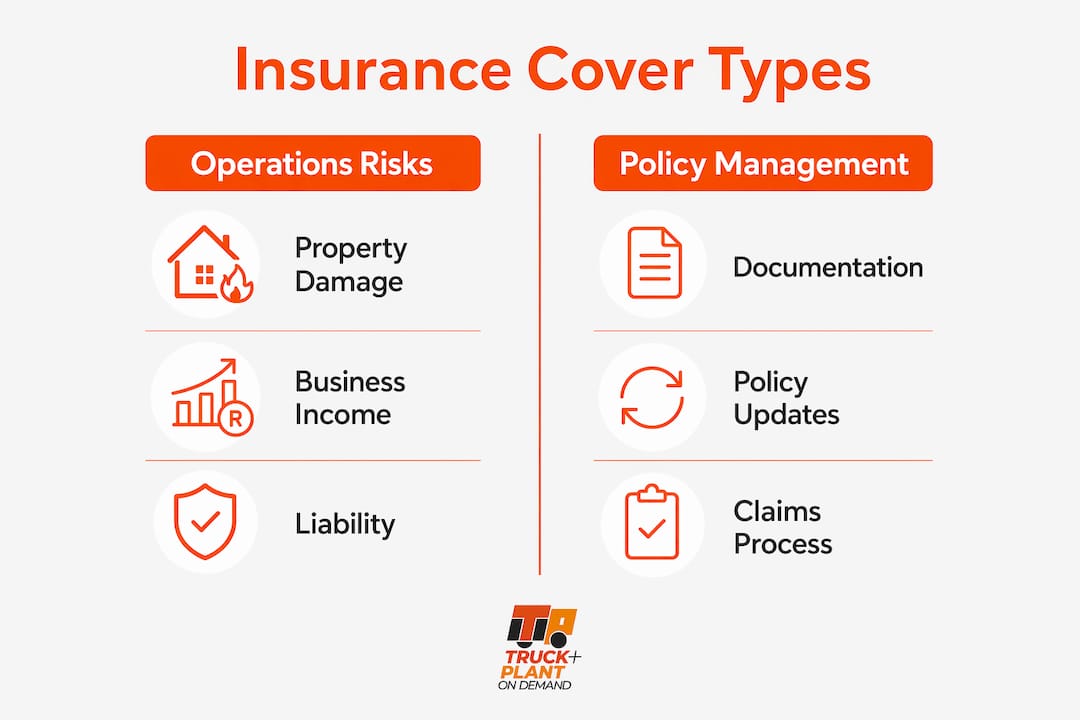
How business operations affect cover: the key drivers
Your insurance premium is calculated on a snapshot of your business at the time of underwriting. When that snapshot becomes outdated, your cover becomes inaccurate.
Several operational inputs directly alter your risk exposure:
- Revenue growth. Significant revenue fluctuations of 20% or more require an immediate policy review. A 50% revenue increase might only raise your premium by 20–30%, but failing to update your limits can result in denied claims or retroactive premium bills.
- Employee headcount. Workers’ compensation and liability premiums are calculated on payroll and safety records. Adding staff, especially on active construction sites or behind the wheel, raises your exposure directly.
- Fleet and equipment size. Each additional vehicle or piece of plant machinery is a new liability. Insurers price this risk individually, so an unregistered addition to your fleet is effectively uninsured.
- Contract size and complexity. Larger contracts in construction and transport carry greater professional and general liability exposure. Standard $1M general liability limits are insufficient for growing firms; $2M/$4M limits are recommended once revenue exceeds $1M, given that nuclear verdicts frequently exceed $1.5M in construction and transport sectors.
- New locations or depots. Opening a new yard or depot adds property risk, increases the geographic spread of your operations, and may require separate policy endorsements.
Pro Tip: Review your 2026 fleet insurance trends before your annual renewal. AI underwriting models now flag businesses with rapid growth but flat safety budgets for automatic premium increases, regardless of claims history.
The impact of business operations on your cover is cumulative. Each change alone may seem minor. Together, they can push your actual risk far beyond what your current policy covers.
What does business interruption insurance actually cover?
Business interruption insurance, also called business income insurance, covers the income you lose when a covered event forces your operations to stop. The definition matters because this cover is widely misunderstood.
The most important rule: business interruption insurance only triggers if the underlying cause of the shutdown is a covered property damage event. If your depot floods and fire is the only covered peril on your property policy, the income loss from the flood is excluded too. Your business interruption cover is only as broad as your property cover.
When a valid claim exists, the cover typically includes:
- Lost net income during the shutdown period
- Fixed operating expenses that continue regardless of trading status
- Extra expenses incurred to resume operations faster
- Employee retraining costs after a covered event
The distinction between continuing and non-continuing expenses is where many claims fall short. Rent, loan repayments, and key employee salaries are continuing expenses and are covered during a shutdown. Variable costs like materials and hourly wages stop when operations stop, so they are excluded from claims.
Misunderstanding which expenses continue during a shutdown leads to inaccurate claim settlements. Only expenses actually incurred during the shutdown period are reimbursed. Estimating or inflating these figures does not increase your payout. It creates a disputed claim.
Documentation is the other critical factor. 60% of denied claims are rejected because of poor documentation, not policy exclusions. Profit and loss statements, tax returns, and payroll records are the evidence your insurer requires to validate and pay a claim.
Pro Tip: Keep your financial records updated monthly, not just at year-end. Clean books are your strongest asset when a business interruption claim is on the table.
When must you update your insurance policy?
Operational changes do not pause your risk exposure. Your policy does not automatically adjust when your business grows. That mismatch creates real financial consequences.
The following events require a mid-policy review:
- Revenue increases of 20% or more. Your coverage limits are tied to projected income. Underinsuring your income triggers coinsurance penalties.
- Hiring additional employees. Payroll changes affect workers’ compensation calculations directly.
- Adding vehicles or plant machinery. Each new asset must be scheduled on your policy before it operates.
- Winning a contract above your previous largest. Larger contracts increase your liability exposure and may require higher general liability or professional indemnity limits.
- Opening new premises or depots. New locations require property and liability cover from day one of occupation.
The consequences of not updating are specific and measurable. Ignoring operational changes leads to denied claims, retroactive premium bills, and coinsurance penalties. Coinsurance penalties are particularly damaging: if you insure only 50% of your required coverage, your insurer pays only 50% of any claim, even if your loss is fully documented.
| Operational change | Coverage action required |
|---|---|
| Revenue grows by 20%+ | Increase income and liability limits |
| Fleet expands | Schedule new vehicles immediately |
| New employees hired | Update payroll for workers’ comp |
| New contract won | Review professional liability limits |
| New premises opened | Add location to property and liability cover |
Reviewing your policy coverage at each of these trigger points prevents the retroactive billing and claim denials that catch most business owners off guard.
How to use a business impact analysis to align cover with operations
A Business Impact Analysis, or BIA, is a formal process that maps your operational activities to their financial consequences if disrupted. It is the most reliable tool for identifying where your insurance cover does not match your actual risk.

The BIA process identifies and quantifies the financial impact of operational disruptions. It prioritises which business processes must be restored first and highlights specific loss scenarios, including lost revenue, increased costs, and regulatory fines.
For construction and transport businesses, a BIA typically examines:
- Which vehicles or equipment, if taken off the road, stop revenue immediately
- Which contracts carry penalty clauses for delays or non-delivery
- Which operational processes depend on a single location, system, or supplier
- What the daily revenue loss looks like for each critical process that stops
Mapping your processes to the systems and assets that support them also reveals technology dependencies that affect operational continuity. A fleet management system going offline, for example, may not trigger a property damage claim but can still halt dispatch operations and create income loss.
Pro Tip: Use your BIA findings as a negotiating tool with your broker. Documented loss scenarios give you a factual basis to request higher limits or specific endorsements, rather than accepting a standard package.
The BIA output also feeds directly into your fleet insurance analytics, helping you identify which assets carry the most financial risk and where your current cover has gaps. Proper truck parts inventory management is one operational factor that BIA often surfaces, since parts availability directly affects how quickly you can restore a grounded vehicle to revenue-generating service.
Key takeaways
Operational changes are the primary driver of insurance coverage gaps, and proactive policy management is the only reliable way to stay adequately covered.
| Point | Details |
|---|---|
| Revenue triggers coverage gaps | A 20%+ revenue change requires an immediate policy review to avoid coinsurance penalties. |
| Business interruption needs property cover | This cover only pays out if the cause of shutdown is a covered property damage event. |
| Documentation determines claim outcomes | 60% of denied claims fail due to poor records, not policy exclusions. |
| Operational growth demands mid-policy updates | New hires, contracts, and assets must be added to your policy before they create a claim. |
| BIA aligns operations with insurance | A formal Business Impact Analysis identifies financial exposure and coverage gaps before a loss occurs. |
The uncomfortable truth about business interruption cover
Most business owners I speak with assume their insurance keeps pace with their business. It does not. Policies are static documents. Your business is not.
The biggest misconception I encounter is around business interruption cover. Operators assume it functions like a safety net that catches any income loss. The reality is far narrower. It only activates when property damage is the cause, and it only pays what your financial records can prove. Two conditions that many businesses fail on simultaneously.
The second issue is the annual review habit. Most business owners review their cover once a year, at renewal. But construction and transport businesses do not grow on a 12-month schedule. A new contract in March, three new trucks in July, and a second depot in October each change your risk profile the moment they happen. Waiting until renewal to catch up means operating underinsured for months at a time.
Clean financial records and a proactive relationship with your broker are not administrative tasks. They are risk management tools. The businesses that handle claims well are the ones that treated their bookkeeping and policy management as seriously as their operations.
— Coert
Cover that moves with your operations
Construction and transport businesses do not operate on a fixed schedule, and your insurance should not either.
Truckplant’s Truck & Plant On-Demand™ fleet insurance is built specifically for commercial vehicles and plant machinery in South Africa. You choose what to insure, when to insure it, and how. When your fleet grows, shrinks, or shifts between projects, your cover adjusts with it. You pay for the cover you actually need, not a fixed premium that no longer reflects your business. If your operations are changing and your current policy has not kept up, navigate your changing insurance needs and find out where the gaps are before a claim reveals them.
FAQ
How do business operations affect insurance premiums?
Operational factors like revenue, payroll, fleet size, and claims history directly determine your premium. Insurers recalculate risk when these inputs change, which is why mid-policy updates are required after significant operational growth.
What triggers a business interruption insurance claim?
Business interruption cover only activates when a covered property damage event forces your operations to stop. If the cause of the shutdown is an excluded peril, the income loss is excluded too.
What are coinsurance penalties in business insurance?
Coinsurance penalties reduce your claim payout proportionally when your coverage limits are lower than your actual insured value. Insuring 50% of the required amount means your insurer pays only 50% of any valid claim.
How often should I review my business insurance policy?
Review your policy whenever a significant operational change occurs, including revenue growth of 20% or more, new hires, fleet additions, new contracts, or new premises. Annual renewal reviews alone are not sufficient for growing businesses.
What records do I need for a business interruption claim?
Insurers require profit and loss statements, tax returns, and payroll records to validate a business interruption claim. Poor documentation is the leading cause of denied claims, not policy exclusions.