


TL;DR:
- Running a business in civil, construction, or transport industries exposes you to unique risks that require a structured insurance needs assessment. Regularly reviewing data, applying frameworks like the DIME method, and verifying policy endorsements help prevent coverage gaps and ensure legal compliance. On-demand insurance solutions tailored to operational changes can protect your business accurately while optimizing costs.
Running a business in the civil, construction, or transport sector means you are exposed to risks most industries never encounter. A single uncovered incident — a damaged excavator, an injured subcontractor, a vehicle accident on a live project — can create financial consequences that outlast the project itself. Knowing how to analyse insurance needs, or conducting a formal insurance needs assessment, is not a once-off task. It is a structured process that protects your business from coverage gaps, legal non-compliance, and premium waste. This guide walks you through each stage of that process with sector-specific clarity.
Table of Contents
- Key takeaways
- How to analyse insurance needs: gathering the right data
- Structured methods to quantify your cover
- Verifying policy compliance and coverage adequacy
- Adjusting your insurance plan as your business evolves
- My take: where most businesses actually go wrong
- Cover that adapts to how you actually work
- FAQ
Key takeaways
| Point | Details |
|---|---|
| Gather data before you analyse | Compile assets, liabilities, contracts, and workforce details before assessing any coverage gap. |
| Use structured analysis methods | Apply frameworks like the DIME method, adapted for business debt and operational costs, to quantify your actual needs. |
| Compliance goes beyond having a policy | Check for correct endorsements, Additional Insured status, and completed operations cover on every contract. |
| Review cover when your business changes | Reassess annually and after major triggers such as new projects, fleet growth, or regulatory changes. |
| On-demand cover reduces premium waste | Flexible, activity-based insurance lets you pay for cover that matches your actual operations at any given time. |
How to analyse insurance needs: gathering the right data
Before you can evaluate insurance coverage properly, you need a clear picture of what your business actually owns, owes, and is contractually obligated to cover. Skipping this step is the single biggest reason businesses end up either underinsured or paying for cover that does not match their risk profile.
Start by pulling together the following information:
- Assets: All commercial vehicles, yellow plant machinery, tools of trade, and physical infrastructure
- Liabilities: Outstanding loans on equipment, lease agreements, and third-party financial obligations
- Contracts: Project agreements that specify minimum insurance requirements and endorsed coverage types
- Workforce: Number of employees, subcontractors, and any labour broker arrangements
- Revenue and operating costs: Needed to calculate income replacement benchmarks and business interruption exposure
Once you have this data, map it against the policies your sector typically requires. Construction programs commonly include general liability, workers’ compensation, commercial auto, builder’s risk, contractor’s equipment, professional liability, and umbrella cover. Transport businesses add goods-in-transit and fleet-specific covers. No single policy covers all risks in either sector.
| Document or data point | Why it matters |
|---|---|
| Equipment and vehicle register | Confirms asset values for replacement cost calculations |
| Active contracts with insurance clauses | Identifies minimum limits and required endorsements |
| Existing policy schedule | Reveals current cover, exclusions, and gaps |
| Subcontractor agreements | Determines whose insurance covers which party for which risk |
| Claims history (3 years) | Signals recurring risk areas and informs future premium negotiations |
Pro Tip: Request copies of all subcontractor certificates of insurance before any project begins. Verifying these early prevents rushed compliance failures mid-project.
Structured methods to quantify your cover
Once your data is in order, you can move to the analysis itself. This is where determining insurance needs shifts from guesswork to a defensible calculation.
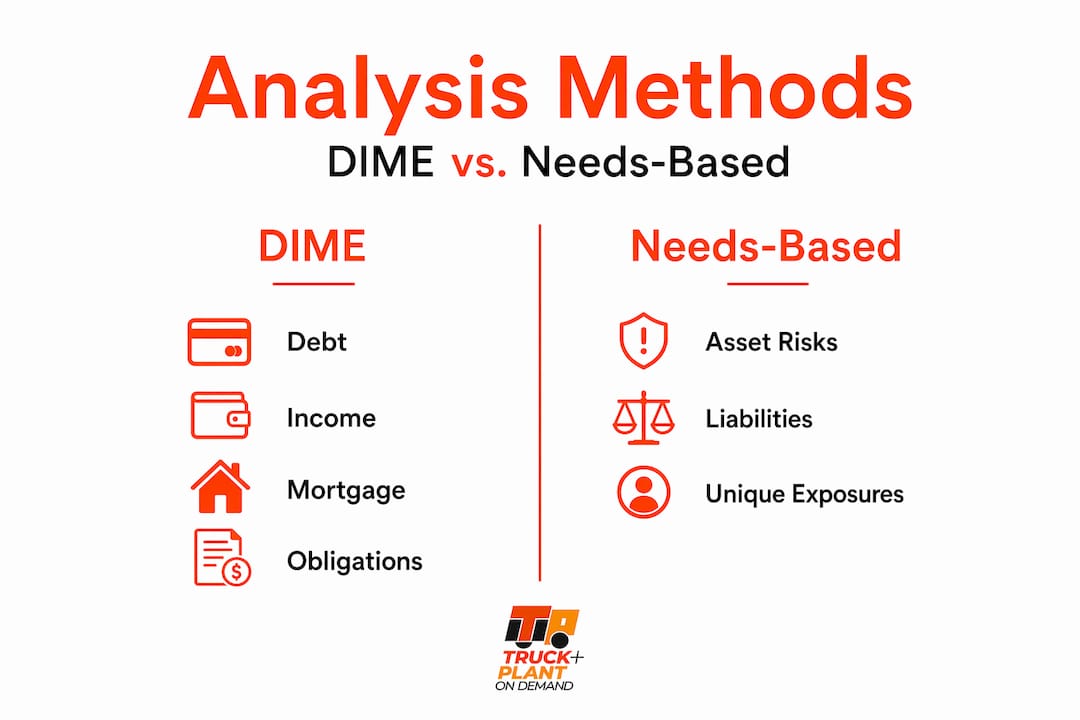
The DIME method is the most widely used structured framework for this purpose. Originally designed for individual life insurance, it adapts directly to business contexts:
- Debt: Total outstanding business loans, equipment finance, and credit facilities
- Income: Annual revenue or profit that would need replacing if operations were disrupted — typically 7 to 10 years of income replacement is the benchmark
- Mortgage or operational costs: Fixed costs that continue even when revenue stops, including lease obligations and staff salaries
- Education or future obligations: For business owners, this includes succession planning, buy-sell agreement funding, and long-term capital commitments
Running the DIME calculation for your business gives you a coverage floor. It shows the minimum total protection your business needs to survive a major loss event.
A complementary approach is a needs-based analysis, which ties each coverage type to its specific financial purpose. Generic multiplier methods often miss critical obligations when used alone, which is why mapping cover to purpose produces more accurate results.
| Analysis method | Best suited for | Key limitation |
|---|---|---|
| DIME method | Quantifying total coverage floor | Does not address policy-type allocation |
| Needs-based analysis | Matching cover to specific financial obligations | Requires detailed financial data to be accurate |
| Income replacement multiplier | Quick benchmark estimates | Can miss sector-specific risk exposures |
| Contract-driven analysis | Meeting project-specific insurance requirements | Reactive, not proactive |
Pro Tip: Run all three methods and compare the results. If the outputs diverge significantly, it signals a complexity in your risk profile that deserves a broker conversation before you finalise any cover.
For civil and construction businesses, adjust your DIME calculation to include site-specific risks: third-party liability on public-access sites, plant breakdown exposure on long-duration projects, and liability tail coverage that extends beyond project completion. Transport businesses must factor in per-vehicle liability, cargo values, and driver risk profiles. Understanding these factors affecting insurance needs is what separates a precise coverage plan from a generic one.
Verifying policy compliance and coverage adequacy
Completing a coverage analysis is only half the work. The other half is confirming that your actual policies deliver what your analysis says you need. In construction and transport, simply having insurance is not sufficient. Missing specific endorsements or incorrect limit types can leave you exposed even when a policy exists.
The Certificate of Insurance (COI) is the primary compliance document in construction. But most COI failures are not about missing policies. They are about missing details within policies.
Key endorsements to verify on every construction project:
- Additional Insured (ongoing operations): Covers the project owner or general contractor while work is in progress
- Additional Insured (completed operations): The CG 20 37 endorsement extends protection after work is finished. Without this endorsement, coverage ends the moment your subcontractor’s work is complete, leaving long-tail liability exposed
- Waiver of Subrogation: Prevents your insurer from pursuing third parties involved in a claim, which many contracts require
- Primary and Non-Contributory language: Confirms your policy responds first, before the additional insured’s own cover kicks in
The most common gap in construction insurance is inadequate subcontractor risk transfer and missing completed operations coverage. This is not a minor administrative oversight. A claim arising two years after project completion, when that subcontractor’s COI no longer shows completed operations cover, becomes your liability.
| Compliance item | Required? | Common failure point |
|---|---|---|
| Additional Insured (ongoing ops) | Yes, most contracts | Endorsement missing from COI |
| Additional Insured (completed ops) | Yes, post-project exposure | CG 20 37 absent from subcontractor policy |
| Waiver of Subrogation | Often required | Not endorsed on workers’ comp policy |
| Primary and Non-Contributory | Contractually required | Listed on COI but not endorsed on policy |
| Correct policy limits | Always | Limits correct on face but wrong per-occurrence structure |
Pro Tip: Do not rely on a subcontractor’s COI as proof of compliance. Request the actual endorsement pages from their broker. A COI can state Additional Insured status without the underlying policy actually containing the required endorsement.
For transport businesses, compliance checks focus on fleet policy schedules: confirming all active vehicles are listed, goods-in-transit limits are adequate per load, and driver exclusions do not create gaps in daily operations.
Adjusting your insurance plan as your business evolves
An insurance plan that matched your business three years ago may be seriously misaligned with your operations today. The process of assessing insurance requirements is not a static exercise.
Here is a practical review framework:
- Annual scheduled review: Audit all policies against your current asset register, workforce size, and revenue figures. Compare against your updated DIME calculation.
- Project-triggered review: Every time you take on a new contract, check whether its insurance requirements exceed your current cover. Do not assume existing policies are sufficient.
- Fleet and equipment changes: Adding a vehicle or a piece of plant machinery creates an immediate coverage gap if your policy schedule is not updated before that asset begins operating.
- Regulatory and legislative shifts: Changes to road transport regulations, COID Act obligations, or construction sector requirements can alter your minimum compliance thresholds.
- Subcontractor base changes: If your regular subcontractor pool changes, rerun your COI compliance checks for the new parties.
Periodic reviews prevent underinsurance and enable you to cut costs where your risk profile has genuinely reduced. A transport business that downsized its fleet by 20% should not be paying premiums on vehicles it no longer operates. Equally, a civil contractor that won a larger-than-usual infrastructure tender needs to confirm its liability limits are adequate before the first subcontractor sets foot on site.
Integrate your insurance review into your existing risk management and safety programme. When safety incidents trigger internal reviews, those same findings should feed directly into your coverage reassessment. The two functions inform each other and collectively reduce your total cost of risk.

My take: where most businesses actually go wrong
I’ve spent years working with businesses in civil, construction, and transport, and the pattern is consistent. Most business owners know they need insurance. Very few have actually gone through the discipline of a structured insurance needs assessment. They buy cover reactively: a broker recommends a package, they accept it, and they renew it every year without question.
What I’ve found is that the biggest exposures almost never sit in the obvious places. They sit in the gaps between policies. In my experience, a construction company can hold six separate policies and still be completely exposed on a completed operations claim because nobody verified the CG 20 37 endorsement on a subcontractor’s COI.
The other mistake I see regularly is treating the DIME method as a personal finance tool rather than a business planning tool. When you adapt it to aggregate business debt, operational income, and long-term capital obligations, it becomes a surprisingly precise way to identify your coverage floor. The businesses that do this properly almost always discover they are carrying either significantly more or significantly less cover than they actually need.
My advice is practical: do the structured analysis once, properly, with your broker and your finance team in the same room. Then build the review triggers into your operational calendar rather than waiting for a renewal notice. The difference between an insurance programme that protects your business and one that merely satisfies a checkbox is usually that one conversation.
— Coert
Cover that adapts to how you actually work
If the analysis above revealed that your current insurance programme is misaligned with your real operational risks, the solution does not have to be more policies or higher premiums.

Truckplant’s Truck & Plant On-Demand™ was built specifically for businesses in civil, construction, and transport that need cover to move with their operations. You choose what you insure, when you insure it, and how. When your fleet scales up for a large project and scales back down after, your premium follows. You can explore on-demand fleet insurance options tailored for commercial vehicle operations, or look at truck insurance cover that adjusts to your route activity and load requirements. If your business runs tools and plant machinery on site, Truckplant’s tool of trade insurance protects the equipment your revenue depends on. Speak to the Truckplant team and let your cover reflect your actual risk.
FAQ
What is an insurance needs assessment?
An insurance needs assessment is a structured process of gathering business data, quantifying financial obligations, and comparing them against existing cover to identify gaps or overspend. It is the foundation of sound insurance planning for any civil, construction, or transport business.
How often should I reassess my insurance cover?
Reviews should happen annually and after any major business change, including new projects, fleet changes, ownership shifts, or regulatory updates. Waiting for renewal notices is not a sufficient trigger.
What is the DIME method and how does it apply to businesses?
The DIME method sums Debt, Income replacement, Mortgage or operational costs, and future obligations to calculate a coverage floor. For businesses, it means aggregating total financial exposure to determine the minimum protection required.
What is completed operations coverage and why does it matter?
Completed operations coverage protects against liability claims that arise after a project is finished. In construction, the CG 20 37 endorsement is required to maintain Additional Insured status for post-completion claims, and its absence is one of the most common and costly coverage gaps in the sector.
How do I know if my subcontractor’s insurance is adequate?
Do not rely on the certificate of insurance alone. Request the actual endorsement pages from their broker to confirm that Additional Insured, completed operations, Waiver of Subrogation, and Primary and Non-Contributory requirements are properly documented in the underlying policy.