


Insurance is the financial backbone that keeps industrial fleets and plant operations solvent, compliant, and able to recover after catastrophic events. For fleet operators and construction businesses, it converts unpredictable, high-severity losses into predictable operating costs, satisfies FMCSA and state motor carrier requirements, and preserves the working capital you need to keep equipment on the road and on site.
Three things insurance does that nothing else can:
- Catastrophic loss protection: Replaces a written-off truck or stolen excavator without draining your reserves.
- Regulatory and compliance proof: Certificates of insurance satisfy FMCSA filings, contract requirements, and state motor carrier rules.
- Cash-flow smoothing: A predictable premium is far easier to budget than a six-figure repair or liability settlement paid out of pocket.
Table of Contents
- Why insurance matters in industrial fleets and construction operations
- Core insurance types every fleet or plant operator should know
- How insurance should work with your internal risk management
- Common coverage gaps that catch fleet and plant operators off guard
- How on-demand insurance closes the gaps that static policies leave open
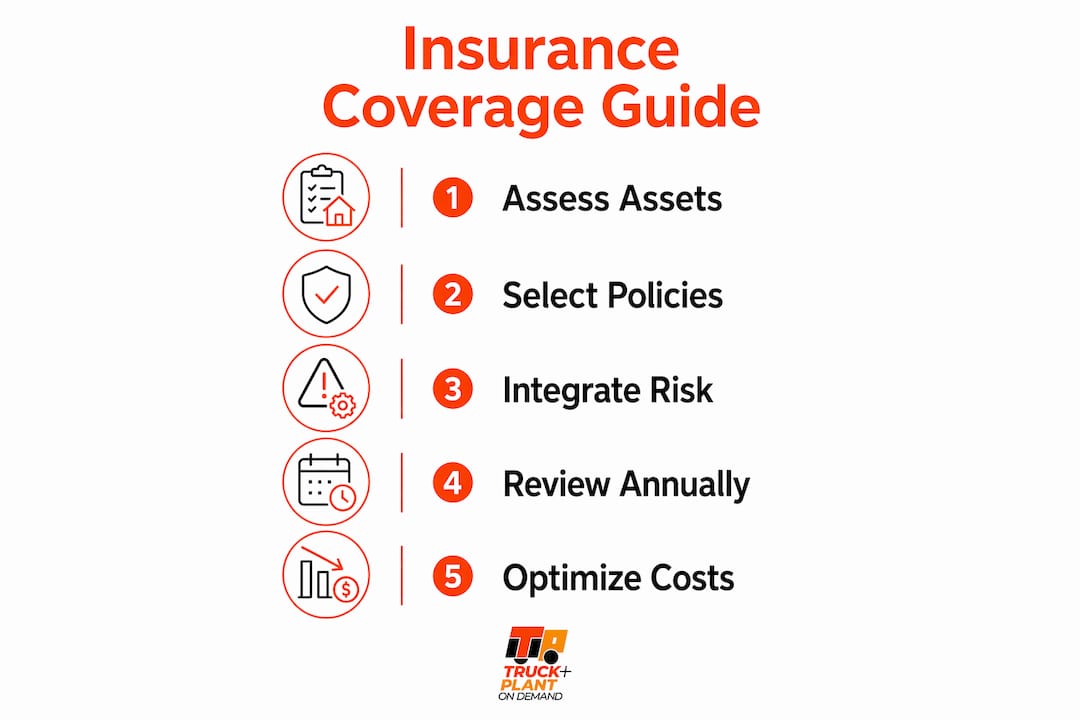
- Step-by-step: build your coverage plan in 30–90 days
- Claims, digital documentation, and keeping your premiums in check
- Case examples: what flexible cover looks like in practice
- Key takeaways
- What operators consistently get wrong about industrial insurance
- Truck & Plant On‑Demand™: cover that moves with your operation
- Further reading and authoritative sources
Why insurance matters in industrial fleets and construction operations
Business insurance protects firms from unexpected costs and supports continuity when operations are disrupted. For fleet and plant operators, that protection is not optional. A single truck total-loss, the theft of a hired excavator, or an environmental spill at a worksite can each generate losses that exceed a small operator’s entire annual revenue.
The deeper business case is financial stability. Property/casualty insurers paid around $414.6 billion in claims in 2017 alone, illustrating the scale of losses the industry absorbs on behalf of businesses. Without that transfer mechanism, those losses fall directly on operators’ balance sheets, threatening solvency and credit lines.
Lenders and general contractors require proof of cover before they will finance equipment or award contracts. Insurance is therefore a commercial prerequisite, not just a safety net.

| Metric | Figure | Source |
|---|---|---|
| P/C industry claims paid (2017) | several hundred billion dollars | Insurance Information Institute |
| Flood losses insured, OECD members | A large share | OECD |
| U.S. P/C insurer investment in the economy | over one trillion dollars | American Insurance Association |
The OECD figure is a sharp reminder that even in developed markets, a large share of losses go uninsured. For fleet and plant operators exposed to environmental perils, that gap is a direct business risk.
Core insurance types every fleet or plant operator should know
The critical cover types are commercial auto/fleet, equipment/plant, general liability, workers’ compensation, inland marine/cargo, environmental/pollution liability, business interruption, and umbrella/excess. Each protects a different asset or exposure.
- Commercial auto/fleet: Covers trucks, vans, and trailers for collision, theft, and third-party liability. Required by FMCSA for interstate carriers.
- Equipment/plant insurance: Covers excavators, cranes, and other yellow plant against damage, theft, and breakdown on and off site.
- General liability: Protects against third-party bodily injury or property damage claims arising from your operations.
- Workers’ compensation: Covers employee medical costs and lost wages after on-the-job injuries. Mandatory in most U.S. states.
- Inland marine/cargo: Covers tools, equipment, and goods in transit between sites or during short hires.
- Environmental/pollution liability: Covers spill cleanup, third-party claims, and regulatory fines from fuel or chemical releases.
- Business interruption: Replaces lost revenue when a covered event halts operations.
- Umbrella/excess: Sits above primary limits to cover catastrophic claims that exhaust underlying policies.
For tailored cover by asset type, match each piece of equipment to the policy that covers its specific exposure. A rented tool on a short hire needs inland marine cover; a long-haul truck needs FMCSA-compliant auto liability.
How insurance should work with your internal risk management
Insurance protects what controls cannot eliminate. It is the financial transfer layer in a risk program, not a substitute for safety protocols, driver vetting, or preventive maintenance. The ILO’s guidance on workplace safety is clear: layered defenses reduce frequency and severity, while insurance handles the residual financial risk.
A practical risk-management checklist for fleet and plant operators:
- Conduct pre-trip vehicle inspections and document them digitally.
- Vet all drivers with motor vehicle record (MVR) checks before assignment.
- Schedule and log preventive maintenance for every asset.
- Maintain written incident response plans covering accidents, spills, and equipment failures.
- Review near-miss reports monthly and share findings with your insurer.
The role of insurance in operational safety is most effective when it is integrated with an enterprise risk management (ERM) framework: avoid, reduce, transfer, accept. Insurance is the transfer step, applied after controls have already reduced frequency.
Pro Tip: Bring telematics data, maintenance logs, and near-miss reports to every renewal conversation. Insurers price on expected loss, and documented loss-control activity is one of the most direct levers you have to reduce that expectation.
Common coverage gaps that catch fleet and plant operators off guard
Underinsurance in dynamic operations usually comes from mismatched policy periods, idle assets, short hires, and activities that fall outside a policy’s original scope. Static annual policies are priced on a snapshot of your operation at inception. When that operation changes, the cover often does not.
Run this gap checklist against your current program:
- Idle equipment: Is plant sitting on your yard covered, or does cover lapse when it is not in active use?
- Short-term hires: Does your policy extend to equipment hired out for a day or a week, or does it require endorsement?
- Seasonal peaks: If you add vehicles or plant during a busy season, are those assets added in time?
- Cross-border trips: Does your commercial auto policy follow trucks into neighboring states or across the U.S.-Mexico border?
- Leased equipment on site: Who carries primary cover for a leased machine — you or the lessor? Contracts often leave this ambiguous.
- Pollution limits: Are your environmental liability limits adequate for a fuel spill at a large worksite?
The SBA recommends reassessing policies annually and whenever operations change. Most operators do not. Understanding commercial moving insurance consequences illustrates the same principle: a single uncovered transit event can generate losses that dwarf the cost of the endorsement that would have prevented them.
How on-demand insurance closes the gaps that static policies leave open
On-demand and usage-based insurance aligns your premium spend directly with your actual exposure. You activate cover for a trip, a hire period, or a seasonal surge, and the price reflects the hours or days of real use rather than a full-year estimate.
“Our offering was created on the simple premise that you shouldn’t have to pay the same premium every month, when the cover you need isn’t always the same.” — Truck & Plant On‑Demand™
The concrete benefits for fleet and plant operators are real. Cost alignment means you stop paying for idle assets. Faster ad-hoc hires become possible because cover can be activated in minutes rather than waiting for a broker endorsement. Proof of cover for a contract is available digitally, on demand.
There are conditions to understand. Underwriters still require minimum data: an accurate asset register, utilization logs, and pre-approved driver lists. Activation windows matter; cover activated after an incident has already occurred is not valid. Some exclusions, such as pre-existing damage or mechanical wear, apply regardless of the model. Flexible insurance for SMEs works best when your data is clean and your operations are documented.
Step-by-step: build your coverage plan in 30–90 days
A 30–90 day plan gives most operators enough time to collect the right data, identify gaps, pilot on-demand cover on a subset of assets, and roll out changes across the fleet.
- Days 1–30 (Discovery): Compile your asset register, utilization logs (hours/km per asset), claims history for the past three years, driver MVRs, and all hire/rental contracts. Identify which assets are idle more than 30% of the time.
- Days 30–60 (Pilot): Select a subset of assets (five to ten vehicles or pieces of plant) and run them under a usage-based or on-demand policy. Compare actual premium spend against the equivalent annual-policy cost for the same period.
- Days 60–90 (Rollout): Apply findings to the full fleet. Adjust limits, add endorsements for gaps identified in the checklist, and set a calendar reminder for annual reassessment.
Key cost drivers to track during the pilot:
| Cost driver | What to measure |
|---|---|
| Claims history | Frequency and severity over time |
| Vehicle/equipment class | Replacement value and repair cost benchmarks |
| Territory | State-specific liability minimums and loss trends |
| Average utilization | Hours or km per asset per month |
Insurance strategies for fleet management work best when the data feeding your broker conversation is the same data driving your operational decisions.
Claims, digital documentation, and keeping your premiums in check
Good documentation and digital claims workflows materially lower your total cost of risk. A well-documented claim settles faster, with less dispute over liability or repair scope, and a clean claims record directly influences your next renewal premium.
Claims documentation checklist:
- Photographs of damage from multiple angles, taken immediately after the incident.
- Telematics logs showing speed, location, and driver behavior at the time of loss.
- Current service and maintenance records for the affected asset.
- Repair estimates from at least one qualified repairer.
- Copies of all relevant certificates of insurance and contracts.
- Police or incident reports where applicable.
Pro Tip: Preserve subrogation rights by avoiding any admission of liability at the scene and by documenting third-party details thoroughly. Tag every incident in your fleet management system with a cost code so you can run loss analytics by asset class, driver, or territory at renewal.
Case examples: what flexible cover looks like in practice
Operators who switch to usage-based cover typically see two outcomes: lower cost per unit of exposure and faster compliance for short-term hires. The III analysis of insurance’s role in economic stability supports this: when cover aligns to actual use, businesses preserve working capital rather than funding idle-asset premiums.
Case A — Plant hire company with seasonal peaks: A mid-sized plant hire business carried full annual cover on 40 machines, but average utilization across the fleet was below 50% for six months of the year. Switching idle assets to on-demand cover during the low season reduced premium spend on those assets without creating a coverage gap during active hire periods.
Case B — Construction subcontractor on short-term site contracts: A subcontractor needed proof of cover for a two-week site contract but held only an annual policy that excluded the specific equipment class required. An on-demand activation for the hire period satisfied the contract requirement within 24 hours, avoiding a delay that would have cost more than the premium itself.
Truck & Plant On‑Demand™ publishes detailed guidance on dynamic insurance for construction fleets and transport operations for operators who want to go deeper on either scenario.
Key takeaways
Aligning insurance cover to actual asset utilization is the single most effective way for fleet and plant operators to reduce premium waste while maintaining full protection.
| Point | Details |
|---|---|
| Insurance converts loss to cost | Transfer high-severity, low-probability losses to an insurer to protect cash flow and credit. |
| Static policies create gaps | Reassess cover annually and whenever operations, assets, or territories change. |
| On-demand cover aligns spend to use | Activate cover per trip or hire period to stop paying for idle assets. |
| Documentation drives claims outcomes | Telematics logs, maintenance records, and photos shorten settlement time and protect renewal terms. |
| Truckplant’s on-demand model | Truck & Plant On‑Demand™ lets you activate, adjust, and manage cover in real time for commercial vehicles and plant. |
What operators consistently get wrong about industrial insurance
The conventional wisdom says “get insured and renew annually.” That advice is not wrong, but it misses the more costly mistake: treating insurance as a compliance checkbox rather than a financial management tool.
The operators who control their total cost of risk are the ones who bring data to their broker, not just a renewal form. They know their utilization rates, their claims frequency by asset class, and their exposure by territory. That data is what shifts the conversation from “what is the market rate?” to “here is why our rate should be lower.”
Usage-based cover is not a magic fix. It requires discipline: accurate asset registers, clean utilization logs, and pre-approved driver lists. Operators who skip that groundwork and activate on-demand cover without it often find that a claim is disputed because the documentation does not support the activation. The product works when the data works.
The broader point is that the importance of insurance in industry is not just about having a policy. It is about having the right policy, structured to match how your operation actually runs, reviewed often enough to stay current, and documented well enough to survive a claim.
Truck & Plant On‑Demand™: cover that moves with your operation
Stop paying a fixed monthly premium for cover that does not match what your fleet or plant is actually doing. Truck & Plant On‑Demand™ gives you real-time control over your commercial vehicle and plant insurance: activate cover for a single trip, a hire period, or a seasonal surge, and pay only for the protection you actually use.
For fleet operators and construction businesses, the practical difference is immediate. No idle-asset premiums. Digital proof of cover available on demand for contract compliance. Claims managed through a digital workflow that shortens settlement time. Cover that includes commercial vehicles, trucks, trailers, plant and tool hire equipment, group personal accident, environmental liability, and machinery breakdown.
To get started, have your asset register, recent utilization logs, and claims history ready. Then request a quote and a Truckplant specialist will walk you through a pilot scoped to your fleet size and territory.
Further reading and authoritative sources
Verify state motor carrier requirements directly with FMCSA before changing your program, and check your state insurance regulator for local filing obligations. OSHA’s site safety standards apply independently of your insurance program and should be reviewed alongside your risk management checklist.
- FMCSA insurance requirements — federal minimum liability filings for interstate carriers.
- OSHA construction standards — workplace safety rules that reduce frequency and influence underwriting.
- SBA business insurance guidance — cover types and annual reassessment recommendations.
- Insurance Information Institute — industry data on claims payments and economic role of insurance.
- OECD insurance analysis — coverage gap data for environmental and catastrophe perils.
- Truckplant on-demand resources — guides on fleet cover, construction insurance, and usage-based pilots.
State-specific insurance minimums, FMCSA filing categories, and motor carrier registration rules change. Confirm current requirements with the relevant regulator or a licensed commercial insurance broker before modifying your coverage program. This article is general information, not professional insurance or legal advice.