


TL;DR:
- On-demand insurance offers flexible, usage-based coverage for construction machinery in South Africa.
- Proper documentation and security measures can reduce premiums and improve claims outcomes.
- Traditional fixed policies often lead to overpayment and under-protection for fluctuating project needs.
Most construction and civil engineering businesses in South Africa assume their only option is a fixed annual insurance policy. That assumption costs them money. When your operational needs shift from one project to the next, a one-size-fits-all policy rarely reflects your actual risk exposure. You may be paying full premiums for machinery sitting idle on a yard, or worse, running equipment with inadequate cover on an active site. This article breaks down the real risks plant operators face, the types of cover available, what drives costs, and how on-demand insurance is changing the way South African businesses protect their plant and people.
Table of Contents
- Why insurance matters for plant operators
- Types of insurance available for plant operators in South Africa
- Key factors influencing insurance costs and requirements
- How leading providers differ: Flexible vs traditional cover
- Steps to get the right insurance for your plant operators
- Unpacking the real value of on-demand insurance for plant operators
- Get flexible, tailored insurance for your plant and operators
- Frequently asked questions
Key Takeaways
| Point | Details |
|---|---|
| Flexible insurance options | On-demand and project-specific cover gives South African plant operators cost and operational flexibility. |
| Know your risks | Solid risk assessment and up-to-date documentation are crucial for getting the right insurance and fast claims. |
| Provider differences matter | Choosing between traditional and on-demand insurers affects costs, claims, and administrative effort. |
| Proactive cost control | Bundling cover and regular policy reviews help cut expenses and ensure complete protection. |
Why insurance matters for plant operators
Operating plant machinery on a construction or civil engineering site carries significant financial exposure. A single incident, whether it is an excavator rollover, a crane collision, or equipment theft overnight, can result in losses that threaten the viability of a business. Plant operators face machinery risks, liability, and operational losses that are unique to the construction environment, and standard commercial policies rarely address them adequately.
The core risks that plant operators face include:
- Accidental damage: Collisions, rollovers, and site accidents involving machinery
- Theft: Plant equipment is a high-value target, particularly on remote or unsecured sites
- Third-party liability: Damage or injury caused to people, property, or neighbouring structures during operations
- Operational downtime: Loss of income when machinery is out of service due to damage or repair
For subcontractors, the stakes are even higher. Many principal contractors and project owners require proof of insurance before work can commence. Without plant hire insurance, you may lose contracts or face legal exposure when things go wrong on site.
Being underinsured is just as dangerous as having no cover at all. If your declared asset value is lower than the actual replacement cost of your machinery, your insurer may only pay out a proportionate amount at claim stage. This is called underinsurance, and it catches many operators off guard.
In South Africa’s construction sector, equipment theft and accidental damage are among the most frequently reported claims. The financial impact is compounded when you factor in the cost of hiring replacement equipment and the delay to project timelines.
Pro Tip: Before any project begins, photograph and document the condition of all machinery. Keep service records, operator licences, and asset registers updated. This documentation speeds up claims and reduces disputes with insurers.
Types of insurance available for plant operators in South Africa
Understanding your options is the first step to making a smart insurance decision. Plant operators have access to plant all risks, hired-in plant, liability, and on-demand cover depending on their operational model and project requirements.
Here is a breakdown of the main categories:
- Plant all risks: Covers accidental damage, fire, theft, and sometimes flood for owned machinery. This is the most common form of cover for businesses that own their fleet outright.
- Third-party and public liability: Covers damage or injury caused to third parties during operations. Often contractually required on large civil and government projects.
- Hired-in plant cover: Protects equipment you have hired from another party while it is in your care. If a hired excavator is damaged on your site, this cover protects you from the hire company’s repair or replacement claim.
- On-demand and usage-based cover: Flexible, on-demand cover options allow you to activate and deactivate cover based on actual usage, project timelines, or seasonal demand.
| Cover type | Best suited for | Cost predictability | Activation ease |
|---|---|---|---|
| Plant all risks | Owned fleet, full-time operations | Fixed monthly premium | Standard policy setup |
| Public liability | All operators, contractual compliance | Fixed or project-based | Included in most policies |
| Hired-in plant | Businesses that hire equipment | Variable, per hire period | Activated per hire agreement |
| On-demand cover | Project-based or seasonal operators | Pay-as-you-use | Instant digital activation |
For businesses that move between short-term projects, on-demand cover is often the most cost-efficient choice. You are not paying for cover during periods when machinery is not deployed.
Key factors influencing insurance costs and requirements
Insurance premiums for plant operators are not arbitrary. Operator history, plant value, usage patterns, and security measures all influence what you pay and what cover you qualify for.
The most significant cost drivers include:
| Factor | Impact on premium |
|---|---|
| Machinery type and value | Higher value equipment attracts higher premiums |
| Age and condition of plant | Older machines may carry higher risk ratings |
| Operator experience and licences | Qualified, experienced operators reduce risk |
| Claims history | A clean claims record lowers your risk profile |
| Security measures | Tracking devices and immobilisers reduce theft risk |
| Project location | Remote or high-crime areas increase risk ratings |
| Type of work | Demolition or mining carries higher risk than road building |
Security measures are particularly important. Insurers look favourably on businesses that fit GPS tracking devices, use immobilisers, and store machinery in secured yards. These steps directly reduce your risk profile and can result in meaningful premium savings.
To optimise your premiums and eligibility, follow these steps:
- Maintain an accurate and updated asset register for all machinery
- Ensure all operators hold valid licences and certifications
- Install tracking and security devices on all high-value equipment
- Keep a clean claims record by investing in operator training and site safety
- Review your cover at the start of each new project or financial year
- Explore essential insurance strategies that align cover with actual operational risk
Pro Tip: Bundling your plant machinery cover with your commercial vehicle insurance under a single provider often unlocks premium discounts and simplifies administration. One policy, one renewal date, one point of contact for claims.
How leading providers differ: Flexible vs traditional cover
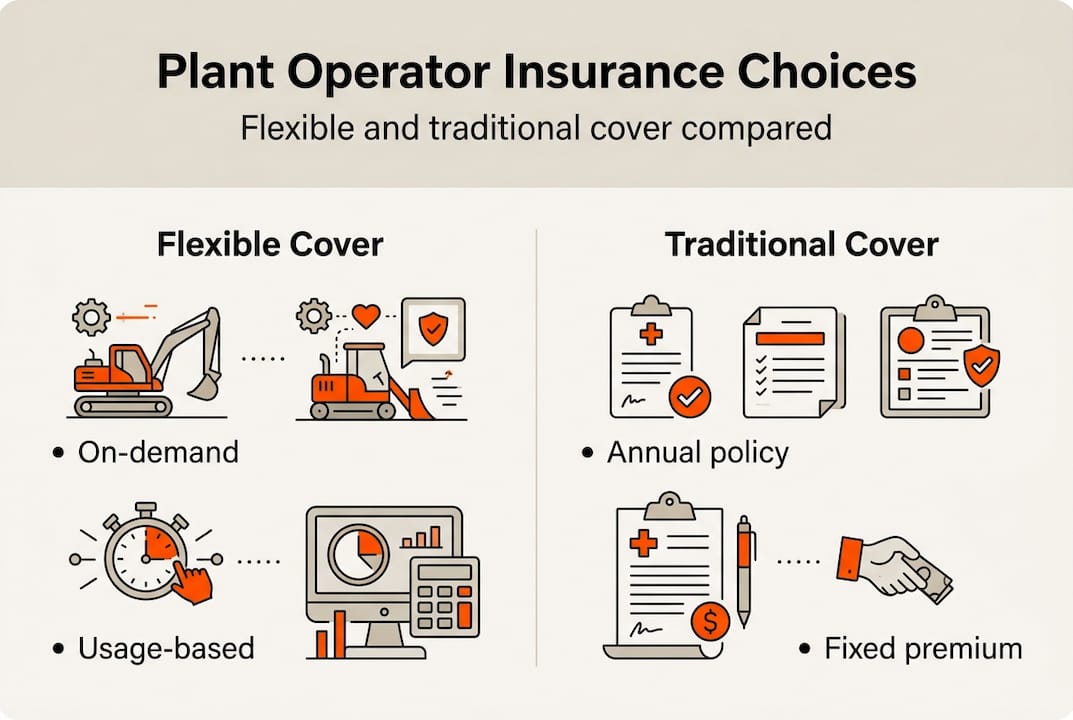
Not all insurance providers approach plant operator cover the same way. Traditional insurers typically offer annual policies with fixed premiums, regardless of how much or how little you use your equipment. On-demand insurtech providers work differently.
On-demand insurance models offer project-specific activation and cost advantages that are particularly relevant to construction businesses with fluctuating workloads. You activate cover when a machine is deployed and pause it when the machine is idle. Your premium reflects actual usage, not a fixed annual estimate.
“The construction and transport industries operate in cycles. Insurance should follow the same logic. Paying a flat monthly premium for machinery that sits unused for weeks at a time is a structural inefficiency that on-demand models are designed to eliminate.”
When comparing providers, ask these questions:
- How quickly can I activate or deactivate cover?
- Is the claims process digital or paper-based?
- Can I manage multiple assets and operators from a single platform?
- Are there penalties for adjusting cover mid-policy?
- Does the provider understand the South African construction environment?
| Feature | Traditional annual policy | On-demand cover |
|---|---|---|
| Premium structure | Fixed monthly amount | Usage-based, variable |
| Activation | Once at policy start | Per project or per day |
| Claims process | Manual, paper-heavy | Digital, faster turnaround |
| Flexibility | Limited mid-term changes | Full control at any time |
| Admin burden | High for fleet operators | Reduced, centralised platform |
For businesses managing fleet insurance options across multiple vehicles and machines, the administrative simplicity of on-demand platforms is a genuine operational advantage.
Steps to get the right insurance for your plant operators
Getting the right cover does not have to be complicated. A structured assessment and documentation process ensures you get appropriate cover and avoids problems at claim stage.
Follow these steps to get started:
- List all machinery and vehicles you want to insure, including make, model, year, and current market value
- Gather operator information including licences, certifications, and experience records
- Document safety and usage practices such as site induction records and maintenance logs
- Assess your project pipeline to determine whether fixed or on-demand cover better suits your workload
- Request quotes from at least two providers and compare coverage terms, not just premium amounts
- Check contractual requirements from principal contractors or project owners before selecting a policy
- Activate cover before any machine is deployed on a new site or project
Common pitfalls to avoid include poor asset registers, outdated operator documentation, and failing to update your cover when you add or remove machines from your fleet. These gaps create disputes at claim stage and can result in partial or declined payouts.
For guidance on road freight liability cover and broader fleet protection, it is worth reviewing your entire risk exposure, not just individual machines.
Pro Tip: Schedule a policy review at the start of every major project and at your annual renewal. Your fleet changes, your projects change, and your cover should change with them.
Unpacking the real value of on-demand insurance for plant operators
Here is an uncomfortable truth that most insurance conversations avoid: many construction businesses are simultaneously overpaying and under-protected. They pay fixed premiums for machines sitting in a yard while deploying equipment on active sites without reviewing whether their cover reflects the actual risk.
Traditional annual policies were designed for a different era of business. They assume consistent usage, predictable risk, and stable fleets. That does not describe most South African construction businesses in 2026.
The real opportunity with on-demand plant insurance goes beyond cost savings. When you activate cover per project, you generate a usage record that reveals which machines are deployed most frequently, which operators are associated with claims, and where your risk is actually concentrated. That data is operationally valuable, not just financially useful.
The future of plant operator insurance is usage-driven. Businesses that adopt flexible models now are building better risk habits, not just saving on premiums.
Get flexible, tailored insurance for your plant and operators
If your current insurance does not reflect how your business actually operates, it is time to change that. Truck & Plant On-Demand™ was built specifically for the civil, construction, and transport industries in South Africa.
With truck insurance for operators and plant hire cover available on a flexible, usage-based model, you only pay for the cover you actually need. Activate cover per project, manage your fleet from a single platform, and eliminate the admin burden of traditional policies. Whether you run a single machine or a large fleet, explore on-demand insurtech cover designed to match your operational reality. Get in touch today and take control of your insurance.
Frequently asked questions
What does insurance for plant operators typically cover?
Insurance for plant operators usually covers accidental damage, theft, liability, and hired-in plant risks, with options for tailored add-ons. Plant all risks, hired-in plant, and liability cover are the standard building blocks of a complete policy.
Can insurance be activated only for specific projects or timeframes?
Yes, on-demand or usage-based insurance allows activation for project-specific or short-term periods, especially suited to the South African construction sector. On-demand cover is designed for exactly this kind of flexible, project-aligned activation.
What information do insurers require from plant operators?
Insurers need machinery details including make, model, and value, as well as operator licences, safety records, and proof of ownership or hire agreements.
How can I lower my plant operator insurance premiums?
Maintain a good claims record, install security devices, and review your policy regularly to avoid over-insuring idle equipment. Security measures and regular reviews are two of the most effective ways to reduce your risk rating.
Is liability insurance mandatory for plant operators in South Africa?
Liability insurance is often contractually required by principal contractors and strongly recommended for legal and financial protection. Liability cover is a core part of most major hire and subcontractor agreements in South Africa.