


Running a construction business or managing a fleet means operating in one of the highest-risk industries around. A single equipment breakdown, jobsite injury, or vehicle accident can stall a project, trigger legal action, and drain your cash reserves faster than any budget overrun. Most construction business owners assume their standard liability or auto policy covers every scenario. It rarely does. Understanding the specific insurance policy types available, how they interact, and where the gaps hide is not just useful knowledge. It is the difference between a business that survives a major claim and one that does not.
Table of Contents
- Core insurance policies every construction business needs
- Fleet and equipment insurance: Inland marine, commercial auto, and builder’s risk
- Workers’ compensation and liability policies: Compliance and risk management essentials
- Customizing coverage for construction fleets: Avoiding gaps and optimizing protection
- What most construction owners miss about insurance coverage
- Powerful insurance solutions for fleets and construction businesses
- Frequently asked questions
Key Takeaways
| Point | Details |
|---|---|
| Layered coverage needed | No single policy covers all construction risks—combine liability, asset, and employee policies. |
| Fleet and equipment risks | Mobile machinery, vehicles, and tools require specialized policies beyond standard auto insurance. |
| Premiums rising in 2026 | Rates for liability and auto insurance are up 5-20%—review coverage and reduce risks with telematics. |
| Compliance is crucial | Workers’ compensation is mandatory; failure to comply risks legal and financial penalties. |
| Customization prevents gaps | Tailor policies and coordinate coverage to avoid gaps, especially for fleets and multi-site projects. |
Core insurance policies every construction business needs
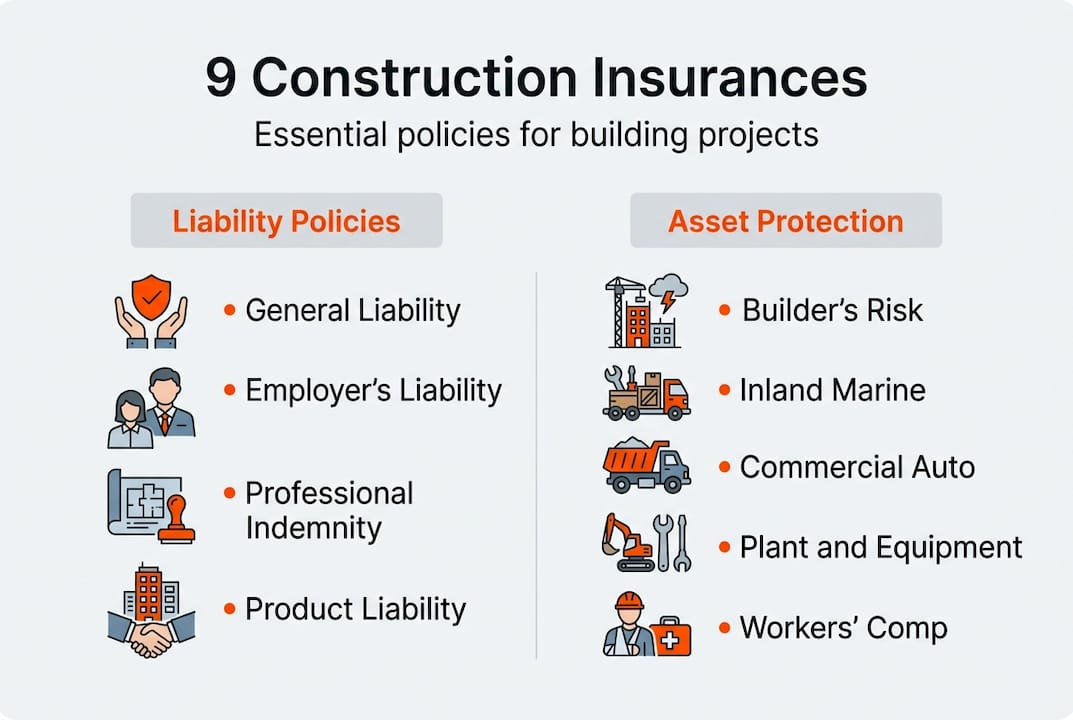
Construction insurance is not a single product. It is a layered system of policies, each designed to address a specific category of risk. Core insurance policy types for construction businesses include General Liability, Workers’ Compensation, Commercial Auto, Inland Marine, Builder’s Risk, Umbrella/Excess, Professional Liability, Pollution Liability, and Surety Bonds. Knowing what each one does, and when it applies, is the foundation of sound risk management.
Here is a quick breakdown of the most critical policies and when they matter most:
- General Liability (GL): Covers third-party bodily injury and property damage. Essential when clients, subcontractors, or members of the public are on or near your site.
- Commercial Auto: Covers vehicles used for business purposes, including trucks, utility vehicles, and trailers. Standard personal auto policies do not extend to commercial use.
- Inland Marine (Contractors Equipment): Covers mobile tools, equipment, and materials in transit or stored at jobsites. Think excavators, cranes, and compactors.
- Builder’s Risk: Covers structures under construction against fire, theft, and weather damage. Typically tied to a specific project.
- Workers’ Compensation: Mandatory coverage for employee injuries, medical expenses, and lost wages.
- Umbrella/Excess Liability: Extends the limits of your GL, auto, or employer’s liability policies when a claim exceeds the base policy cap.
- Professional Liability: Covers design errors, project management failures, and advice-related claims. Increasingly relevant for design-build contractors.
- Pollution Liability: Covers cleanup costs and third-party claims from accidental pollution events on or off site.
- Surety Bonds: Not insurance in the traditional sense, but guarantees project completion or payment to subcontractors and suppliers.
| Policy type | Typical annual premium range | Mandatory? |
|---|---|---|
| General Liability | R15,000 to R80,000+ | Often contractually required |
| Workers’ Compensation | Varies by payroll | Yes, for employers |
| Commercial Auto | R8,000 to R40,000 per vehicle | Yes, for business vehicles |
| Inland Marine | R5,000 to R30,000+ | No, but strongly recommended |
| Builder’s Risk | 1% to 5% of project value | Often contractually required |
A common misconception is that a strong GL policy covers everything on site. It does not. GL protects against third-party claims, not your own equipment or your workers. For a fuller picture of key insurance policies and how they apply to your operations, reviewing your full coverage stack annually is essential. Staying current with insurance trends for risk management also helps you anticipate new exposures before they become claims.
Fleet and equipment insurance: Inland marine, commercial auto, and builder’s risk
Once you know the insurance types, it is vital to understand how fleet and equipment coverage work in practice. This is where many construction businesses lose money, either by over-insuring static assets or leaving mobile equipment exposed.
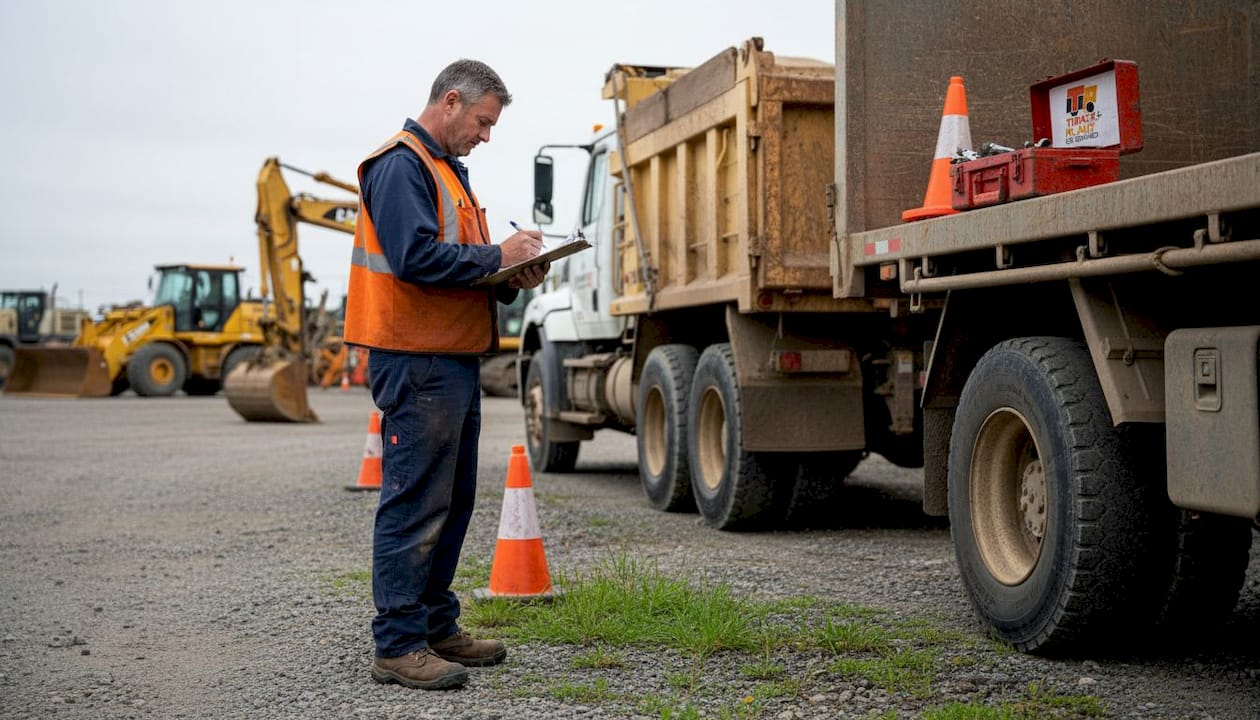
Inland marine coverage covers mobile tools, equipment, and materials in transit or storage at jobsites, making it essential for fleet operators running heavy machinery like excavators and cranes. The name is misleading. Inland marine has nothing to do with water. It originated from marine cargo insurance and evolved to cover property that moves, which is exactly what construction equipment does.
Builder’s risk, on the other hand, covers the structure being built and materials on site. The overlap with inland marine is real. Inland marine is broad movable property that can include builder’s risk as a subset, and overlaps are possible, so you need to coordinate both policies carefully to avoid gaps in transit versus on-site coverage. The key question to ask your broker: what happens to your equipment the moment it leaves one site and arrives at another?
Here is a practical process for scheduling your fleet and equipment correctly:
- List every asset by category: Separate owned vehicles, leased equipment, and rented plant machinery.
- Assign replacement values, not book values: Insurers pay based on the value you declare. Undervaluing costs you at claim time.
- Add rental reimbursement cover: If a key machine is out of action, this covers the cost of hiring a replacement.
- Include downtime coverage: Lost revenue from equipment downtime can exceed repair costs on major projects.
- Review the schedule every six months: New acquisitions and disposals must be updated or you risk being uninsured on new assets.
For flexible fleet coverage that adapts as your asset mix changes, on-demand models are increasingly practical. You can also explore dedicated commercial auto insurance and tool of trade insurance for more targeted protection.
Pro Tip: Fitting GPS and telematics devices to your fleet vehicles and heavy equipment does more than track location. Insurers use telematics data to assess driver behaviour, idle time, and route risk. Better data means a stronger case for lower premiums at renewal.
Workers’ compensation and liability policies: Compliance and risk management essentials
Beyond assets, you must protect employees and manage overall liability. This is where compliance and layered policies come into play, and where non-compliance carries the heaviest consequences.
“Workers’ compensation is mandatory for every employer with payroll.”
Workers’ compensation is legally required in all 50 states for employers with payroll, covering employee injuries, medical expenses, and lost wages. In South Africa, the Compensation for Occupational Injuries and Diseases Act (COIDA) sets similar obligations. The construction industry has one of the highest injury rates of any sector, which means your workers’ comp premiums are directly tied to your claims history and your payroll size.
Beyond workers’ comp, liability coverage works in layers:
- General Liability forms the base, covering third-party bodily injury and property damage up to your policy limit.
- Employer’s Liability (often included with workers’ comp) covers lawsuits from employees who claim negligence beyond a standard comp claim.
- Umbrella/Excess Liability sits above your GL and auto policies, extending limits when a single claim is large enough to exhaust your base cover.
- Pollution Liability covers accidental releases of pollutants, fuel spills, or hazardous material incidents that your GL policy typically excludes.
- Professional Liability protects design-build firms and project managers against errors in plans, specifications, or project oversight.
For risk management in construction, the most effective approach is to treat safety programmes as a direct cost-reduction tool. Fewer incidents mean fewer claims, and fewer claims mean lower premiums over time. Environmental liability coverage is also worth reviewing if your projects involve excavation, demolition, or work near water sources.
Pro Tip: On large projects, consider an Owner Controlled Insurance Programme (OCIP) or Contractor Controlled Insurance Programme (CCIP). These wrap-up programmes consolidate all project insurance under one policy, eliminating coverage gaps between subcontractors and reducing the total premium spend.
Customizing coverage for construction fleets: Avoiding gaps and optimizing protection
Now that the basics are covered, here is how to tailor insurance and avoid costly gaps for fleets and growing construction companies.
No two construction businesses carry the same risk profile. A civil contractor running 20 trucks on a road project has very different exposures to a specialist subcontractor with two vehicles and a single excavator. Your coverage should reflect that reality. Accurate asset scheduling, rental reimbursement, downtime coverage, and GPS/telematics are the tools fleet operators use to reduce premiums and improve risk data.
Here are the features worth adding to a flexible, dynamic insurance programme:
- Agreed value cover on high-value plant machinery, so you receive the full insured amount at claim time without depreciation arguments.
- Blanket equipment cover for businesses with frequently changing asset lists, avoiding the need to schedule every item individually.
- On-site and off-site cover that follows your equipment from yard to jobsite and back, with no gaps during transit.
- Hired-in plant cover for equipment you rent from third parties. You are often contractually liable for damage to hired assets.
- Seasonal or project-based activation for cover that matches actual usage rather than a flat annual premium.
For a structured approach, use a fleet insurance checklist to audit your current policies against your actual asset list and operational risks. If your business moves goods between sites, goods in transit coverage is another layer that prevents costly blind spots.
Premium benchmarks vary widely. Industry data shows that construction businesses with strong safety records, telematics data, and accurate asset schedules consistently achieve better rates at renewal.
Pro Tip: Conduct a full coverage review at least once a year, ideally before your renewal date. Bring your asset list, claims history, and any new project contracts to that conversation. Insurers reward preparation with better terms.
What most construction owners miss about insurance coverage
Having explored ways to customize coverage, let us step back and examine what even experienced construction leaders frequently get wrong.
The most common mistake is assuming that equipment is automatically covered once you have any form of insurance in place. It is not. A machine sitting on your yard may be covered. The same machine on a trailer heading to a new site may fall into a gap between your inland marine and commercial auto policies if those policies are not coordinated.
Another overlooked issue is the named-peril versus all-risk distinction. Named-peril policies only cover the specific events listed. All-risk policies cover everything except what is explicitly excluded. For major construction projects, all-risk cover is almost always the better choice, even if the premium is higher.
We also see many businesses ignore the shift happening in how premiums are calculated. Insurtech solutions and telematics are changing how risk management trends translate into pricing. Businesses that embrace data-driven risk management are getting meaningfully better rates. Those that do not are subsidising the industry’s worst performers. The opportunity to use your own operational data to negotiate better cover is real, and most businesses are not taking it.
Powerful insurance solutions for fleets and construction businesses
Ready to apply these insights? Here is how to get flexible cover that fits your fleet and project needs.
Truck & Plant On-Demand™ was built specifically for businesses like yours. Whether you manage a single truck or a fleet of 50 vehicles and plant machines, our platform lets you control exactly what you insure, when you insure it, and how much cover you carry at any given time.
Explore our truck insurance solution for commercial vehicles, our dedicated plant hire protection for yellow machinery and hired-in equipment, and our trailer insurance for fleets to close the gaps in your current programme. Stop paying for cover you do not need. Start paying for cover that works as hard as your business does.
Frequently asked questions
What is the difference between builder’s risk and inland marine insurance?
Builder’s risk covers property during construction at a fixed site, while inland marine covers mobile equipment, tools, and assets in transit or between jobsites. Both policies can overlap, so coordinate them carefully to avoid coverage gaps.
Is workers’ compensation mandatory for all construction businesses?
Workers’ compensation is legally required for employers with payroll, covering employee injuries, medical expenses, and lost wages. Most jurisdictions treat non-compliance as a serious legal and financial offence.
How can fleet operators lower their equipment and vehicle insurance premiums?
Accurate asset scheduling, adding downtime and rental reimbursement coverage, and using GPS/telematics for risk data are the most effective ways to reduce insurance costs at renewal.
What insurance policies should construction businesses prioritize when operating a fleet?
General liability, commercial auto, inland marine, builder’s risk, and workers’ compensation are the essential policies for construction fleets. Umbrella cover and pollution liability add important protection as project size and complexity grow.