


TL;DR:
- Insurance renewal is a rigorous underwriting process that significantly impacts your fleet’s coverage, premiums, and risk exposure. Starting 60 to 90 days before expiry, you should review current policies, disclose all business changes, and compare offers carefully to avoid gaps or unfavorable terms. Engaging early and thoroughly ensures optimal risk management and cost-effective coverage aligned with your operational needs.
Insurance renewal is the formal process by which your insurer reassesses your risk profile and offers to extend, revise, or decline your existing policy for another term. For fleet operators and business owners in civil, construction, and transport, this process is not a billing formality. It is a carrier underwriting decision that can alter your coverage terms, premiums, and exclusions in ways that directly affect your operational risk. Getting the insurance renewal steps right protects your vehicles, plant machinery, and business continuity. Done poorly, it can leave you exposed at the worst possible moment.
What are the insurance renewal steps and when do you start?
The renewal process begins earlier than most fleet managers expect. Expert agents recommend initiating your review 60 to 90 days before your policy expiration date to allow adequate time for analysis, shopping, and any underwriting requirements. Most insurers are required by law to provide at least 30 days’ notice before renewal, but for commercial fleets with multiple vehicles, yellow plant, or specialised equipment, 30 days is rarely enough time to make informed decisions.
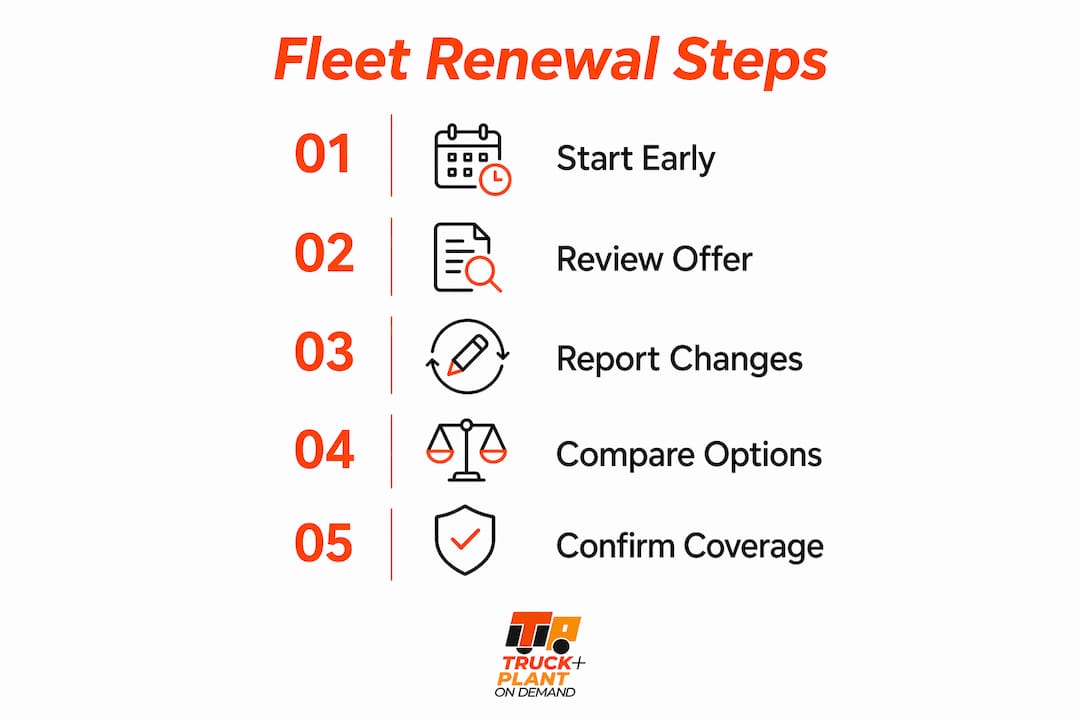
Starting early gives you space to gather the documents you need, identify gaps in your current cover, and approach alternative carriers without pressure. The core insurance renewal process follows a clear sequence:
- Retrieve your current declarations page and loss run reports (claims history for the past 3 to 5 years)
- Confirm your policy expiration date and note the insurer’s required notice period
- List all assets to be covered, including any vehicles or equipment added or disposed of during the year
- Document operational changes such as new routes, expanded project scopes, or additional drivers
- Contact your broker or agent to flag any underwriting concerns before the renewal offer arrives
Complex commercial renewals can require 60 to 90 days of lead time to avoid rushed decisions, particularly when lender approvals or property inspections are involved. If you manage a mixed fleet of trucks and plant machinery, your underwriter may request physical inspections or updated valuations before confirming terms.
Pro Tip: Set a calendar reminder 90 days before your policy expiration date. Use that date to pull your loss runs and declarations page, not to wait for the renewal notice to arrive.

How do you review and compare your renewal offer?
When your renewal offer arrives, the single most effective method is a line-by-line comparison between your new declarations page and the previous year’s document. This approach catches subtle but impactful changes that a quick premium scan will miss entirely.
The table below shows the key elements to compare side by side:
| Review element | What to check |
|---|---|
| Insured parties and vehicles | Confirm all assets are listed; verify no vehicles have been dropped |
| Coverage limits | Check that limits match or exceed your current operational exposure |
| Deductibles | Note any increases, especially on comprehensive or collision sections |
| Endorsements | Identify new additions or removals that expand or restrict cover |
| Exclusions | Flag any new exclusions that could affect claims for your specific operations |
| Premium breakdown | Separate carrier-wide rate adjustments from risk-specific changes |
Premium increases require context. Significant premium increases should be investigated to determine whether they reflect carrier-wide rate adjustments approved by regulators or changes specific to your claims history and risk profile. A 15% increase driven by industry-wide rate hardening is a different conversation from a 15% increase caused by three at-fault accidents in your fleet.
New exclusions deserve particular scrutiny. A construction fleet operator who adds a new exclusion for “loading and unloading operations” may discover that a significant portion of their daily risk is no longer covered. Endorsements work in both directions: some add valuable cover, while others restrict it.
Pro Tip: Ask your broker to provide a written summary of every change between last year’s policy and the renewal offer. If they cannot produce this, request the declarations pages yourself and compare them manually.
Carriers also update their discount programmes regularly. Verifying all available discounts every year is part of a thorough renewal review, as programmes for fleet safety technology, driver training, or telematics adoption may have been added since your last renewal.
What business changes must you report at renewal?
Accurate disclosure at renewal is not optional. Insurers review material changes every 6 to 12 months, and these changes directly affect your premiums, eligibility for discounts, and the validity of your cover. Failing to report a material change can result in a claim being denied or your policy being voided.
The following changes must be reported to your insurer or broker before or during the renewal window:
- New vehicles or plant: Any truck, trailer, excavator, or other yellow plant added to your operations since the last renewal must be declared and scheduled on the policy.
- Disposed or sold assets: Vehicles removed from your fleet should be deleted from the policy to avoid paying premiums on uninsured assets.
- Operational scope changes: Expanding into new geographic areas, taking on heavier haulage contracts, or adding hazardous materials transport all change your risk profile materially.
- Safety programme implementations: Installing telematics, dashcams, or driver fatigue monitoring systems can qualify your fleet for premium reductions. Report these proactively.
- Property acquisitions: New depots, yards, or storage facilities need to be added to your commercial property cover.
- Driver changes: Significant changes to your driver pool, including new hires with limited experience or the departure of senior drivers, affect underwriting assessments.
Understanding how changing business needs affect cover is particularly relevant for civil and construction businesses where project scope, equipment inventory, and subcontractor arrangements shift frequently. Keeping a running log of these changes throughout the year, rather than trying to reconstruct them at renewal, saves time and reduces the risk of omissions.
How do you compare renewal options and shop alternative policies?
The moment your renewal notice arrives is the moment to request quotes from alternative carriers. Waiting until two weeks before expiration limits your negotiating position and your options. A structured comparison process protects you from accepting unfavourable terms simply because time has run out.
Follow these steps when shopping alternative policies:
- Request quotes immediately after receiving your renewal notice. Give each carrier or broker the same information: current declarations page, loss runs, and a complete asset schedule.
- Compare coverage forms, not just premiums. A lower premium that removes hired-in plant cover or reduces your public liability limit is not a saving. It is a risk transfer back to your business.
- Conduct a gap analysis. Gap analysis involves comparing multiple carrier offers on identical coverage assumptions to identify both premium and coverage differences that affect your risk tolerance. Your broker should produce this in writing.
- Assess insurer financial stability. A carrier offering the lowest premium but carrying a weak financial strength rating creates its own risk. Check ratings from recognised rating agencies before binding.
- Evaluate claims service reputation. For fleet operators, the speed and quality of claims handling directly affects vehicle downtime and project continuity. Ask your broker for claims settlement data or peer references.
- Negotiate terms before accepting. Renewal offers are not fixed. Deductibles, endorsements, and even premium rates are often negotiable, particularly if you bring competing quotes to the table.
Working with an independent broker who has access to multiple fleet insurance carriers gives you the broadest view of the market and the strongest negotiating position. Captive agents represent one carrier; independent brokers represent your interests.
What are the most common renewal challenges and how do you handle them?
Many policyholders treat renewal as a billing event when it is actually a carrier underwriting decision that may alter terms significantly. This misunderstanding is the root cause of most renewal problems.
The three most common challenges are conditional renewals, unexpected premium hikes, and non-renewal notices.
Conditional renewals mean the insurer will continue your cover but only under revised terms. These terms might include higher deductibles, reduced limits, or new exclusions. Ignoring renewal documents can lead to automatic acceptance of reduced coverage or higher deductibles. Read every condition carefully before the renewal date passes.
Unexpected premium hikes require investigation. Renewal offers arrive after carrier underwriting reevaluates risk, including claims history and property condition, alongside regulatory rate approvals that set industry-wide premium changes. Separate the two causes before deciding how to respond.
Non-renewal notices are the most urgent situation. Non-renewal means the insurer refuses to continue coverage at term end, requiring immediate action to find a replacement policy. Non-renewal often results from claims history or changes in the carrier’s underwriting appetite, not necessarily from fault on your part. If you receive a non-renewal notice:
- Contact your broker immediately and begin market shopping the same day
- Request the specific reason for non-renewal in writing
- Explore specialist markets or surplus lines carriers who cover higher-risk commercial fleets
- Investigate state residual market options as a temporary measure if standard market placement fails
Never cancel your existing policy until a new policy is bound and effective. Coverage gaps risk claims denial; keep your binding confirmation saved in a dedicated folder alongside your new declarations page.
Coordinating effective dates carefully is the final safeguard. Confirm the exact start time of your new policy and the exact end time of your expiring policy to eliminate any gap, even one of a few hours.
Key takeaways
Effective insurance renewal requires starting 60 to 90 days early, comparing declarations pages line by line, reporting all material business changes, and never cancelling existing cover until a replacement policy is bound.
| Point | Details |
|---|---|
| Start 60 to 90 days early | Early preparation allows time for underwriting reviews, inspections, and competitive quoting. |
| Compare declarations pages | A line-by-line review catches new exclusions, limit changes, and endorsement shifts that a premium scan misses. |
| Report all material changes | Fleet additions, operational changes, and safety upgrades must be disclosed to maintain valid cover and access discounts. |
| Conduct a gap analysis | Compare multiple carrier offers on identical coverage terms before accepting any renewal or alternative quote. |
| Never allow a coverage gap | Bind the new policy before cancelling the old one; keep proof of binding in a dedicated file. |
Renewal is a risk management decision, not paperwork
I have worked with fleet operators across civil, construction, and transport for long enough to know that the businesses that get hurt at renewal are almost always the ones who treated it as routine. They glanced at the premium, saw a modest increase, and signed. Then a claim came in and they discovered an exclusion that had been quietly added the year before.
The renewal process is the one moment each year when your insurer formally reassesses your risk. That makes it your one formal opportunity to reassess theirs. Are their terms still competitive? Is their claims service still acceptable? Has your fleet grown in ways that require a different product entirely?
My honest advice: treat your renewal date the way you treat a contract renewal with a major client. Prepare your position in advance, know your alternatives, and do not accept the first offer without scrutiny. The fleet insurance optimisation strategies that deliver the best outcomes over time are not about finding the cheapest cover. They are about finding the right cover at a fair price, and knowing the difference between the two.
One more thing that most guides skip: your claims history is your most powerful negotiating tool, in both directions. A clean loss run gives you leverage. A poor one tells you exactly where to invest in risk management before the next renewal cycle begins.
— Coert
How Truckplant simplifies renewal for commercial fleets
Renewal complexity is exactly the problem Truckplant was built to address. If you operate commercial vehicles or yellow plant machinery in the civil, construction, or transport sectors, the standard annual renewal cycle forces you to pay for cover that does not always match your operational reality.
Truck & Plant On-Demand™ changes that. You choose what to insure, when to insure it, and how your cover is structured, so your premium reflects your actual exposure rather than a fixed annual estimate. Whether you manage a single owner-driver truck or a large mixed fleet, Truckplant tailors cover to your business as it operates today, not as it operated 12 months ago. Explore fleet insurance for commercial vehicles and see how on-demand cover removes the guesswork from your next renewal.
FAQ
What are the basic insurance renewal steps?
The core steps are: review your renewal notice, compare your new declarations page against last year’s, report all material business changes, obtain competitive quotes, and bind your new or renewed policy before the expiration date. Starting 60 to 90 days before expiration gives you adequate time for each step.
How early should I start the insurance renewal process?
Expert agents recommend beginning your renewal review 60 to 90 days before your policy expiration date. Commercial fleet renewals often require underwriting reviews, inspections, and lender approvals that cannot be completed in the final two weeks.
What happens if I ignore my renewal notice?
Ignoring renewal documents can result in automatic acceptance of revised terms, including reduced coverage limits or higher deductibles. In some cases, the policy may lapse entirely, leaving your fleet uninsured.
What is a non-renewal notice and what should I do?
A non-renewal notice means your insurer will not extend your policy at the end of the current term. Non-renewal often occurs due to claims history or changes in underwriting appetite. Contact your broker immediately and begin sourcing replacement cover the same day you receive the notice.
Can I negotiate my renewal premium?
Yes. Renewal offers are not fixed, particularly if you present competing quotes or demonstrate improvements in your risk profile such as telematics adoption, driver training programmes, or a clean claims record. An independent broker with access to multiple carriers strengthens your negotiating position considerably.