


TL;DR:
- Insurtech offers flexible, data-driven fleet insurance that reflects actual vehicle usage.
- Technologies like telematics and AI enable real-time risk assessment and faster claims processing.
- Successful adoption depends on clean data, operational discipline, and viewing insurers as partners.
Fleet managers in the civil, construction, and transport industries know the frustration well. You pay a fixed premium every month, whether your trucks are running flat out or sitting idle on a job site. Traditional commercial vehicle insurance was built for a world where operations were predictable and uniform. That world no longer exists. Insurtech, the application of technology to insurance, is changing how fleets and equipment get covered. This article explains what insurtech means for your business, how the technology works in practice, what the market numbers show, and how to choose the right solution for your fleet.
Table of Contents
- What is insurtech in commercial vehicle insurance?
- How technology powers flexible, on-demand fleet insurance
- Market insights: Growth, key numbers, and what drives change
- Choosing a smart insurtech solution for your fleet or business
- Where most fleet managers go wrong with insurtech
- Get fleet-ready insurtech cover in minutes
- Frequently asked questions
Key Takeaways
| Point | Details |
|---|---|
| Flexible risk management | Insurtech enables on-demand fleet insurance that adapts instantly to changing business needs. |
| Tech-driven cost savings | Telematics and AI power more accurate risk pricing and can drive measurable savings for fleets. |
| Market-proven growth | Commercial vehicle and machinery insurtech markets are posting strong year-on-year growth. |
| Smart adoption tips | Success depends on integrating new tech with operational readiness and clear goals. |
What is insurtech in commercial vehicle insurance?
Insurtech combines insurance and technology to create smarter, faster, and more flexible cover. For commercial vehicles and plant machinery, this means moving away from rigid annual policies toward dynamic, data-driven solutions that reflect how your business actually operates.
The three core components driving insurtech in the fleet and equipment space are:
- Telematics: GPS and sensor systems that track vehicle location, driver behaviour, speed, and maintenance needs in real time
- Artificial intelligence (AI): Algorithms that assess risk, process claims, and detect fraud faster and more accurately than manual methods
- Digital platforms: Online portals and apps that let you manage cover, adjust policies, and lodge claims without paperwork or delays
Traditional insurance treats your fleet as a static risk. Every truck, every driver, every route gets lumped into a single premium calculated on broad averages. Insurtech flips this model. Risk is assessed dynamically, based on actual usage, driver performance, and real-time data. The result is cover that is faster to obtain, easier to adjust, and more accurately priced.
The transport, civil, and construction industries are leading adoption. These sectors operate equipment and vehicles with highly variable usage patterns. A concrete mixer might work five days a week during a major contract and sit unused for two weeks afterward. A tipper truck might cross provinces during peak season and operate locally the rest of the year. Static premiums make no sense for this reality.
“Insurtech solutions emphasize telematics, AI, and on-demand models for fleet insurance, reshaping how commercial operators access and manage their cover.”
The scale of this shift is significant. There are currently 297 active commercial insurtechs, and AI is already speeding up data extraction by 100 times compared to manual processing. This is not a future trend. It is happening now, and businesses that adapt early gain a clear cost and operational advantage.
For fleet managers exploring on-demand insurance solutions, understanding these foundations is the first step toward smarter cover decisions. You can also explore the latest construction insurance trends to see how the broader market is shifting.
How technology powers flexible, on-demand fleet insurance
Knowing what insurtech is matters less than understanding what it does for your bottom line. Here is how the key technologies translate into real operational benefits.
Telematics in practice
Telematics devices fitted to your vehicles collect data on distance travelled, driving hours, braking patterns, fuel use, and route history. This data feeds directly into your insurer’s risk model. Safe drivers with consistent routes and low incident rates attract lower premiums. High-risk behaviour triggers alerts before it becomes a claim.
Despite the clear advantages, only 5% of policies currently use telematics data, which means early adopters have a real competitive edge when negotiating cover.
AI-driven underwriting
AI removes the bottleneck from traditional underwriting. Where a manual review might take days, AI processes applications in minutes. AI can make underwriting 100 times faster and improve carrier acceptance rates by 30%. For fleet operators who have previously been declined or overcharged, this is a meaningful shift.

Static vs. dynamic insurance: a practical comparison
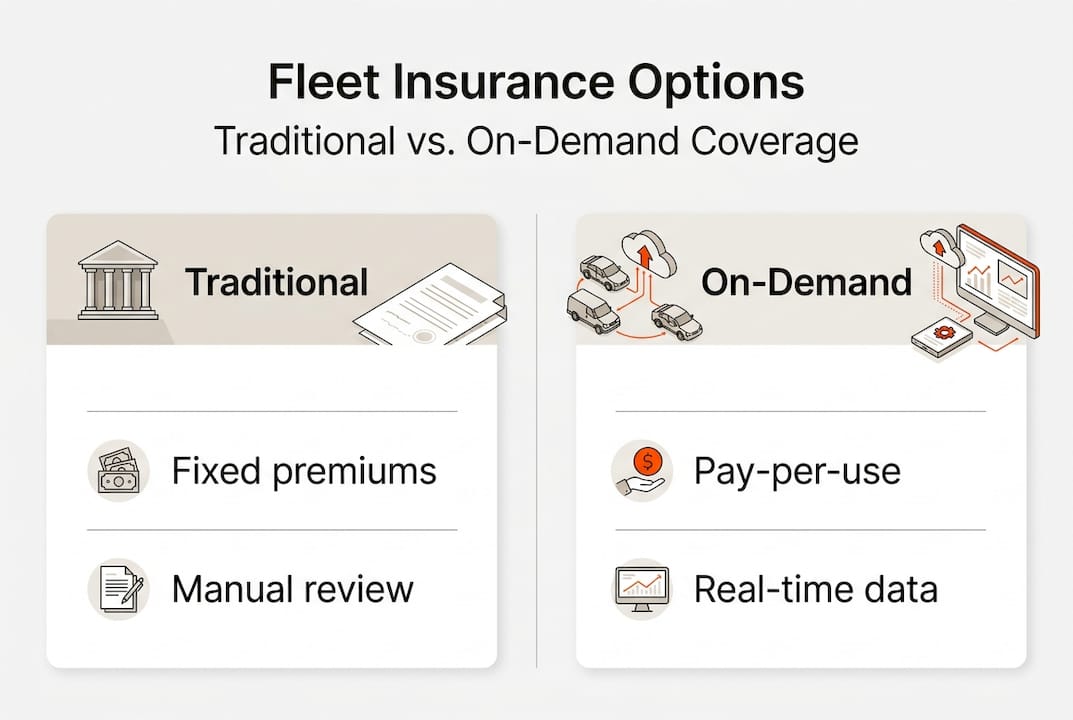
| Feature | Traditional insurance | Insurtech on-demand |
|---|---|---|
| Premium structure | Fixed monthly amount | Pay for actual usage |
| Policy adjustments | Annual or manual | Real-time via app |
| Claims processing | Days to weeks | Hours with AI support |
| Risk assessment | Broad averages | Individual vehicle data |
| Cover flexibility | Limited | High, including short-term |
Here is a real scenario. A construction company runs 12 vehicles. During a major infrastructure contract, all 12 are active. Between contracts, only 4 are in use. With traditional insurance, the company pays for 12 vehicles every month regardless. With an insurtech on-demand model, cover scales with actual operations. The saving over a year can be substantial.
To get the most from flexible cover, follow these steps:
- Audit your fleet’s actual usage patterns over the past 12 months
- Identify vehicles or equipment with seasonal or project-based downtime
- Map your current premium against actual usage to find the waste
- Use this data when requesting quotes from insurtech providers
- Start with your highest-cost, lowest-usage assets to demonstrate savings quickly
Pro Tip: Share your telematics data proactively with your insurer. Fleets that provide verified driving and usage records often qualify for better rates and faster claims approvals. Use your data as a negotiating tool, not just a compliance requirement.
For a detailed breakdown, compare flexible fleet insurance options and use our vehicle insurance checklist to make sure you are covering the right assets at the right level.
Market insights: Growth, key numbers, and what drives change
The numbers behind insurtech adoption in commercial vehicles and machinery tell a clear story. This is a market in rapid motion, and the drivers are structural, not temporary.
Key market figures for 2026
| Segment | Growth rate (CAGR) | Key driver |
|---|---|---|
| Machinery breakdown insurance | 6.3% | Rising asset values, tech integration |
| Heavy equipment insurance | 6.8% | Construction sector expansion |
| On-demand fleet cover | Accelerating | Flexible work models, digital platforms |
Both the machinery breakdown and heavy equipment insurance markets are growing at between 6.3% and 6.8% annually. This growth reflects rising asset values, more complex equipment, and the increasing cost of unplanned downtime.
Short-term and on-demand insurance is moving from niche to mainstream. Short-term truck insurance typically costs between $150 and $500 per week for liability cover, making it a practical option for seasonal operators, subcontractors, and businesses with fluctuating fleet sizes.
The key factors driving this shift include:
- Technology integration: Telematics, AI, and digital platforms are making dynamic pricing practical at scale
- Regulatory evolution: Insurers and regulators are increasingly comfortable with usage-based and short-term policy structures
- Rising asset values: As trucks and plant machinery become more expensive, operators want cover that matches actual risk, not a flat rate
- Workforce flexibility: More subcontractors and owner-operators mean more demand for short-term, project-specific cover
For South African fleet operators, these global trends are directly relevant. The civil and construction sectors are expanding, asset replacement costs are rising, and the pressure to control operating costs is intense. On-demand insurance is not just a convenience. It is a financial discipline.
Explore how these insurance trends for equipment are reshaping risk management, and understand the specific on-demand benefits available to South African businesses.
Choosing a smart insurtech solution for your fleet or business
Not all insurtech providers are equal. Choosing the wrong platform can leave you with gaps in cover, poor claims support, or technology that does not integrate with your operations. Here is how to make a sound decision.
What to look for in an insurtech provider
- Policy flexibility: Can you adjust cover daily, weekly, or per project? Can you add or remove vehicles without penalties?
- Technology stack: Does the provider support telematics integration? Is the platform accessible via mobile?
- Claims simplicity: How are claims lodged and processed? What is the average settlement time?
- Customisation: Can cover be tailored to specific vehicle types, equipment categories, or operational zones?
- Support quality: Is there a dedicated account manager or claims contact for commercial clients?
Questions to ask before switching
- What data do you require from my fleet to underwrite cover?
- How quickly can I scale cover up or down as my operations change?
- What happens to my premium if my telematics data shows improved driver behaviour?
- How are disputes or declined claims handled?
Common mistakes to avoid
- Failing to integrate GPS or telematics before applying, which limits your access to better rates
- Underestimating the volume and quality of data your fleet needs to generate for accurate pricing
- Switching all vehicles at once without running a pilot on a subset of your fleet first
- Choosing a provider based on price alone without assessing claims track record
Telematics and GPS are now essential for trucking fleets that want the best value and the broadest cover options. Providers that can access verified usage data offer better terms and process claims more efficiently.
Pro Tip: Run a 90-day pilot with 20% of your fleet before committing fully to a new insurtech provider. This gives you real data on claims responsiveness, platform usability, and actual premium savings before you scale the change across your entire operation.
Use our guide to compare insurance for fleets and review the on-demand business benefits relevant to your sector before making a final call.
Where most fleet managers go wrong with insurtech
After working with fleet operators across the civil, construction, and transport industries, one pattern stands out. When insurtech adoption fails, the technology is almost never the problem.
The real obstacles are operational. Managers switch platforms without first cleaning up their data. Driver records are incomplete. Vehicle usage logs are inconsistent. The insurer’s AI has nothing reliable to work with, so the pricing benefit disappears.
There is also a mindset issue. Many operators treat insurtech as a product swap, the same cover from a shinier platform. The businesses that get the most value treat it as a partnership. They share data openly, engage with their insurer on risk trends, and use the platform’s insights to improve driver behaviour and reduce incidents.
The hard truth is that insurtech rewards discipline. If your fleet operations are well-documented and your data is clean, you will see meaningful savings. If they are not, you will get average results at best. The smart fleet comparison starts with an honest look at your own operations, not just the provider’s features.
Get fleet-ready insurtech cover in minutes
If this article has made one thing clear, it is that paying a fixed premium for cover that does not match your actual operations is a cost you do not need to carry.
At Truck & Plant On-Demand™, we offer fleet insurance built specifically for the civil, construction, and transport industries in South Africa. Whether you need truck insurance cover for a single vehicle or a full fleet, or plant hire insurance for your yellow machinery, you choose what to insure, when to insure it, and how. Get a quote in minutes and take control of your cover today.
Frequently asked questions
How does insurtech reduce fleet insurance costs?
Insurtech uses real-time telematics and usage data to price cover based on your fleet’s actual risk profile, which often results in lower premiums than static traditional policies. Telematics and data can reverse up to 30% of previous declinations and reduce overall costs.
What makes on-demand insurance different from standard policies?
On-demand insurance lets you buy cover only when you need it, making it ideal for seasonal operations, short contracts, or variable fleet sizes. Short-term truck cover typically ranges from $150 to $500 per week for liability, compared to fixed annual premiums that charge you regardless of usage.
Does insurtech work for both vehicles and machinery?
Yes. Modern insurtech platforms cover commercial trucks, trailers, heavy equipment, and plant machinery across transport, civil, and construction operations. Both the machinery and heavy equipment insurance markets are expanding rapidly to meet this demand.
Why is telematics important for commercial fleet insurance?
Telematics gives insurers verified, real-time data on how your vehicles are used and how your drivers perform. This improves underwriting accuracy and opens access to better policies. Telematics and GPS directly boost carrier acceptance rates and approval outcomes for commercial fleet operators.