


Machinery breakdown insurance pays to repair or replace business equipment after sudden, unforeseen mechanical or electrical failure, and it often extends to lost income while that equipment sits idle. You need it if your operation depends on production lines, plant, HVAC systems, refrigeration, or any machinery whose failure would stop revenue. The details of what’s covered, what’s excluded, and how premiums get set matter far more than the label on the policy.
TL;DR:
- Machinery breakdown insurance is essential for businesses relying on equipment whose failure can halt operations, covering sudden electrical or mechanical failures.
- Typical coverage includes repairs, business interruption losses, spoilage, and off-site supplier equipment failures, but excludes wear, gradual damage, and neglect.
- Premiums depend on equipment value, usage intensity, safety features, location, and chosen deductible, with usage-based policies offering cost savings for seasonal operations.
- Making claims requires prompt reporting, technical assessment, and documentation of maintenance, with fast evidence collection speeding up settlement processes.
- Flexible, on-demand coverage options are ideal for businesses with variable machinery use, allowing tailored protection aligned with actual operational periods.
Table of Contents
- What machinery breakdown insurance actually covers
- What does machinery breakdown insurance pay for?
- What does machinery breakdown insurance exclude?
- How is machinery breakdown insurance priced?
- How do machinery breakdown claims work?
- How do you choose the right machinery breakdown policy?
- Why fixed annual cover often misses how modern plant operations actually run
- Get flexible machinery breakdown cover with Truck & Plant On-Demand™
- Sources
What machinery breakdown insurance actually covers
Standard property insurance responds to fire, storm, or theft. It generally doesn’t respond when a compressor bearing seizes or a control board fails from an internal electrical fault, because there’s no external event causing the loss. That’s the gap machinery breakdown insurance fills. The trigger is sudden and unforeseen mechanical or electrical failure, and cover typically starts only after the equipment has been properly commissioned and tested.
Manufacturer warranties help for a limited window, usually a year or two, and only for defects the manufacturer accepts responsibility for. Once that warranty lapses, or if the failure falls outside its terms, you’re exposed. Businesses running production machinery, plant equipment, boilers, HVAC systems, refrigeration units, and construction plant are the typical buyers of this cover, precisely because a single breakdown can halt operations for days.
What does machinery breakdown insurance pay for?
Most policies pay for more than just a replacement part. A typical claim can include:
- Repair or replacement of damaged mechanical and electrical components or full assemblies
- Labour, testing, and re-commissioning costs once the repair is complete
- Business interruption losses, meaning lost income while the machine is offline
- Extra cost of working, such as hiring temporary equipment to keep production running
- Spoilage or contamination losses, where stock or materials are ruined by a breakdown (a walk-in freezer failure spoiling frozen stock, for example)
- Off-site supplier equipment failure, in some wordings, where a breakdown at a third party disrupts your supply
Coverage for boiler explosion, damage from power supply fluctuation, and even certain operator errors also appears in many commercial machinery breakdown wordings. Business interruption cover under these policies can stretch to lost income, the extra costs of staying operational, and the cost of replacing spoiled stock caused by the failure.
Pro Tip: Ask your broker whether spoilage and business interruption are automatically included or sold as extensions. Some insurers bundle them; others price them separately, and that difference can swing your premium considerably.
What does machinery breakdown insurance exclude?
Insurers draw a firm line between insuring against sudden failure and insuring against poor upkeep. Expect these exclusions in almost every policy:
- Wear and tear from normal operation
- Gradual deterioration, corrosion, or rust
- Inherent design or material defects
- Wilful damage or neglect
- Losses linked to equipment that was never properly commissioned
Policies also carry warranties, meaning conditions you must meet for cover to remain valid. The most common warranty requires proper maintenance, regular testing, and formal commissioning of the equipment. Aon South Africa notes plainly that a machinery breakdown policy is not a maintenance policy. If an insurer’s engineer traces a claim back to a skipped service or a known fault that was never addressed, expect the claim to be reduced or declined.
Pro Tip: Keep a dated maintenance log for every insured machine, even if your service provider already keeps records. Duplicating this yourself gives you a fallback if a claim is disputed.
How is machinery breakdown insurance priced?
Premiums are driven by a mix of factors specific to your equipment and how you use it:
- Replacement value and age of the machinery
- How intensively the equipment runs and how critical it is to revenue
- Built-in safety and monitoring systems
- Location and exposure to downtime-related risk
- The deductible you choose and the total sum insured
A higher deductible lowers your premium but increases what you pay out of pocket before cover kicks in. A higher sum insured raises the premium but closes the gap between what you’d receive and what full replacement actually costs. As a general market pattern, commercial equipment breakdown premiums can sit well under 1% of replacement value annually, though critical or high-risk machinery pushes that higher.
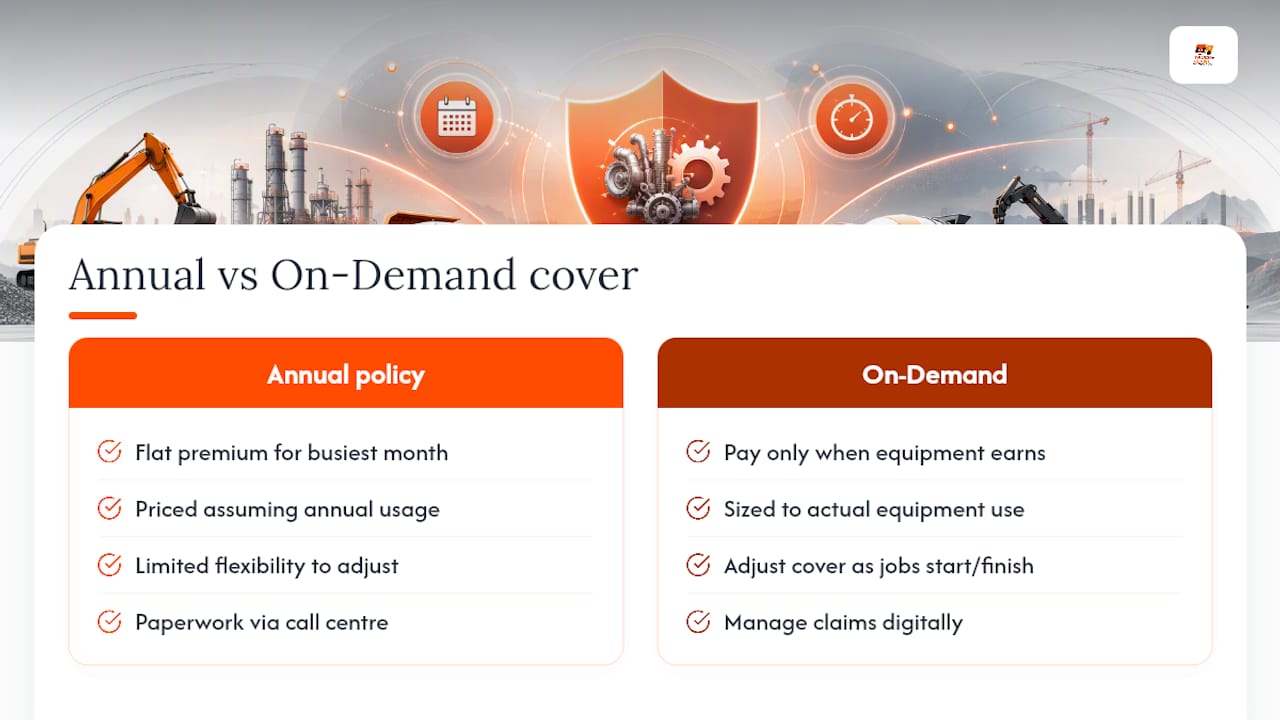
Fixed annual premiums make sense for equipment you run year round. If your plant or fleet usage swings with seasonal contracts or project cycles, usage-based cover that lets you pay only for active periods can cut spend meaningfully compared to a flat annual policy sized for peak use.
How do machinery breakdown claims work?
A claim typically moves through four stages:
- Immediate notification to your insurer, followed by temporary repairs if it’s safe to attempt them
- Engineer inspection, where a loss adjuster or specialist examines the failed component
- Assessment, checking the failure against policy terms, maintenance records, and commissioning history
- Settlement, covering repair costs and any business interruption loss once proven
You’ll typically need to produce maintenance logs, commissioning or test certificates, operator statements, and original purchase invoices. Business interruption loss is generally proven by comparing your pre-breakdown revenue trend against the actual shortfall during downtime, backed by financial records.
While you wait on assessment, sourcing spare parts quickly, arranging temporary hire equipment, and having a contingency plan for critical machinery all limit how much income you actually lose. Some specialist insurers pair breakdown cover with engineering inspection services like thermography and vibration analysis, catching problems before they become claims at all.
Pro Tip: Photograph the failed component before any repair work begins. Loss adjusters move faster when there’s clear visual evidence of the failure mode, and it removes ambiguity if the cause is later disputed.
How do you choose the right machinery breakdown policy?
Start with the fundamental choice between agreed value and indemnity/replacement cost. Agreed value locks in a payout figure upfront; replacement cost pays what it actually takes to replace the machine at the time of loss, which can run higher on older equipment as prices rise.
Before comparing quotes, work through this checklist with your broker:
- How often does the insurer require inspection, and does that affect premium?
- Are there sub-limits on specific components, like electronics or control systems?
- Is there a waiting period before business interruption cover activates?
- Are perils clearly defined, or is the wording vague about what counts as “sudden and unforeseen”?
- Does the deductible apply per claim or per policy period?
There’s a genuine trade-off between limits and premium. A lower sum insured or higher deductible saves money monthly but leaves you exposed on a serious failure. Gather your underwriting information early:
- A full equipment schedule with values and ages
- Purchase invoices
- Maintenance history for each machine
- Commissioning and testing certificates
Insurers routinely request all four of these during underwriting, and having them ready speeds up both the quote process and any future claim. Preventive maintenance also matters here. Fleet operators running braking systems, for instance, can lean on technical resources like Haldex’s multi-vehicle service planning guide to keep components within the tolerances insurers expect.
Why fixed annual cover often misses how modern plant operations actually run
Most machinery breakdown policies are still priced and sold as if every business runs its equipment identically every month of the year. That assumption breaks down fast for contractors, plant hire operators, and fleet businesses whose machinery use rises and falls with contracts. A policy sized for your busiest quarter, held constant for twelve months, quietly overcharges you for the other three.
The bigger mistake I see across underwriting conversations is treating maintenance records as paperwork rather than leverage. Businesses that keep clean, dated logs get faster claims and fewer disputes. Those that don’t, hand the insurer every reason to push back on a payout.
— Coert
Get flexible machinery breakdown cover with Truck & Plant On-Demand™
Truck & Plant On-Demand™ gives you a way to size machinery breakdown cover to how your equipment actually runs, not how an annual policy assumes it runs. You choose what’s insured, adjust cover as jobs start and finish, and manage claims digitally instead of chasing paperwork through a call centre.

This fits owner-operators running a handful of critical machines, plant hire businesses cycling equipment in and out of contracts, contractors moving between sites, and fleet operators whose plant needs shift by season. Instead of paying a flat premium sized for your busiest month, you pay for cover when the equipment is actually earning. If you’re weighing why insuring plant machinery matters for your risk exposure, that reasoning applies directly here: idle machinery you’re still fully insuring is money left on the table.
To get a quote, have your equipment schedule, maintenance records, and commissioning certificates ready. Start with Truckplant’s fleet and plant insurance page to see how on-demand cover applies to your machinery.
Sources
For policy wording detail and proposal requirements, Consort’s machinery breakdown overview and Chubb’s boiler and machinery product page are useful starting points. Nationwide’s equipment breakdown guide and HSB’s inspection-linked breakdown product cover loss-prevention services worth asking your broker about.
This article is general information, not a substitute for advice from a qualified financial advisor. Consult a qualified financial professional about your own circumstances before acting on anything here.
- Boiler and Machinery Breakdown Insurance | Chubb
- Equipment breakdown coverage – Nationwide
- Equipment breakdown insurance | HSB