


TL;DR:
- Real-time insurance updates enable instant, automated policy changes through API integration and workflow automation. These systems reduce errors by 96%, cut processing time from minutes to seconds, and improve fleet coverage flexibility. Implementing such technology requires overcoming legacy systems and ensuring mobile, bi-directional data capabilities.
Real-time insurance policy updates are defined as the instant processing and confirmation of coverage changes through automated systems and carrier API integration, without manual intervention. For fleet managers and business owners in South Africa, this capability means you can adjust cover the moment your operational needs change, whether you are adding a vehicle, changing a route, or responding to a new contract. The industry term for this process is automated policy endorsement processing, and it sits at the core of modern insurtech platforms. Automated systems reduce processing time from 22 minutes to 47 seconds, cutting labor by 97%. That figure alone explains why fleet operators who still rely on manual policy changes are carrying a hidden operational cost every single day.
How do real-time insurance policy updates actually work?

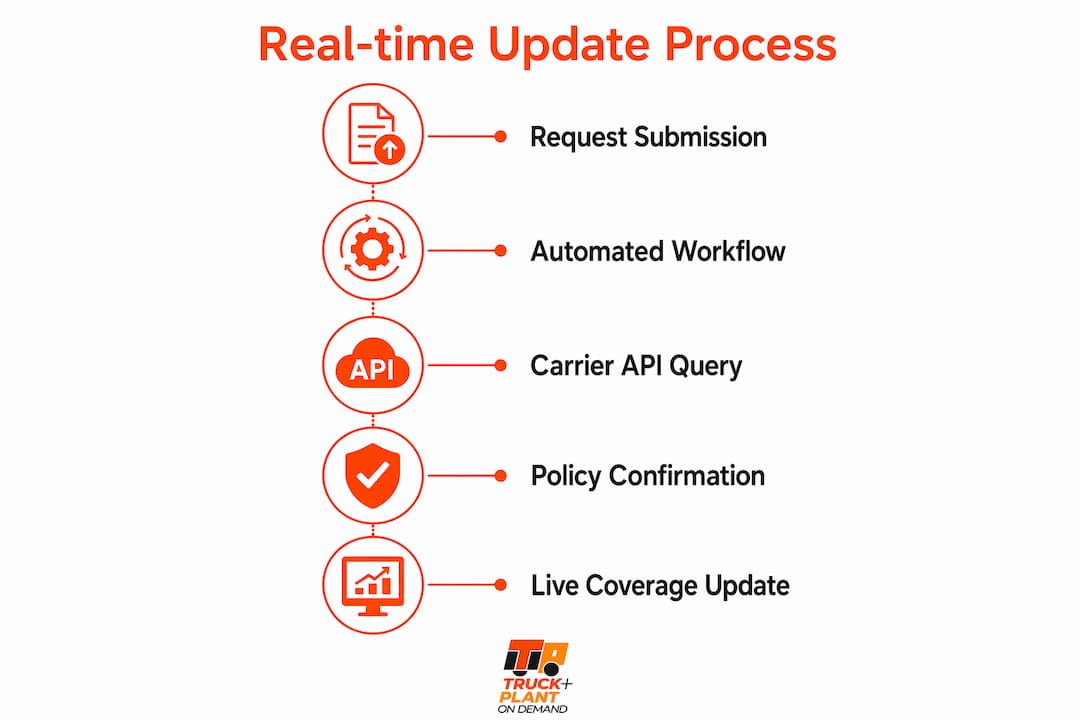
The end-to-end process starts the moment you request a coverage change. Your request enters an automated workflow that validates the change, submits it to the carrier via API, receives confirmation, and updates your policy record, all without a human touching the file.
Carrier APIs are the backbone of this process. When a carrier provides a live API connection, your system can query, submit, and confirm changes in seconds. Where carrier APIs are not available, platforms fall back on Robotic Process Automation (RPA), which mimics manual data entry but at machine speed. RPA is a reliable bridge, though it is slower than a direct API and more sensitive to carrier portal changes.
Bi-directional data flow is what separates a true real-time system from a one-way submission tool. When confirmed policy data flows back into your dashboard instantly, your billing records, commission data, and coverage summaries all stay in sync. Without this return flow, you get confirmation on one screen and outdated information on another, which creates exactly the kind of record mismatch that causes claims disputes.
The numbered steps below show how a standard automated policy change moves through the system:
- Fleet manager submits a change request via the self-service portal or mobile app.
- The system validates the request against current policy rules and flags any conflicts.
- The validated request is submitted to the carrier via API or RPA fallback.
- The carrier confirms the change and returns updated policy data.
- The system syncs the confirmed data back into the dashboard, billing, and records in real time.
Pro Tip: When evaluating a platform, test both a simple change (adding a vehicle) and a complex one (changing cover type mid-term). The gap in processing speed between these two tells you more about the system’s real-world performance than any vendor demo.
What operational benefits do South African businesses gain?
The most direct benefit is coverage flexibility. When your fleet takes on a new contract or a vehicle goes off-road for maintenance, you need cover to reflect that change immediately, not at the next billing cycle. Real-time policy notifications give you that control, and they eliminate the risk of paying for cover on a vehicle that is not working or being uninsured on one that is.
Error reduction is equally significant. Automation decreases error rates by 96% and pushes client satisfaction scores from 3.2 to 4.6 out of 5. Errors in manual policy processing typically show up as billing discrepancies, incorrect cover levels, or missed endorsements. Each one costs time to fix and erodes trust with your insurer.
The financial impact of live insurance updates also shows up in cancellation rates. Self-service portals with real-time premium previews reduce post-change cancellations by 28%. When fleet managers can see the exact premium impact of a change before confirming it, they make better decisions and avoid surprises on the next invoice.
Key operational benefits for South African fleet operators include:
- Immediate coverage adjustments aligned to fleet changes, contract wins, or seasonal operations.
- Mobile access to policy management, with 62% of portal access happening via mobile devices.
- Reduced CSR call volumes as self-service portals handle routine changes without staff involvement.
- Regulatory compliance maintained in real time, as South African insurance regulations require accurate, current policy records at all times.
- Cost control through on-demand cover that reflects actual operational exposure rather than a fixed annual estimate.
For fleet operators managing flexible fleet coverage, the ability to adjust cover without delays is not a convenience. It is a financial control mechanism.
What challenges come with implementing real-time policy updates?
The biggest obstacle is legacy system architecture. Many carriers in South Africa and globally operate on core systems built decades ago. These systems were not designed for API connectivity, which means legacy silos create data synchronization challenges across platforms even when modern APIs exist on top of them. The result is “near real-time” rather than true instant updates, particularly for billing and commission data.
Complex endorsements add another layer of difficulty. Between 70% and 80% of policy changes can be fully automated, but the remaining 20–30% require human review. These include changes that affect underwriting risk, mid-term cover type switches, or endorsements that fall outside standard business rules. A well-designed system routes these cases to a human reviewer automatically, keeping the standard changes fast while maintaining quality control on the complex ones.
Organizational silos also slow adoption. When your operations team, finance team, and insurer are each working from different data sources, a real-time update on one platform does not automatically resolve inconsistencies on the others.
Common implementation challenges to plan for:
- API maturity gaps at the carrier level, requiring RPA fallback for some transactions.
- Sync delays between coverage confirmation and billing or commission records in legacy environments.
- Business rule rigidity in platforms that require IT downtime to update workflows.
- Staff resistance to self-service models, particularly in operations teams accustomed to phoning brokers.
Pro Tip: Before committing to any platform, ask the vendor for their quoting turnaround time and commission reporting speed under live conditions. These two metrics reveal more about true real-time capability than any feature list.
How do you evaluate real-time insurance update solutions for fleet operations?
The evaluation process starts with carrier connectivity. A platform that connects to your primary carriers via live API is fundamentally different from one that relies entirely on RPA or manual submission. Ask vendors to list their carrier API connections and their fallback methods for carriers not yet on their network.
Self-service portals with identity verification, guided change flows, and change status tracking are now standard features in credible platforms. If a platform does not offer these, it is not built for fleet-scale operations. For South African businesses, mobile responsiveness is non-negotiable given the operational environments fleet managers work in.
The table below outlines the key feature categories and their operational impact:
| Feature category | Operational impact |
|---|---|
| Carrier API integration | Instant policy submission and confirmation without manual steps |
| Bi-directional data sync | Eliminates record mismatches across billing, cover, and commissions |
| Self-service portal with premium preview | Reduces post-change cancellations and CSR call volumes |
| Mobile-responsive interface | Enables on-the-go cover adjustments for field-based fleet managers |
| Business rule flexibility | Allows workflow updates without IT downtime or system restarts |
| Automated routing for complex changes | Keeps standard changes fast while flagging exceptions for review |
For South African fleet operators, local regulatory compatibility matters as much as technical features. Your platform must reflect current South African insurance compliance requirements in its policy records and audit trails. Regulators increasingly require transparency in rate calculations, and your system must incorporate regulatory changes immediately to stay compliant.
You can also use insurance analytics for fleets to benchmark your current processing performance before selecting a new platform. Knowing your baseline error rate and processing time makes vendor comparisons far more meaningful.
Practical steps to integrate real-time updates into your fleet workflows
Integration works best as a phased process. Trying to automate everything at once creates confusion and increases the risk of coverage gaps during the transition.
- Assess system connectivity. Map your current policy management tools, carrier relationships, and data flows. Identify which carriers offer live APIs and which require RPA.
- Set up automated workflows. Configure standard change types (vehicle additions, address updates, cover level changes) for full automation. Define routing rules for complex changes requiring human review.
- Train your operations team. Staff need to understand what the system handles automatically and when they need to intervene. Clear escalation paths reduce errors during the transition period.
- Monitor API health and error rates. Set up alerts for failed submissions, sync delays, and unusual error spikes. Review these weekly in the first three months.
- Run continuous improvement cycles. Use your platform’s analytics to identify which change types still take too long or generate errors. Adjust workflows and business rules accordingly.
For logistics businesses, fleet management best practices recommend treating insurance integration as part of a broader operational technology review rather than a standalone IT project. This framing gets buy-in from operations and finance teams, not just the insurance administrator.
Pro Tip: Schedule a quarterly review of your automated routing rules. Business operations change, and a rule that worked well when you had 10 vehicles may create bottlenecks when you have 50.
Key takeaways
Real-time insurance policy updates deliver the most value when automated workflows, bi-directional API data flow, and self-service portals work together as a single system.
| Point | Details |
|---|---|
| Processing speed matters | Automation cuts policy change time from 22 minutes to 47 seconds, freeing staff for higher-value work. |
| Bi-directional sync is non-negotiable | Without return data flow, billing and cover records fall out of sync and create claims disputes. |
| 70–80% automation is achievable | Most standard changes can be fully automated; complex endorsements still need human review. |
| Mobile access drives adoption | Over 60% of portal use happens on mobile, making responsive design a practical requirement. |
| Evaluate vendors on real metrics | Test quoting turnaround and commission reporting speed, not just feature lists. |
Why I think most fleet operators underestimate the integration challenge
Real-time insurance is not a switch you flip. I have seen businesses invest in a platform with strong marketing claims, only to discover that their primary carrier still runs on a legacy core system that delivers “near real-time” at best. The gap between marketing language and operational reality is where most implementations run into trouble.
The businesses that get the most value from automated policy updates are the ones that treat it as an ongoing process, not a one-time deployment. They monitor API health, review routing rules regularly, and push their technology partners to improve carrier connectivity over time. They also set realistic expectations with their operations teams: some changes will still require a human, and that is not a failure of the system.
What I find most compelling about platforms like Truckplant’s Truck & Plant On-Demand™ is the underlying philosophy. You should only pay for cover when you need it, and you should be able to change that cover as your business changes. That principle aligns perfectly with what real-time policy update technology makes possible. The technology is the enabler. The business model has to match it.
— Coert
Truckplant’s on-demand fleet cover with live policy control
Fleet managers who need cover that moves with their operations now have a practical option built specifically for the South African market.
Truckplant’s Truck & Plant On-Demand™ fleet insurance gives you full control over what you insure, when you insure it, and how your cover is structured. You only pay for the cover you actually need, and you can adjust it as your fleet and contracts change. Whether you run a single truck or a large mixed fleet of commercial vehicles and plant machinery, Truckplant tailors cover to your operational reality. Contact Truckplant to get a quote or request a demonstration of the platform’s real-time policy management capabilities.
FAQ
What are real-time insurance policy updates?
Real-time insurance policy updates are instant, automated changes to your coverage that are confirmed without manual processing. Automated systems reduce processing time from 22 minutes to 47 seconds using carrier API integration and workflow automation.
How do automated policy updates reduce errors?
Automation removes manual data entry from the process, which cuts error rates by 96% and raises client satisfaction scores significantly. Errors from manual processing typically appear as billing discrepancies or incorrect cover levels.
Can all policy changes be automated?
Between 70% and 80% of standard policy changes can be fully automated. Complex endorsements that affect underwriting risk still require human review and are routed automatically to a reviewer.
What should I look for in a real-time insurance platform?
Prioritise carrier API connectivity, bi-directional data sync, a mobile-responsive self-service portal, and the ability to update business rules without system downtime. Test quoting turnaround time and commission reporting speed under live conditions before committing.
How does Truckplant support real-time cover changes for South African fleets?
Truckplant’s Truck & Plant On-Demand™ is built for commercial vehicles and plant machinery in South Africa, allowing fleet managers to adjust cover as operational needs change. You pay only for the cover you need, with full control over your policy at any time.