


TL;DR:
- Insurance is essential for business continuity because it provides the financial resources needed to recover from disruptions. It includes multiple policies such as business interruption, extra expense, contingent business interruption, and cyber insurance to address different risks. Regularly aligning coverage with business plans and testing policies helps prevent costly gaps and enhances resilience.
Insurance is a critical financial tool that supports business continuity by covering losses and enabling rapid recovery during disruptions. The industry term for this function is “business continuity insurance,” which encompasses several policy types that work together to keep operations running when a crisis hits. 87% of C-suite leaders now view commercial insurance as a strategic resilience tool, with 43% considering it integral to overall business performance rather than just a cost. That shift in thinking reflects a deeper truth: the role of insurance in business continuity is not passive protection. It is an active financial mechanism that funds recovery, maintains payroll, and preserves the trust of customers and suppliers when operations are under pressure.
What types of insurance are essential for business continuity?
True continuity planning requires multiple coverages working together. No single policy covers every disruption scenario. Here are the core policy types every business owner should understand:
- Business interruption insurance replaces lost revenue when a covered event forces operations to halt. It typically requires a physical property damage trigger before it pays out, and most policies include a waiting period before benefits begin. That waiting period means you need cash reserves or a credit facility to bridge the gap.
- Extra expense coverage pays for costs above your normal operating expenses that you incur to keep the business running. Think temporary premises, expedited shipping, or renting replacement equipment.
- Contingent business interruption (CBI) insurance covers losses caused by disruptions at a supplier or key customer, not just at your own premises. Supply chain failures are among the most underinsured risks businesses face.
- Civil authority coverage activates when a government order prevents access to your premises, even if your property itself is undamaged. This clause became critically relevant during pandemic-era lockdowns.
- Cyber insurance has evolved well beyond data breach reimbursement. Cyber insurance now offers bundled services including monitoring, threat alerts, and rapid-response expertise that actively reduce the likelihood and severity of an incident.
Pro Tip: Review your business interruption policy’s indemnity period carefully. Most standard policies default to 12 months, but rebuilding a damaged facility or restoring a disrupted supply chain often takes longer. A 24-month indemnity period is a more realistic safety net for most operations.
The combination of these coverages addresses different layers of operational risk. Relying on business interruption insurance alone leaves significant gaps that only become visible when a claim is denied.
How does insurance integrate with a business continuity plan?
Insurance and a business continuity plan (BCP) are not the same thing, but they must work together. Insurance provides the financial resources needed to execute a BCP by covering losses, funding temporary facilities, and ensuring payroll during disruptions. Without that financial backing, even the most detailed recovery plan stalls.

The most common failure point is siloed planning. Operations teams build continuity plans without aligning with the finance or risk teams responsible for insurance purchasing. The result is a mismatch between what the BCP assumes and what the policy actually covers. When a crisis hits, that mismatch becomes a financial shortfall.
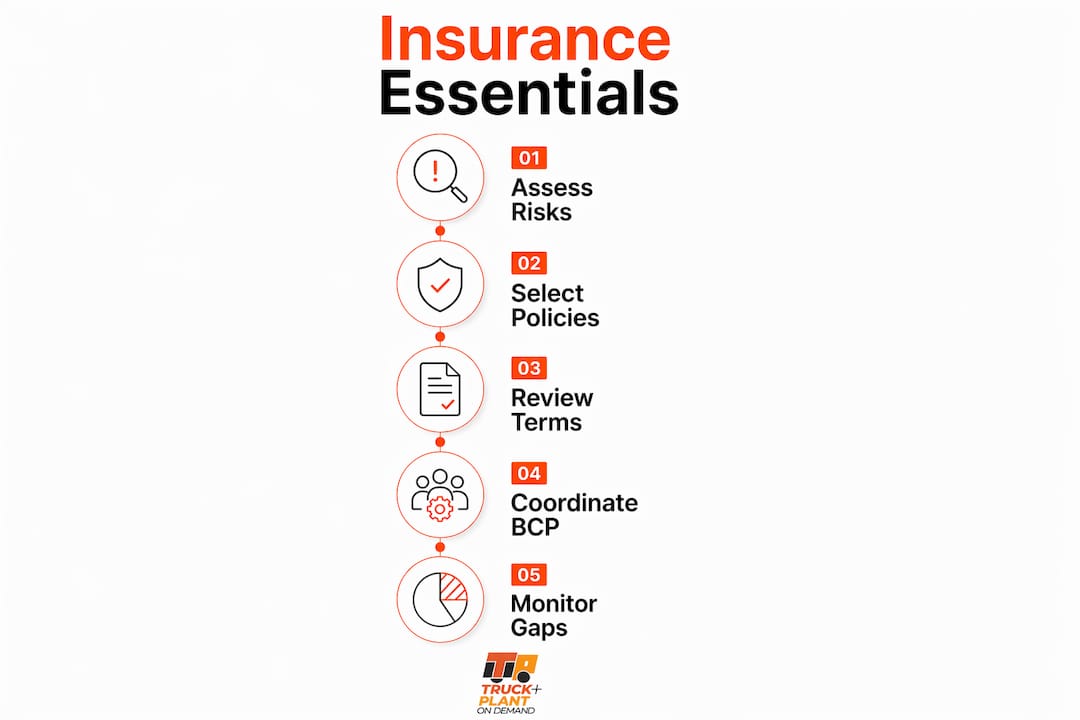
Aligning your BCP with your insurance coverage requires a structured approach:
- Conduct a business impact analysis (BIA). Identify your most critical processes, the maximum tolerable downtime for each, and the financial cost of each hour or day of disruption.
- Map dependencies to policy coverage. For each critical process, identify which insurance policy would respond to a disruption and whether the coverage limits and indemnity periods match your BIA findings.
- Document a gap analysis. Where your BIA shows a 90-day recovery window but your policy only covers 30 days, you have a documented gap that requires either additional coverage or an operational workaround.
- Test the alignment annually. Run tabletop exercises that include your insurance broker. Confirm that the scenarios in your BCP match the triggers and exclusions in your policies.
- Update both documents together. When your business changes, such as adding a new facility, entering a new market, or onboarding a critical supplier, update your BCP and your insurance schedule at the same time.
Pro Tip: Bring your insurance broker into your BCP review meetings, not just your annual renewal. Brokers who understand your operations can identify coverage mismatches before a claim reveals them.
Insurers often require proof of a tested BCP for favorable coverage terms. That means good continuity planning directly reduces your premium cost and improves your coverage availability. The relationship between insurance and business continuity planning is genuinely two-directional.
What are common coverage gaps in business continuity insurance?
Coverage gaps are the most dangerous blind spot in business continuity planning insurance. A 2026 survey found that 94% of business owners are concerned their insurance may not cover specific events. That near-universal anxiety reflects a real problem: most standard policies were not designed with modern risk complexity in mind.
The most common gaps include:
- Climate and flood underinsurance. Flood is a top weather risk concern, cited by 53% of business owners, yet only 30% carry flood insurance. That gap between concern and coverage is one of the clearest examples of underinsurance in the market today.
- Waiting period exposure. Business interruption policies typically include a waiting period of 48–72 hours before benefits begin. Businesses without cash reserves to cover that window face immediate liquidity pressure.
- Supply chain blind spots. Standard policies rarely cover losses from a second-tier supplier failure. CBI coverage often requires you to name specific suppliers in the policy, which means unnamed suppliers create uninsured exposure.
- Documentation failures. Lack of detailed financial and operational records is one of the leading causes of delayed or disputed claims. Insurers need granular evidence to validate losses, and businesses that cannot produce it face slower payouts at the worst possible time.
Regular policy reviews close these gaps before they become claims problems. A review tied to your annual BCP update is the most efficient way to keep coverage aligned with actual risk exposure.
How is insurance innovation changing business resilience?
Insurance is no longer a passive indemnity product. The most forward-looking insurers now function as active partners in risk reduction, not just financial backstops after a loss.
| Innovation | What it does | Business continuity benefit |
|---|---|---|
| Cyber resilience bundles | Combines coverage with monitoring, threat alerts, and incident response teams | Reduces breach likelihood and accelerates recovery |
| BCP-linked underwriting | Offers better terms to businesses with tested continuity plans | Incentivizes proactive planning and lowers premium costs |
| Climate resilience alignment | Links coverage pricing to physical risk reduction investments | Rewards businesses that invest in flood barriers, backup power, and similar measures |
| Parametric insurance | Pays out automatically when a defined trigger occurs, such as a flood level or wind speed | Eliminates claims delays during large-scale weather events |
Cyber insurance now functions as a decentralized enforcer of cybersecurity best practices across interconnected firms. Insurers set minimum security standards as a condition of coverage, which raises the baseline across entire supply chains. That systemic effect goes well beyond what any single business could achieve alone.
Aligning insurance incentives with physical risk reduction investments lowers long-term costs and stabilizes operations. Businesses that install flood mitigation measures, backup generators, or fire suppression systems increasingly receive premium reductions that partially offset the capital cost of those investments. Insurance is becoming a financial incentive for resilience, not just a safety net after failure.
Insurance is increasingly viewed as a “resilience dividend” that pays returns through enhanced creditworthiness, supply chain trust, and employee retention. Lenders and major customers now routinely ask for evidence of adequate coverage as part of due diligence. Being well-insured is a competitive signal, not just a compliance requirement.
For businesses in transport and logistics, these trends are particularly relevant. Understanding insurance trends for commercial fleets in 2026 shows how on-demand and usage-based models are reshaping how operators manage coverage costs alongside operational risk.
Key takeaways
Insurance supports business continuity by providing the financial resources that turn a recovery plan into a recovery reality, but only when coverage is aligned with actual operational risk.
| Point | Details |
|---|---|
| Insurance enables BCP execution | Coverage funds temporary facilities, payroll, and lost revenue so recovery plans can actually run. |
| Multiple policy types are required | Business interruption, extra expense, CBI, and cyber coverage each address different disruption scenarios. |
| Alignment prevents costly gaps | Map your business impact analysis to policy limits and indemnity periods before a crisis, not during one. |
| Documentation accelerates claims | Granular offsite financial records reduce claims disputes and speed up payouts when you need them most. |
| Innovation links coverage to prevention | BCP-linked underwriting and climate resilience incentives reward proactive risk management with lower premiums. |
Why I think most businesses are still treating insurance as a receipt, not a tool
The disconnect I see most often is not between businesses and their insurers. It is between the operations team that writes the BCP and the finance team that buys the insurance. They work in separate rooms, on separate timelines, and they rarely compare notes until a claim is filed. By then, the mismatch is already expensive.
The businesses that handle disruptions best treat their insurance broker the same way they treat a legal or financial advisor. They bring the broker into strategic conversations, not just renewal meetings. They share their BCP, their supplier list, and their growth plans. In return, they get coverage that actually fits their risk profile, not a standard policy that was designed for a generic business that looks nothing like theirs.
The emerging risk landscape makes this integration more urgent, not less. Climate volatility, cyber threats, and supply chain fragility are all increasing in frequency and severity. A policy that was adequate three years ago may have significant gaps today. The businesses that review coverage annually, test their BCPs, and treat insurance as a resilience investment in transport and operations are the ones that recover fastest when something goes wrong.
The uncomfortable truth is that most businesses discover their coverage gaps during a claim. That is the worst possible time to find out. The fix is not complicated. It requires a conversation between the people who plan operations and the people who buy insurance, held before a crisis forces it.
— Coert
How Truckplant supports continuity for commercial fleets
For transport operators, construction companies, and fleet managers, operational downtime is not an abstract risk. Every day a vehicle or piece of plant machinery sits idle is a day of lost revenue and missed contracts.
Truckplant’s Truck & Plant On-Demand™ insurance is built around that reality. You pay for cover when you need it and adjust your coverage as your operations change, without being locked into a fixed premium that does not reflect your actual exposure. Whether you run a single truck or a large mixed fleet, on-demand fleet cover keeps your insurance aligned with your business continuity needs at any given time. That flexibility means you are never paying for cover you do not need, and never caught without cover when you do.
FAQ
What is the role of insurance in business continuity?
Insurance provides the financial resources that allow a business to execute its continuity plan during a disruption, covering lost revenue, extra operating costs, and payroll. Without adequate coverage, even a well-designed recovery plan can stall due to lack of funds.
What insurance policies are most important for business continuity?
Business interruption, extra expense, contingent business interruption, and cyber insurance are the core policies for continuity planning. Each addresses a different type of operational disruption, and most businesses need a combination of all four.
How does a business continuity plan relate to insurance?
A BCP defines what needs to happen during a disruption, and insurance provides the money to make it happen. Aligning your BCP with your policy limits and indemnity periods is critical to avoiding financial shortfalls during recovery.
Why do so many businesses have coverage gaps?
A 2026 survey found 94% of business owners are concerned their insurance may not cover specific events. The most common gaps involve flood, supply chain disruptions, and documentation failures that slow or block claims.
How often should businesses review their insurance for continuity purposes?
Businesses should review their insurance coverage at least annually, and immediately after any significant operational change such as adding a new facility, supplier, or market. Tying the review to the annual BCP update is the most practical approach.