


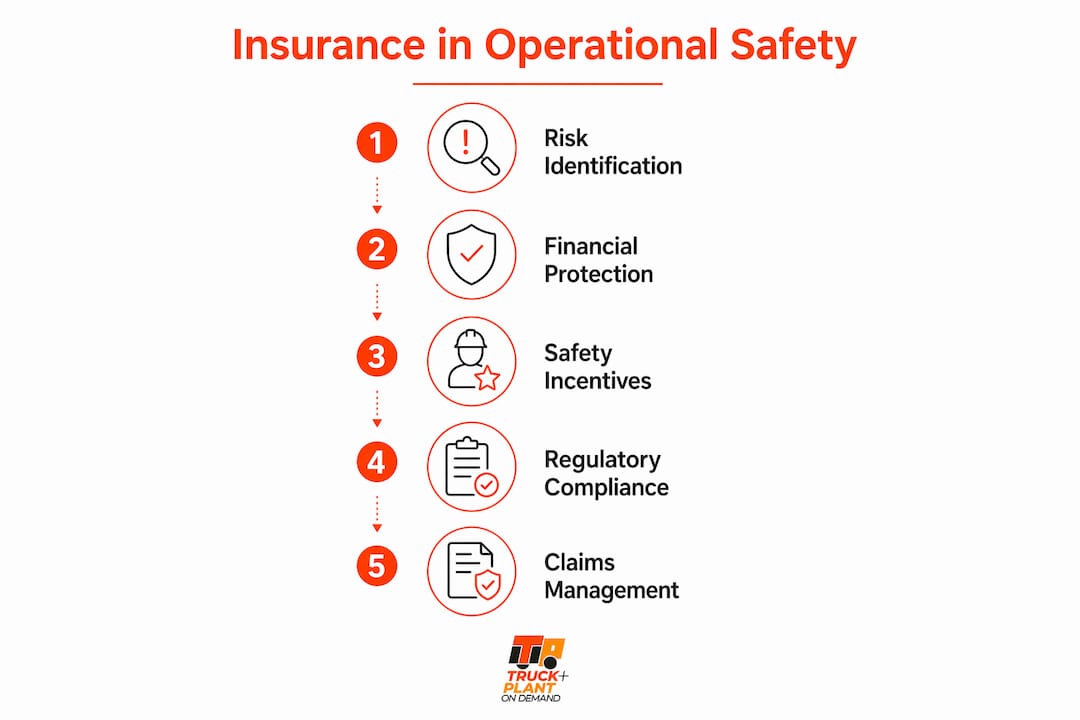
Insurance is not a passive cost centre. For risk managers and operations professionals, it serves as both a financial safeguard and an active driver of safer business practices. The role of insurance in operational safety covers three core functions: transferring financial exposure from unforeseen events, incentivising organisations to adopt stronger safety controls, and supporting business continuity when incidents do occur. Understanding how these functions work together is what separates organisations that merely comply with insurance requirements from those that use cover as a genuine operational tool.
Here is what that looks like in practice:
- Financial protection: Insurance absorbs losses from equipment failures, accidents, liability claims, and business interruptions that would otherwise threaten solvency.
- Risk transfer: By shifting financial exposure to an insurer, organisations free up capital to invest in prevention rather than reserves.
- Safety incentives: Insurers price risk based on your safety record, which means better practices translate directly into lower premiums.
- Liability management: Liability cover protects against third-party claims, regulatory fines, and legal costs arising from operational failures.
- Regulatory compliance: Many industries require specific insurance types by law or contract, making cover a baseline compliance tool.
- Business continuity: Business interruption insurance funds recovery operations, reducing downtime after a major incident.
1. How insurance mitigates operational risks
The financial scale of operational risk in the United States is not abstract. The National Safety Council estimated that work-related deaths and injuries cost the nation more than $1.3 trillion in 2023, with employers paying more than $1 billion weekly in direct workers’ compensation costs for disabling injuries. Those figures make the case for insurance coverage more clearly than any theoretical argument.
Insurance mitigates operational risk through several distinct mechanisms, not just by paying claims after the fact.
Financial protection from losses
When equipment fails, a fire damages a facility, or a worker is injured, insurance converts an unpredictable catastrophic loss into a manageable, budgeted cost. Without cover, a single serious incident can wipe out years of operating profit. With it, the financial impact is contained within agreed deductibles and policy limits.
Experience rating and premium pricing
One of the most direct ways insurance improves safety is through experience rating, where your premium reflects your actual claims history. Research published in the Scandinavian Journal of Economics found that experience-rated pricing reduced insured drivers’ claim frequency by 12%. The mechanism is straightforward: when poor safety performance costs you more at renewal, the financial incentive to invest in prevention becomes concrete and measurable.
Collaboration between insurers and operators
Insurers do not simply wait for claims. Risk engineers from insurance companies conduct on-site surveys of industrial plants, reviewing safety management systems, maintenance practices, and process controls. These assessments produce risk ratings that directly influence premium calculations. According to research presented at the AIChE CCPS Global Summit on Process Safety, insurer risk engineering assessments influence premium levels, with the management component accounting for roughly 50% of a plant’s overall risk rating. That weighting reflects how seriously insurers treat the quality of your safety culture, not just your physical infrastructure.

Claims processes and continuity planning
How you handle a claim shapes your next renewal. Organisations that document incidents thoroughly, respond quickly, and demonstrate corrective action tend to maintain better risk profiles with their insurers. This creates a feedback loop where the claims process itself becomes a driver of operational improvement, not just a financial transaction.
Safety data collection and risk profile improvement
Insurers increasingly value an operator’s internal safety data as much as external certifications. Maintaining detailed records of near-misses, safety occurrences, and corrective actions builds insurer confidence and can reduce the scope of on-site investigations. The quality of your data signals the quality of your safety culture.
Statistic callout: Over 60% of CFOs surveyed report that every $1 invested in injury prevention returns $2 or more, largely through reduced insurance premiums and lower lost-productivity costs.
2. Insurance’s role in liability and compliance management
Liability exposure is one of the most financially damaging risks an organisation faces. A single third-party claim, whether from a contractor injured on your site, a customer affected by a product failure, or a member of the public harmed by your operations, can generate legal costs and damages that far exceed the original incident cost. Liability insurance exists precisely to absorb that exposure.
What liability cover actually protects
General liability and professional liability policies cover legal defence costs, court-awarded damages, and settlements arising from third-party claims. In industries like construction, transport, and manufacturing, where your operations interact directly with the public and other contractors, this cover is not optional in any practical sense. Many project contracts and government tenders require proof of liability insurance before work can begin, making it a compliance prerequisite as much as a financial tool.
Regulatory requirements and mandatory cover
OSHA standards, state workers’ compensation laws, and sector-specific regulations in the United States create a baseline of mandatory insurance requirements. Workers’ compensation cover is compulsory in virtually every state, and commercial vehicle operators must carry minimum liability limits set by the Federal Motor Carrier Safety Administration. Failing to maintain required cover exposes organisations to regulatory penalties, contract termination, and personal liability for directors and officers.
Alignment between regulatory audits and insurer assessments
There is a practical overlap between what OSHA inspectors look for and what insurer risk engineers assess. Both evaluate your safety management systems, incident records, training programmes, and corrective action processes. A 2012 study cited by OSHA found that inspections by California’s Division of Occupational Safety and Health reduced injuries and generated estimated savings of $355,000 per inspected firm in injury claims and compensation over the study period. Organisations that prepare for insurer assessments with the same rigour they apply to regulatory audits tend to perform better on both fronts.
Reputational and financial risk from non-compliance
The financial consequences of non-compliance extend beyond fines. A serious incident that attracts regulatory scrutiny, litigation, and media attention can damage client relationships and make future insurance cover more expensive or harder to obtain. Liability insurance does not prevent reputational damage, but it funds the legal response and settlement process that determines how quickly and cleanly an organisation recovers.
Risk transfer and internal policy alignment
Effective liability management treats insurance as one layer in a broader risk control structure. Your internal operational safety policies set the standards; your liability cover funds the consequences when those standards are not met or when incidents occur despite them. The two work together. Organisations that treat liability cover as a substitute for strong internal controls tend to face higher premiums and more difficult renewals over time.
Practical liability scenarios
- A construction subcontractor damages a third party’s property. Public liability cover funds the claim and legal defence.
- A transport operator is involved in a road incident injuring another driver. Commercial motor liability cover responds to the claim.
- A manufacturing defect causes injury to a customer. Product liability cover absorbs the legal costs and damages.
- A data breach at an operations centre exposes client information. Cyber liability cover funds notification, legal response, and regulatory penalties.
For fleet operators and civil contractors, understanding insurance in transport operations is particularly relevant, given the layered liability exposures that come with commercial vehicle use.
3. How insurance encourages good safety practices and operational resilience
The relationship between insurance and safety is not one-directional. Insurance does not simply respond to risk; it actively shapes the safety behaviours of the organisations it covers. This happens through pricing signals, contractual requirements, and the collaborative relationships that develop between safety teams and their insurers.
Premium discounts for strong safety programmes
Insurers reward demonstrable safety performance with more favourable terms at renewal. Organisations that hold recognised safety certifications, maintain low claims histories, and can evidence structured safety management systems typically access lower rates than peers with weaker records. The International Business Aviation Council reports that approximately one-third of operators registered under IS-BAO (International Standard for Business Aircraft Operations) report significant insurance savings as a result of registration. The same principle applies across industries: certification to a recognised standard signals to underwriters that your risk is predictable and well-managed.
Process Safety Management and Mechanical Integrity requirements
In high-hazard industries such as chemical processing, oil and gas, and heavy manufacturing, insurers often require evidence of Process Safety Management (PSM) compliance as a condition of cover. OSHA’s PSM standard (29 CFR 1910.119) sets out requirements for managing hazards associated with highly hazardous chemicals, and insurers treat compliance as a proxy for overall operational discipline. Mechanical Integrity, one of the 14 elements of PSM, serves as a critical link between engineering and underwriting, providing safety assurance and stronger underwriting confidence through predictable equipment behaviour. When your equipment maintenance records are thorough and your inspection schedules are current, insurers can model your risk with greater confidence, which typically translates into better pricing.
Risk engineering as a safety resource
Insurer risk engineers are not auditors in the adversarial sense. Their assessments identify gaps, recommend controls, and provide benchmarking against industry peers. Organisations that treat these recommendations as a continuous improvement input rather than a compliance exercise tend to see the most benefit. The assessment cycle, typically every two to four years for major industrial facilities, creates a structured external review that complements internal safety audits.
Internal safety data as an insurer trust signal
Insurers place significant weight on the quality and transparency of an operator’s internal safety data. Detailed records of near-misses, safety occurrences, and corrective actions demonstrate that your organisation identifies and addresses risk proactively rather than reactively. When an insurer considers your internal data sufficient in quality and scope, it may reduce the intensity of on-site investigation for minor occurrences, which saves time and supports a more efficient claims process.
Reducing moral hazard through well-designed cover
Poorly structured insurance can inadvertently reduce safety incentives. Research on insurance pricing distortions shows that flat-rate or inadequately experience-rated policies can reduce operational safety incentives by transferring immediate accident costs to insurers without future premium penalties. The solution is cover designed with appropriate deductibles, experience rating, and claims-responsive pricing, so that your financial exposure remains linked to your safety performance.
Pro Tip: Request a copy of your insurer’s risk engineering report after each site assessment. Treat every recommendation as a prioritised action item, and document your response. This paper trail directly supports your next renewal negotiation.
4. Integrating insurance with enterprise risk management frameworks
Insurance does not operate in isolation. For risk managers working within formal Enterprise Risk Management (ERM) frameworks, insurance is one component of a broader risk treatment strategy that also includes risk avoidance, risk reduction, and risk retention. Getting the integration right determines whether your insurance spend genuinely supports operational safety or simply fulfils a compliance checkbox.
Insurance within the ERM cycle
ERM frameworks such as ISO 31000 and COSO ERM establish a cycle of risk identification, assessment, treatment, and monitoring. Insurance enters at the treatment stage, as a tool for financing residual risk that cannot be eliminated or reduced to an acceptable level through operational controls alone. The key discipline is sequencing: you reduce risk first through engineering controls, training, and process design, then use insurance to cover what remains. Organisations that skip the reduction step and rely on insurance to absorb avoidable losses pay more at renewal and accumulate a claims history that compounds the problem.
Transparency and data sharing between insurers and risk managers
Effective ERM integration requires genuine information sharing with your insurer. This means providing your risk register, incident data, safety audit results, and business continuity plans, not just the minimum required for underwriting. Insurers that understand your operations in depth can price your risk more accurately and offer more relevant cover structures. The relationship described in aviation safety research, where aligning internal risk management with insurer observations improves decision-making, applies equally to construction, transport, and industrial operations.
Business continuity planning and insurance alignment
Business interruption insurance is most effective when it is designed alongside your business continuity plan (BCP), not purchased separately and then forgotten. Your BCP should identify the maximum tolerable downtime for each critical process, and your business interruption cover should be structured to fund recovery within that window. Mismatches between BCP assumptions and policy terms are a common source of underinsurance, particularly for organisations with complex supply chains or specialist equipment with long lead times for replacement.
Insurance analytics and risk treatment decisions
Insurance data, specifically your claims history, loss runs, and risk engineering reports, is a legitimate input into risk treatment decisions. Patterns in claims data can reveal systemic weaknesses in specific operations, locations, or equipment types that internal reporting may miss. Fleet operators, for example, can use insurance analytics for fleets to identify which vehicle types, routes, or drivers generate disproportionate claims, then target safety interventions accordingly.
Selecting cover aligned with your risk appetite
Your organisation’s risk appetite, the level of financial exposure it is willing to retain, should directly determine your deductible levels, policy limits, and the scope of cover you purchase. A risk-averse organisation with limited cash reserves will set lower deductibles and broader cover. An organisation with strong reserves and a mature safety programme may retain more risk through higher deductibles, accepting short-term volatility in exchange for lower premiums. Neither approach is inherently correct; the right structure depends on your financial position, operational risk profile, and the cost of available cover in your market.
Practical ERM integration steps
- Map your risk register to your insurance programme to identify gaps between insured and uninsured exposures.
- Include your insurer or broker in annual risk reviews, not just at renewal.
- Use loss run data from your insurer as an input into your annual safety plan.
- Align business interruption cover limits with your BCP’s maximum tolerable downtime assumptions.
- Review your cover structure whenever your operations change materially, such as when you add new equipment, enter new markets, or take on new contract types.
For commercial fleet operators, a structured fleet risk management guide provides a practical framework for embedding insurance within day-to-day operational risk decisions.
5. Types of insurance relevant to operational safety
Operational safety risk does not fit neatly into a single policy. Effective cover requires a portfolio of insurance types, each addressing a distinct category of exposure. Understanding what each policy does, and where the gaps between policies can appear, is fundamental to building a programme that genuinely supports your safety objectives.
Property insurance
Property insurance covers physical assets, including buildings, plant, machinery, and stock, against damage from fire, flood, theft, and accidental damage. For construction and civil engineering operations, this typically includes cover for plant and equipment on site, which is often the most significant asset at risk. The scope of cover matters: an “all risks” property policy provides broader protection than a named-perils policy, and the difference becomes apparent when an unusual incident occurs.
General liability insurance
General liability (GL) cover responds to third-party bodily injury and property damage claims arising from your operations. It is the foundational liability policy for most businesses and is typically required by contracts and project owners. GL cover does not protect your own employees; that function belongs to workers’ compensation.
Workers’ compensation insurance
Workers’ compensation is mandatory in virtually every US state and covers medical treatment, rehabilitation, and lost wages for employees injured at work. It also protects employers from most civil lawsuits by injured workers. The premium you pay is directly linked to your payroll, your industry classification, and your experience modification rate (EMR), which reflects your claims history relative to industry peers. A low EMR signals strong safety performance and reduces your premium.
Commercial auto and motor liability insurance
Any organisation operating commercial vehicles requires commercial auto cover, which addresses liability for accidents involving your vehicles, as well as physical damage to the vehicles themselves. For transport operators and fleet managers, this is typically the largest single insurance cost, and it is the area where insured moving operations and logistics providers face the most direct financial exposure from safety failures.
Business interruption insurance
Business interruption (BI) cover replaces lost revenue and funds ongoing fixed costs when a covered event, such as a fire or flood, forces operations to stop. The indemnity period, the length of time the policy pays out, must be long enough to cover the full recovery timeline, including equipment replacement, regulatory approvals, and staff retraining. Underestimating the indemnity period is one of the most common and costly mistakes in BI cover design.
Professional indemnity insurance
Professional indemnity (PI) cover protects organisations that provide advice, design, or professional services against claims that their work caused a client financial loss. For engineering firms, safety consultants, and project managers, PI cover addresses the liability gap that GL policies do not fill.
Cyber liability insurance
Operational technology systems, including SCADA systems, fleet telematics, and industrial control systems, are increasingly exposed to cyber threats. A successful cyberattack on operational technology can cause physical safety incidents, not just data breaches. Cyber liability cover funds incident response, regulatory notification, and business interruption losses arising from cyber events.
Umbrella and excess liability insurance
Umbrella and excess liability policies sit above your primary liability covers and respond when underlying policy limits are exhausted. For organisations with significant public exposure or large contract values, umbrella cover provides the depth of protection that primary policies alone cannot deliver.
Product liability insurance
Manufacturers and distributors face liability for injuries or property damage caused by defective products. Product liability cover addresses this exposure and is often required by retailers and distributors as a condition of supply agreements.
Environmental liability insurance
Operations involving hazardous materials, waste disposal, or activities near sensitive ecosystems carry environmental liability exposure that standard property and GL policies typically exclude. Environmental liability cover responds to clean-up costs, third-party claims, and regulatory penalties arising from pollution events.
6. Regulatory and legal requirements for insurance in operational safety
Regulatory requirements for insurance in the United States operate at federal, state, and industry-specific levels. For risk managers, understanding which requirements apply to your operations is not optional; non-compliance creates both legal exposure and gaps in your risk financing programme.
Federal requirements
The Federal Motor Carrier Safety Administration (FMCSA) sets minimum liability insurance requirements for commercial motor carriers operating in interstate commerce. Requirements vary by cargo type and vehicle weight, with higher minimums for carriers transporting hazardous materials. OSHA does not directly mandate specific insurance policies, but its standards on workers’ compensation, personal protective equipment, and process safety management create the operational conditions that insurers assess when pricing cover.
State workers’ compensation mandates
Workers’ compensation insurance is compulsory in 49 states, with Texas being the only state where private employer participation is not mandated by law. State workers’ compensation boards set the rules for coverage, benefits, and approved insurers. Employers who fail to maintain required cover face penalties, loss of legal protections, and personal liability for workplace injury claims.
Industry-specific and contractual requirements
Beyond statutory requirements, many industries impose insurance requirements through contracts, licences, and professional body memberships. Construction project owners routinely require contractors to carry minimum GL, workers’ compensation, and professional indemnity limits as a condition of contract award. Government contracts often specify additional requirements, including performance bonds and pollution liability cover. Failure to maintain required cover can result in contract termination and blacklisting from future tenders.
The role of OSHA’s Voluntary Protection Programs
OSHA’s Voluntary Protection Programs (VPP) recognise employers with safety and health management systems that go beyond basic compliance. VPP sites average a Days Away Restricted or Transferred (DART) case rate 52% below the industry average, which translates directly into lower workers’ compensation premiums and improved risk ratings with insurers. VPP participation is a credible signal to underwriters that your safety programme is mature and independently verified.
Insurance as a regulatory audit proxy
Insurer risk engineering assessments and regulatory inspections cover overlapping ground. Both evaluate your safety management systems, incident records, and corrective action processes. Organisations that maintain the documentation and systems needed to satisfy insurer assessments are typically well-positioned for regulatory audits as well. The two processes reinforce each other when managed as part of a unified safety and compliance programme.
7. The claims process and its impact on operational continuity
A claim is the moment insurance converts from a policy document into an operational tool. How you manage the claims process determines how quickly your operations recover and how your risk profile is affected at the next renewal.
Immediate response and notification
Most policies require prompt notification of incidents that may give rise to a claim. Delayed notification can complicate coverage and give insurers grounds to dispute liability. Your incident response procedure should include a clear step for notifying your broker or insurer, with the relevant policy numbers and contact details accessible to site managers and safety officers.
Documentation and evidence preservation
The quality of your claim documentation directly affects settlement speed and outcome. Photographs, witness statements, maintenance records, and safety inspection logs all support your position and help insurers assess the incident accurately. Organisations with strong safety data systems, where incident records are maintained digitally and consistently, tend to resolve claims faster than those relying on paper-based or inconsistent records.
Working with loss adjusters
For significant claims, insurers appoint loss adjusters to investigate the incident, assess the damage, and determine the quantum of the claim. Loss adjusters are independent of both the insurer and the insured, but their findings carry significant weight in the settlement process. Cooperating fully, providing requested documentation promptly, and maintaining professional communication throughout the process supports a fair and timely outcome.
Business interruption claims and continuity
Business interruption claims are among the most complex to settle because they require projecting what revenue would have been earned had the incident not occurred. Maintaining up-to-date financial records, including monthly management accounts and revenue forecasts, is essential for substantiating a BI claim. Organisations that have tested their business continuity plans and can demonstrate a structured recovery response tend to minimise the indemnity period and the total claim cost.
Claims history and renewal impact
Every claim affects your renewal. Frequency matters as much as severity; multiple small claims can signal systemic safety weaknesses and push premiums up more than a single large event. Organisations that invest in root cause analysis after incidents, implement corrective actions, and communicate those improvements to their insurer at renewal are better positioned to manage the premium impact of claims. For fleet operators, tracking and addressing the patterns behind claims is a core function of fleet risk management.
8. Collaboration between insurers and safety teams to improve risk outcomes
The most effective insurance relationships are not transactional. They are built on genuine collaboration between your safety team and your insurer’s risk engineering function, with both parties working toward the shared goal of fewer incidents and lower total cost of risk.
What collaborative insurer relationships look like
Long-term insurer relationships, where your insurer understands your operations, your safety culture, and your improvement trajectory, tend to produce more stable pricing and more responsive claims handling than annual price-shopping. As aviation safety research notes, if an insurer knows how a client is organised and that it operates to recognised standards, it will be more flexible on individual premiums. That flexibility is earned through transparency and consistency over time.
Insurer-provided safety resources
Many insurers, particularly in the industrial and commercial sectors, offer risk management resources as part of the relationship: safety audit tools, training materials, loss prevention guidance, and access to risk engineering expertise. These resources are most valuable when your safety team engages with them actively rather than treating them as background noise. Requesting a post-survey debrief from your insurer’s risk engineer, for example, often surfaces practical improvement recommendations that internal audits miss.
Sharing internal safety data proactively
Proactively sharing your internal safety data, including near-miss reports, safety observation trends, and corrective action logs, with your insurer builds the trust that underpins favourable renewal terms. Insurers that have access to quality internal data can assess your risk with greater confidence and reduce their reliance on conservative assumptions that inflate premiums. This is particularly relevant for operators in sectors where external loss data is limited or not directly comparable to your specific operations.
Safety teams as underwriting partners
The most forward-thinking organisations treat their safety teams as active participants in the insurance relationship, not just as the people who fill out renewal questionnaires. Safety managers who can articulate their programme’s structure, metrics, and improvement trajectory in underwriting terms, such as incident rates, near-miss ratios, and training completion rates, give their brokers the material needed to negotiate effectively on their behalf.
Insured moving and logistics operations
In logistics and moving operations, where cargo liability, vehicle liability, and workers’ compensation exposures intersect, the quality of safety management directly determines insurance costs. Operators who invest in driver training, vehicle maintenance programmes, and cargo handling procedures tend to access better terms from insurers who specialise in this sector. Understanding what insured moving companies look for in their cover structures provides a useful reference point for logistics operators building their own insurance programmes.
9. Data-driven insights and the business case for insurance in operational safety
The business case for integrating insurance with operational safety is supported by hard numbers, not just risk management theory. The data points toward a consistent conclusion: organisations that invest in safety, and structure their insurance programmes to reinforce that investment, spend less on total risk costs than those that treat insurance as a passive expense.
The cost of inaction
The National Safety Council’s 2023 estimate of $1.3 trillion in annual work-related injury and illness costs in the United States is the baseline against which safety investments should be measured. That figure includes workers’ compensation payments, medical expenses, lost productivity, and administrative costs. For individual employers, the weekly workers’ compensation cost of more than $1 billion across the US economy translates into a direct, measurable drain on operating margins.
Return on safety investment
OSHA’s business case data shows that over 60% of CFOs report a return of $2 or more for every $1 invested in injury prevention. A forest products company cited in OSHA’s programme data saved over $1 million in workers’ compensation and related costs between 2001 and 2006 by investing approximately $50,000 in safety improvements and employee training. That ratio, roughly 20:1, illustrates the leverage available when safety investment is targeted at the right exposures.
Experience rating as a financial incentive
The 12% reduction in claim frequency associated with experience-rated insurance pricing demonstrates that financial incentives embedded in insurance design genuinely change safety behaviour. The mechanism works because it makes the cost of poor safety performance visible and immediate at renewal, rather than diffuse and delayed.
The moral hazard caveat
Not all insurance structures support safety improvement. Research on auto insurance minimums found that a 1% increase in state liability minimums was associated with a 0.1% increase in traffic fatalities, a small but statistically significant moral hazard effect. Similarly, flat-rate policies that do not reflect individual claims history can reduce the financial incentive to invest in prevention. The implication for risk managers is that the design of your insurance programme matters as much as the fact of having cover.
Data table: safety investment vs. insurance cost outcomes
| Safety investment type | Operational outcome | Insurance impact |
|---|---|---|
| OSHA VPP participation | DART rate 52% below industry average | Lower workers’ compensation EMR and premiums |
| Process Safety Management (PSM) implementation | Improved risk rating from insurer surveys | Reduced property and all-risks premium rates |
| Experience-rated workers’ compensation | 12% reduction in claim frequency | Lower renewal premiums through improved EMR |
| Internal safety data systems (near-miss tracking) | Reduced insurer investigation scope | Faster claims resolution, improved risk profile |
| Safety certification (IS-BAO) | Recognised standard compliance | Approximately one-third of IS-BAO operators report significant savings |
| $1 invested in injury prevention | $2+ return reported by 60%+ of CFOs | Reduced claims costs and premium spend |
Insurance as an active risk management partner
The organisations that extract the most value from their insurance programmes treat their insurer as an active partner in risk management, not a passive payer of claims. This means engaging with risk engineering assessments seriously, sharing internal data transparently, and structuring cover to reinforce rather than replace internal safety controls. As research in the aviation sector demonstrates, insurance as a safety asset drives continuous improvement in safety culture and operational controls beyond what compliance alone requires.
How Truckplant supports operational safety through on-demand cover
For commercial vehicle operators and plant machinery users in the civil, construction, and transport sectors, the challenge is not just having the right cover. It is having the right cover at the right time, without paying for protection you do not need when your operations change.
Truckplant’s Truck & Plant On-Demand™ is built around that reality. You choose what to insure, when to insure it, and how to structure your cover, adjusting it as your operational needs shift. Whether you run a single truck or a large fleet of yellow plant machinery, your premium reflects your actual exposure, not a fixed monthly cost that ignores the reality of how your business operates.
For risk managers looking to align insurance spend with genuine operational risk, on-demand fleet cover gives you the control to do exactly that.
Key takeaways
Insurance functions most effectively in operational safety when it is actively integrated with risk management, not treated as a standalone compliance cost.
| Point | Details |
|---|---|
| Financial scale of operational risk | Work-related injuries and deaths cost the US more than $1.3 trillion in 2023, making insurance a critical financial tool. |
| Safety investment returns | Over 60% of CFOs report $2 or more returned for every $1 invested in injury prevention, largely through reduced insurance costs. |
| Experience rating drives behaviour | Experience-rated insurance pricing reduced claim frequency by 12%, demonstrating that financial incentives change safety outcomes. |
| Insurer assessments improve safety | Risk engineering surveys from insurers, where management accounts for roughly 50% of risk rating, directly influence premium levels and safety practices. |
| Cover design matters | Flat-rate or poorly structured policies can reduce safety incentives; cover must be aligned with claims history and operational risk to be effective. |