


Risk assessment in insurance is the process of identifying, measuring, and analysing potential losses to determine premiums, coverage limits, and policy terms. It sits at the foundation of every underwriting decision an insurer makes. Without it, pricing becomes guesswork, solvency becomes fragile, and policyholders end up paying rates that bear no relation to their actual risk profile.
The process covers far more than simply deciding whether to accept a risk. It shapes how insurers group similar risks into classes, calculate expected claim costs, and set the financial reserves needed to pay future losses. For commercial operators, fleet managers, and construction businesses, understanding how insurers assess risk directly affects the cover you can access and what you pay for it.
Key elements of insurance risk assessment:
- Risk identification: Pinpointing the specific hazards and exposures an insured party faces.
- Risk classification: Grouping risks with similar characteristics to determine average claim costs and equitable pricing.
- Risk quantification: Measuring the probability and financial severity of potential losses.
- Underwriting evaluation: Assessing individual risk characteristics to decide on acceptance and terms.
- Ongoing monitoring: Continuously reviewing the risk profile as conditions change.
Table of Contents
- How does risk assessment differ from risk management in insurance?
- How do insurance companies perform risk assessment?
- What tools and technologies improve insurance risk assessment?
- What are the benefits of accurate risk assessment in insurance?
- Regulatory frameworks and expert insights on risk assessment in the United States
- Examples of risk evaluation methods and technologies
- Challenges and limitations of risk assessment in insurance
- Truckplant gives you cover that matches how you actually operate
- Key takeaways
How does risk assessment differ from risk management in insurance?
These two terms are often used interchangeably, but they describe distinct functions. Risk assessment is the evaluation step: identifying what risks exist and measuring their potential impact. Risk management in insurance is the broader, ongoing process of deciding how to respond to those risks, whether by accepting, mitigating, transferring, or avoiding them.
The distinction matters because the two functions operate at different levels inside an insurance company. On the carrier side, risk assessment focuses on the risks the insurer itself assumes across its entire book of business. The goal is maintaining solvency across diverse scenarios, not just evaluating individual policies. A corporate buyer, by contrast, uses risk management to decide how much risk to retain and how much to transfer through insurance.
Key distinctions and interrelationships:
- Risk assessment feeds directly into risk appetite and tolerance decisions at board level.
- Risk management uses assessment outputs to set policy, allocate capital, and design mitigation strategies.
- Continuous assessment processes, such as the Own Risk and Solvency Assessment (ORSA), integrate both functions into a single enterprise risk management framework.
- Carrier-side assessment evaluates aggregate portfolio risk; buyer-side management focuses on individual exposure and transfer decisions.
- Neither function is a one-off exercise. Both require regular review as the risk environment evolves.
How do insurance companies perform risk assessment?
The process follows a structured sequence, though the depth of analysis varies by line of business and the complexity of the risk.

Step 1: Identify risk factors. Underwriters and actuaries gather information about the insured party, the assets being covered, and the operating environment. For a commercial fleet, this includes vehicle types, driver records, routes, cargo, and maintenance history.
Step 2: Classify the risk. Risks are grouped into categories based on shared characteristics. Risk classification allows insurers to apply average claim cost data to individual risks, which is the only practical way to price cover across large portfolios.
Step 3: Measure probability and severity. Actuaries apply statistical and probabilistic models to estimate how often losses will occur and how large they will be. This step produces the expected loss figures that drive premium calculations.
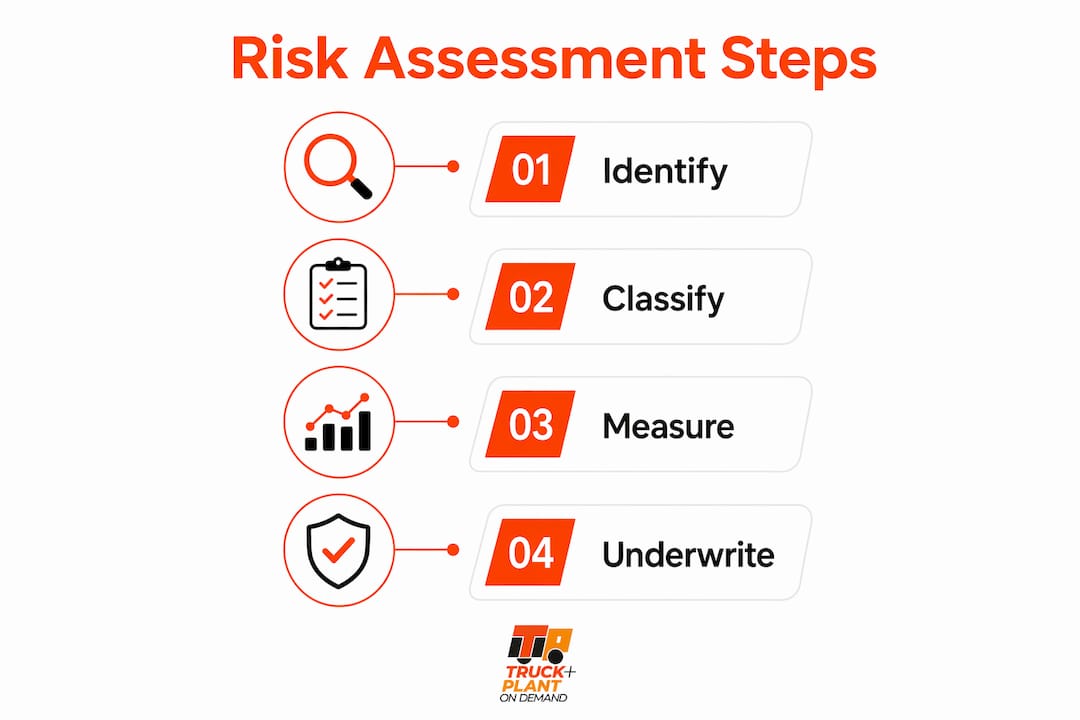
Step 4: Underwriting evaluation. Individual risks are reviewed against underwriting guidelines. Factors that fall outside standard parameters trigger additional scrutiny or adjusted terms.
Step 5: Stress testing and scenario analysis. Sound risk management practice requires testing how the portfolio performs under extreme but plausible conditions, such as a major weather event or a spike in claims frequency.
Key components of the process:
- Actuarial modelling to predict losses and variability around central estimates.
- Underwriting guidelines that translate risk scores into acceptance decisions and pricing.
- Data collection systems that capture claims history, exposure data, and emerging trends.
- Scenario analysis to assess the impact of low-frequency, high-severity events.
- Feedback loops that return claims experience to pricing and product development teams.
What tools and technologies improve insurance risk assessment?
Modern insurers rely on a combination of data analytics, telematics, and machine learning to sharpen the accuracy of their assessments. The shift from static historical data to real-time behavioural data has changed what is measurable and how quickly insurers can respond to changing risk profiles.

Telematics in fleet insurance provides a clear example. Devices fitted to commercial vehicles capture speed, braking patterns, route data, and hours of operation. That granular data feeds directly into risk scoring models, allowing underwriters to price cover based on actual driving behaviour rather than broad vehicle categories. The result is more accurate pricing and a stronger incentive for operators to maintain safe practices.
Advanced analytics and machine learning extend this further by identifying patterns across large datasets that no human analyst could detect manually. These models improve claims prediction, flag emerging risk trends, and support automated underwriting decisions for standard risks.
Key technologies in use:
- Telematics: Real-time vehicle and equipment monitoring for behavioural risk scoring.
- Machine learning models: Predictive analytics for claims frequency and severity.
- Big data platforms: Integration of weather, geographic, and economic data into risk models.
- Automated underwriting systems: Rules-based engines that process standard risks without manual review.
- Cyber risk modelling tools: Specialised frameworks for quantifying digital exposure, an area where traditional actuarial data is still limited.
Pro Tip: If you operate a commercial fleet, ask your insurer whether telematics data can be used to adjust your premium mid-term. Many carriers now offer this, and operators with strong safety records often see meaningful reductions.
What are the benefits of accurate risk assessment in insurance?
Accurate risk assessment protects both sides of the insurance contract. For insurers, it aligns premiums with expected losses, which is the only reliable way to maintain solvency over time. For policyholders, it means paying a price that reflects their actual risk rather than subsidising higher-risk groups.
Balancing risk classification also prevents adverse selection, the tendency for higher-risk individuals to buy more cover while lower-risk individuals opt out. When pricing is poorly calibrated, this dynamic erodes the financial stability of the entire pool. Effective assessment keeps the pool balanced and coverage accessible.
Beyond pricing, accurate assessment gives management the information needed to anticipate financial shocks before they materialise. Proactive risk identification consistently produces better outcomes than reactive crisis management, which tends to be more costly and disruptive. The risk of insurer crises rises sharply when rigorous assessment is neglected.
Specific benefits:
- Fair, equitable pricing across diverse risk profiles.
- Protection of insurer solvency through alignment of premiums with expected losses.
- Reduced adverse selection, keeping coverage available and affordable.
- Informed strategic decisions on capital allocation and product development.
- Regulatory compliance, particularly under frameworks that require documented risk assessments.
- Early identification of emerging risks before they generate large claims.
Regulatory frameworks and expert insights on risk assessment in the United States
The most significant regulatory development in US insurance risk assessment is the NAIC ORSA Model Act, which requires qualifying insurers to maintain a risk management framework, conduct their own risk and solvency assessment, and submit an annual ORSA summary report to their lead state regulator. The threshold applies to insurers with premiums and insurance groups above high specified amounts.
The ORSA is not a compliance checkbox. The International Association of Actuaries describes it as an ongoing strategic process that provides senior management and the board with a current and forward-looking view of material risks and capital adequacy. Its value comes from being tailored to the insurer’s own risk profile rather than relying on standardised regulatory formulas.
The NAIC ORSA process is principles-based, meaning insurers must design their assessment approach to fit their specific business model. That flexibility is intentional. A monoline workers’ compensation carrier faces fundamentally different risks than a multiline commercial insurer, and a one-size-fits-all formula would obscure more than it reveals.
Expert guidance from the actuarial community reinforces that risk assessment should be integral to board-level decision-making, not delegated entirely to technical teams. Boards are expected to actively frame and oversee the ORSA process, challenge activities that fall outside the company’s risk appetite, and hold management accountable for the results.
Key regulatory and compliance points:
- NAIC ORSA applies to US insurers above defined premium thresholds.
- The process must cover all material risks, including underwriting, credit, market, operational, and liquidity risks.
- Annual ORSA summary reports are submitted to the lead state regulator.
- Actuaries play a central role in designing and executing the assessment, working alongside risk, finance, legal, and claims professionals.
- The Actuarial Standards Board’s standards on risk classification provide additional guidance on fair and equitable pricing practices.
Regulatory note: The ORSA requirement has been adopted across most US states following the NAIC model, making it the de facto standard for enterprise risk assessment among larger carriers. Smaller insurers not subject to ORSA thresholds are still expected to maintain documented risk management frameworks under state solvency regulations.
Examples of risk evaluation methods and technologies
Insurance risk evaluation draws on a range of established methods, each suited to different types of exposure.
Actuarial loss modelling remains the backbone of property and casualty pricing. Actuaries build models using historical claims data, exposure metrics, and trend factors to project future losses. For commercial vehicle fleets, this means analysing claims frequency by vehicle class, driver age, and operating territory.
Catastrophe modelling is used extensively in property insurance to estimate losses from natural disasters. Vendors like RMS and AIR Worldwide provide probabilistic models that simulate thousands of event scenarios, giving insurers a distribution of potential losses rather than a single point estimate.
Credit scoring and financial analysis are standard tools in commercial lines underwriting. A business’s financial stability, claims history, and management quality all feed into the underwriting decision alongside the physical risk characteristics.
Telematics-based scoring is now well established in personal and commercial auto. For fleet operators, risk assessment checklists combined with telematics data create a continuous feedback loop between driving behaviour and insurance pricing.
Cyber risk quantification is a newer discipline. Frameworks such as FAIR (Factor Analysis of Information Risk) translate cyber threat scenarios into financial loss estimates, helping underwriters price a risk category where historical data is still sparse.
In transportation and logistics, risk grouping strategies adapted for bulk freight operations illustrate how sector-specific exposure data improves the accuracy of classification models.
Challenges and limitations of risk assessment in insurance
Risk assessment is only as good as the data and models behind it. Several structural challenges limit its accuracy, particularly for emerging or novel risks.
Data scarcity for new risks. Cyber insurance is the clearest example. Actuaries need decades of claims data to build reliable loss models, and cyber risk has only been a mainstream insurance product for a relatively short time. Underwriters are pricing risks they cannot yet fully quantify.
Model risk. Every predictive model embeds assumptions about the future that may not hold. A model calibrated on pre-pandemic claims data, for instance, may significantly underestimate post-pandemic loss patterns. Stress testing helps, but it cannot anticipate every scenario.
Climate change. Rising frequency and severity of weather-related losses are outpacing the historical data that property catastrophe models rely on. Insurers in coastal and wildfire-prone regions are finding that past loss experience is a poor guide to future exposure.
Fairness and regulatory scrutiny. Risk classification must balance actuarial accuracy with social acceptability. Using certain variables, even if statistically predictive, may be prohibited or restricted under state insurance regulations. Striking that balance requires ongoing dialogue between actuaries, underwriters, and regulators.
Operational complexity. For large, diversified insurers, aggregating risk assessments across multiple lines, geographies, and legal entities into a coherent enterprise view is technically demanding. Correlation between risks, particularly during stress events, is difficult to model accurately.
Emerging risks move faster than assessment cycles. Pandemic risk, supply chain disruption, and geopolitical instability can shift an insurer’s risk profile faster than annual assessment cycles can capture. Continuous monitoring and trigger-based reassessment are increasingly necessary.
Truckplant gives you cover that matches how you actually operate
Understanding how insurers assess risk is one thing. Paying a premium that actually reflects your operation is another. Most traditional insurance structures charge a fixed monthly premium regardless of whether your trucks are on the road or your plant equipment is sitting idle on site.

Truckplant was built specifically for commercial vehicle operators and plant machinery businesses that need cover to move with their work. With Truck & Plant On-Demand™, you choose what to insure, when to insure it, and how. If your fleet is off the road for a period, you are not paying for cover you are not using. If your risk profile changes because you have taken on a new contract or added vehicles, you can adjust your cover immediately.
For fleet operators who want their insurance pricing to reflect the risks in commercial vehicle operation they actually face, rather than a generic category average, Truckplant’s approach puts that control in your hands. Get a quote for on-demand fleet cover and see what tailored, usage-based insurance looks like in practice.
Key takeaways
Risk assessment is the process that makes insurance pricing fair, keeps insurers solvent, and ensures coverage remains available to the businesses that need it most.
| Point | Details |
|---|---|
| Core function | Risk assessment identifies, classifies, and quantifies potential losses to set premiums, coverage limits, and policy terms. |
| Regulatory standard | The NAIC ORSA Model Act requires qualifying insurers to maintain a risk management framework and submit annual risk assessments to state regulators. |
| Technology impact | Telematics and machine learning improve risk scoring accuracy by using real-time behavioural and environmental data rather than static historical averages. |
| Key limitation | Emerging risks like cyber and climate change outpace the historical data that traditional actuarial models depend on, requiring continuous reassessment. |
| Truckplant | Truckplant’s Truck & Plant On-Demand™ cover lets commercial operators pay only for the cover they need, with pricing that adjusts to their actual risk profile. |