


Small tools usually need insurance, but whether a claim pays out depends on the policy section they sit under, not on a general legal rule. If your gear regularly leaves your premises, it typically needs cover under an all-risks, tool-of-trade, or goods-in-transit section rather than a basic contents policy. Your first move: pull out your policy schedule, check where your tools are listed, and tell your broker exactly how and where that equipment moves.
TL;DR:
- Small tools need to be insured under the correct policy section, such as all-risks or tool-of-trade, especially if they frequently leave the premises.
- Claims are often rejected due to inadequate documentation, misclassification of policy sections, or failure to meet tracker and security conditions at the time of theft.
- Accurately scheduling high-value items with serial numbers and updating their replacement costs annually reduces the risk of underinsurance and claim disputes.
- Contracts and tenders frequently require specific minimum cover levels, security measures, or proof of insurance, which must be verified with your broker before signing.
- On-demand insurance products that adjust cover based on actual equipment use provide better protection for contractors with seasonal or variable tool exposure.
Table of Contents
- What are the small tools insurance requirements you actually need to meet?
- What does small equipment insurance typically cover and exclude?
- How do scheduled items and sum insured limits work?
- When does a contract or tender make tool insurance mandatory?
- What should you check before choosing a policy or renewing one?
- What drives the cost of small tools insurance?
- Why do small-tool claims get rejected, and how do you avoid it?
- Why on-demand tool-of-trade cover fits how contractors actually work
- What legal and regulatory rules apply to small tools insurance?
- What insurance clauses show up in construction and trade contracts?
- Which endorsements actually strengthen small tool coverage?
- What documentation proves you’re meeting insurance requirements?
- Get a tailored quote for your tools and equipment
- Where to check the primary policy wordings
- A practical note on getting this right
- Sources
- FAQ
What are the small tools insurance requirements you actually need to meet?
There’s no single law that forces you to insure a grinder, a drill, or a laser level. What creates the requirement is your own risk exposure and, very often, a contract, hire agreement, or tender condition that names a minimum cover level. Small tools generally means hand tools, portable power tools, and diagnostic or electronic kit — the things a tradesperson carries between vehicle, site, and workshop daily.
Several policy sections can pick these items up, and each behaves differently:
- Business contents covers equipment kept on fixed premises, but it often excludes or limits items once they leave the building.
- Business all-risks extends cover to items away from premises, which is usually the section small tools actually need.
- Plant all-risks targets larger mobile machinery but sometimes includes attachments and smaller equipment tied to plant use.
- Goods-in-transit covers loss or damage while tools are being moved between sites or in a vehicle.
- Tool-of-trade is a specific, often optional section built around portable equipment used for work.
The marketing name on your policy document means far less than the schedule and wording behind it. An example commercial policy wording lists tools and machinery under “all other contents,” yet ties actual cover to what’s declared on the schedule and which sections were selected and paid for. If a tool isn’t scheduled correctly, it may not be covered at all, regardless of what the policy’s cover page implies.
What does small equipment insurance typically cover and exclude?
A standard tool-of-trade or all-risks section usually responds to theft (whether from your premises, a site, or a locked vehicle), accidental damage, vandalism, and fire. Some policies extend to transit loss, but only when that section has been specifically selected and premium paid for it.
The exclusions and conditions are where most disputes start, and they matter more than the list of perils covered:
- Wear and tear and gradual deterioration are never covered. Insurers treat a worn-out grinder disc as maintenance, not a claim.
- Mechanical or electrical breakdown typically sits outside all-risks cover entirely; that’s a separate machinery breakdown product.
- Theft from a vehicle is frequently repudiated if a required tracker or immobiliser wasn’t active, or if the vehicle wasn’t secured overnight as the policy demands.
- Cross-border movement often falls outside standard territorial limits unless a specific endorsement was added.
Claim condition checklist insurers commonly apply: an approved tracker with an active subscription, a fitted and functioning immobiliser, overnight securing in a locked structure or yard, and a SAPS case number reported within the policy’s stated timeframe.
Plant all-risks guidance is blunt about this: theft is the single most disputed claim type, and it’s almost always disputed on the grounds that one of these conditions wasn’t met at the time of loss, according to Mont Blanc Financial Services. A tracker that lapsed three months before a break-in, or a site hut left unlocked overnight, hands the insurer a clean reason to decline the claim, even where the theft itself is not in question.
How do scheduled items and sum insured limits work?
Insurers expect anything above a certain value to be individually scheduled, meaning it’s listed by make, model, and serial number with its own declared value, rather than bundled into a general sum. A laser level worth $3,000 sitting inside an unscheduled “tools” category with a $15,000 aggregate limit could easily be underpaid if three items are stolen in one incident and the aggregate cap gets reached first.
Getting this right comes down to a few disciplined habits:
- List every item above your insurer’s scheduling threshold individually, with serial number and purchase date.
- Value at current replacement cost, not what you paid three years ago. Power tool prices move, and historic cost almost always underestimates what it takes to replace a stolen item today.
- Understand your limit structure: single-item limits cap what one tool pays out, per-occurrence limits cap one incident, and aggregate limits cap your total claims across the policy period.
- Review sums insured every year, ideally at renewal, especially after buying new equipment.
Pro Tip: Keep a running spreadsheet with photos, serial numbers, and receipts for every tool over your insurer’s scheduling threshold. When a claim happens, that five-minute habit from a year ago becomes the difference between a same-week payout and a drawn-out dispute.
When does a contract or tender make tool insurance mandatory?
No statute obligates a contractor to insure a cordless drill. What actually creates a binding requirement is almost always a document you’ve signed: a main contract, a plant or tool hire agreement, a finance agreement, or a tender condition that specifies minimum cover.
Read these documents for a few recurring triggers:
- Minimum cover clauses that name a specific rand value or policy type you must carry before work starts.
- Required security measures, such as mandatory trackers, chained storage, or fitted immobilisers as a condition of the hire or contract itself.
- Hired-in equipment clauses that shift liability for damage or loss of hired plant onto the contractor using it, regardless of fault.
- Certificate of insurance requirements, where the principal contractor wants proof of cover before allowing you onto site.
This is also where your broker’s legal duty comes in. Under the Financial Advisory and Intermediary Services Act, a broker must gather the relevant facts about how you use your equipment and place cover that actually matches that use. A FAIS Ombud determination found exactly this failure: equipment that was regularly removed from the insured premises had been placed under an electronic equipment section instead of an all-risks section, and the Ombud ruled the broker hadn’t obtained and conveyed the material facts needed to place correct cover. If your broker never asked how often your tools leave the workshop, that’s a red flag worth raising before you sign anything.
What should you check before choosing a policy or renewing one?
Getting a quote that actually fits your operation means answering a short set of questions honestly, not just accepting whatever the broker’s system defaults to.
- How often do tools leave your premises? Daily site use needs an all-risks or tool-of-trade section, not contents cover.
- Are you hiring equipment in, or hiring your own equipment out? Each direction needs a different endorsement, and missing either one leaves a real gap.
- Do you need goods-in-transit cover for tools moved between sites, in a bakkie, or on a trailer?
- Does your insurer require a tracker or immobiliser endorsement, and is that subscription currently active, not lapsed?
- Is your sum insured based on replacement cost, updated for this year’s prices, rather than what you paid when you bought the gear?
Ask your broker directly: “Which section covers my tools once they leave the yard, and what conditions do I need to meet for that cover to respond?” A vague answer here is itself useful information.
Pro Tip: Get every condition in writing before you pay the premium. A verbal assurance that “you’re covered either way” means nothing at claim time if the policy wording says otherwise.
Insist your broker put three things in writing: which section actually applies to your mobile tools, confirmation that off-site movement has been disclosed, and a list of every endorsement your policy requires to stay valid.
What drives the cost of small tools insurance?
Premiums for small equipment cover move on a handful of predictable factors, and understanding them helps you read a quote instead of just reacting to the number at the bottom.
- Declared sum insured is the biggest lever. A higher replacement value across your fleet of tools means a higher premium, but it also means you’re actually covered if the worst happens.
- Scheduled high-value items add cost individually, since insurers price each one on its own risk profile rather than folding it into a blanket rate.
- Claims history matters. A contractor with two theft claims in three years pays more than one with a clean record.
- Geography and theft risk at your typical work sites factor directly into pricing, particularly for tools left in vehicles overnight.
- Tracker and immobiliser use can lower premiums, since insurers see these as measurable risk reduction rather than a promise.
- Frequency of off-site use pushes cost up, because equipment away from a controlled premises is statistically more exposed.
Endorsements for goods-in-transit, hired-in or hired-out equipment, and cross-border territorial extensions all add premium on top of the base rate, precisely because Mont Blanc’s guidance notes standard territorial limits generally stop at the border and hired-in plant needs its own endorsement to be covered at all. An on-demand pricing model changes when you pay for these extensions. Instead of a flat annual premium covering exposure you don’t always have, cover and cost adjust with actual use, which suits contractors whose tool movement varies by project.
Why do small-tool claims get rejected, and how do you avoid it?
Most repudiated tool claims share the same handful of root causes, and nearly all of them are preventable with basic paperwork discipline.
- Wrong policy section. Tools insured under contents or electronic equipment cover, when they should sit under all-risks, are a documented cause of rejected claims.
- Nondisclosure of movement. If your broker never knew your tools left the premises daily, the insurer can argue the risk wasn’t properly assessed or priced.
- Unmet tracker or immobiliser conditions. A lapsed subscription or a disconnected unit at the time of theft gives the insurer solid grounds to decline.
- Late or missing SAPS case numbers. Reporting theft outside your policy’s stated window, or not reporting it at all, is one of the most common and avoidable failure points.
- No proof of ownership. Without serial numbers, invoices, or receipts, proving what was actually stolen becomes your problem, not the insurer’s.
Plant and commercial policy guidance repeatedly flags missing serial numbers and delayed SAPS reporting as the two most common, and most preventable, reasons claims stall or fail, according to Mont Blanc Financial Services.
At the time of loss, gather photos of the scene, your SAPS case number, tracker activity logs, serial numbers, and original invoices before you submit anything. If a claim is repudiated and you believe the broker failed to place correct cover or explain your obligations, that’s the same category of dispute the FAIS Ombud ruled on in the Botha determination, and it’s grounds for a formal complaint with that documentation as your evidence.
Why on-demand tool-of-trade cover fits how contractors actually work
Flat annual premiums assume your tool exposure stays constant all year. It usually doesn’t. A contractor running three sites in winter and one in the off-season is paying for risk they don’t have half the time.
Truck & Plant On-Demand™ Tool of Trade Insurance lets you adjust your sums insured and scheduled items as your operation changes, rather than locking you into one static figure for twelve months. That directly addresses the underinsurance and wrong-section problems covered above: cover, admin, and claims sit in one place, built around how civil and construction businesses actually deploy equipment. Rather than guessing at your annual exposure upfront, you adjust as jobs, sites, and tool movement change.
What legal and regulatory rules apply to small tools insurance?
There’s no dedicated statute mandating small tools cover the way vehicle insurance is regulated in some markets. What does govern the relationship is the Financial Advisory and Intermediary Services Act, which sets a legal duty on brokers and insurers to gather the facts needed to advise correctly and place cover that matches your actual use of equipment.
That duty is why the Botha determination carries weight beyond one dispute. It establishes that a broker who doesn’t ask how, where, and how often you use your tools, and then places cover under the wrong section as a result, can be held accountable through a formal Ombud complaint. This matters for both directions of the relationship. You have an obligation to disclose accurately how your tools are used and moved. Your broker or insurer has an obligation to translate that disclosure into the right section, the right endorsements, and the right sum insured.
Regulatory compliance here isn’t about ticking a legal box. It’s about the paper trail: a schedule that reflects reality, a broker who documented your disclosures, and a policy wording that matches how your business actually operates. If a dispute ever reaches the FAIS Ombud, that paper trail is what decides the outcome, not what either party remembers saying.
What insurance clauses show up in construction and trade contracts?
Most tool-related insurance obligations don’t come from government regulation. They come from the contracts you sign to get work in the first place, and these clauses are often non-negotiable if you want the job.
Principal contractors on larger sites frequently require subcontractors to hold specific minimum cover before allowing them on-site, often specifying an all-risks or tool-of-trade section by name. Tool and plant hire agreements commonly shift liability for loss or damage onto the hirer for the full duration of the rental, which means your own policy, not the hire company’s, needs to respond if equipment is stolen or damaged while in your care.
Tender documents for public and larger private projects go further still, sometimes demanding a certificate of insurance as a prerequisite for even submitting a bid. Watch for clauses that specify required security measures, such as mandatory tracking devices on hired plant, as a condition of the agreement itself, separate from anything your own insurer requires. Missing this doesn’t just risk an uninsured loss. It can put you in breach of the contract that got you the job.
Read every hire agreement and tender pack for the words “insurance,” “liability,” and “security,” and flag anything that names a specific policy type, cover level, or device requirement to your broker before you sign.
Which endorsements actually strengthen small tool coverage?
A base all-risks or tool-of-trade section covers the obvious perils, but a handful of endorsements close the gaps that cause most disputes.
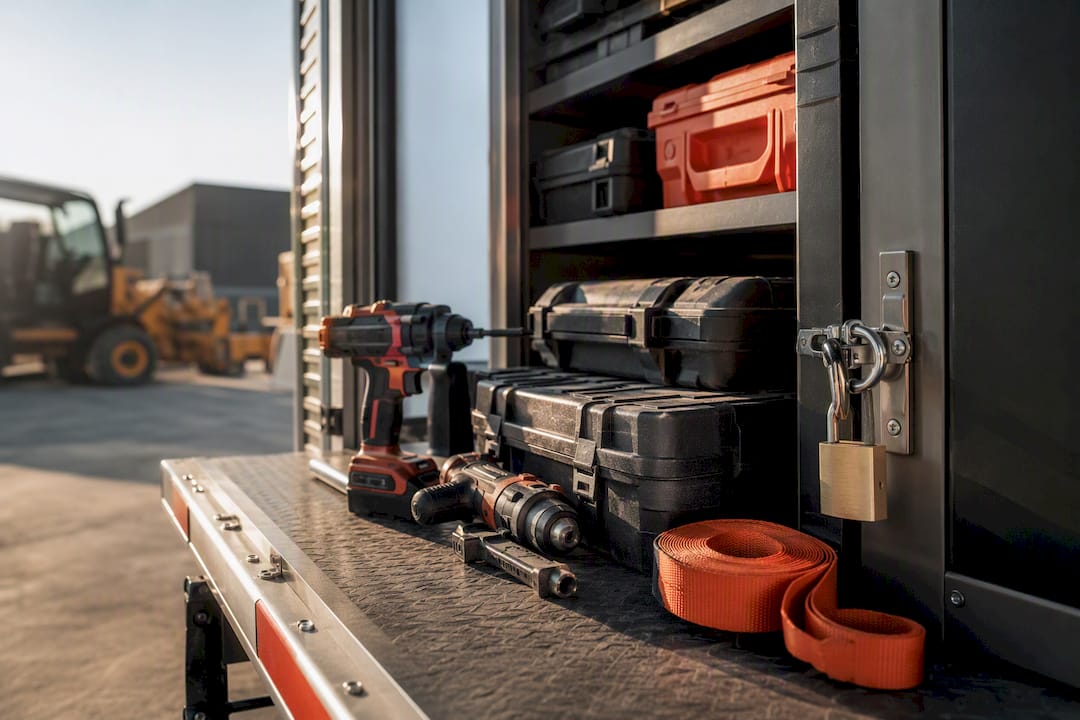
Goods-in-transit is the endorsement most contractors skip and most regret skipping. If your tools travel in a bakkie or trailer between sites daily, transit loss without this endorsement often isn’t covered at all.
Hired-in equipment cover protects you against liability for plant or tools you’ve rented, which matters because most hire agreements make you responsible for that equipment regardless of fault. Hired-out cover works the other way, protecting your own tools when someone else is using them.
Cross-border or territorial extensions matter for contractors who occasionally work across provincial or national boundaries, since standard policies typically stop at the border by default.
Tracker and immobiliser endorsements aren’t just theft deterrents. On many policies, they’re a hard condition for theft cover to apply at all, so confirming the endorsement matches your actual device and subscription status matters more than the device itself.
Each of these adds premium, but each one also targets a specific, documented reason claims get repudiated. Adding the endorsement upfront is almost always cheaper than losing an entire claim to a gap you could have closed for a few extra rand a month.
What documentation proves you’re meeting insurance requirements?
Proving compliance, whether to a principal contractor, a tender panel, or your own insurer after a loss, comes down to a specific paper trail you should build before you ever need it.
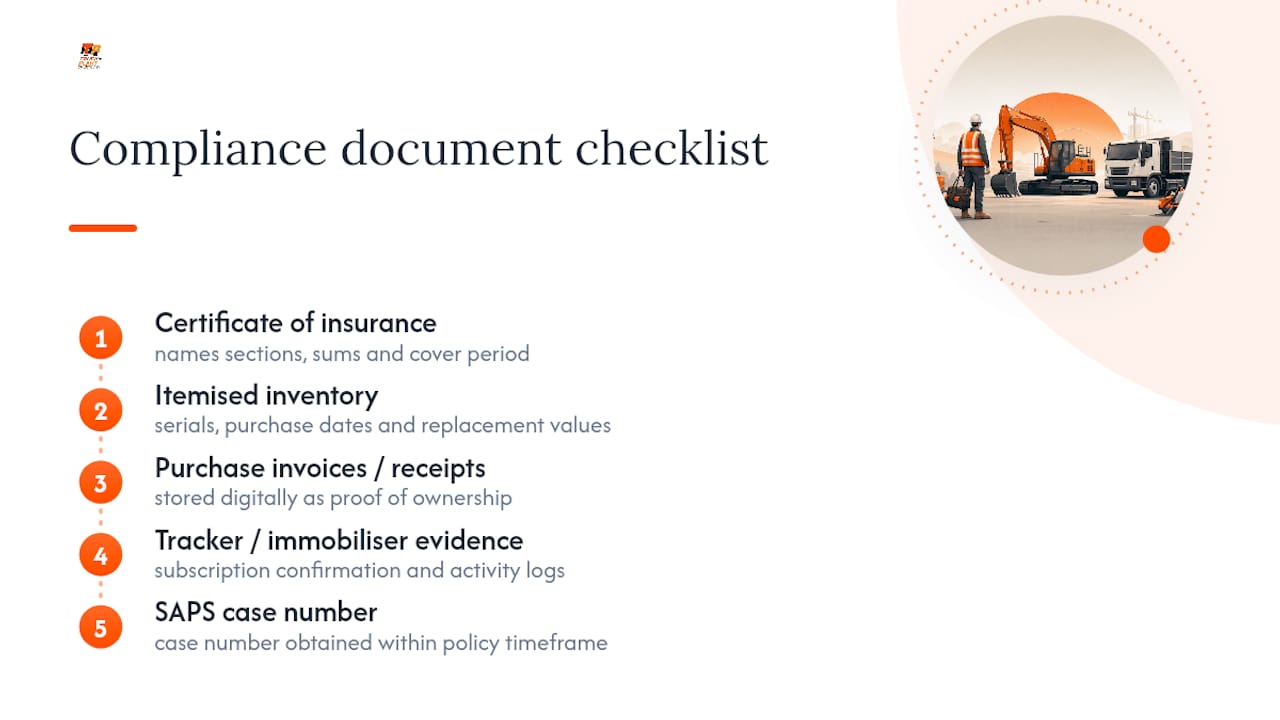
A certificate of insurance from your broker or insurer, naming the policy sections, sums insured, and period of cover, is the document most contracts and tenders will demand upfront. Keep it current and reissue it every renewal, not just when someone asks.
An itemised inventory with serial numbers, purchase dates, and current replacement values for every scheduled item gives you and your insurer a shared reference point that removes ambiguity at claim time. Pair it with purchase invoices or receipts, stored digitally so a stolen laptop doesn’t take your proof of ownership with it.
For tracker and immobiliser conditions, keep subscription confirmation and activity logs accessible, since these are exactly what an insurer will request first if a theft claim gets scrutinised. And if a loss does happen, a SAPS case number obtained within your policy’s stated timeframe is non-negotiable documentation, not an optional extra.
None of this is complicated to assemble. It just has to exist before the moment you need it, not after.
Get a tailored quote for your tools and equipment
You’ve seen how much a claim outcome depends on the right policy section, an accurate schedule, and disclosed movement. Truck & Plant On-Demand™ builds its Tool of Trade Insurance around exactly that reality. Instead of locking you into a fixed annual sum that either overcharges you in quiet months or underinsures you during a busy tender season, cover adjusts as your equipment use changes.

That flexibility matters most for contractors juggling multiple sites, seasonal work, or hired-in plant, where a static policy rarely matches actual exposure. If you’re unsure whether your current schedule reflects how your tools really move between site, vehicle, and workshop, request a tailored quote through Truck & Plant On-Demand™ and get cover that matches your operation instead of a generic annual estimate.
Where to check the primary policy wordings
For the wording behind the claims discussed here, consult the FAIS Ombud’s Botha determination for how misclassification plays out in a real dispute, the Barker commercial policy wording for section and limit language, and Mont Blanc’s plant all-risks guidance for the claim conditions insurers apply to theft.
A practical note on getting this right
The pattern behind most rejected tool claims isn’t fraud or bad luck. It’s a mismatch between how equipment is actually used and how the policy describes it on paper. Two habits fix most of this: confirm your tools sit under the correct section, not just any section with “contents” in the name, and keep a serial-numbered inventory current enough to survive scrutiny. From there, cover that adjusts with your actual workload, like Truck & Plant On-Demand™’s tool-of-trade product, closes the gap between what you’re paying for and what you’re actually exposed to.
— Coert
Sources
- FAIS Ombud: Determination — Botha (claim rejection due to wrong policy section)
- Business insurance policy wording (example) — Autogen brochure
- Plant all risks cover: what contractors need to know — Mont Blanc Financial Services
- Barker commercial insurance policy wording (full PDF)
FAQ
How can I insure my tools?
Start by checking which policy section your tools currently sit under: contents, all-risks, or a dedicated tool-of-trade section. If they regularly leave your premises, ask your broker to move them to a section built for off-site use, and disclose exactly how and where the equipment travels.
What is the average cost of tool insurance for a tradie?
Cost depends on your declared sum insured, claims history, theft risk in your area, and whether you use trackers or immobilisers, so there’s no single published rate. Truck & Plant On-Demand™ doesn’t publish a fixed price either; request a quote directly through their Tool of Trade Insurance page based on your actual equipment list.
How do I insure my work tools?
List every tool above your insurer’s scheduling threshold with its serial number and current replacement value, then confirm with your broker which policy section applies to off-site use. Discuss any tracker, immobiliser, or overnight securing conditions your insurer requires before you finalise cover.
What does tools insurance cover?
Most tool-of-trade or all-risks sections cover theft, accidental damage, vandalism, and fire, with transit loss included only if that section was specifically selected. Wear and tear, mechanical breakdown, and theft where security conditions weren’t met are typically excluded.