


TL;DR:
- Effective claims management relies on disciplined documentation, clear staff authority, and a structured workflow from claim reporting to settlement. Proper preparation prevents delays and denials, with AI playing an increasing role in streamlining early claim tasks. Businesses that treat claims management as an ongoing process see faster settlements and fewer legal risks.
Claims management is the end-to-end process of recording, validating, and settling an insurance claim from the moment an incident occurs through to final payout. For business owners in civil, construction, and transport, a poorly managed claim costs more than the incident itself. Industry standards define the reporting window as 24–72 hours post-incident for most commercial policies. Miss that window and you risk denial before the process even begins. Step by step claims management removes that risk by giving every person in your operation a defined role, a clear sequence, and no room for guesswork. About 20% of claims are denied initially, most often due to missed deadlines or incomplete documentation. A structured workflow closes those gaps before they open.
What do you need before you start managing claims?
Effective claims handling starts before any incident occurs. The businesses that recover fastest are the ones that have their documentation systems, staff training, and communication protocols in place on day one.
Required documentation
Every claim needs a core set of evidence to be taken seriously by an insurer. Collect and store the following for every incident:
- Photographs of all damage, taken immediately and from multiple angles
- Police reports where applicable, especially for theft, collision, or third-party incidents
- Repair estimates from qualified contractors or panel beaters
- Invoices and purchase records for damaged equipment or vehicles
- Driver or operator statements captured within hours, not days
- Witness contact details where available
Missing any one of these items forces your adjuster to chase information, which adds days to your cycle time.
Tools and systems that enforce completeness
Structured digital intake forms that prevent submission until all required fields are complete cut the time lost to chasing missing information. Paper-based intake is the single biggest source of incomplete files in fleet and plant operations. A digital checklist tied to your first notice of loss (FNOL) process removes that risk entirely.
Defined authority limits for staff are equally critical. Only authorised personnel should discuss coverage, make commitments, or negotiate on behalf of the business. Unqualified staff making coverage promises can inadvertently waive your rights before the claim is even lodged.
Pro Tip: Set your digital intake form to lock submission until every mandatory field is complete. This one change eliminates the most common cause of delayed claims: missing information discovered days after the incident.
Communication records
Documenting every interaction with timestamped notes creates a defensible timeline if a dispute arises. Log every call, email, and site visit in a central file. This record becomes your strongest asset if the insurer challenges your version of events.

For fleet operators managing fleet management efficiency, the same discipline that keeps vehicles on the road applies directly to claims. Structured processes, clear accountability, and complete records produce better outcomes in both areas.
What are the steps in the claims management workflow?
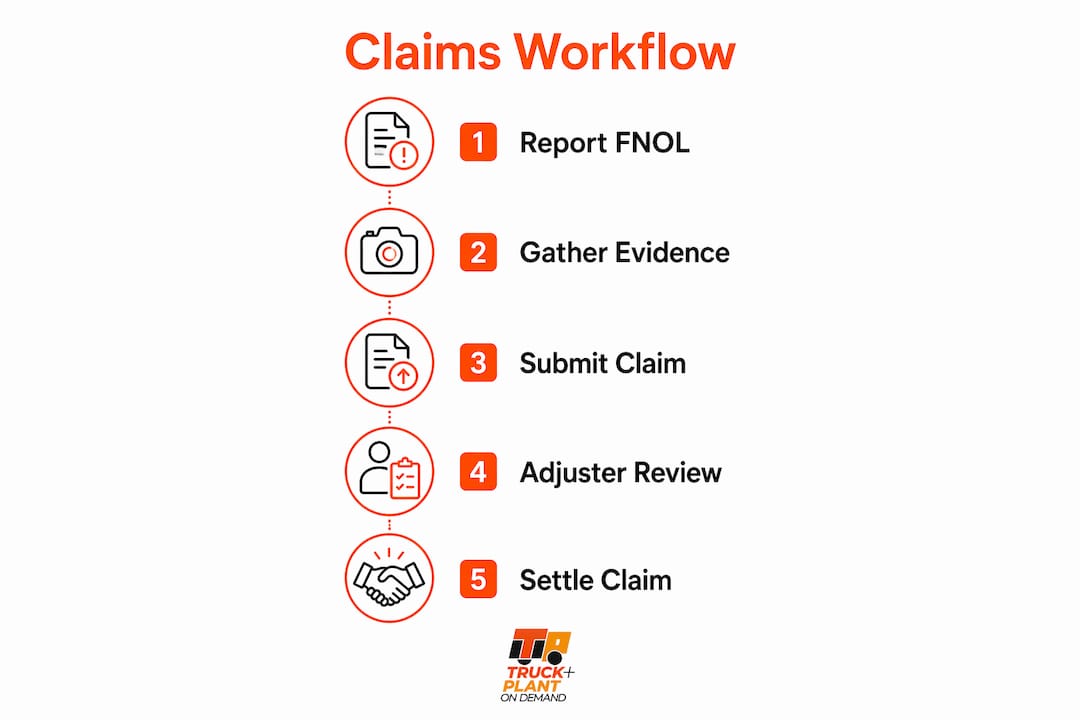
The claims lifecycle follows five stages. AI now handles 30–40% of claim lifecycle tasks before a human adjuster engages, which means your digital intake quality directly determines how fast your claim moves. Here is the full workflow:
-
First Notice of Loss (FNOL)
- Report the incident within the 24–72 hour window required by your policy.
- Record facts only. Do not speculate on cause, fault, or coverage.
- Capture photos, driver statements, and police report numbers at this stage.
- Assign a claim reference number and open a dedicated file immediately.
-
Validation and investigation
- Submit all supporting documentation: photos, estimates, invoices, and official reports.
- Your insurer or adjuster will verify the facts against your policy terms.
- Provide contractor estimates from qualified, registered service providers.
- Do not begin repairs until the insurer has confirmed authorisation in writing.
-
Triage and routing
- Claims are assigned based on severity, complexity, and value.
- High-value plant or fleet claims go to specialist adjusters.
- Early fraud indicators are flagged at this stage, so complete and consistent documentation protects you.
- Confirm the adjuster’s name, contact details, and expected response timeline.
-
Communication and coordination
- Omnichannel communication reduces inbound calls and prevents information loss. Use email for formal updates and phone for urgent escalations.
- Provide updates to all stakeholders: drivers, site managers, and finance teams.
- Never speculate on settlement amounts or timelines. State only what is confirmed.
- Set a follow-up schedule and stick to it.
-
Settlement and closure
- Review the settlement offer against your policy terms, not against your expectations.
- If the offer is below what your documentation supports, submit a formal written dispute.
- Confirm payout details in writing before closing the file.
- Conduct a post-settlement review to identify process gaps for next time.
Pro Tip: At the FNOL stage, train every driver and site manager to say only: “I am reporting an incident. Here are the facts.” Nothing more. Language discipline at this stage prevents coverage commitments that create legal liability later.
The table below shows who is responsible for each stage:
| Stage | Business owner | Adjuster | Insurance agent |
|---|---|---|---|
| FNOL | Reports incident, gathers evidence | Opens file, assigns reference | Confirms policy details |
| Validation | Submits documentation | Verifies facts and policy | Clarifies coverage scope |
| Triage | Confirms adjuster contact | Assigns specialist if needed | Escalates complex cases |
| Communication | Updates internal teams | Provides formal status updates | Manages insurer relationship |
| Settlement | Reviews offer, signs off | Calculates and authorises payout | Advises on dispute options |
For a more detailed breakdown of the fleet claims process, Truckplant’s resource covers the specific steps for transport and fleet operators.
What mistakes cause claim denials and delays?
The most common claims errors are predictable and preventable. Knowing them in advance is the difference between a paid claim and a denied one.
- Late reporting. Missing the 24–72 hour notification window is the fastest route to denial. Set an internal rule: any incident triggers an immediate report, regardless of perceived severity.
- Incomplete documentation. A claim without photos, estimates, or a police report gives the insurer grounds to reduce or reject the payout. Collect everything at the scene, not the next morning.
- Premature repairs. Starting repairs before submitting documentation can result in denial or a reduced settlement. Photograph all damage first. Get written authorisation before any work begins.
- Unauthorised coverage discussions. Staff who discuss coverage without authority can waive your rights. Only designated personnel should speak to insurers or adjusters about coverage terms.
- Broken communication loops. Files stall when no one owns the follow-up. Assign a named person to each claim and set calendar reminders for every follow-up deadline.
- File abandonment after settlement. Closing the file without a post-settlement review means repeating the same mistakes. Schedule a brief debrief after every significant claim.
Pro Tip: Tell your clients and internal teams exactly when they will hear from you: “You will receive an update every Tuesday by 3:00 PM.” Specific commitments prevent the ‘inbox black hole’ where claims stall because no one knows who is waiting on whom.
How do you negotiate a claim settlement effectively?
Settlement negotiation is not about arguing. It is about presenting documented evidence that supports the value of your claim.
The policy contract is the source of truth, not perceived fairness. Read the relevant clauses before you respond to any offer. If the insurer’s calculation does not match your reading of the policy, request a written explanation of their methodology.
Understanding how insurers calculate settlements matters. Actual cash value (ACV) deducts depreciation from the replacement cost of an asset. Replacement cost value (RCV) pays the full cost to replace the item at current prices. Most commercial plant and fleet policies specify which method applies. Know which one governs your claim before you negotiate.
| Negotiation approach | When to use it | Key tip |
|---|---|---|
| Submit additional evidence | Offer is below documented value | Attach contractor quotes, invoices, and photos |
| Request written explanation | Calculation method is unclear | Ask insurer to detail ACV vs RCV basis |
| File a formal written dispute | Offer is materially below policy entitlement | Reference specific policy clauses in your letter |
| Engage a public adjuster | Claim value is large and complex | Weigh their fee (typically a percentage of settlement) against the potential uplift |
For large civil or construction claims, a public adjuster can negotiate on your behalf. Their fee is typically a percentage of the final settlement, so the cost-benefit calculation depends on the gap between the initial offer and your documented claim value. For guidance on policy contract terms, Truckplant’s terminology guide clarifies the language that matters most in these negotiations.
Key takeaways
Effective claims management requires documentation discipline, defined staff authority, and a structured five-stage workflow from FNOL through to settlement review.
| Point | Details |
|---|---|
| Report within 24–72 hours | Late notification is the leading cause of claim denial across commercial policies. |
| Document everything at the scene | Photos, statements, and estimates collected immediately protect your settlement value. |
| Restrict who discusses coverage | Only authorised staff should speak to insurers to prevent inadvertent rights waivers. |
| Use the policy as your negotiation anchor | Reference specific clauses and documented evidence to challenge low settlement offers. |
| Review every claim after closure | Post-settlement debriefs reduce repeat errors and shorten future cycle times. |
Claims management is a discipline, not a one-time event
I have worked with enough fleet and plant operators to know that the businesses with the best claims outcomes are not the ones with the fewest incidents. They are the ones with the most disciplined intake processes. The difference shows up in cycle time. When documentation is complete at FNOL, adjusters move faster. When staff know exactly what they can and cannot say, disputes are rare.
The part most operators underestimate is language discipline. At FNOL, the instinct is to reassure the driver or the client. That instinct leads to phrases like “don’t worry, this will be covered” before anyone has read the policy. Those words create liability. Training your team to state facts and nothing more is not about being cold. It is about protecting the claim.
Technology helps, but it does not replace judgment. AI now handles a significant portion of early claim processing, which means your digital intake quality determines how quickly a human adjuster sees your file. A clean, complete digital submission moves faster than a paper file with handwritten notes every time.
The operators I respect most treat claims management as an ongoing operational discipline, not something they think about only after an incident. They run quarterly reviews of their claims history, update their intake checklists, and retrain staff when gaps appear. That approach pays for itself in faster settlements and fewer denials.
— Coert
Truckplant’s cover for businesses that need claims to work
Managing a claim efficiently starts with having the right cover in place before the incident happens. Truckplant’s fleet insurance for commercial vehicles is built specifically for civil, construction, and transport operators who need cover that matches how their business actually works, not a fixed premium for assets that sit idle half the month.
Truckplant’s Truck & Plant On-Demand™ gives you control over what you insure, when you insure it, and how your cover changes as your operations change. Whether you run a single truck or a mixed fleet of yellow plant machinery, the cover adjusts to your workload. When a claim does arise, you are working from a policy that reflects your actual operations, which makes the entire claims process cleaner and faster. Explore plant hire insurance or truck insurance tailored to your sector.
FAQ
What is the first step in claims management?
The first step is the First Notice of Loss (FNOL): report the incident to your insurer within 24–72 hours, record facts only, and open a dedicated claim file with all available evidence.
Why are so many insurance claims denied initially?
About 20% of claims are denied initially, most often because of missed reporting deadlines or incomplete documentation submitted at intake.
Can I start repairs before my claim is settled?
No. Beginning repairs before submitting documentation can result in claim denial or a reduced payout. Photograph all damage and obtain written authorisation from your insurer before any repair work begins.
What is the difference between actual cash value and replacement cost?
Actual cash value deducts depreciation from the cost to replace an asset. Replacement cost value pays the full current replacement price. Your policy specifies which method applies, and knowing this before you negotiate is critical.
How does AI affect the claims process in 2026?
AI now handles 30–40% of claim tasks before a human adjuster engages. This means a complete, well-structured digital submission moves through the system faster than an incomplete or paper-based file.