


Yes, telematics can lower fleet insurance costs, but only when you hand your insurer high-quality, insurer-ready driving and video evidence. Fleets that share validated safety data can earn up to 20% off their premiums, according to Geotab. That figure isn’t a blanket guarantee. It depends on how clean your data is, how your insurer’s underwriting model treats telematics, and how your fleet’s risk profile compares to its own history.
TL;DR:
- Fleets that provide complete, normalized telematics data combined with dashcam footage can earn up to 20% insurance premium discounts in South Africa.
- Consistent, actionable safety trends and documented coaching actions over several months significantly increase the likelihood of premium reduction.
- Data gaps, mixed hardware, and lack of driver consent or clear governance can cause underwriters to discount the insurance benefits of telematics programs.
- Using a comprehensive insurer-ready data pack that includes mileage, event rates, high-risk routes, and video evidence simplifies underwriting and speeds up renewal negotiations.
- On-demand insurance paired with telematics can reduce costs by charging only for active operation, especially beneficial for fleets with seasonal or variable workloads.
Table of Contents
- How telematics changes the insurer’s view of fleet risk
- What telematics metrics and evidence insurers use when pricing fleets
- Usage-based insurance: typical savings, how discounts are earned, and realistic expectations
- Preparing an insurer-ready telematics underwriting pack before renewal
- Operational benefits that support insurance outcomes
- How Truck & Plant On-Demand™ aligns telematics with flexible insurance for fleets
- Challenges and limitations of telematics insurance for fleets
- Privacy and data security considerations for fleet telematics data
- Regulatory compliance related to telematics data usage in insurance
- Case studies or examples of successful telematics insurance programs for fleets
- Author’s perspective: when telematics is worth the investment for your fleet
- Get insurer-ready with Truck & Plant On-Demand™
- Sources
How telematics changes the insurer’s view of fleet risk
Traditional fleet insurance pricing leans on blunt instruments: vehicle count, cargo type, claims history, and a rough sense of your operating radius. Telematics insurance for fleets replaces guesswork with a continuous feed of driving evidence, and that shift changes how underwriters actually think about your risk.
Modern telematics platforms capture GPS location, speed against posted limits, harsh braking and acceleration events, engine diagnostics, mileage, and detailed trip patterns. Insurers value this data because it’s granular and it’s inspectable. A single at-fault claim tells an underwriter almost nothing about your fleet’s day-to-day behaviour. Six months of event data across forty vehicles tells them everything.
This is exactly why underwriters increasingly reject summarised “black box” scores in favour of normalized, high-frequency raw telematics data they can validate themselves and plug into their own risk models. A vendor’s proprietary safety score might be directionally useful, but it doesn’t let an underwriter interrogate the underlying events, and that limits how much credit they’re willing to extend at renewal.
What this data actually enables:
- Behaviour-based pricing that rewards individual driver improvement, not just fleet-wide averages
- Granular segmentation by route, time of day, and vehicle type instead of one flat commercial rate
- Faster identification of the small percentage of drivers generating most of your risk exposure
- A defensible paper trail if a claim ever goes to dispute or litigation
Implementation isn’t frictionless. Patchy cellular coverage in rural operating areas creates data gaps that look suspicious to an underwriter even when they’re purely a connectivity issue. Inconsistent sampling rates between older and newer units can skew event counts. And if you don’t have clear data governance, meaning who owns the data, how long it’s retained, and how driver consent is documented, your underwriter has no way to trust what you’re handing them.
Pro Tip: Standardize your device fleet where possible. Mixing three telematics vendors across one fleet makes your data pack look inconsistent to an underwriter, even if every vehicle is driving safely.
What telematics metrics and evidence insurers use when pricing fleets
Underwriters don’t read raw GPS logs. They read a specific set of derived metrics, and knowing which ones matter lets you focus your coaching and reporting effort where it actually moves the needle at renewal.
- Driver scorecards and event counts. Harsh braking frequency, speeding events per 100 kilometres, phone-use flags, and cornering aggression all roll into individual driver scores that insurers weight heavily.
- Usage and exposure metrics. Total mileage, garaging location, operating radius, and time-of-day patterns (night driving carries materially different risk than daytime delivery runs).
- Contextual corroborating evidence. Route heatmaps that flag known high-risk corridors or intersections your fleet regularly travels through.
- Video and dashcam clips. Objective footage tied to specific events, used both to demonstrate safe driving and to contest false liability claims.
- The consolidated data pack. Everything above, normalized and packaged for the underwriter at quote or renewal stage.
Dashcam evidence deserves particular attention here. Video footage tied to inspectable telematics can materially reduce claim severity and shorten disputes, which matters enormously in commercial auto lines where a single catastrophic verdict can run into the tens of millions. Insurers underwriting fleets know this, and fleets that can produce clean video evidence on demand are treated differently at renewal than fleets that can only offer a verbal account of what happened.
Usage-based insurance: typical savings, how discounts are earned, and realistic expectations
Usage-based insurance for fleets isn’t one product. It’s a spectrum, and where your fleet lands on it determines what kind of savings you can realistically expect.
At the simple end, insurers apply a one-time renewal discount after reviewing a season’s worth of telematics data. In the middle, some carriers price policies dynamically against ongoing mileage and behaviour trends. At the more sophisticated end, a handful of programs adjust rates closer to daily or monthly, reflecting exposure almost in real time.
Geotab’s reported savings of up to 20% sits at the strong end of that range, and it typically applies to fleets that share complete, full-fleet coverage data rather than a partial sample from a handful of “good” vehicles. A few factors tend to increase your odds of meaningful savings:
- Full-fleet telematics coverage, not just the newest or best-behaved vehicles
- Dashcam footage layered on top of driving data, not GPS tracking alone
- A visible improving trendline over several months, not a single clean snapshot
- Documented coaching actions tied to flagged events
The reverse is also true. If your data shows deteriorating safety trends, missing exposure history, or gaps that suggest you’re only reporting your best vehicles, telematics can just as easily push your premium up rather than down. Insurers reward transparency and improvement. They penalise ambiguity.
Preparing an insurer-ready telematics underwriting pack before renewal
Most fleets already own enough telematics hardware to qualify for insurer discount programs. The real barrier is normalising and packaging the right evidence rather than acquiring new devices. Here’s the protocol brokers actually use.
- Export twelve months of history. Pull mileage, trip logs, engine data, and event records across your entire fleet inventory, not a curated subset.
- Calculate fleet-level event rates per 100,000 kilometres. This normalization step is what lets an underwriter compare your fleet fairly against industry benchmarks.
- Identify your top ten highest-risk routes. Route heatmaps showing where harsh events cluster give underwriters context that raw numbers alone don’t provide.
- Document coaching actions and outcomes. If a driver’s harsh-braking events dropped 40% after a coaching session, that trendline is worth more to an underwriter than a clean record with no history behind it.
- Select representative video clips tied to specific incidents. A handful of well-chosen dashcam clips demonstrating safe defensive driving carries more weight than hours of unreviewed footage.
This five-step format, used by fleet insurance brokers working high-risk transport accounts, shortens insurer due diligence considerably because it hands the underwriter exactly what they need to validate, rather than raw data they have to interpret themselves.
Pro Tip: Pilot your data pack process on one depot or vehicle class first. It’s far easier to fix normalization errors, like inconsistent event definitions or missing driver IDs, on twelve vehicles than on a fleet of two hundred.
Before you roll this out fleet-wide, get driver buy-in. Explain that scorecards inform coaching, not punishment, and be explicit about what data is retained and for how long. Skipping that conversation is the single most common reason telematics programs stall internally, long before they ever reach an underwriter’s desk.
Operational benefits that support insurance outcomes
Insurance savings rarely come from telematics data alone. They come from what that data lets you do operationally, and those downstream effects are what actually move an underwriter’s opinion of your fleet over time.
Dashcam footage paired with electronic first notice of loss (eFNOL) workflows shortens claim settlement times and reduces dispute costs. High-fidelity video can exonerate a driver in a false third-party liability claim, and the ability to route that footage directly into a claims system materially cuts your legal exposure on severe incidents.
Behaviour-change programs built on scorecard data produce measurable results. Fleets that act on harsh-braking and speeding flags, rather than just collecting them, typically see event frequency and severity drop within a few months of consistent coaching.
Maintenance alerts generated from engine diagnostics catch mechanical issues, worn brakes, failing sensors, before they become incidents. Fewer mechanical-failure claims means a cleaner loss history independent of driver behaviour entirely.
The compounding effect matters most at renewal:
- Fewer claims filed means a stronger loss-run history to present to your broker
- Lower claim severity (thanks to video evidence) means insurers pay out less per incident
- Faster settlements mean less reserve capital tied up in open claims
- A documented coaching program shows the underwriter you’re managing risk actively, not just monitoring it
Each of these compounds into a stronger renewal negotiation. An underwriter reviewing three years of falling event rates and shrinking claim severity has a genuinely different conversation with your broker than one starting from a flat loss history with no context.
How Truck & Plant On-Demand™ aligns telematics with flexible insurance for fleets
Telematics data tells you and your insurer when your fleet is actively operating and when it isn’t. Traditional annual policies ignore that entirely. You pay the same premium whether a truck runs six days a week or sits idle for a month during a slow season.
Truck & Plant On-Demand™ works differently. You insure vehicles and plant equipment only when they’re active, and you adjust cover as your operations change. Paired with telematics evidence, this combination directly addresses total cost of ownership: you stop paying full premium on idle assets, and the safety data you’re already collecting strengthens your position when you do need cover switched on.
If you’re ready to test this, the practical next step is straightforward: assemble a basic data pack from your existing telematics platform, covering mileage, driver scorecards, and any available video evidence, and request a pilot quote. You don’t need new hardware to start. You need the evidence you already have, packaged and presented properly.
Challenges and limitations of telematics insurance for fleets
Telematics insurance for fleets isn’t a universal fix, and pretending otherwise sets fleet managers up for disappointment at renewal.
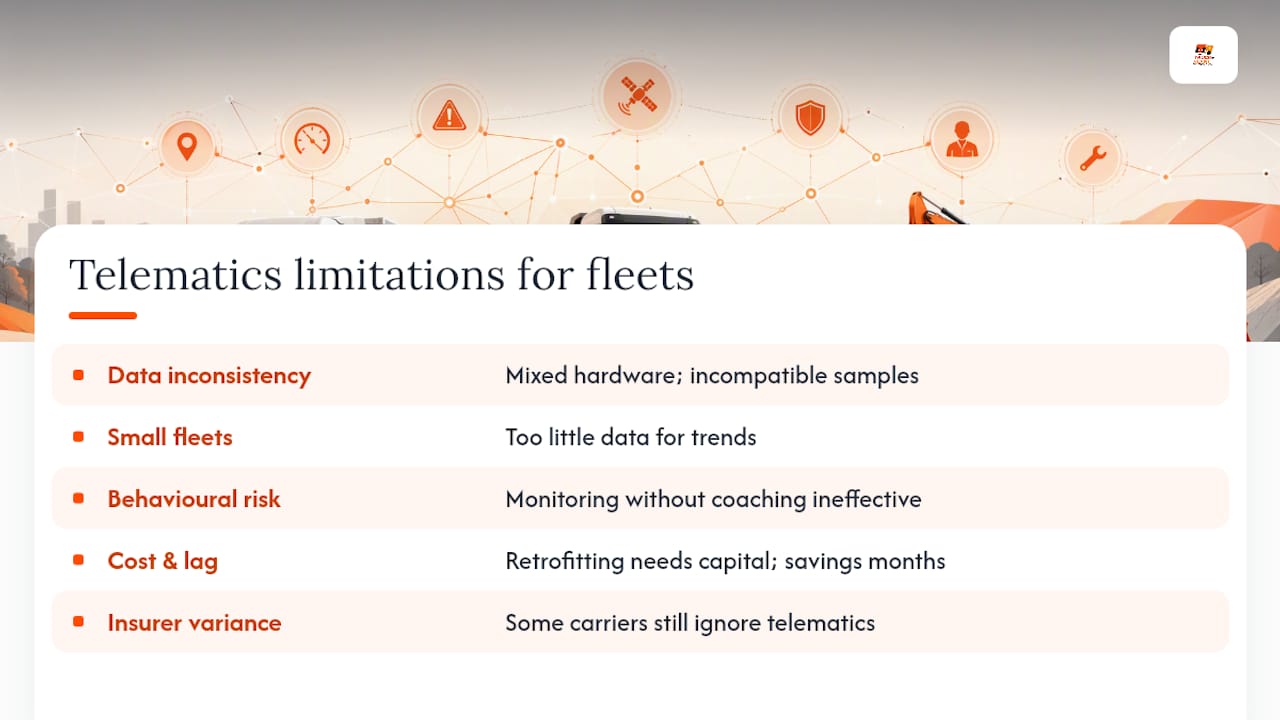
The most common limitation is data inconsistency. Fleets running mixed hardware, some older units, some newer, often generate event data with different sampling rates and definitions. An underwriter reviewing that data sees noise, not a clear risk trend, and may discount its value entirely.
Small fleets face a structural disadvantage too. A five-vehicle operation simply doesn’t generate enough data volume for statistically meaningful trends the way a two-hundred-vehicle fleet does, which limits how much weight some insurers give telematics evidence at that scale.
There’s also a behavioural risk: telematics only helps if fleets act on what it shows. Collecting harsh-braking data without a coaching program attached demonstrates monitoring, not risk management, and underwriters increasingly distinguish between the two.
Cost is a real factor as well. Retrofitting dashcams and telematics units across an existing fleet requires upfront capital, and the return in premium savings takes months to materialize, not weeks. Fleets need to budget for that lag.
Finally, not every insurer weighs telematics equally. Some carriers have mature usage-based programs; others still price almost entirely on traditional factors like vehicle count and cargo class, meaning the discount you earn depends as much on which insurer you’re with as on how well you drive.
Privacy and data security considerations for fleet telematics data
Fleet telematics data is sensitive by nature. It tracks where a vehicle, and by extension a driver, is at every moment of a working day, and that raises legitimate concerns fleet managers need to address before rolling out any insurance-linked monitoring program.
Driver consent is the starting point. Drivers need clear, documented explanation of what’s being collected, who sees it, and how it factors into coaching or disciplinary decisions. Skipping this step erodes trust fast, and a workforce that distrusts monitoring will find ways to work around it, undermining the data quality you need for underwriting purposes anyway.
Data retention policy matters just as much. Fleets should define, in writing, how long raw GPS and video data is kept, who can access it, and under what circumstances it gets shared externally, including with insurers. Handled transparently, telematics data becomes a shared tool between fleet and driver. Handled poorly, it becomes a surveillance flashpoint.
Security is the third pillar. Telematics platforms transmit location and behavioural data continuously, which makes them a target worth protecting with the same rigor you’d apply to any other business-critical system, encryption in transit, access controls, and regular audits of who within your organization can pull driver-level reports.
Regulatory compliance related to telematics data usage in insurance
Telematics sits at the intersection of insurance regulation and data protection law, and fleet managers need to treat both seriously rather than assuming a telematics vendor has compliance fully covered.
On the data protection side, South African fleets fall under the Protection of Personal Information Act, which governs how location and behavioural data tied to identifiable drivers can be collected, stored, and shared. Insurance-linked telematics programs need a clear lawful basis for processing that data, typically documented consent, and drivers need visibility into how their information feeds into pricing decisions.
On the insurance side, how telematics data can be used in underwriting varies by insurer and by product line. Some carriers build telematics discounts into standard commercial auto policies; others treat it as a separate usage-based rider with its own terms. Fleet managers should ask their broker directly how telematics data will be used in pricing, whether it can ever increase a premium as well as decrease one, and how disputes over data accuracy get resolved.
Compliance isn’t a one-time checkbox. As your fleet adds new telematics vendors, integrates new dashcam systems, or expands into new operating regions, your consent documentation and data-sharing agreements need to keep pace. A program that was compliant at launch can drift out of compliance quietly if nobody revisits it.
Case studies or examples of successful telematics insurance programs for fleets
The clearest pattern across fleets that successfully turn telematics into premium savings is consistency, not sophistication. Fleets don’t need the most advanced platform on the market. They need complete coverage, clean data, and a visible track record of acting on what the data shows.
Transport and logistics operators working high-risk corridors have used the route heatmap and coaching-log approach to shift renewal conversations from defensive to collaborative. Instead of a broker justifying a flat loss history to an underwriter, they arrive with evidence of exactly which routes generated risk and what the fleet did about it.
Fleets combining GPS tracking with AI-enabled dashcams report the strongest combined effect: reduced incident frequency and severity driven by both proactive coaching and the deterrent effect of drivers knowing footage exists. That combination, behaviour data plus video evidence, tends to produce more durable underwriting relationships than telematics alone, because it gives insurers two independent data sources that corroborate each other rather than one score they have to take on faith.
The common thread across these programs isn’t the specific vendor or hardware. It’s fleet-level coverage applied consistently, month after month, with someone on the fleet side actually reviewing the output and acting on it.
Author’s perspective: when telematics is worth the investment for your fleet
Telematics pays off fastest for fleets with an existing claims history and the operational bandwidth to act on flagged events. If your fleet is small, your losses are already low, and nobody has time to review scorecards weekly, you’ll likely see limited return. Pursue it as an insurance-first play only once you’ve got the governance to back it. Otherwise, build the operational habit first: driver trust and clean data discipline matter as much as the hardware itself.
— Coert
Get insurer-ready with Truck & Plant On-Demand™
Traditional annual fleet policies charge you the same premium whether your trucks run flat out or sit idle for weeks. Truck & Plant On-Demand™ is a genuine alternative: cover that switches on and off with your actual operations, so you’re never paying full premium for equipment that isn’t earning.

Pair that flexibility with the telematics evidence you’ve already started collecting, driver scorecards, mileage records, dashcam clips, and you’ve got a fleet insurance strategy that adjusts to both how much you’re driving and how safely you’re driving it. If you’re managing real-time policy changes across a South African fleet, on-demand cover removes the friction of waiting for a full annual renewal to reflect changes in your operation.
Ready to see what it looks like for your fleet? Get a quote for fleet cover and bring your telematics data pack. It’s the fastest way to find out exactly where your premium stands.
Sources
- Telematics insurance: Fleet manager’s guide on how it works, benefits + provider options | Geotab
- Telematics data for commercial auto insurance | Terminal
- FleetCam: nuclear verdicts and the value of evidence