


TL;DR:
- Self-service insurance enables construction businesses to manage policies, claims, and compliance remotely, reducing costs and delays. Effective platforms validate endorsement requirements, automate routine workflows, and require accurate data to build trust and ensure risk mitigation. A hybrid approach combining automation with human expertise is essential for optimal risk management and operational efficiency.
Self-service insurance is defined as the digital, user-driven management of insurance policies, claims, certificates, and documents through online platforms, without requiring phone calls or broker intermediaries for routine tasks. For civil and construction business owners, this model is no longer a convenience. It is a direct lever for cutting administrative costs, speeding up compliance, and keeping projects on track. Platforms like Isner Insurance’s COI portal and AWS-powered contact centre solutions demonstrate that the role of self-service insurance extends well beyond basic policy viewing. It reshapes how your entire operation handles risk, documentation, and vendor onboarding.
How does self-service insurance work for civil and construction businesses?
Self-service insurance platforms give you direct control over the full policy lifecycle through a digital portal. You can view active policies, pay premiums, submit and track claims, generate certificates of insurance (COI), and download compliance documents, all without waiting for a broker or call centre agent. For construction managers juggling multiple subcontractors and project sites, 24/7 portal access removes the bottleneck of business-hours-only support.

The technology behind these platforms has advanced considerably. AI-driven chatbots and automated inquiry routing now handle a significant share of inbound questions. AI-enabled self-service handles roughly 60 to 70% of inbound insurance policy inquiries for major U.S. property and casualty carriers, with complex cases routed to human agents. This means your team spends less time on hold and more time managing site operations.
Core features you should expect from a construction-ready self-service platform include:
- Policy lifecycle management: View, amend, and renew cover without manual broker intervention
- COI portals: Generate certificates instantly for subcontractors, clients, and project owners
- Claims submission and tracking: Log incidents, upload photos, and monitor claim status in real time
- Document automation: Access endorsements, schedules, and compliance records on demand
- AI inquiry handling: Get answers to routine policy questions through chatbot or automated response
Pro Tip: When evaluating a COI self-service portal, confirm it validates endorsement-level requirements, not just basic certificate issuance. Construction contracts frequently require additional insured status, waiver of subrogation clauses, and specific notice periods. A portal that only generates standard certificates will leave you exposed to compliance failures and contract disputes.
What are the key benefits of self-service insurance for business owners?
The most direct benefit is cost reduction. Toyota Insurance’s AWS implementation cut customer service infrastructure costs by 98.5% while handling 60% of inquiries through self-service. That figure reflects what happens when manual, phone-based processes are replaced with automated digital workflows at scale. For a construction company managing a fleet of vehicles and plant equipment, the same principle applies to your insurance administration overhead.
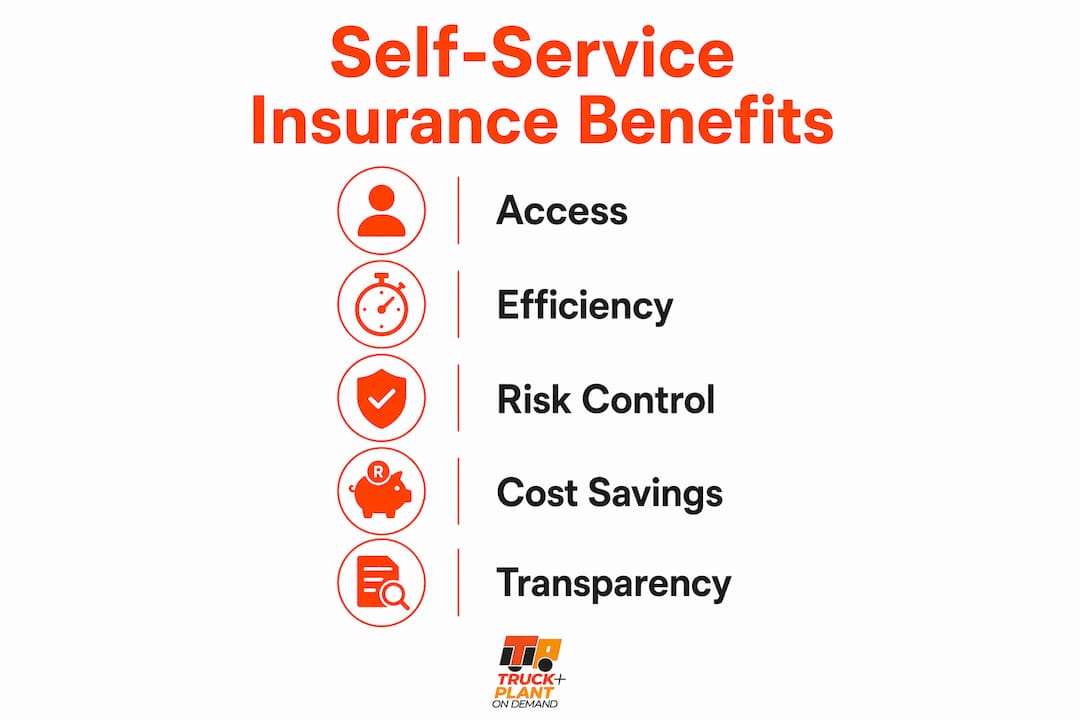
Beyond cost, the self-service insurance advantages for civil and construction firms include:
- Faster compliance: Certificates are generated in minutes, not days, removing project start delays caused by waiting for broker-issued COIs
- Vendor onboarding speed: Subcontractors can be verified and onboarded faster when compliance documentation is available on demand
- Reduced administrative load: Digitizing document-heavy workflows shifts staff effort from manual processing to higher-value tasks, delivering the highest cost relief in insurance operations
- Improved first-contact resolution: AI-powered platforms resolve routine queries immediately, improving satisfaction without adding headcount
- 24/7 access: Site managers and project administrators can pull policy documents or submit claims outside business hours, which matters when incidents happen on night shifts or weekends
The impact of self-service in insurance is also felt in risk management. When your team can access policy details and claims history instantly, they make better-informed decisions about coverage gaps and renewal priorities. That kind of visibility was previously reserved for large corporates with dedicated risk managers.
What are the challenges of implementing self-service insurance effectively?
Self-service works only when the data behind it is accurate and consistent. Inconsistent policy data, outdated documents, or mismatched endorsement records erode trust quickly. Successful self-service insurance depends on combining automation with broker or human expertise, and inconsistent data is the fastest way to undermine that combination. If a subcontractor pulls a certificate that reflects the wrong coverage limit, the consequences on a construction site can be severe.
Four implementation challenges deserve specific attention:
- Static document vaults: Portals that store documents without workflow integration underperform. Effective self-service portals create auditable tasks behind the scenes, triggering action and compliance checks rather than simply displaying files.
- Channel transition failures: When a self-service query escalates to a human agent, the handover must be seamless. Customers who have to repeat their problem from scratch lose confidence in the platform entirely.
- Endorsement verification gaps: For construction businesses, COI self-service must cover endorsement-level and contract-specific requirements, including additional insured validation and subrogation waivers, not just basic certificate generation.
- Over-reliance on automation: Complex claims, disputed coverage, and contract-specific queries still require human judgment. Removing that layer entirely creates risk, not efficiency.
Pro Tip: Before deploying a self-service platform for your construction business, audit your existing policy data for consistency across all vehicles, plant, and equipment. Clean, structured data is the foundation of a trustworthy portal. Garbage in, garbage out applies to insurance just as much as it does to any other data system.
How to leverage self-service insurance to optimise coverage and reduce costs
Choosing the right platform is the starting point. Look for self-service insurance platforms with strong policy administration integrations, real-time compliance checks, and construction-specific COI functionality. A platform that cannot validate endorsements or integrate with your project management workflows will create more problems than it solves. Truckplant’s approach to fleet insurance optimisation reflects this principle: cover should match operational reality, not a fixed annual estimate.
Once you have the right platform, set up automated workflows for the three highest-volume tasks: certificate generation, claims lodgement, and renewal reminders. These three processes account for the bulk of insurance administration time in construction businesses. Automating them frees your team to focus on site management and project delivery.
Track these metrics to measure the impact of self-service in your operation:
- Containment rate: The percentage of inquiries resolved entirely within the self-service channel, without escalation
- First-contact resolution rate: How often a query is resolved on the first interaction, whether digital or human
- Cost per inquiry: Total insurance administration cost divided by total inquiries handled, tracked monthly
- Certificate issuance time: Average time from request to delivery, which directly affects project start timelines
A hybrid model is the most practical structure for civil and construction businesses. Use self-service for routine tasks: certificate generation, premium payments, policy document access, and standard claims lodgement. Reserve human broker support for complex claims, contract-specific coverage negotiations, and major renewals. Brokers remain central to outcomes in complex insurance situations, and the best platforms make it easy to escalate without friction.
To evaluate ROI, compare your pre-implementation administration costs against post-implementation costs at the 3-month, 6-month, and 12-month marks. Include staff time, broker fees for routine tasks, and any project delays attributable to certificate or compliance bottlenecks. Use AI analytics built into your platform to identify which inquiry types still generate the most escalations. Those are your next automation targets. For practical steps on cutting fleet insurance costs, the approach mirrors this framework: measure, automate, review, and adjust.
Key takeaways
Self-service insurance platforms deliver the greatest value when they combine automated workflows, accurate policy data, and clear escalation paths to human expertise.
| Point | Details |
|---|---|
| Define the platform scope | Choose a platform with COI generation, endorsement validation, claims tracking, and policy lifecycle management built in. |
| Automate the highest-volume tasks | Certificate generation, claims lodgement, and renewal reminders deliver the fastest return on administration time. |
| Track the right metrics | Monitor containment rate, first-contact resolution, cost per inquiry, and certificate issuance time to measure real impact. |
| Use a hybrid model | Self-service handles routine tasks; human brokers handle complex claims and contract-specific coverage decisions. |
| Audit data before launch | Consistent, accurate policy data is the foundation of a trustworthy self-service portal in construction environments. |
Why self-service insurance is worth the investment, but only if you do it right
I have watched construction businesses invest in digital insurance portals and then wonder why adoption stalled six months later. The answer is almost always the same: the platform was built around the insurer’s workflow, not the contractor’s. Certificates that don’t reflect contract-specific endorsements. Claims portals that require data the site manager doesn’t have on hand. Escalation paths that dump the customer back at a call centre queue.
The self-service insurance advantages are real and measurable. The Toyota Insurance and AWS case is not an outlier. It reflects what happens when automation is applied to genuinely repetitive, high-volume tasks. But civil and construction businesses have a compliance layer that most other industries don’t. Every subcontractor relationship, every project contract, and every piece of plant on site carries specific insurance requirements. A generic portal won’t cover that.
What I find most encouraging about the current direction of self-service insurance platforms is the shift toward workflow integration rather than document storage. Static vaults are being replaced by systems that trigger tasks, validate endorsements, and flag compliance gaps automatically. That is the version of self-service that actually reduces risk for a construction business, rather than just reducing phone calls.
Trust is the variable that determines whether self-service succeeds or fails in this sector. Your subcontractors, project owners, and clients need to trust that the certificate they receive is accurate and compliant. Your team needs to trust that the platform reflects your actual cover at any given moment. Build that trust through data quality and you will see the efficiency gains follow.
— Coert
Take control of your fleet and plant cover with Truckplant
Truckplant’s Truck & Plant On-Demand™ is built on the same principle that makes self-service insurance work: you should only pay for the cover you actually need, and you should be able to change it when your operations change. Whether you’re managing a fleet of commercial vehicles or a yard full of yellow plant machinery, on-demand fleet insurance gives you full control over what you insure, when you insure it, and how much you pay. For civil and construction businesses that need cover to flex with project demands, that flexibility is not a luxury. It is a practical cost management tool. Explore tool of trade cover for your equipment alongside fleet protection in one place.
FAQ
What is the role of self-service insurance in construction businesses?
Self-service insurance gives construction business owners direct digital control over policy management, certificate generation, claims submission, and compliance documentation. It removes reliance on broker intermediaries for routine tasks, reducing delays and administrative costs.
How does self-service insurance work for certificate of insurance requests?
Self-service COI portals allow you to generate certificates instantly, 24/7, without contacting a broker or insurer by phone or email. The most effective portals also validate endorsement-level requirements such as additional insured status and subrogation waivers, which are standard in construction contracts.
What metrics should I track to measure self-service insurance performance?
Track containment rate, first-contact resolution rate, cost per inquiry, and certificate issuance time. These four metrics give you a clear picture of how much administrative load the platform is absorbing and where human intervention is still needed.
Can self-service insurance replace brokers entirely for construction firms?
No. Automation handles routine inquiries effectively, but complex claims, contract-specific coverage decisions, and major renewals still require human broker expertise. A hybrid model combining self-service efficiency with broker-led complex case handling is the most effective structure for construction businesses.
What is the biggest risk of implementing self-service insurance poorly?
Inaccurate or inconsistent policy data is the primary risk. If your portal displays incorrect coverage details or generates certificates that don’t reflect actual endorsements, you face compliance failures and potential contract disputes on site.