


TL;DR:
- Yellow plant insurance in South Africa includes Plant All Risk (PAR), covering individual machinery for theft, damage, and transit loss, and Contractors All Risk (CAR), which protects entire project sites and third-party liabilities. Contractors should assess their operational needs to include optional covers like breakdown, SASRIA, and goods in transit, ensuring comprehensive protection. Managing multiple policies effectively involves deliberate coordination, with on-demand insurance solutions like Truckplant offering flexible, tailored coverage aligned with evolving project demands.
Yellow plant insurance is a category of specialist cover designed to protect construction machinery such as excavators, loaders, graders, and backhoe loaders against theft, accidental damage, fire, transit loss, and project liabilities. In South Africa, the two primary types of yellow plant insurance are Plant All Risk (PAR) and Contractors All Risk (CAR), each serving a distinct purpose and scope. Understanding the difference between them, and knowing which optional extensions apply to your operation, is what separates a contractor who is fully protected from one who discovers gaps only at claims stage.
What are the types of yellow plant insurance?
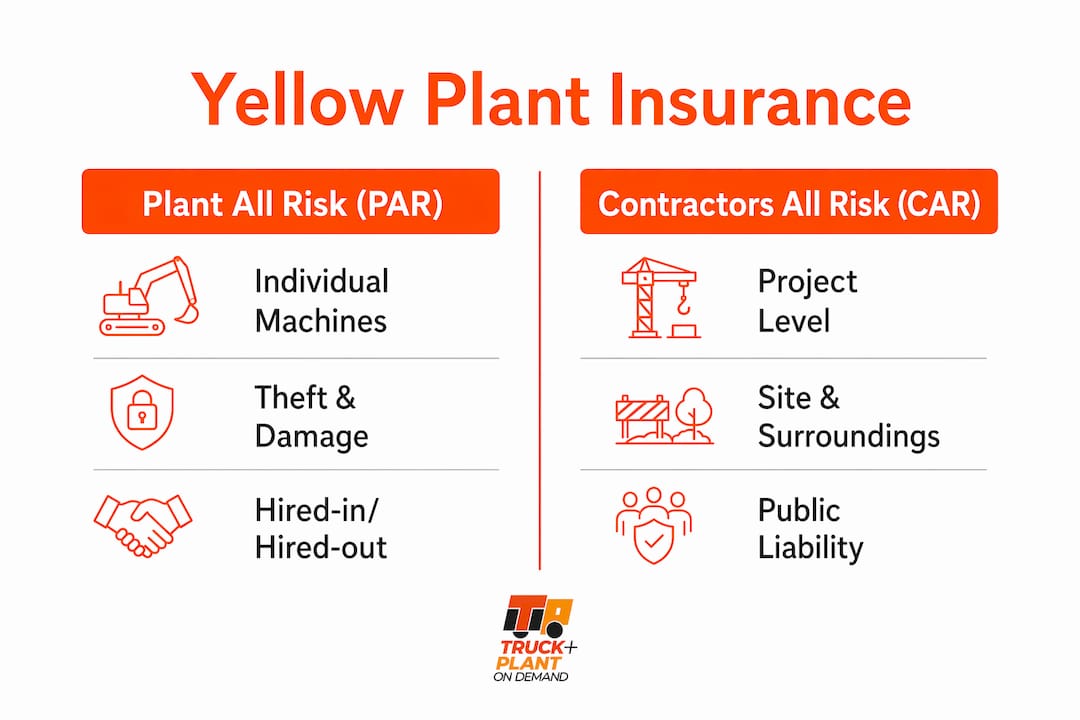
Plant All Risk insurance is the most common policy for individual yellow plant machinery in South Africa. PAR covers individual machines like excavators, loaders, and backhoe loaders against theft, fire, accidental damage, overturning, and collision, whether the machine is in storage, in transit, or actively working on site. This makes PAR the default starting point for any contractor who owns or finances yellow plant equipment.
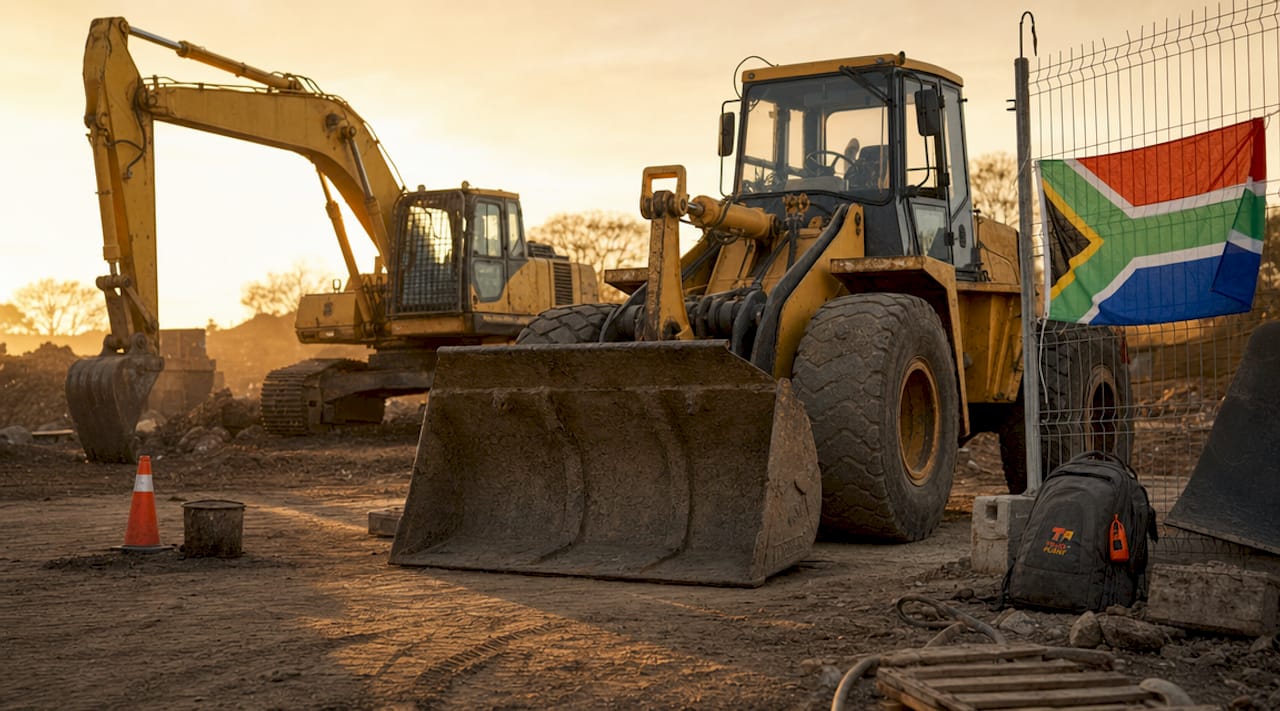
PAR policies are built around the machine itself rather than the project it is working on. This distinction matters because your excavator does not stop being a financial liability the moment it leaves a job site. A machine sitting in a yard overnight or being transported on a lowbed between contracts carries real risk, and PAR addresses all three phases of that exposure.
Common PAR coverage events include:
- Theft and attempted theft, including hijacking during transit
- Fire and explosion damage
- Accidental damage and overturning on site
- Collision damage during loading or transport
- Storm, flood, and weather-related damage
Pro Tip: If your machine is financed or leased, your lender will almost certainly require proof of PAR cover before releasing funds. Treat PAR as a financial compliance requirement, not just a risk management choice.
PAR policies can be extended to cover hired-in plant, hired-out plant, and hire charges lost due to downtime. This extension is particularly valuable for contractors who supplement their own fleet with rented equipment on larger projects, since a standard PAR policy on your owned machines will not automatically cover a hired excavator that gets damaged on your site.
How does Contractors All Risk (CAR) insurance differ?
Contractors All Risk insurance operates at the project level rather than the machine level. CAR covers the contract works including the construction site itself, surrounding property, and public liability, providing a broader scope than PAR. Where PAR protects your assets, CAR protects the project and the people around it.
The practical difference becomes clear when you consider what each policy responds to. If your excavator is stolen from a site, PAR responds. If your excavator damages a neighbouring building or injures a third party during operations, CAR responds. Most contractors working on large civil or building projects need both policies running simultaneously.
CAR is typically structured around four key coverage areas:
- Contract works: Physical damage to the works under construction, including materials and temporary structures
- Surrounding property: Damage to existing structures or infrastructure adjacent to the project
- Public liability: Bodily injury or property damage claims from third parties arising from site operations
- Employer’s liability: Claims from workers injured on site, depending on policy wording
CAR is also a tender requirement on most government and large private sector projects in South Africa. Submitting a bid without valid CAR cover in place will disqualify you before your price is even considered.
| Feature | PAR | CAR |
|---|---|---|
| Coverage focus | Individual machines | Entire project and site |
| Typical trigger | Machine theft, damage, transit loss | Third-party claims, works damage |
| Who needs it | All plant owners and operators | Contractors on formal projects |
| Tender requirement | Rarely required | Frequently required |
| Can they coexist? | Yes | Yes |
What optional covers complement yellow plant policies?
Beyond PAR and CAR, several optional extensions address risks that standard policies exclude. Getting these right is where contractors often leave themselves exposed, particularly in the South African operating environment.
Mechanical and electrical breakdown cover is the most frequently overlooked extension. This cover addresses sudden failures of mechanical or electrical components and is recommended for older or heavily used machinery where the risk of operational downtime is highest. Standard PAR policies exclude breakdown because it is considered a maintenance issue rather than an insured peril. The distinction matters: a hydraulic failure caused by a site accident is a PAR claim, but a hydraulic pump that fails due to internal wear is a breakdown claim. Without the extension, you carry that cost entirely.
SASRIA cover is non-negotiable for most South African contractors. SASRIA protects against losses caused by riot, strike, public disorder, and terrorism, perils that are explicitly excluded from standard insurance policies. South Africa’s history of labour unrest and community protests makes this a genuine operational risk rather than a theoretical one. SASRIA cover must be purchased separately and is added as an endorsement to your existing policy.
Goods in transit insurance fills the gap that PAR leaves during transportation. This cover protects plant and machinery during movement between sites, a phase where risk exposure is high and accidents are common. A machine being loaded onto a lowbed, transported on a public road, and offloaded at a new site passes through multiple risk events that a site-focused PAR policy may not fully address.
- SASRIA cover: purchased separately, covers riot, strike, terrorism, and public disorder
- Breakdown cover: optional extension, covers sudden mechanical or electrical failure
- Goods in transit: covers damage or loss during transportation between sites
- Hired-in plant extension: covers rented equipment operating under your supervision
Pro Tip: Bundle SASRIA cover onto every plant policy you hold. The premium is modest relative to the exposure, and a single protest-related incident can write off a machine worth several million rand.
What factors should contractors consider when choosing cover?
Selecting the right yellow plant insurance options requires an honest assessment of how your business actually operates. The right policy for a contractor running a single owned excavator on a long-term mine contract looks very different from the right policy for a civil contractor managing a fleet of hired and owned machines across multiple active sites.
Finance and ownership status is the first consideration. Insurance is often a condition for equipment financing or leasing agreements, where proof of comprehensive PAR cover may be required before funds are released. If you are financing yellow plant, your insurer and your lender need to be aligned from day one.
Key factors to evaluate when selecting plant insurance options:
- Owned vs. hired-in plant: Owned machines need PAR; hired-in machines need a PAR extension or a separate hired-in plant policy
- Stationary vs. mobile operations: Machines that move frequently between sites need stronger transit cover and goods in transit insurance
- Project type and size: Large formal contracts almost always require CAR; smaller subcontract work may not
- Machine age and condition: Older machines benefit significantly from breakdown cover extensions
- Geographic risk: Sites in areas with higher crime or labour unrest rates justify SASRIA and enhanced security requirements
- Contract and tender obligations: Review every contract for insurance requirements before signing
The cost of underinsurance consistently exceeds the cost of correct cover. A contractor who saves on premiums by skipping SASRIA or breakdown cover will pay far more when a claim is declined.
How do contractors manage multiple plant insurance policies?
Contractors commonly hold both PAR and CAR for their machinery fleets and individual projects, reflecting the differing scopes and coverage needs of each policy type. Managing these policies without gaps or redundancies requires deliberate coordination.
The most common pitfall is assuming that PAR and CAR overlap when they do not. PAR responds to machine-level events; CAR responds to project-level events. A contractor who holds only CAR and assumes it covers machine theft will discover the gap at the worst possible moment.
| Policy type | Renewal cycle | Managed by | Key coordination point |
|---|---|---|---|
| PAR (fleet) | Annual | Broker or insurer | Machine additions and disposals |
| CAR (project) | Project duration | Broker or principal contractor | Contract start and end dates |
| SASRIA | Annual (endorsement) | Attached to PAR or CAR | Confirm on each policy renewal |
| Goods in transit | Annual or per trip | Broker or insurer | Align with fleet movements |
Digital insurance platforms are changing how contractors manage this complexity. Truckplant’s Truck and Plant On-Demand model allows you to adjust cover as your fleet and project load changes, rather than locking into a fixed annual premium that does not reflect your actual operations. This is particularly relevant for contractors whose machine count and site exposure fluctuate significantly across the year. You can learn more about on-demand insurance solutions and how they apply to construction operations.
Key takeaways
PAR and CAR are not interchangeable. Every South African contractor operating yellow plant needs to hold both, supplemented by SASRIA, breakdown cover, and goods in transit insurance based on their specific operational profile.
| Point | Details |
|---|---|
| PAR covers individual machines | Use PAR for owned or financed yellow plant against theft, damage, fire, and transit loss. |
| CAR covers the project | CAR responds to third-party claims, works damage, and public liability at the project level. |
| SASRIA is not optional in SA | Riot, strike, and public disorder risks require a separate SASRIA endorsement on every policy. |
| Finance requires PAR proof | Lenders and financiers typically require valid PAR cover before releasing equipment finance. |
| Breakdown cover fills a critical gap | Older or heavily used machines need mechanical and electrical breakdown extensions to avoid uninsured downtime costs. |
Why I think most contractors are underinsured on yellow plant
by Coert
After years of working with construction contractors across South Africa, the pattern I see most often is not deliberate underinsurance. It is incomplete insurance. Contractors take out PAR because their lender requires it, and they assume that covers everything. It does not.
The SASRIA gap is the one that surprises people most. A community protest blocks site access, equipment gets damaged, and the contractor assumes their PAR policy responds. It does not. SASRIA is a separate purchase, and without it, you are carrying that risk entirely on your own balance sheet. Given South Africa’s labour relations environment, that is a significant exposure to leave unaddressed.
My honest advice: sit down with your broker and map every machine you own, every machine you hire in, and every project you are currently running. Then check whether your PAR covers the hired-in fleet, whether your CAR is current for each active project, and whether SASRIA is endorsed onto every policy. Most contractors find at least one gap in that exercise. Finding it before a claim is the only time it is not expensive.
The contractors I have seen handle claims most effectively are those who treat insurance as an operational system rather than an annual admin task. They update their schedules when machines are added or disposed of, they confirm CAR cover before mobilising on a new contract, and they review breakdown cover eligibility every renewal cycle. That discipline is what separates a smooth claim from a disputed one.
— Coert
Get tailored yellow plant cover with Truckplant
Truckplant is built specifically for contractors and fleet operators who need cover that matches how they actually work. Whether you run a single machine or a mixed fleet of owned and hired yellow plant, the Truck and Plant On-Demand model gives you control over what you insure, when you insure it, and how your cover changes as your projects do.
You should not pay a fixed premium every month for cover that does not reflect your current operations. With Truckplant, you can adjust your fleet insurance cover as your machine count and project load changes, add SASRIA and breakdown extensions where needed, and meet tender and finance requirements without overpaying. Explore plant hire insurance options or get a quote today to see how on-demand cover works for your business.
FAQ
What is Plant All Risk (PAR) insurance?
PAR insurance covers individual yellow plant machines such as excavators and loaders against theft, fire, accidental damage, and transit loss. It is the most common policy for construction machinery in South Africa and is often required by lenders before equipment finance is released.
Do I need both PAR and CAR insurance?
Yes, in most cases. PAR covers your machines; CAR covers the project, surrounding property, and public liability. Large civil and building contracts typically require CAR as a tender condition, while PAR is required for asset protection and finance compliance.
What does SASRIA cover on a plant insurance policy?
SASRIA covers losses caused by riot, strike, public disorder, and terrorism, perils excluded from standard PAR and CAR policies. It must be purchased as a separate endorsement and is strongly recommended for all plant insurance policies in South Africa.
Is mechanical breakdown covered under standard yellow plant insurance?
Standard PAR policies exclude mechanical and electrical breakdown. Breakdown cover is an optional extension that must be added separately and is particularly recommended for older or heavily used machinery to protect against uninsured downtime costs.
What is goods in transit insurance for yellow plant?
Goods in transit insurance covers plant and machinery during transportation between sites, a high-risk phase not always fully addressed by site-focused PAR policies. It complements PAR by protecting machines during loading, road transport, and offloading operations.