


Yes, underinsurance on plant equipment is one of the most common and costly risks facing construction, civil engineering, and fleet businesses today. Charterfields’ 2025 underinsurance survey found that a large majority of locations were underinsured for plant, equipment, and contents, with a significant portion declared at less than half their true replacement cost. The immediate action is straightforward:
- Pull your current schedule of declared values for every critical asset
- Flag any machine you suspect is valued below its real replacement cost
- Commission a specialist valuation wherever you find a shortfall, starting with your highest-value plant first
Key Takeaways
Underinsurance on plant equipment stems from stale asset registers and outdated valuations, and it shrinks claim payouts in direct proportion to the shortfall.
| Point | Details |
|---|---|
| Scale of the problem | Most surveyed sites were underinsured, and a significant portion valued below half of true replacement cost. |
| Root cause | Book values and building-index adjustments consistently understate real plant replacement cost. |
| Financial consequence | The average clause cuts claim payouts proportionally to the declared-value shortfall. |
| Valuation fix | Include installation, commissioning, and debris removal costs, and revalue critical plant every two to three years. |
| Flexible cover option | Truck & Plant On-Demand™ lets declared cover flex with equipment churn instead of waiting for annual renewal. |
Table of Contents
- How common is underinsurance on plant equipment?
- What causes underinsurance on plant equipment?
- What happens when plant equipment is underinsured?
- How do you calculate the correct insurable value?
- A checklist for closing your plant insurance gaps this quarter
- What the underinsurance data actually tells us
- Sources
How common is underinsurance on plant equipment?
The scale is larger than most operators assume. Charterfields’ survey puts the figure at 77% of sites carrying inadequate cover for plant, equipment, and contents, and industry commentary from AJG corroborates that this isn’t a niche problem confined to small operators.
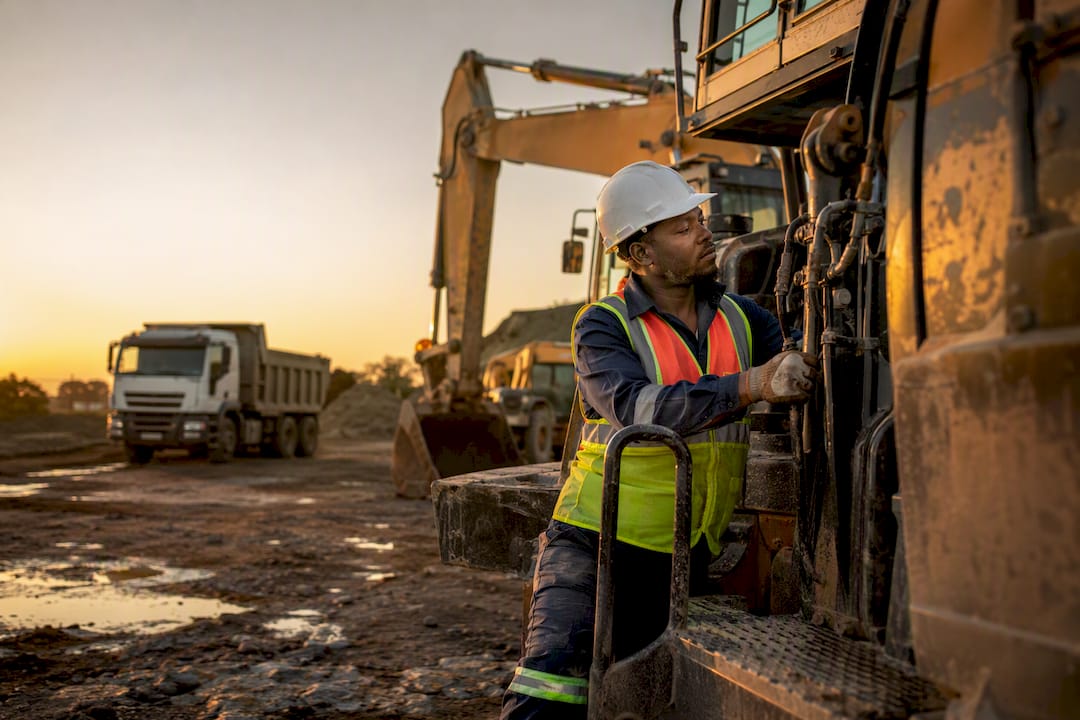
Many sites surveyed were underinsured, and a substantial share were valued at under half their true replacement cost.
Sector variance matters too. Commercial Risk’s coverage points to manufacturing, logistics, and arts sectors carrying particularly wide gaps, often because these sites run complex, high-value plant that’s rarely revalued once installed.
- Declared values below true replacement cost trigger the insurer’s average clause
- A claim payment can be reduced in proportion to the amount of underinsurance
- A 50% shortfall in declared value can mean a 50% cut to your payout, regardless of the actual damage
What causes underinsurance on plant equipment?
Underinsurance rarely happens because someone deliberately cuts corners. It happens because asset registers go stale while machinery keeps changing.
- Asset churn and undocumented upgrades. Equipment gets modified, retrofitted, or upgraded for safety compliance, and the cost of those changes never makes it back into the insurance schedule.
- Book values instead of replacement cost. Depreciated ledger figures reflect accounting policy, not what it would cost to replace the machine today. A Charterfields technical note on asset registers identifies this stale data as the single biggest practical driver of underinsurance.
- Indexing plant against building costs. AJG warns that machinery replacement costs move independently of construction indices, so applying a building inflation rate to plant consistently understates its true value.
- Omitted ancillary costs. Installation, commissioning, specialist contractor fees, and debris removal are routinely left out of declared values, even though they’re real costs of reinstatement.
- Currency and supply chain pressure. Imported components and specialist parts are exposed to exchange rate swings and shipping delays that generic online calculators never account for.
Custom modifications deserve particular attention here. A machine fitted with safety upgrades or site-specific attachments can cost considerably more to replace than a standard catalog model, yet asset registers rarely capture that premium.
What happens when plant equipment is underinsured?
The consequences extend well beyond a disappointing settlement cheque.
- The insurer’s average clause reduces your payout in direct proportion to the shortfall in declared value
- Business interruption cover, calculated against unrealistic reinstatement timelines, runs out before replacement plant arrives
- Cash flow tightens fast when you’re funding the gap between the payout and the actual replacement cost
- Delayed reinstatement can put you in breach of client contracts or site safety obligations
Underinsurance is often a dual failure: a reinstatement shortfall on the asset itself, and a business interruption gap when replacement lead times stretch beyond the period the BI policy was built to cover.
Picture a mid-sized civil contractor whose crushing plant is destroyed in a site fire. The specialist machine has a 14 week lead time, but the BI policy was written around a 6 week reinstatement assumption. The result is a site shutdown, a missed handover date, and a client invoking contractual penalty clauses, all stemming from one outdated valuation.
How do you calculate the correct insurable value?
Getting declared values right starts with using the right definition. Replacement cost (also called reinstatement cost) is what it would take to replace the asset new, in its current specification, today. Actual Cash Value subtracts depreciation and reflects the used market value instead, useful for certain older or fully depreciated assets, as equipment appraisal guidance explains, but a poor basis for most operational plant still doing daily work.
RICS and EVS guidance is explicit that insurable value should capture more than the sticker price of the machine itself:
- The purchase price or manufacturing cost of the replacement unit
- Delivery, installation, and commissioning charges
- Professional fees tied to reinstatement
- Debris removal and site clearance costs
Aviva’s risk guidance recommends independent specialist valuations wherever no recent formal assessment exists, with a full reassessment every two to three years and lighter annual updates in between to catch indexation drift. Keep plant declarations separate from your buildings schedule. AJG’s warning about building indices applies just as strongly here: bundling machinery into a property valuation nearly guarantees the plant figure goes stale first.
Pro Tip: Flag any imported plant with a high proportion of foreign-sourced components for more frequent review. Exchange rate swings can move replacement cost well ahead of your annual indexation adjustment.

A checklist for closing your plant insurance gaps this quarter
Fixing underinsurance is an operational project, not a one-off form to submit.
- Audit the asset register. Confirm purchase date, current replacement cost estimate, location, installation complexity, and ownership status for every item.
- Rank assets by criticality. Send your highest-value and most complex plant to a specialist valuer first; lower-value items can follow on a lighter review cycle.
- Set review triggers. Major upgrades, relocations, or new procurement should each prompt an immediate valuation update, not wait for renewal.
- Capture leased and third-party equipment. Hired-in plant and off-site machinery need the same scrutiny as owned assets, since gaps here are just as costly.
- Stress-test your BI timelines. Match business interruption assumptions to realistic lead times for specialist machinery, not generic reinstatement periods.
- Assign ownership. Name someone internally who’s accountable for keeping declared values and the valuation calendar current.
| Point | Details |
|---|---|
| Audit frequency | Update asset registers annually and commission a full specialist reassessment every two to three years. |
| Critical asset priority | Send high-value or highly modified plant for specialist valuation before lower-value catalog items. |
| BI alignment | Match business interruption periods to actual lead times for replacement machinery. |
Why on-demand cover fits fluctuating plant needs
Equipment churn is the enemy of accurate declared values, which is exactly what Truck & Plant On-Demand™ is built to handle.
- Adjust cover as machinery is hired, retired, or upgraded, instead of waiting for annual renewal
- Match cover to seasonal projects and short-term hires without carrying a fixed annual premium
- Keep declared values current with less administrative friction between valuation updates
What the underinsurance data actually tells us
The conventional advice on this topic treats underinsurance as a paperwork problem: fill in the schedule correctly, tick the box, move on. That misses what’s actually happening. Charterfields’ survey shows the gap widening precisely because plant assets change faster than insurance renewal cycles do, and the businesses treating declared values as a static annual exercise are the ones getting caught out.
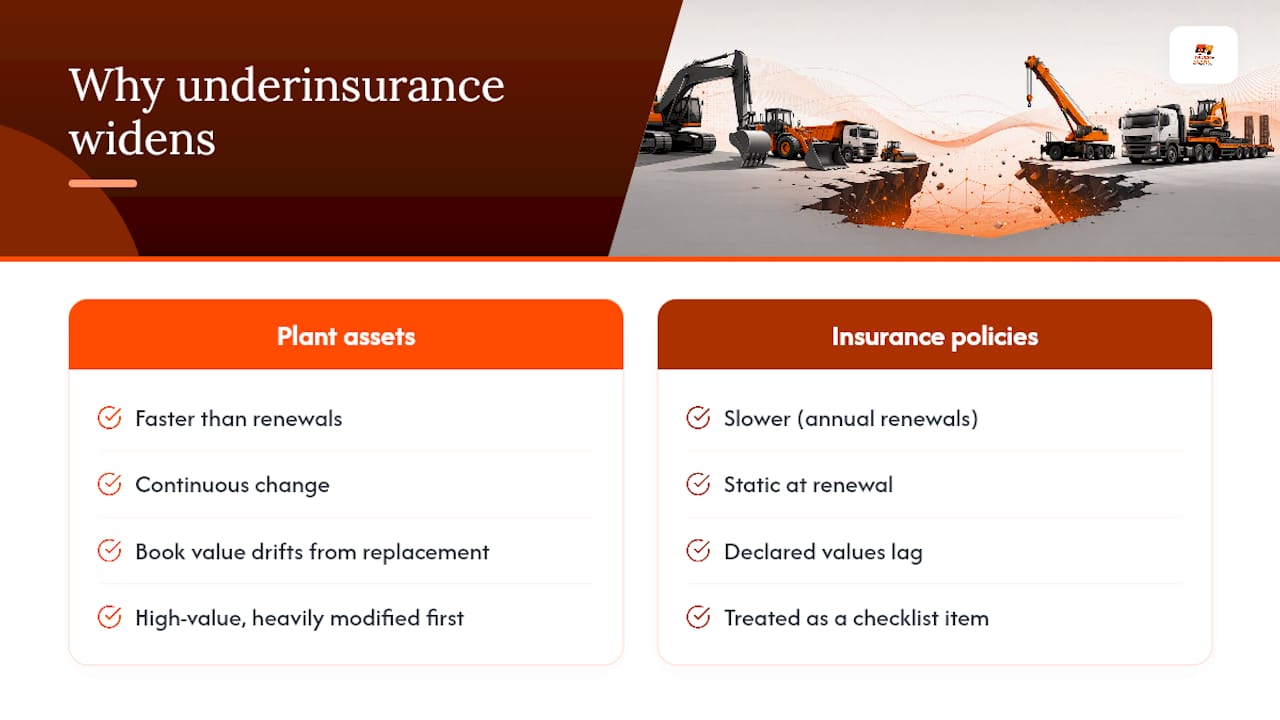
What’s underrated here is the interaction between shortfall and time. That’s the real lesson from the average clause mechanics: the damage isn’t linear, it’s stacked.
Prioritize your highest-value and most-modified plant first. That’s where book values drift furthest from replacement cost, and where a specialist valuation earns back its fee many times over. Everything else on the checklist matters, but it matters less urgently than getting your biggest assets right.
— Coert
Get plant cover that moves with your fleet
Static annual policies force you to insure for what you might own next year, not what you actually run today. Truck & Plant On-Demand™ lets you adjust cover as machinery is hired, retired, or redeployed, so your premium tracks your actual asset base instead of a schedule frozen at renewal.

Built for construction, civil, and transport businesses running plant that churns through the year, this cover works alongside specialist valuations rather than instead of them. Get your declared values right first, then use flexible cover to keep them accurate without repapering your whole policy each time equipment changes. Combine that with well-maintained assets: partners like Autotronics’ remanufacturing guide explain how remanufactured components can shift replacement cost calculations for complex machinery. Head to the Fleet Insurance in SA page to request a quote and see how your cover could flex with your equipment schedule.
Sources
- Plant and Equipment: A Concerning Gap in Insurance Coverage | Charterfields Limited
- Is Your Risk Exposure Being Impacted by Underinsurance or Overinsurance? | AJG United Kingdom
- RICS: Reinstatement cost assessment of buildings (EVS guidance / RICS)
- Underinsurance – getting declared values for plant and machinery correct – Aviva Risk Management Solutions