


A waiver of subrogation is a promise, built into your contract or your policy, that stops your insurer from chasing another party for a loss it just paid out on. If a hire or subcontract agreement requires one, the practical move is simple: notify your broker, get the endorsement issued on your policy, and get a fresh Certificate of Insurance before the equipment or work starts.
TL;DR:
- A waiver of subrogation must be agreed upon in writing before a loss occurs, as post-damage requests rarely hold legal weight.
- Insurers typically charge a premium premium or fee, usually based on a percentage of the hire rate, to issue a waiver endorsement.
- Confirm the endorsement lists the exact parties and project details, matches the certificate of insurance, and predates work start dates.
- Use on-demand insurance products to activate waiver coverage precisely during short-term hires, avoiding year-round premiums for idle equipment.
- The endorsement document, not just the contract clause, is the critical element that legally binds the insurer’s waiver of recovery rights.
Table of Contents
- What is a waiver of subrogation, and what forms does it take?
- How does a waiver of subrogation actually work?
- Why do hirers and subcontractors ask for waivers?
- What does a waiver of subrogation cost?
- How to secure a waiver of subrogation for hired plant or subcontract work
- Watch these policy limits before you sign
- How Truck & Plant On-Demand™ handles waivers for hire work
- Where to check the details yourself
- What most guidance on this topic gets backwards
- Get waiver-ready cover without paying for idle time
- Sources
What is a waiver of subrogation, and what forms does it take?
The clause you sign in a hire agreement is a promise between you and the other party. The endorsement your insurer adds to your policy is the thing that actually stops a claims recovery. Only the endorsement binds the insurer, and a contract clause with no matching endorsement behind it is a gap waiting to be discovered mid claim.
You will run into two structures:
- Scheduled endorsement: names a specific party or project, common when a plant hire firm hires a single crane to one named contractor for one job.
- Blanket endorsement: applies automatically across all contracts requiring a waiver, useful for hire companies or subcontractors running many jobs at once.
A plant hire agreement typically wants a scheduled waiver naming the hirer. A subcontractor working across a busy site portfolio often prefers blanket cover, so one endorsement handles every job without repeat paperwork. Equipment leases split between the two depending on how many properties or clients are involved.
How does a waiver of subrogation actually work?
Insurance recovery normally runs in one direction: your insurer pays your claim, then goes after whoever caused the damage to recover its money. A waiver interrupts that second step for whichever party the endorsement names.
Here’s the sequence that matters for hire and subcontract work:
- A loss occurs on hired equipment or subcontracted work.
- Your insurer pays the claim under your policy, as normal.
- Without a waiver, the insurer investigates fault and pursues recovery from the responsible party.
- With a valid waiver in place, that recovery path is closed for the named party.
- The insurer absorbs the loss instead of pursuing it further.
Timing decides whether any of this holds up. A waiver must generally be agreed in writing before the loss occurs; an endorsement requested after damage has already happened rarely holds any legal weight. Proof matters just as much as timing. The endorsement page on your policy declarations and a Certificate of Insurance reflecting that endorsement are what a hirer, a site owner, or a court will actually ask to see.
Why do hirers and subcontractors ask for waivers?
Project owners and hirers request waivers mainly to keep disputes out of court. Channeling losses through insurance rather than litigation is common enough that contract form families like AIA build mutual waivers into their standard templates, specifically to stop project partners suing each other after a covered loss.
The benefits run both ways:
- The party granting the waiver protects a working relationship instead of facing a lawsuit from its own insurer’s recovery team.
- The party receiving the waiver gets faster claims resolution, since nobody is waiting on a subrogation investigation to settle.
- Everyone on a multi-party hire or subcontract chain reduces the odds of finger pointing after a loss.
Insurers see it differently. Waiving subrogation removes one of their main recovery tools, so they price that risk in through a premium adjustment or a flat endorsement fee.
Pro Tip: Before agreeing to any waiver clause, ask whether it’s mutual or one-sided. A one-way waiver that only protects the hirer, while leaving your own recovery rights intact, is a much easier clause to accept than one that strips you of protection too.
What does a waiver of subrogation cost?
Insurers rarely hand over a waiver for free, since giving one up means losing a recovery option they’d otherwise use. Expect either a flat endorsement fee or a premium loading, and in plant and equipment hire specifically, subrogation damage waiver fees commonly are set as a percentage of the hire rate, according to industry guidance..
That range gives contractors and hire firms an actual number to plan around, rather than guessing at what an underwriter might quote on the day.
To speed up approval, hand your broker the full contract clause, the named parties, project dates, and equipment values in one package rather than piecemeal. Insurers commonly increase premium or charge a fee precisely because the request adds risk on their side, so the cleaner the submission, the faster the endorsement lands.
Check three things on the paperwork once it arrives:
- The endorsement page lists the exact named party and project or contract reference.
- The Certificate of Insurance reflects that same endorsement, not just a general liability summary.
- The effective date on the endorsement predates the start of the hire or subcontract work.
How to secure a waiver of subrogation for hired plant or subcontract work
Follow this sequence any time a hire agreement or subcontract requires a waiver:
- Send the clause to your broker or insurer before you sign anything. Don’t wait until the contract is executed.
- Specify scheduled or blanket cover. Tell the insurer exactly which parties need naming, or confirm blanket status if you run multiple contracts.
- Confirm the endorsement is actually on the policy. A verbal assurance from an underwriter is not proof. You need it on the declarations page.
- Request an updated Certificate of Insurance that shows the endorsement, not just the base policy.
- Check your policy limits against the hired equipment’s replacement value. A waiver granted on an underinsured policy just shifts the exposure onto you.
- If the insurer declines the full waiver, negotiate scope. Ask for a narrower version, or add an indemnity clause with defined limits instead.
- Keep every document. Save the endorsement page and the COI, and share copies with the contract counterparty as proof.
Pro Tip: Set a calendar reminder to reconfirm the endorsement every renewal cycle. Waivers tied to annual policies don’t automatically carry over, and a lapsed endorsement discovered after a loss defeats the entire point of asking for one.
Watch these policy limits before you sign
A waiver doesn’t fix an underinsured policy, it just decides who can’t chase who afterward. Check that your limits actually match the replacement value of hired-in plant, since a standard commercial policy limit rarely reflects what a crane or excavator would cost to replace outright.
Watch for these red flags on the paperwork:
- Aggregate limits that look adequate for one loss but thin out fast across multiple hired items on the same job.
- Missing policy form numbers on the endorsement (a genuine general liability waiver typically cites a form like ISO’s CG 24 04).
- Named parties left vague or generic instead of listing the exact hirer or contractor.
- Retroactive start dates that predate when the endorsement was actually processed.
- Workers’ compensation lines, which often restrict or outright bar subrogation waivers regardless of what the general liability policy allows.
How Truck & Plant On-Demand™ handles waivers for hire work
Waivers move fastest when your insurance already flexes with the job, rather than sitting on a fixed annual structure that wasn’t built for short hires. An on-demand insurance product lets you activate cover for the exact duration of a plant hire or subcontract, which shortens the gap between a signed contract and a usable endorsement.
- On-demand activation for crane hires, plant hire, and short-term subcontract work.
- Same-day proof-of-cover so you’re not stalling a site start waiting on paperwork.
- Endorsement pages and updated Certificates of Insurance supplied on request, matched to the specific hire period.
| What you need | What Truck & Plant On-Demand™ provides |
|---|---|
| Fast endorsement for a single hire | On-demand cover activated for that job’s duration |
| Proof of cover before site access | Same-day COI issued against the active policy |
| No cover paid for idle equipment | Pay-per-use structure instead of a flat annual premium |
Where to check the details yourself
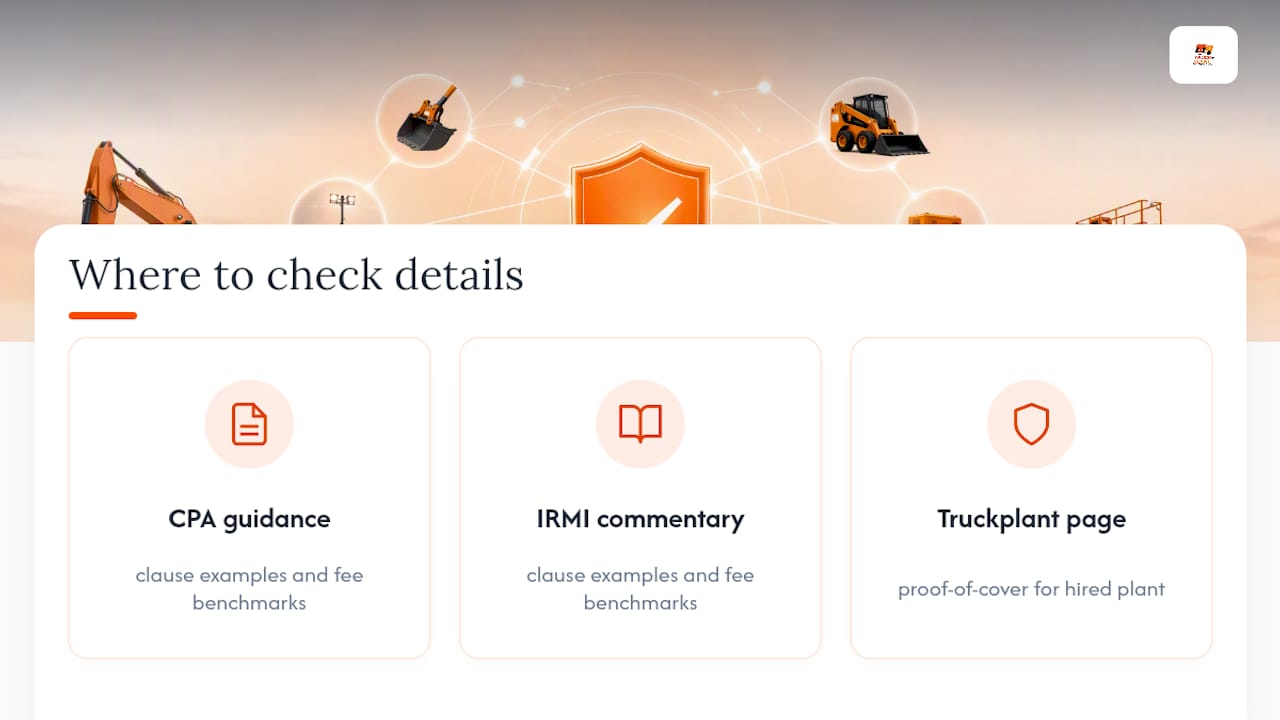
For clause examples and fee benchmarks, review the Construction Plant-hire Association’s subrogation guidance and IRMI’s commentary on contract waivers. For proof-of-cover on hired plant, see Truckplant’s plant hire insurance page.
What most guidance on this topic gets backwards
Most explainers treat a subrogation waiver as a legal formality, something a lawyer inserts and everyone forgets about. That’s backwards. The clause is the easy part. The endorsement, the one document that actually binds your insurer, is where deals fall apart, usually discovered during a claim rather than before one.
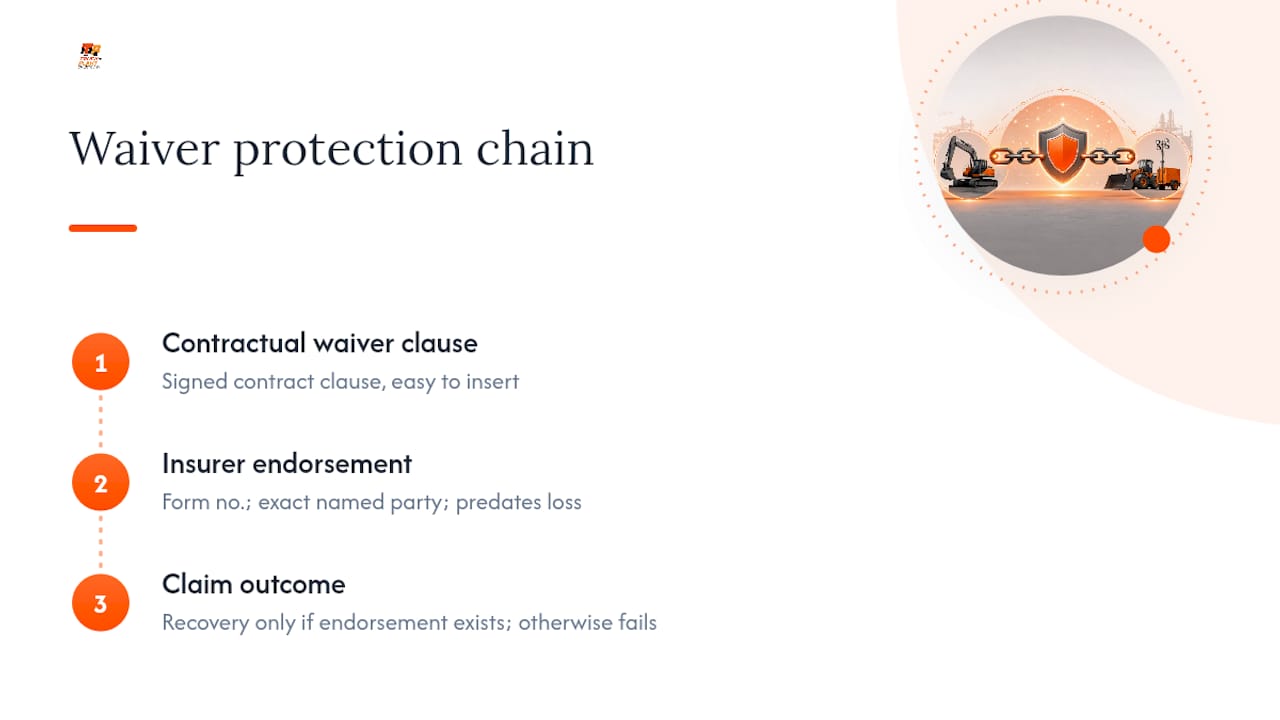
The conventional advice tells contractors to “just get insurance approval.” It rarely says what approval actually needs to look like: a form number on the endorsement page, a named party that matches the contract exactly, and a date that predates the loss. Skip any one of those and you’ve got a signed contract clause and nothing an insurer will honor.
If you take one thing from this, prioritize timing over everything else. A waiver requested after a loss is close to worthless. The businesses that handle this well aren’t the ones with the best lawyers, they’re the ones who build the insurer notification into their contract signing process, every single time, before a single piece of equipment moves onto site.
— Coert
Get waiver-ready cover without paying for idle time
Traditional annual policies force you to carry subrogation waiver coverage year round, even on months when you’ve got no hired plant or subcontract work running. An on-demand insurance model allows you to activate cover, request the endorsement, and get your proof-of-cover for the exact stretch a hire agreement demands, then switch it off when the job ends.

That structure suits contractors juggling multiple hire agreements with different waiver requirements, since you’re not stuck reshaping one fixed policy to fit every contract that lands on your desk. If a subcontract requires a scheduled waiver naming a specific hirer, you can get that endorsement issued and reflected on your Certificate of Insurance without waiting on a full renewal cycle. Businesses managing hired transport assets alongside plant equipment can also review Haulier for a look at how risk controls extend across haulage fleets.
Check your fleet and plant insurance options and request a quote built around your next hire contract, not a generic annual estimate.
Sources
- Subrogation damage waiver — Construction Plant-hire Association
- Waiver of subrogation form: what it is and how it works — Legal Clarity
- The facts about waiver of subrogation clauses — Conroy Simberg (blog)
- What Is Subrogation … and Why Is My Contract Waiving It? — IRMI