


In a wet hire, the plant owner who supplies the operator typically remains the primary insurer for both the machine and the operator. That means arranging plant/all-risks, public liability and workers’ compensation before the equipment leaves your yard. The single action that protects you most: do not mobilise until the wet hire contract is signed and every certificate of currency has been checked against the agreed limits.
TL;DR:
- Wet hire insurance mainly covers public liability, plant all risks, workers’ compensation, and transit, with specific extensions depending on the operation.
- Insurers rely heavily on signed contracts, certificates of currency, and documented operational controls to determine coverage and prevent disputes.
- Pre-mobilisation checks should verify insurance limits, machine condition, operator identity, and signed agreements before equipment leaves your yard.
- On-demand insurance products enable quick activation and adjustment of coverage, ensuring proof-of-cover for urgent wet hire jobs.
- Effective contractual terms and thorough paperwork matter more for claim disputes than simply having broader insurance policies.
Table of Contents
- Wet hire insurance requirements: dry hire vs wet hire and why control decides who pays
- Core insurance covers to arrange for wet hire
- Contract and proof-of-cover: what insurers and principals expect on paper
- Operator risks and controls that matter to insurers
- Pre-mobilisation checklist: what to verify before the machine leaves your yard
- How on-demand insurance solves proof-of-cover and timing friction
- Why the contract, not the policy wording, decides most wet hire disputes
- Get same-day proof-of-cover before your next wet hire
- Sources
- FAQ
Wet hire insurance requirements: dry hire vs wet hire and why control decides who pays
The line between wet hire and dry hire comes down to one word: control. In dry hire, you hand over a machine and the hirer supplies their own operator, so the hirer usually carries the operational liability and insures the work being done. In wet hire, you supply both the machine and the operator, and because that operator stays under your instruction and payroll, you generally retain the insurance burden for their actions on-site.
This distinction directly shapes claims outcomes. If a wet-hired excavator operator strikes a gas line, the claim typically lands on the owner’s public liability and plant/all-risks policies, because the owner controlled how the work was carried out. In a dry hire arrangement, that same incident would more likely sit with the hirer’s own liability cover, since their staff operated the machine under their supervision.
- Wet hire: owner supplies operator and machine, owner typically insures both.
- Dry hire: hirer supplies operator, hirer typically carries operational liability.
- Mixed arrangements: read the contract carefully. Some agreements shift supervision (and therefore liability) mid-project.
Wet hire insurance exists specifically because the “owner supplies the operator” model creates employer-style obligations that standard equipment cover was never built to handle.
Core insurance covers to arrange for wet hire
Four policy types do the heavy lifting in a wet hire arrangement, and skipping any one of them leaves a real gap.
Plant all risks covers accidental damage, theft, and transit loss for the machine itself, based on its declared value. Standard plant policies frequently exclude or restrict cover once equipment starts earning income on someone else’s site, so a hired-out plant extension or standalone policy is usually necessary to keep that protection active while the asset is working under hire.
Public liability protects against third-party injury or property damage the operator causes while working. Head contractors and larger principals routinely set minimum limits before they’ll let a wet-hired machine on-site, and other markets commonly cite figures in the $10 million to $20 million range as a benchmark for higher-risk plant work. Treat any such figure as an example of principal conditioning rather than a fixed local rule, and always confirm the actual number your contract or project demands.
Workers’ compensation covers your supplied operator for injury on the job, since they remain your employee for statutory purposes even while working at someone else’s site.
Road and transport cover matters the moment a machine travels between sites on public roads. This is where owners get caught out: a plant all-risks policy rarely extends automatically to transit exposure, and motor or road-risk cover fills that specific gap.
Beyond those four, several adjunct covers deserve a look depending on your operation:
- Loss of use or downtime cover, to recover income while a damaged machine sits idle
- Environmental liability, relevant for fuel spills or contamination during earthworks
- Hired-in plant cover, if you’re subcontracting equipment from another owner
- Professional indemnity, relevant only where you’re also providing design or specification advice alongside the hire
Pro Tip: Ask your insurer to confirm in writing that your plant all-risks policy responds while the machine is “hired out with operator.” Some policies quietly treat wet hire as a different risk class from standard on-site use, and that distinction only surfaces at claim time if you haven’t checked it first.
Contract and proof-of-cover: what insurers and principals expect on paper
A verbal handshake does not satisfy an insurer. Insurers commonly require a signed hire agreement before they’ll confirm that cover responds to a claim, which makes the contract itself part of your risk management, not just an administrative formality.
Build these elements into every wet hire agreement:
- Named insured and minimum limits stated explicitly, so there’s no ambiguity about whose policy responds first.
- Principal’s indemnity clause, protecting the site owner or head contractor from claims arising out of your operator’s work.
- Cross-liability wording, treating each party as though they held separate policies, which prevents one insurer from denying a claim because another party on-site was technically at fault.
- Non-solicitation clause, since a client poaching your skilled operator is a real and recurring risk in this industry, and enforceable non-solicitation terms give you contractual recourse.
- Operator supervision terms, spelling out who directs daily tasks versus who retains overall control, since this is exactly the detail insurers scrutinize after a loss.
On the paperwork side, legal guidance on hire arrangements recommends requesting a certificate of currency, a full policy schedule showing endorsements (not just a summary page), and signed written acceptance of the terms before equipment leaves your yard. Insurers also condition cover on permitted use: if your policy schedule lists general earthworks but the job involves demolition or confined-space work, notify your insurer first. Undisclosed high-risk activity is one of the most common reasons claims get reduced or declined.
Operator risks and controls that matter to insurers
Supplying an operator turns you into an employer with obligations that follow the machine wherever it goes. Insurers know this, and they price and condition wet hire cover accordingly. Documented operational controls matter as much as the policy wording itself. Weak record-keeping is frequently the reason insurers reduce or dispute a payout, even when the cover was technically in place.
Keep these checks current and on file:
- Licence and ticket verification for every operator, updated whenever a certification lapses.
- Training records showing competency on the specific machine class deployed.
- A drug and alcohol policy with evidence of enforcement, not just a document.
- Fatigue management limits, especially on multi-shift or long-haul earthmoving contracts.
- Supervision notes recording who directed the operator’s work each day.
Handover records and toolbox talks feel like paperwork until the day you need them. A signed handover confirming machine condition, attachments, and site hazards briefed to the operator becomes the difference between a straightforward claim and a drawn-out dispute over who missed what.
Pre-mobilisation checklist: what to verify before the machine leaves your yard
Run through this sequence before every wet hire, no matter how familiar the client or how tight the deadline.
- Verify and save certificates of currency for plant all-risks, public liability, and workers’ compensation, confirming the limits meet what the contract or principal actually requires.
- Photograph the machine’s condition and any attachments before departure, timestamped and stored with the job file.
- Confirm transport and transit cover applies for the specific route and vehicle combination moving the equipment.
- Verify operator identity and licence status, then have the operator sign acknowledgement of site rules and reporting obligations.
- Sign the wet hire agreement and log both parties’ acceptance before the machine crosses the gate.
Pro Tip: Build a five-minute pre-mobilisation routine around these five steps and assign one person to own it. The mobilisations that go wrong are almost always the ones where “someone” was supposed to check the paperwork.
Know when to say no. Delay mobilisation if the certificate of currency doesn’t match the contracted limits, if the hirer’s identity or project details can’t be verified, or if the scope of work has quietly shifted into higher-risk territory than your policy covers. A delayed job is recoverable. An uninsured incident often isn’t.
How on-demand insurance solves proof-of-cover and timing friction
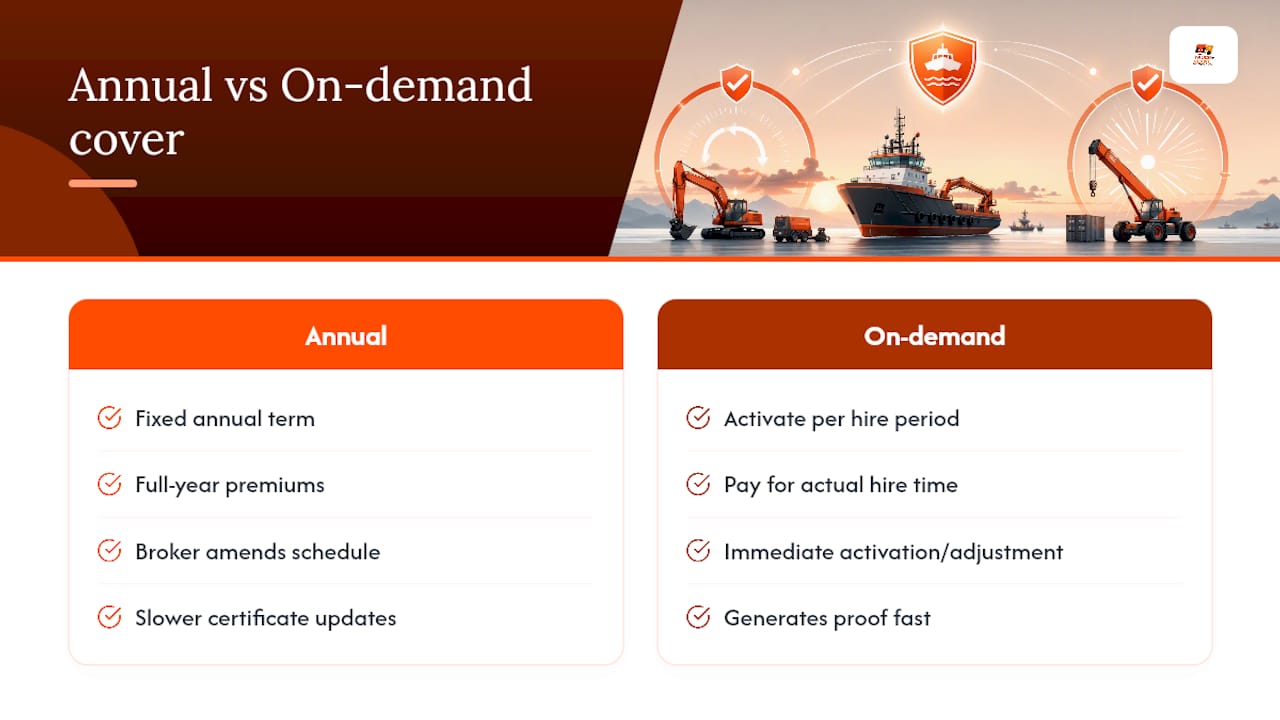
Traditional annual plant policies were not built for the pace of wet hire work, where a job can be confirmed one afternoon and need to mobilise the next morning. On-demand cover lets you adjust plant/all-risks and liability protection to match the actual hire period, so you’re not paying full-year premiums for equipment that only earns income in short bursts.
An on-demand insurance product was built around that exact gap. Instead of waiting on a broker to amend an annual schedule, cover can be activated or adjusted for a specific machine and timeframe, generating proof-of-cover fast enough to satisfy a principal’s pre-mobilisation checks. That matters most on the jobs that come together quickly, where a delayed certificate of currency can cost you the contract as easily as an insurance gap could cost you the claim.
To get a quote moving quickly, have your equipment list, declared values, and operator details ready. Truckplant’s plant hire insurance resources and hire-specific guides cover the templates and documentation patterns that make this process faster on repeat jobs, drawing on Coert’s work helping plant owners structure cover around real operating conditions rather than generic annual policies.
Why the contract, not the policy wording, decides most wet hire disputes
Most owners treat insurance as the safeguard and the contract as paperwork. That gets the priority backwards. A well-drafted wet hire agreement with named limits, cross-liability wording, and principal’s indemnity does more to prevent a dispute than a marginally broader policy ever will, because insurers make coverage decisions based on what the contract actually says happened, not what you assumed was covered.
The overlooked risk isn’t catastrophic damage. It’s the operator who gets poached mid-project, or the handover that never got documented, leaving you unable to prove machine condition when a damage claim surfaces weeks later. Conventional advice fixates on buying “enough” cover. The more useful question is whether your paperwork can prove, on the day of a claim, exactly who was responsible for what.
If you supply operators, prioritise the signed contract and the certificate verification step before anything else. Everything downstream, from claims speed to dispute resolution, depends on getting that sequence right the first time.
— Coert
Get same-day proof-of-cover before your next wet hire
Waiting days for a broker to amend an annual policy doesn’t work when a wet hire job needs to mobilise tomorrow. On-demand insurance lets you activate or adjust plant all-risks and liability cover for the exact period a machine and operator are on-site, avoiding premium waste on idle equipment or last-minute paperwork scrambling.

To move quickly, have four things ready: your equipment list with declared values, your operator roster, a signed hire agreement, and any recent loss history. With those on hand, Truckplant can typically turn around proof-of-cover fast enough to clear a principal’s pre-mobilisation checks. Whether you need standalone construction public liability cover or a full Truck & Plant On-Demand™ quote spanning plant, transport, and liability, request pricing now and get your certificate of currency sorted before the next job lands on your desk.
Sources
For deeper reading on contract structure and hired-out plant cover, see hired-out plant insurance guidance, legal differences between dry and wet hire, and specialty coverage explanations from Quality Insurance Agency on minimum limits and endorsements common to wet hire operations.
This article is general information, not a substitute for advice from a qualified financial advisor. Consult a qualified financial professional about your own circumstances before acting on anything here.
- Hired-out plant insurance: protecting equipment you lease to others
- Wet hire insurance (Shielded Insurance)
- Dry vs Wet Hire: Legal differences for businesses | Sprintlaw
FAQ
What Does “Wet Hire” Mean?
Wet hire means the equipment owner supplies both the machine and a qualified operator, keeping the operator under the owner’s instruction and payroll. This differs from dry hire, where the hirer supplies their own operator and typically carries more of the operational liability.
Do I Need Insurance to Hire a Mini Digger?
Yes. Even a small machine needs plant all-risks cover for damage or theft, and if you’re supplying the operator, public liability and workers’ compensation apply too. Standard plant policies often exclude cover once equipment is earning income on someone else’s site, so confirm your policy explicitly covers hired-out use before mobilising.
Who Qualifies for Professional Indemnity Insurance?
Professional indemnity applies to businesses giving advice, design input, or specifications alongside their hire work, not to straightforward equipment and operator supply. Most wet hire operators won’t need it unless they’re also providing engineering or planning input on the job.
What Are the Two Types of Business Insurance Most Relevant to Wet Hire?
Public liability and plant/all-risks form the core pairing for most wet hire operations, covering third-party harm and equipment damage respectively. Add workers’ compensation on top whenever you’re supplying the operator, since that’s what covers your employee while they’re working under your instruction on someone else’s site.
How Fast Can I Get Proof of Cover for a Last-Minute Wet Hire Job?
Turnaround depends on your insurer, but on-demand products like Truck & Plant On-Demand™ are built specifically to issue adjustable cover and same-day proof-of-cover, which suits jobs confirmed with little notice. Have your equipment list, operator details, and signed hire agreement ready to speed up the request.