


TL;DR:
- Flexible insurance for SMEs allows businesses to adjust premiums and coverage in real time based on operational changes. It offers cash flow benefits by eliminating large deposits and surprise year-end bills while providing customizable employee benefits. Implementing such strategies involves using digital platforms, regular reviews, and choosing policies that scale with business needs.
Flexible insurance for SMEs is defined as a customizable coverage model that lets small and medium-sized businesses adjust their premiums, benefits, and coverage limits in real time as their operational demands change. Unlike traditional fixed-premium policies, this approach ties what you pay to what you actually need. 47% of SMEs prioritize flexibility in their insurance coverage, choosing adaptable policies over rigid annual plans. The industry term for the broadest version of this model is “pay-as-you-go insurance,” though points-based benefit structures and on-demand cover also fall under the same umbrella. Truckplant was built on exactly this premise: you should never pay the same premium every month when the cover you need is not always the same.
Why flexible insurance for SMEs is a cash flow decision
The most direct benefit of flexible insurance is cost control tied to actual business activity. Pay-as-you-go models link premium payments directly to your payroll each pay period, eliminating the 15–25% upfront deposit that traditional annual policies require. That deposit alone can strain a small business’s working capital before a single claim is ever filed.

The cash flow advantage goes further than the deposit. Annual billing policies trigger a year-end audit that can produce surprise bills ranging from $7,000 to $90,000+. Pay-as-you-go eliminates that risk entirely by calculating premiums on real payroll data, period by period. For a construction company or transport operator with seasonal contracts, that predictability is worth more than any marginal discount on a fixed annual rate.
The flexible insurance benefits extend to employee-facing cover as well. 79% of employees want benefits customized to their personal circumstances. Offering adaptable cover is no longer a nice-to-have for SME recruitment. It is a retention tool.
Here is a summary of the core advantages:
- Premiums tied to payroll: You pay based on actual workforce size, not a projection made months ago.
- No large upfront deposits: Free up capital for operations, equipment, or growth.
- No audit surprises: Real-time premium calculation removes year-end billing shocks.
- Tailored employee benefits: Points-based structures let staff choose cover that fits their lives.
- Scalable administration: Digital-first platforms automate enrollment, compliance, and claims with minimal HR overhead.
Pro Tip: Review your current annual policy’s upfront deposit and year-end audit history. If either figure has surprised you in the past two years, a pay-as-you-go model will almost certainly save you money.
How does flexible insurance differ from traditional SME plans?
The structural difference between flexible and traditional insurance comes down to billing rhythm and customization depth. Traditional plans bill annually, require upfront deposits, and apply a fixed premium regardless of whether your workforce grows, shrinks, or sits idle for a quarter. Flexible models recalculate continuously, matching your cover to your current reality.
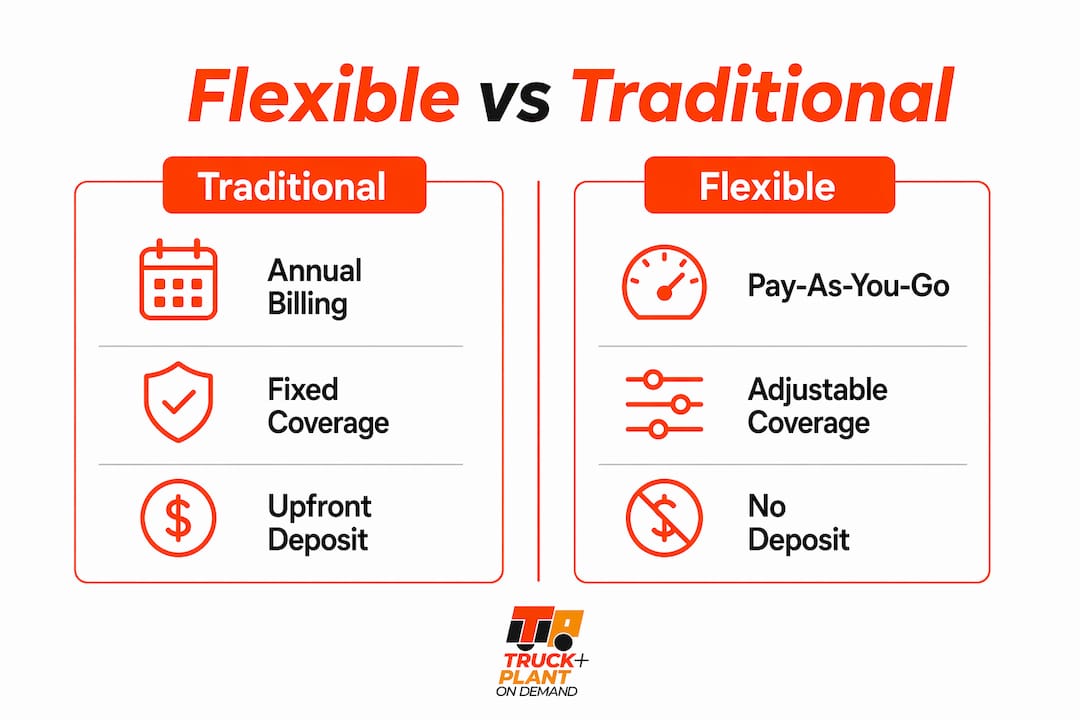
The table below shows the key operational differences:
| Feature | Traditional annual plan | Flexible or pay-as-you-go plan |
|---|---|---|
| Billing cycle | Annual, with upfront deposit | Per pay period, linked to payroll |
| Premium variability | Fixed regardless of workforce changes | Adjusts with actual payroll or usage |
| Year-end audit | Required, with potential surprise bills | Eliminated or minimal |
| Employee benefit choice | Standardized bundle for all staff | Points-based or modular selection |
| Administrative burden | Manual, paper-heavy processes | Automated via digital platforms |
| Scalability | Renegotiated at renewal | Adjusted in real time |
Points-based flexible benefits, which currently account for about 5% of group health premiums in certain markets, represent the employee-facing side of this shift. Each employee receives a budget allocation and selects the cover that suits them. That model is a direct contrast to the one-size bundle that traditional group plans impose.
Private Health Services Plans (PHSPs) offer another alternative. A PHSP reimburses employees for eligible medical expenses up to a set limit, giving SMEs a cost-controlled supplement to core cover without committing to a full group policy. For businesses with fewer than 20 staff, this reimbursement approach often delivers better value than a traditional group plan.
What factors should SMEs consider when choosing flexible cover?
Choosing the right adaptable insurance policy requires more than comparing premium quotes. The decision touches your workforce structure, cash flow patterns, and the administrative capacity your team actually has.
Work through these factors before committing to any plan:
-
Assess payroll variability. If your headcount fluctuates seasonally, a pay-as-you-go model will save you money. If your workforce is stable year-round, the savings may be smaller but the administrative simplicity still justifies the switch.
-
Map your coverage gaps. List the risks your business faces: vehicle damage, liability, equipment breakdown, cargo loss. Tailored insurance solutions for fleet operators, for example, look very different from a retail SME’s needs. Cover what you actually face, not a generic bundle.
-
Evaluate platform usability. Digital platforms that automate enrollment and claims are critical for SMEs without dedicated HR staff. If a platform requires manual data entry for every change, the administrative cost will erode the premium savings.
-
Plan for growth. Your cover should scale without requiring a full policy renegotiation. Ask providers directly: can you add vehicles, employees, or coverage layers mid-term without penalty?
-
Budget for technology investment. Digital insurance platforms sometimes carry setup or subscription costs. Factor these into your total cost of ownership before comparing quotes.
-
Schedule regular reviews. Set a quarterly calendar reminder to review coverage against actual business activity. Changing insurance needs are normal for growing SMEs. A review cycle keeps your cover accurate and your premiums fair.
Pro Tip: Ask your insurer for a mid-term adjustment policy in writing before you sign. If they cannot confirm real-time limit changes, the plan is not truly flexible regardless of how it is marketed.
How can SMEs implement flexible insurance strategies effectively?
Implementation is where most SMEs stall. The concept of flexible cover is straightforward. Putting it into practice requires deliberate steps.
Start with your billing structure. Choose pay-as-you-go if your payroll varies by more than 15% between your busiest and quietest months. For businesses with stable headcounts, a points-based benefit structure for employee cover delivers flexibility without changing the core billing model. For SMEs with seasonal income, pay-as-you-go insurance aligns with cash flow better than any fixed-premium alternative.
Next, partner with a platform built for real-time adjustments. Truckplant’s Truck & Plant On-Demand™ model, for instance, lets operators choose what to insure, when to insure it, and how to insure it, all from a single interface. That level of control is what separates genuine on-demand cover from a traditional policy with a flexible label attached.
Combine core insurance with reimbursement plans where it makes sense. A PHSP alongside a lean group policy gives employees meaningful choice without committing the business to a large fixed premium. This combination works particularly well for SMEs in the 10–50 employee range.
Communicate the change to your team clearly. Employees who do not understand their new benefits options will not use them. A short briefing, a one-page summary, and an open Q&A session are enough to drive adoption. Flexible benefits plans address the needs of multigenerational workforces, but only when employees know what options are available to them.
Monitor usage quarterly. Track which coverage options employees select, which claims are filed, and where premiums are rising. Adjust your coverage layers in response. Bundling policies into a Business Owner’s Policy can save SMEs up to 10%, with digital platforms offering additional discounts through specialist programs. Use bundling strategically, not as a default.
For SMEs in logistics and transport, cargo cover is a specific area worth reviewing. A structured cargo insurance guide can clarify which policy types apply to your freight exposure and where gaps in traditional cover typically appear.
Key takeaways
Flexible insurance for SMEs delivers the most value when premiums are tied directly to actual payroll, coverage adjusts in real time, and administration runs through a digital platform that requires minimal manual input.
| Point | Details |
|---|---|
| Pay-as-you-go saves cash | Eliminating upfront deposits of 15–25% frees working capital from day one. |
| Audit surprises are avoidable | Real-time premium calculation removes year-end bills that can reach $90,000+. |
| Employee choice drives retention | 79% of employees want benefits tailored to their circumstances, not a standard bundle. |
| Digital platforms reduce overhead | Automated enrollment and claims processing is critical for SMEs without dedicated HR staff. |
| Regular reviews keep cover accurate | Quarterly coverage checks prevent overpaying for risks that no longer apply to your business. |
The case for flexibility: a view from the field
The most common mistake I see SMEs make with insurance is treating it as a once-a-year administrative task. They sign an annual policy in january, file it away, and revisit it only when something goes wrong or renewal arrives. By then, the business has changed, the workforce has shifted, and the cover is either too thin or paying for risks that no longer exist.
Inflexible insurance does not just waste money. It creates a false sense of security. A transport operator who added three vehicles mid-year but did not update a fixed annual policy is underinsured, often without realizing it. I have seen this pattern repeatedly in the civil construction and logistics sectors, where contract volumes can double or halve within a single quarter.
The businesses that manage this well share one habit: they treat insurance as a live variable, not a fixed cost. They review cover when they win a new contract, when they hire seasonal staff, and when they park vehicles during a slow period. That discipline, more than any specific product, is what keeps their premiums fair and their risk exposure honest.
Digital platforms have made this discipline far easier to maintain. The barrier used to be administrative. Adjusting cover mid-term meant phone calls, paperwork, and waiting. Now, a fleet operator can authorise a coverage change from a phone in a site office. That shift in accessibility changes the entire relationship between an SME and its insurer.
My advice: choose a provider who treats mid-term adjustments as a standard feature, not an exception. If your insurer charges a fee or requires a broker call every time your operational needs change, the product is not built for how SMEs actually work.
— Coert
Truckplant’s on-demand cover for SME fleets
Truckplant was built for exactly the kind of variability that breaks traditional insurance models. Whether you run a single truck, a mixed fleet of commercial vehicles, or heavy plant machinery on a civil construction site, the cover you need changes as your operations do.
Truck & Plant On-Demand™ gives you full control: choose what to insure, when to insure it, and how to insure it. You pay only for active cover, with no fixed monthly premium eating into your cash flow during quiet periods. For SMEs in the construction and transport sectors, that means fleet insurance that scales with your contracts rather than locking you into a rate set on last year’s numbers. Get a tailored quote from Truckplant and see what on-demand cover actually costs for your fleet.
FAQ
What is flexible insurance for SMEs?
Flexible insurance for SMEs is a coverage model that lets businesses adjust their premiums, benefit levels, and coverage limits based on current operational needs rather than fixed annual terms. Pay-as-you-go and points-based benefit structures are the two most common forms.
How does pay-as-you-go insurance save SMEs money?
Pay-as-you-go insurance eliminates the 15–25% upfront deposit required by traditional annual policies and removes year-end audits that can produce unexpected bills. Premiums are calculated each pay period based on actual payroll, so you never overpay for workforce levels that no longer apply.
What is a points-based flexible benefit plan?
A points-based plan gives each employee a fixed budget allocation to spend across a menu of insurance and benefit options. This lets staff choose cover that fits their personal circumstances rather than accepting a standardized group bundle.
How often should SMEs review their insurance cover?
A quarterly review is the minimum for any SME with variable payroll, seasonal contracts, or a growing fleet. Coverage that matched your business in january may leave you underinsured or overpaying by april if your operations have shifted.
Can SMEs bundle flexible insurance with other policies?
Bundling multiple policies into a Business Owner’s Policy can save SMEs up to 10% on premiums, with specialist digital platforms offering additional discounts. Bundling works best when the policies cover genuinely related risks rather than being grouped purely for a discount.