


TL;DR:
- Innovative insurance models like parametric, captive, and on-demand offer flexible, quicker, and cost-efficient coverage.
- Blending multiple models provides layered protection tailored to specific operational risks and business size.
- Matching insurance tools to your business needs enhances resilience and reduces paying for unnecessary coverage.
Running a civil, construction, or transport business means managing risks that shift constantly. A fleet sitting idle during a slow contract period costs the same in premiums as one running flat out. Weather delays can shut down a construction site for weeks, yet traditional policies rarely cover non-damage losses. Traditional fixed premiums are often inflexible and expensive for low-use operations. The good news is that a new generation of insurance models is changing this. This article examines the most relevant innovations, helping you match cover to your actual operations and stop paying for protection you simply do not need.
Table of Contents
- Key criteria for choosing innovative insurance solutions
- Parametric insurance: Fast, objective payouts for weather and business interruption
- Captive insurance: Custom self-insurance for large and group operations
- On-demand and pay-per-use models: Activation when and where you need it
- Comparing traditional and innovative models: Which fits your business best?
- A smarter path: Blending innovation for real resilience
- Explore flexible on-demand insurance for your fleet or equipment
- Frequently asked questions
Key Takeaways
| Point | Details |
|---|---|
| Adapt coverage to activity | Innovative models let you align insurance costs and protection directly with how and when you use your assets. |
| Speed and efficiency | Parametric and on-demand options can deliver payouts and activate coverage much faster than traditional insurance. |
| Tailor-made for your sector | Construction, civil, and transport businesses can now select solutions that specifically target weather, project, and operational risks. |
| Combine models for resilience | Blending parametric, captive, and pay-per-use approaches can help mitigate each model’s weaknesses for stronger risk management. |
Key criteria for choosing innovative insurance solutions
Before comparing models, you need a clear framework for evaluating them. Not every innovative product suits every business. The right fit depends on your operational profile, risk appetite, and budget structure.
Here are the core criteria to apply when reviewing any insurance solution:
- Flexibility: Does the model adapt to variable operations, seasonal shifts, and changing risk exposures across different project types?
- Speed: How quickly are claims assessed and paid? Days matter when a site is standing still or a truck is off the road.
- Cost efficiency: Are premiums directly linked to actual usage or demonstrated risk reduction, rather than flat annual rates?
- Customisation: Can coverage be tailored to specific projects, contract structures, or equipment categories?
- Transparency and data: Can you track what drives your pricing and use that information to actively manage risk?
Applying these criteria helps you move from passive insurance buying to active risk management. That shift is significant. As the World Economic Forum notes, innovative models proactively manage risk rather than simply reacting to claims after the fact.
“The most resilient businesses treat insurance not as a compliance cost, but as a strategic risk tool that evolves with their operations.”
If you want to see how these criteria apply in practice, compare flexible fleet coverage across current market options to understand what best suits your fleet profile.
Parametric insurance: Fast, objective payouts for weather and business interruption
Now that you know what to look for, let’s examine the first cutting-edge model reshaping construction and civil insurance markets.
Parametric insurance works differently from traditional cover. Instead of assessing actual damage after an event, it pays out automatically when a pre-agreed trigger is reached. That trigger could be a specific rainfall total, wind speed, or temperature threshold recorded at a reference weather station near your site.
Key features of parametric insurance include:
- Trigger-based payouts: Claims are settled based on objective data, not subjective damage assessments or lengthy investigations.
- Speed: Parametric payouts are completed in days rather than the months typical of traditional policies.
- Non-damage business interruption (NDBI): You can cover losses caused by weather delays even when no physical damage has occurred, a major gap in most standard construction policies.
- Practical applications: Weather-related project delays, access road flooding, temperature-sensitive concrete pours, and logistical disruptions are all insurable under parametric structures.
There is one important limitation to understand: basis risk. This refers to the possibility that a payout is triggered even when your actual loss is minimal, or conversely, that you suffer a real loss but the trigger threshold is not met. It is not a reason to avoid parametric cover, but it is a reason to structure it carefully.
Pro Tip: Use a hybrid policy that combines traditional indemnity cover with parametric triggers. This approach fills the gaps that either model alone would leave, giving you faster payouts on weather events while maintaining full damage cover for other losses.
For a broader view of how construction risk trends are reshaping coverage decisions in 2026, the shift toward parametric structures is one of the most significant developments worth tracking.
Captive insurance: Custom self-insurance for large and group operations
While parametric insurance accelerates claims and reduces paperwork, some firms want even more control and customisation in their coverage model.
A captive is essentially an insurance company that you own. Instead of paying premiums to a commercial insurer and losing that money when claims are low, your premiums flow into a structure you control. If claims are low, you retain the underwriting profit. Captive insurance allows firms to self-insure tailored risks and retain those profits directly.
Here is how the main captive structures compare:
| Structure | Minimum capital | Coverage scope | Best for |
|---|---|---|---|
| Single-parent captive | High (often $1M+) | Fully customised | Large firms with $200M+ revenue |
| Group captive | Moderate | Shared, customised | Mid-size firms in same industry |
| Cell captive | Lower | Defined cell scope | Smaller operators, flexible entry |
Captives work best when your business has a strong safety record, consistent operations, and the financial capacity to commit capital. They are not suited to every business size, but the group and cell structures have opened the door for mid-size transport and construction companies.
Pro Tip: If your revenue does not justify a single-parent captive, explore group or cell captives with other operators in your sector. Pooling risk with businesses that share your risk profile can deliver similar cost benefits at a fraction of the capital requirement.
For businesses managing large fleets, reviewing fleet management strategies alongside captive structures can reveal significant opportunities to optimise fleet insurance costs over time.
On-demand and pay-per-use models: Activation when and where you need it
For smaller operations and those prioritising agility, there’s a set of models that make insurance as dynamic as your business.
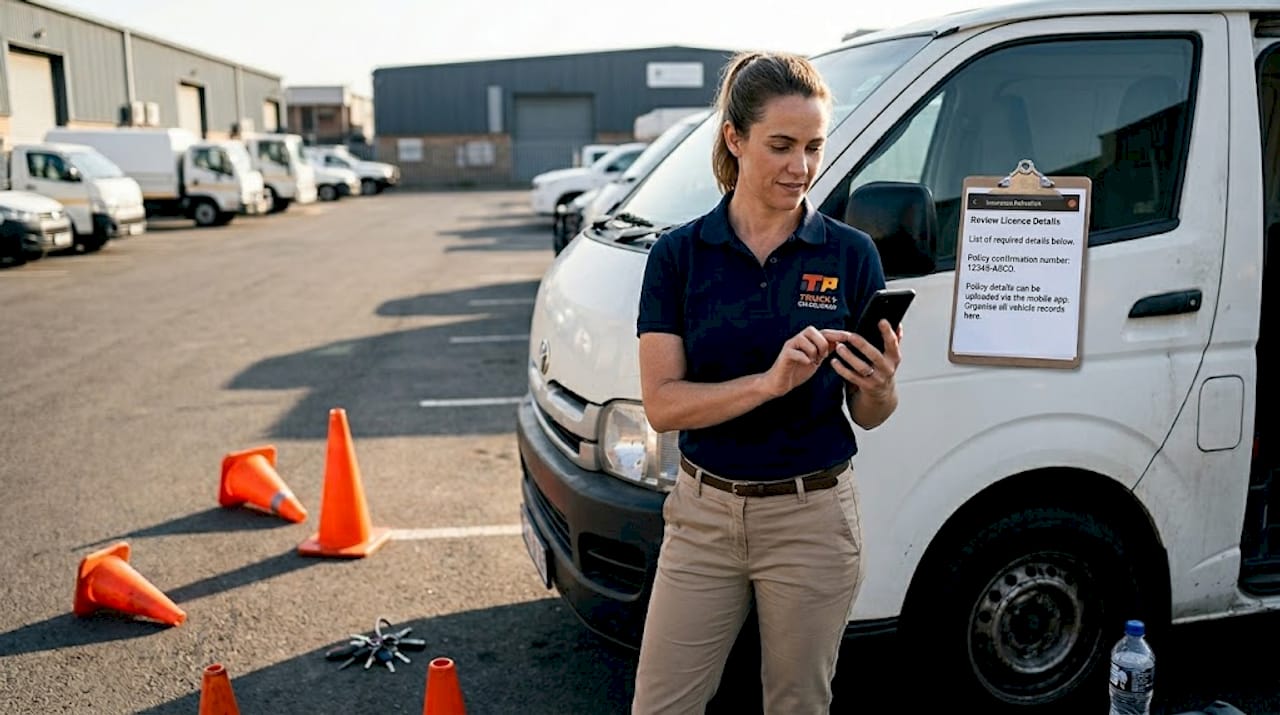
On-demand and pay-per-use insurance lets you activate cover for a specific job, a defined mileage band, or a set period. When the job ends, the cover pauses. You pay for what you actually use, nothing more.
Here is how these models typically work in practice:
- Select your asset: Choose the truck, trailer, or plant equipment you need to cover for a specific period or job.
- Activate cover: Switch cover on via an app or platform, often in minutes.
- Complete the job: Cover remains active for the duration you selected.
- Deactivate and save: When the job is done, cover is switched off and premiums stop.
The savings are material. Pay-per-use models save businesses 20 to 45% compared to fixed annual premiums. For a single truck operator, that can translate to over R80,000 in annual savings depending on usage patterns and coverage type.
These models are particularly effective for seasonal contractors, plant hire businesses, and transport operators with variable workloads. When your fleet is standing, your premiums stand down too.
Pro Tip: Telematics-based pricing uses real driving data to set your premiums. This is powerful, but it requires driver buy-in. Communicate clearly with your team about what data is collected and how it benefits them through lower costs. Resistance from drivers is one of the most common reasons telematics programmes underperform.
Explore how insurtech fleet solutions are making this model accessible, and review the factors influencing insurance cost to understand what drives your current premiums.
Comparing traditional and innovative models: Which fits your business best?
With the main innovations laid out, let’s look at how they measure up against the industry status quo.
Traditional fixed premiums offer certainty but lack adaptability for low-use or variable operations. Here is a direct comparison across the models covered in this article:
| Model | Claim speed | Flexibility | Cost structure | Best risk coverage |
|---|---|---|---|---|
| Traditional | Weeks to months | Low | Fixed annual | Broad, standard risks |
| Parametric | Days | Medium | Event-triggered | Weather, NDBI |
| Captive | Variable | High | Retained premiums | Custom, complex risks |
| On-demand | Immediate | Very high | Usage-based | Variable, project risks |
Situational fit at a glance:
- Large multi-site construction firms: Captive or hybrid captive plus parametric for weather risk.
- Seasonal transport operators: On-demand or pay-per-mile for variable fleet usage.
- Mid-size civil contractors: Group captive or parametric for project-specific weather cover.
- Small owner-operators: On-demand models for maximum cost control and flexibility.
- Complex, high-value projects: Hybrid models combining parametric triggers with traditional indemnity.
The most progressive firms are not choosing one model. They are blending structures to cover different risk layers. Learn more about on-demand insurance solutions and brush up on fleet insurance terminology to make more informed comparisons when engaging brokers or insurers.
A smarter path: Blending innovation for real resilience
Here is a perspective that most insurance conversations miss: no single model is the answer. The businesses that manage risk most effectively are the ones that treat their insurance structure the way they treat their equipment fleet. They match the right tool to the right job.
Parametric cover handles weather triggers fast. Captive structures retain profit when safety programmes work. On-demand models eliminate waste during low-activity periods. Used together, they create layered protection that responds to your actual risk lifecycle. As experts recommend, combining insurance models fills gaps, incentivises safety, and addresses basis risk more effectively than any single approach.
But the strategy only works if your team is on board. Driver behaviour and site safety practices directly affect your telematics pricing and captive claims performance. Getting buy-in is not a soft issue. It is a financial one. Businesses that invest in safety culture see measurable reductions in claims frequency, which compounds into lower premiums over time.
Do not optimise purely for the lowest premium. Optimise for survivability. A business that saves 15% on premiums but lacks cover during a critical weather event or major claim has made a poor trade. Review your smarter risk management trends regularly and build a structure that keeps your business operating when it matters most.
Explore flexible on-demand insurance for your fleet or equipment
Ready to put innovative insurance to work for your business? Here’s where to start.
At Truck & Plant On-Demand™, we built our cover specifically for the civil, construction, and transport industries. We understand that your risk profile changes from month to month, and sometimes from job to job. Our platform gives you full control: choose what to insure, when to insure it, and how to insure it.
Whether you need fleet insurance for commercial vehicles, tailored truck insurance South Africa cover, or specialist plant hire insurance solutions, we have a structure that fits your operation. Stop paying for cover you do not need. Switch to a model that works as hard as your business does.
Frequently asked questions
What is parametric insurance and why is it useful for construction?
Parametric insurance pays claims automatically when a pre-set trigger like rainfall or temperature is reached, making it ideal for covering weather-related delays without lengthy damage assessments. It is particularly valuable for construction sites where weather disruptions cause significant non-damage losses.
Who should consider captive insurance models?
Captive insurance best suits large firms with $200M or more in revenue, or smaller businesses joining cell or group captives, particularly those with strong safety records and the capacity to commit capital to the structure.
How much can pay-per-use insurance save compared to fixed premiums?
On-demand and pay-per-use models typically save businesses 20 to 45% over traditional annual policies, with the greatest gains seen in variable or low-usage fleet operations.
What are common risks or downsides to these innovative insurance models?
The main risks include basis risk in parametric cover, where payouts may not align perfectly with actual losses, significant capital requirements for captive structures, and driver privacy concerns when telematics data is used for pay-per-mile pricing.