


An aggregate deductible is a single cumulative deductible for a policy year: eligible losses feed into one “bucket” until an agreed annual threshold is met, after which the insurer covers subsequent claims under the policy terms. You’ll find this model in family health plans, product liability programs, and transport fleet policies. It usually lowers your premium, but it raises your up-front financial exposure until the bucket fills.
TL;DR:
- Aggregate deductibles are most effective when claims are predictable and low in frequency, benefiting groups with many small, spreading claims.
- They can be complicated by wording issues such as batch clauses, non-eligible charges, and vague occurrence definitions that affect how claims count toward the threshold.
- Groups with fluctuating utilization, like seasonal fleets or construction projects, should consider on-demand coverage to better match actual exposure and avoid overpaying.
- Before signing, it is essential to clarify policy language, review historical claims data, and understand how related claims are treated to prevent unexpected out-of-pocket costs.
- High-utilization groups may find traditional aggregate deductibles less cost-effective, making flexible, usage-based insurance models a better alternative for variable operations.
Table of Contents
- How does aggregate deductible insurance actually work?
- Aggregate vs embedded deductible: which structure fits you?
- Where aggregate deductibles show up most
- Where aggregate deductibles trip people up
- Weighing premium savings against out-of-pocket exposure
- What to check before you sign: a policy wording checklist
- How on-demand cover changes the deductible equation for fleets
- When we recommend aggregate structures, and when we don’t
- Truck & Plant On-Demand™: cover that flexes with your fleet
- Sources
How does aggregate deductible insurance actually work?
Every eligible claim during the policy year gets added to a running total, not reset per incident. Once that total crosses the annual threshold, the aggregate deductible is satisfied and the insurer takes over payment for further covered losses, subject to policy limits.
Three mechanics matter here:
- Policy-year scope — the counting period resets at renewal, so unused progress toward the threshold does not carry forward.
- Eligible charges only — not every cost applies. Plan summaries typically exclude preventive care, out-of-network charges, or non-covered services from the aggregate count.
- Interaction with per-occurrence limits — many commercial programs pair the annual aggregate with a separate per-occurrence deductible or sub-limit, so one large claim might still trigger its own retention regardless of the bucket’s fill level.
Here’s a worked example: a manufacturer carries an aggregate deductible on a product liability policy. Multiple separate claims arrive over the year. The insured pays the full aggregate amount until the threshold is crossed, after which the insurer picks up subsequent covered claims for the rest of the policy year.
Aggregate vs embedded deductible: which structure fits you?
An embedded deductible works differently. Instead of one shared threshold, each covered person (in a family health plan, say) has an individual deductible, but no member owes more than the family maximum, and coverage can kick in for that person once their own share is met, even if the family total isn’t reached yet.
- Aggregate model: nobody gets help until the combined total hits the threshold, which suits groups expecting many small, unpredictable claims spread across members.
- Embedded model: individuals get earlier relief, which suits families where one member might face a single large medical event.
- Employers and businesses often prefer aggregate structures because they smooth cost predictability across a large group, even though any one employee’s early claims offer no individual protection.
- Individuals with one dominant risk (a single chronic condition, one high-value asset) tend to fare better under embedded or per-occurrence structures.
Where aggregate deductibles show up most
Aggregate structures aren’t a niche feature. They’re standard in several corners of commercial and personal insurance:
- Family and group health plans, where employers use a shared aggregate to keep premiums competitive across a diverse workforce.
- Product liability programs, especially for manufacturers facing many small, recurring claims rather than one catastrophic event.
- Transport and fleet insurance, where claim frequency (minor collision damage, cargo mishandling) makes an aggregate cap more predictable than tracking dozens of per-occurrence deductibles. Cargo-specific claims, like those covered under goods in transit insurance, often feed directly into this kind of aggregate count.
- Captive and reinsurance arrangements, where specialty underwriters use aggregate retentions to share frequency risk with the insured while capping their own exposure.
Where aggregate deductibles trip people up
The bucket model sounds simple until contract wording gets involved. Three traps come up again and again.
- The batch clause problem. If several related claims arise from one underlying event, some policies treat them as a single occurrence rather than separate contributions to the aggregate, which changes how fast (or whether) your bucket fills. Practical Law flags this as one of the most consequential wording issues in aggregate contracts.
- Non-eligible charges stalling progress. A claim you assumed counted toward the threshold might not, leaving your bucket lower than expected when a big loss hits.
- Vague occurrence definitions. Without a clear batch clause, insurers can default to per-occurrence treatment, which strips away much of the aggregate’s protective value.
Pro Tip: Ask your broker to define “occurrence” and “eligible charge” in writing before binding the policy, not after your first claim dispute.
Weighing premium savings against out-of-pocket exposure
Insurers price aggregate-retention programs by modeling claim frequency and severity: groups with many small, predictable losses tend to get better rates because the insurer’s own exposure shrinks once the aggregate resets each year. That pricing logic cuts both ways for you.
- Compare your expected annual claims cost against the premium discount. If your realistic exposure sits below the threshold most years, the aggregate saves money.
- High-utilization groups can end up paying more overall, even with a lower monthly premium, because they routinely fill the bucket.
- Budget for the full threshold amount as a cash-flow reserve, not a worst-case scenario. Reviewing your claims analytics before renewal gives you a realistic number to plan around.
What to check before you sign: a policy wording checklist
Before you commit to an aggregate structure, walk through this list with your broker or underwriter:
- Confirm the exact trigger language: does the policy use “annual aggregate,” “benefit year,” or a different counting period?
- Ask how related claims are treated. Is there a batch clause, or does the insurer default to per-occurrence treatment?
- Get a clear list of eligible charges, including how network versus out-of-network claims count.
- Request historical loss-run data and ask whether reinstatements or endorsements can reset the aggregate mid-term.
Pro Tip: Request the loss-run report for the past three years before quoting. It tells you whether your actual claims pattern matches the assumptions behind the premium you’re being offered.
How on-demand cover changes the deductible equation for fleets
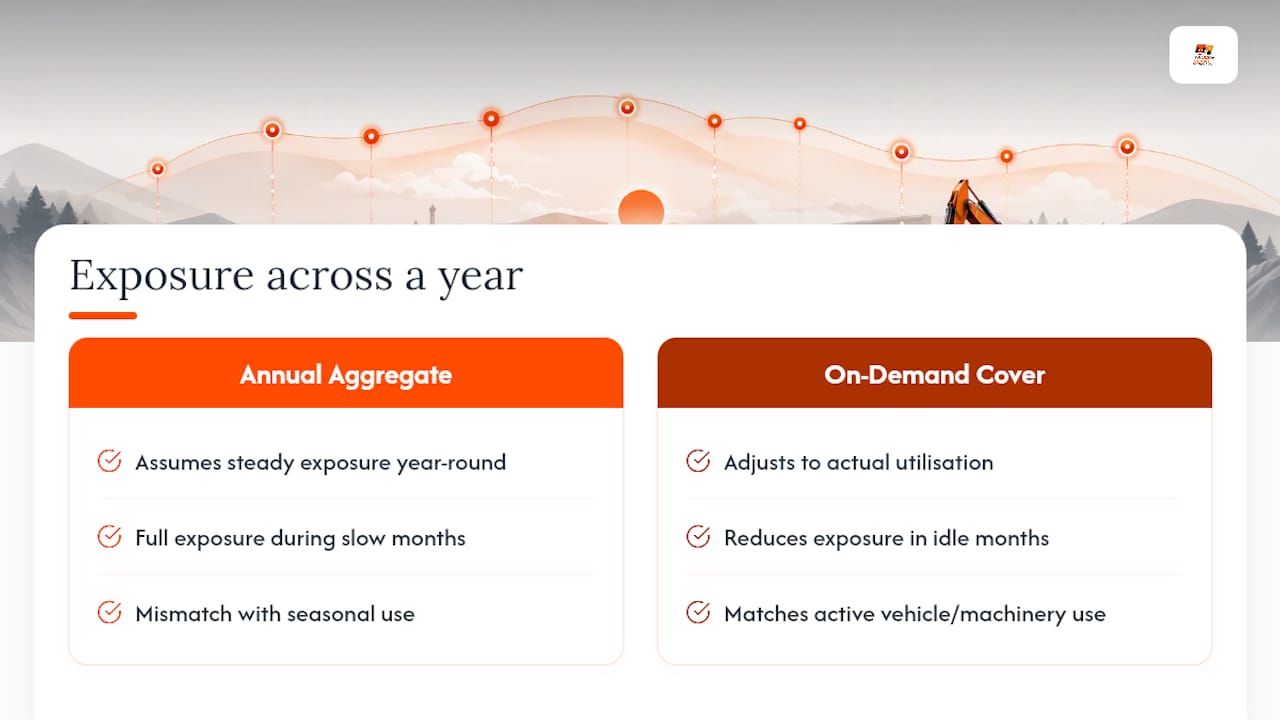
Fleets and plant operators face a specific version of this problem: utilisation swings by season, contract, and project. A large annual aggregate deductible assumes steady exposure all year, which rarely matches how construction and transport businesses actually operate. Truck & Plant On-Demand™ lets you adjust cover to match real utilisation, so you’re not carrying full aggregate exposure during slow months when vehicles or machinery sit idle.
When we recommend aggregate structures, and when we don’t
Aggregate deductibles work best when your claims pattern is genuinely predictable and low-frequency across a group. They work poorly when utilisation swings hard from month to month, which is exactly the profile of many transport and plant fleets. Our experience building on-demand cover keeps coming back to that mismatch: fixed annual thresholds fit static risk, not variable operations. If your fleet’s exposure moves with the seasons, it’s worth comparing that flexibility against a traditional aggregate before renewal.
— Coert
Truck & Plant On-Demand™: cover that flexes with your fleet
Traditional aggregate deductibles lock you into one annual threshold regardless of how much your fleet actually operates that month. An on-demand insurance product is the alternative: you switch cover on and off, and adjust it, based on real utilisation, so idle vehicles and stored machinery stop contributing to a fixed annual exposure you’re not actively generating.

This suits owner-run operators managing a handful of vehicles just as well as large fleet operators juggling seasonal contracts, because you control what’s insured and when, rather than accepting one static aggregate structure for the whole year. If your utilisation varies by project, comparing annual and on-demand models is worth doing before your next renewal, and reviewing cost-saving strategies for commercial fleets can sharpen the comparison further. Ready to see what flexible cover looks like for your operation? Get a quote through the Truck & Plant On-Demand™ fleet insurance page and ask your rep how usage-based premiums compare to your current aggregate exposure.
Sources
For deeper technical grounding, Investopedia covers the core mechanics and a worked numeric example, IRMI details how annual aggregates pair with per-occurrence limits in commercial programs, and Practical Law explains the contract-wording risks around occurrence definitions. For operational context, see how flexible fleet solutions affect premium planning.
- Aggregate Deductible: What it is, How it Works | Investopedia
- Annual aggregate deductible | IRMI
- Aggregate deductible | Practical Law – Thomson Reuters