


TL;DR:
- Many construction businesses underestimate the importance of verifying their machinery insurance coverage to prevent costly gaps.
- A comprehensive checklist includes inventory accuracy, location verification, maintenance records, and appropriate policy types for machinery breakdown.
Working in construction or civil engineering means your machinery is your revenue. A single uninsured breakdown or theft can stop a project, trigger contract penalties, and cost you far more than a year’s premiums. Yet many business owners approach machinery insurance reactively, only discovering gaps in their cover when a claim gets denied. This checklist for insuring machinery gives you a structured, sector-specific process to verify your cover, close the gaps, and make sure every piece of equipment your business depends on is properly protected.
Table of Contents
- Key takeaways
- 1. The core checklist for insuring machinery
- 2. Criteria for selecting the right cover
- 3. Comparing policy options and avoiding common pitfalls
- 4. Steps to implement and maintain your insurance programme
- What I have learned about machinery insurance the hard way
- Cover that fits how your business actually works
- FAQ
Key takeaways
| Point | Details |
|---|---|
| Verify every machine is listed | Equipment at unlisted locations or absent from your policy schedule is not covered, regardless of policy wording. |
| Match limits to replacement cost | Coverage limits must reflect actual equipment replacement cost, not building values or outdated asset registers. |
| Maintenance records affect claims | Poor or undocumented maintenance is a leading cause of claim denial for machinery breakdown policies. |
| Business interruption exposure is underestimated | Restoration lead times for specialised equipment can exceed 12 months, making business interruption cover critical. |
| On-demand cover fits variable fleets | Construction operations that scale up and down benefit from flexible, on-demand insurance rather than fixed annual premiums. |
1. The core checklist for insuring machinery
Before you compare quotes or call your broker, you need a structured insurance coverage checklist that reflects the realities of your operation. The following items are the foundation of any sound machinery insurance review.
Step 1: Build a complete equipment inventory. List every machine by make, model, serial number, purchase date, and current replacement value. This sounds obvious, but many businesses rely on outdated asset registers that omit recently acquired equipment or undervalue older machines that have appreciated due to supply chain pressures.
Step 2: Confirm all insured locations. Policy schedules are legally binding and typically run only two to four pages. Equipment operating at a site not listed on that schedule is uninsured. For construction businesses that move machinery across multiple active sites, this is a critical verification step.
Step 3: Check your policy type. Standard commercial property policies exclude internal mechanical and electrical failures. You need either a standalone equipment breakdown policy or a correctly structured endorsement to cover machinery breakdown specifically.
Step 4: Verify renewal dates and bank clauses. If any machinery is financed or hypothecated, confirm the financier is noted as an interested party on the policy. Lapsed cover on financed equipment creates immediate compliance risk with your lender.
Step 5: Confirm off-premises coverage. Does your policy cover machinery operating off your primary site? For civil engineering contractors, equipment is rarely stationary. Verify that your cover extends to temporary sites, road works locations, and any equipment on hire to third parties.
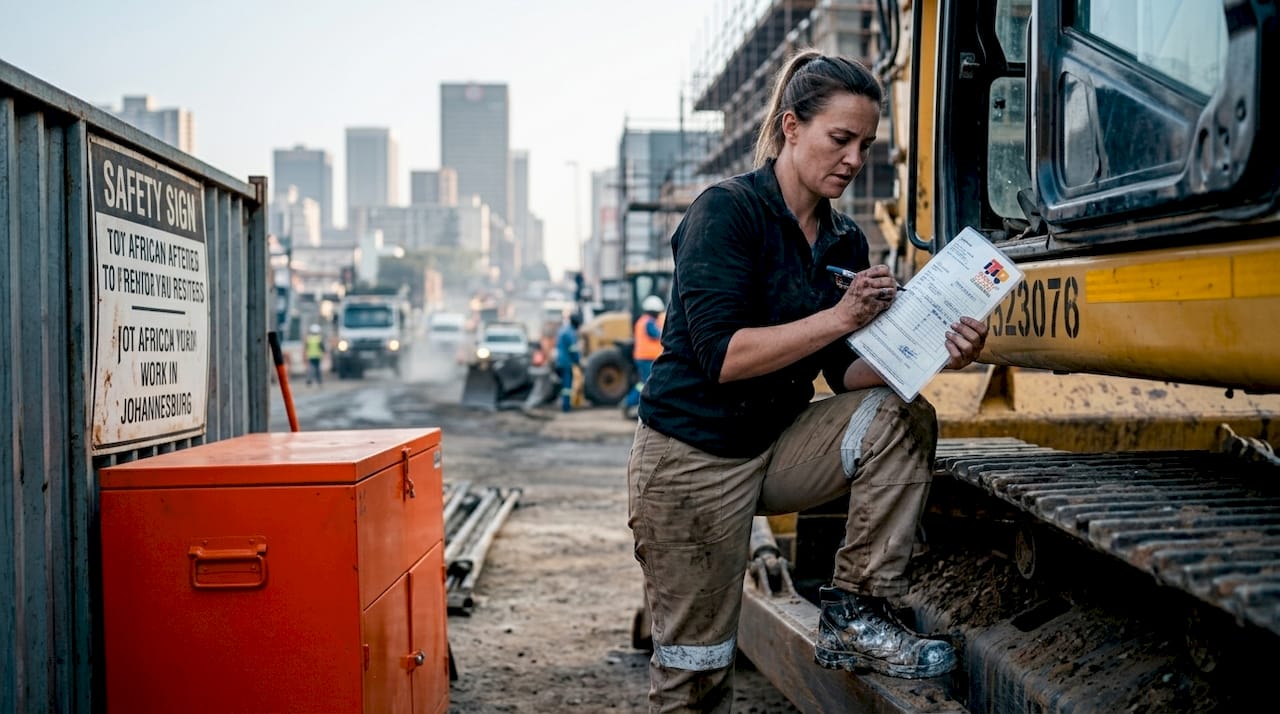
Step 6: Review maintenance log compliance. Maintenance quality is the single most important factor influencing equipment breakdown risk. Most policies require equipment to be maintained in accordance with manufacturer recommendations and statutory inspection schedules. If you cannot produce those records, a claim can be declined regardless of the cause.
Pro Tip: Many insurers offer free or subsidised engineering inspection services as part of an equipment breakdown policy. Request this service. It reduces your risk and produces the inspection records that support future claims.
Step 7: Document safety equipment and functional testing. For high-value or high-risk machinery such as cranes, hoists, and pressure vessels, confirm that safety devices are tested and certified. The absence of functional safety equipment is grounds for claim repudiation and can affect your statutory compliance standing.
2. Criteria for selecting the right cover
Once your inventory and documentation are in order, you need to evaluate what kind of cover actually fits your operation. Not all machinery insurance policies are structured the same way, and the differences matter.
The first criterion is whether a standalone policy or an endorsement to your existing property policy suits your needs better. A standalone policy typically offers broader coverage, higher limits, and dedicated claims handling for machinery. An endorsement is cheaper but usually more restrictive in its definitions and exclusions. For operations with high-value plant equipment, a standalone approach is generally more appropriate.
The second criterion is coverage limits. Equipment breakdown limits should reflect replacement cost, not the book value of your machinery and not a proxy derived from your building value. Replacement costs for specialised construction equipment have risen materially in recent years. Review your limits annually.
Business interruption linked to machinery breakdown is the third, and most frequently underestimated, criterion. Restoration lead times for specialised equipment can extend well beyond 12 months when components must be sourced internationally. A business interruption section that only covers 30 or 60 days of lost income leaves you exposed for the majority of the recovery period.
Finally, consider service interruption cover if your operation depends on equipment you do not own. Generators, HVAC systems, or electrical supply equipment owned by a landlord or utility provider are not covered under your own policy unless you have a service interruption extension explicitly included. This is a commonly overlooked gap for contractors operating from shared or leased premises.
Pro Tip: When reviewing your machinery insurance guide with your broker, ask specifically whether your policy covers “expediting expenses.” These are the emergency costs incurred to speed up repairs, such as air-freighting parts or paying overtime to specialist technicians. They are not automatically included in every policy.
3. Comparing policy options and avoiding common pitfalls
Understanding the differences between policy structures helps you make a genuinely informed decision. The table below summarises the key trade-offs.
| Factor | Standalone policy | Property endorsement |
|---|---|---|
| Coverage breadth | Broader, including expediting expenses and service interruption | Narrower, often restricted to listed perils |
| Premium cost | Higher, but proportional to exposure | Lower, but may leave significant gaps |
| Business interruption | Usually included with extended indemnity periods | May be excluded or limited to 30 days |
| Off-premises cover | Typically available by endorsement | Often excluded by default |
| Claims handling | Specialist machinery adjusters | General property claims process |
The most common errors construction businesses make when insuring industrial equipment are as follows.
- Undervaluing equipment. Using depreciated book value instead of replacement cost means you receive a settlement that cannot actually replace the machine.
- Relying on a general property policy for breakdown. Property policies specifically exclude mechanical breakdown. This is not a grey area. If a motor burns out or a hydraulic system fails due to internal causes, a standard property policy will not respond.
- Ignoring variable loss frequencies. Loss frequencies for equipment breakdown range from 0.2% to 74.5% depending on equipment type. High-frequency machinery categories warrant higher coverage limits and more rigorous maintenance schedules.
- Not updating cover after acquiring new equipment. Failure to update your policy after acquiring new machines or expanding to new sites is one of the most common causes of unexpected coverage gaps at claim time.
The cost calculation here is not complicated. Underinsuring business assets exposes you to losses that can exceed the annual premium savings by orders of magnitude. The incremental premium for adequate cover is rarely significant relative to the asset values in question.
4. Steps to implement and maintain your insurance programme
Having the right policy in place is a starting point, not a conclusion. Machinery insurance requires ongoing management to remain effective. Here is how to build that discipline into your operations.
- Update your equipment inventory at least annually. Any machine acquired, disposed of, or relocated during the year must be reflected in your policy schedule before the end of that period. Do not wait for renewal to catch up.
- Schedule statutory inspections and track compliance. For pressure vessels, lifting equipment, and electrical installations, statutory inspection intervals are regulated. Missing an inspection does not just create a legal risk. It creates grounds for your insurer to repudiate a related claim.
- Meet with your broker at least once a year. A conversation specifically about your current operations, planned acquisitions, and any site changes allows your broker to identify coverage gaps before they become claim problems. This is especially relevant when managing risk in civil and construction operations where the scope of work changes regularly.
- Maintain a claims-ready documentation file. Keep copies of purchase invoices, maintenance records, inspection certificates, and photographs of all major plant items. When a claim arises, your ability to settle it quickly depends entirely on the quality of your documentation.
- Train your site management team. The people responsible for machinery on site need to understand what the policy requires in terms of maintenance, reporting of incidents, and preservation of evidence after a loss event.
- Consider on-demand or flexible cover for variable usage. If your fleet and machinery deployment fluctuates significantly between projects, paying a fixed annual premium for maximum cover year-round is not necessarily the most efficient approach. Reviewing annual vs on-demand insurance models is worth doing when your operational profile changes seasonally or by contract.
Pro Tip: Ask your insurer for their loss control engineering service. Carrier inspection programmes often provide free boiler and pressure vessel inspections that count toward your statutory compliance record and can reduce your premium at renewal.
What I have learned about machinery insurance the hard way
I have spent years working with construction and civil engineering businesses on their insurance programmes, and one pattern stands out consistently. Business owners focus on the premium, not the gap.
The most expensive insurance decision I have seen is not paying too much for cover. It is discovering, at the moment of a major breakdown, that the policy you have been paying for does not respond to the specific cause of loss. Usually because a maintenance record was missing, a site was not listed, or the policy was a property endorsement rather than a standalone breakdown cover.
Business interruption is where the real underestimation happens. Owners look at the daily cost of downtime and multiply it by a few weeks. But when a specialised piece of earthmoving or civil engineering equipment fails and the replacement must be sourced from Europe or the United States, you are not looking at weeks. You are looking at months, sometimes longer.
I have also seen businesses overlook tenant equipment exposure entirely. If your site operations depend on power or cooling supplied through equipment owned by a third party, and that equipment breaks down, your own policy will not cover your resulting losses unless you have a service interruption extension in place.
The practical advice is this. Work with a broker who understands your industry, not just insurance generally. Review your schedule every time your operational footprint changes. And do not let the premium drive the coverage decision when the exposure is existential.
— Coert
Cover that fits how your business actually works
If this checklist has highlighted gaps in your current machinery cover, or if you are tired of paying a fixed premium for a fleet that changes in size and activity throughout the year, Truckplant was built for exactly this situation.
Truck & Plant On-Demand™ gives you full control over your machinery and fleet insurance in South Africa. You choose what you insure, when you insure it, and how. When a project ends and a machine goes into the yard, you are not paying for cover you do not need. When you mobilise for a new contract, your cover updates to match. Truckplant also offers dedicated tool of trade insurance for the mobile equipment your team relies on every day. Explore your options and get cover that reflects the way construction businesses actually operate.
FAQ
What does a checklist for insuring machinery include?
A machinery insurance checklist covers equipment inventory with replacement values, policy schedule verification, maintenance and inspection records, coverage type confirmation, and a review of business interruption limits. It should also verify off-premises cover and any bank or financier clauses.
Does a standard property policy cover machinery breakdown?
No. Standard commercial property policies specifically exclude internal mechanical and electrical failures. You need a standalone equipment breakdown policy or a specific endorsement to cover machinery breakdown losses.
How often should I update my machinery insurance?
You should update your policy every time you acquire new equipment, move machinery to a new site, or change the scope of your operations. At minimum, conduct a full review at renewal each year.
Why is business interruption cover important for machinery?
Restoration lead times for specialised construction equipment can exceed 12 months when parts must be sourced internationally. Without adequate business interruption cover, lost income during that period is entirely at your own expense.
What is service interruption cover and do I need it?
Service interruption cover protects you against losses caused by a breakdown of equipment owned by a third party, such as a landlord’s generator or utility-supplied electrical equipment. If your site operations depend on any equipment you do not own, this extension is worth having.