


TL;DR:
- Standard insurance policies often miss specialist risks relevant to civil, construction, and transport businesses. Customisable cover and targeted endorsements ensure protection aligns with specific operational risks, preventing costly gaps. Regular reviews and adjustments help businesses stay protected as they grow and diversify their activities.
Standard insurance policies are built for average risks. Your business is not average. If you operate commercial vehicles, heavy plant machinery, or civil construction projects, you already know that a generic policy rarely fits what you actually do. Customisable insurance cover lets you match your protection to your real operational risks, not to what an insurer assumes your risks might be. This guide explains how to build, adjust, and maintain insurance that works as hard as your business does.
Table of Contents
- Key takeaways
- Customisable insurance cover: why standard policies fall short
- Building the right base: core coverages explained
- Using endorsements to cover specialised risks
- Setting limits, deductibles, and exclusions correctly
- Keeping your cover current as your business grows
- My take on customising cover in the real world
- Get cover that moves with your business
- FAQ
Key takeaways
| Point | Details |
|---|---|
| Generic policies leave gaps | Standard cover regularly misses specialist risks in construction, transport, and civil operations. |
| Endorsements drive customisation | Adding targeted endorsements to a base policy is the most cost-effective way to close coverage gaps. |
| Limits must reflect rebuild cost | Setting cover limits based on rebuild cost, not market value, prevents costly underinsurance on equipment and property. |
| Reviews protect evolving businesses | Trigger a policy review whenever you acquire new equipment, expand operations, or take on new contract types. |
| On-demand cover gives full control | Flexible, on-demand insurance allows you to adjust cover in real time as your operational needs change. |
Customisable insurance cover: why standard policies fall short
Every construction site, transport fleet, and civil project carries a unique combination of risks. A road-building contractor working on a remote infrastructure project faces completely different exposures than a concrete plant running fixed delivery routes. Yet most standard commercial insurance packages treat these businesses as interchangeable.
Tailored coverage aligns with precise risk profiles and goals, reducing costs and improving protection where generic bundled products simply cannot. When your insurer does not understand the difference between a rigid truck hauling aggregate and a mobile crane on a live construction site, you are paying for assumptions, not for cover.
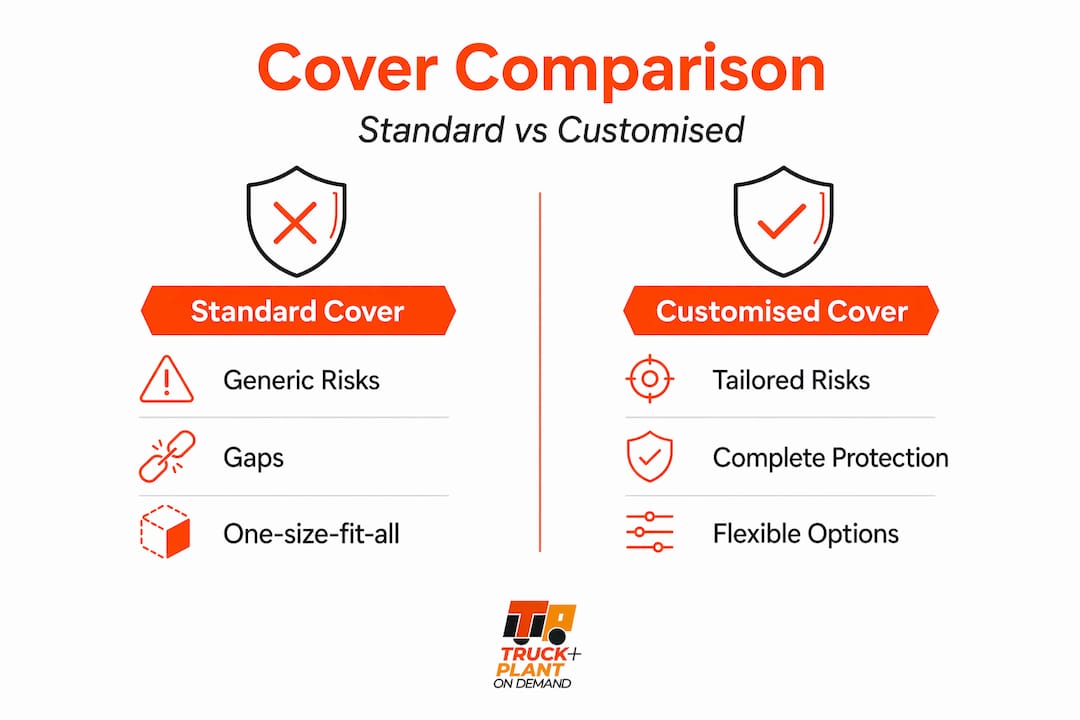
The core issue is coverage gaps. Standard policies are designed around the most common risks across all industries. The moment your operations include specialised equipment, modified vehicles, unusual contract structures, or variable activity levels, those gaps widen. Customising your insurance is not a luxury. It is the only logical response to complex, real-world risk.
Building the right base: core coverages explained
Before you customise anything, you need a solid foundation. The right base policies for civil, construction, and transport businesses typically include:
- General liability cover: Protects against third-party bodily injury and property damage claims arising from your operations or completed projects.
- Commercial property cover: Covers buildings, offices, and fixed assets against damage or loss. For construction businesses, this often extends to materials and temporary structures on site.
- Commercial vehicle cover: Covers your trucks, plant, and fleet vehicles against accidents, theft, and damage. This is non-negotiable for any transport or construction operation.
- Workers’ compensation or employer’s liability: Covers your legal obligations to employees injured on the job. Construction and civil work carry significantly higher injury risks than office environments.
These core policies address the most common risks. But they are starting points, not finished solutions. A standard commercial vehicle policy, for example, applies predetermined baseline coverage limits. Failing to request higher limits explicitly can leave valuable assets seriously underinsured. For a business running a fleet of specialised trucks or heavy plant, that gap is not a technicality. It is a financial exposure that could cripple your operation after a single serious incident.
The right limits matter as much as the right categories. Selecting default minimums to save on premiums is a common mistake that leads to painful shortfalls at claim time.
Using endorsements to cover specialised risks
Once your base policies are in place, endorsements are the primary mechanism for personalised insurance plans. An endorsement, sometimes called a rider, modifies your existing policy to add, remove, or adjust specific coverage. Endorsements allow precise adjustments without purchasing entirely new policies, keeping your programme efficient and cost-controlled.
For businesses in civil, construction, and transport, the most relevant endorsements include:
- Cyber liability: If your fleet uses telematics, GPS tracking, or digital dispatch systems, a cyber incident could expose sensitive data or disrupt operations. Standard policies do not cover this.
- Equipment breakdown cover: Heavy plant and specialised machinery is expensive to repair or replace. Equipment breakdown endorsements cover sudden mechanical or electrical failure not caused by an accident.
- Professional liability: If your business provides design, consulting, or project management services alongside construction work, professional liability protects you against claims of negligence or errors.
- Employment practices liability (EPLI): As your workforce grows, exposure to employment-related claims increases. EPLI is particularly relevant for larger construction firms managing diverse teams.
- Custom parts and modifications cover: Without an explicit endorsement, aftermarket modifications to vehicles such as specialised tipping gear, custom bodywork, or hydraulic systems may not be covered under a standard vehicle policy.
Customising business insurance involves a consultative process that matches your unique operational risks with targeted endorsements. The goal is to avoid paying for coverage bundles that include risks irrelevant to your business while making sure nothing critical slips through.
Pro Tip: Before renewing any policy, list every piece of specialised equipment, every vehicle modification, and every new service your business now offers. Present this list to your broker and ask specifically which of these items falls outside your current cover.
Setting limits, deductibles, and exclusions correctly
Getting the structure of your policy right is one thing. Getting the financial terms right is what separates adequate cover from genuinely protective cover. This is where many business owners make costly errors.

| Factor | Common mistake | Better approach |
|---|---|---|
| Coverage limits | Using market value for plant and equipment | Set limits based on rebuild cost to avoid underinsurance at claim time |
| Deductibles | Choosing the lowest deductible to reduce claim risk | Align your deductible with your actual cash flow capacity for a better premium balance |
| Exclusions | Accepting standard exclusions without review | Read exclusions carefully and use endorsements to reinstate cover where your risks are real |
| Umbrella cover | Assuming primary limits are sufficient | Add an umbrella or excess liability policy for high-value contracts or catastrophic loss scenarios |
Setting realistic limits is not about being conservative. It is about accuracy. A fleet of commercial trucks bought five years ago may have a market value significantly lower than what it would cost to replace those vehicles with equivalent operational units today. If your cover reflects the lower market value, you will face a shortfall at claim time that no amount of negotiation will resolve.
Adjusting deductibles is a legitimate way to control premiums, but only if your business carries enough cash reserve to absorb the deductible amount without disrupting operations. A high deductible that forces you to delay repairs on a critical vehicle is a false economy.
Umbrella or excess liability policies extend your protection beyond the limits of your primary cover. For large civil contracts, infrastructure projects, or any work where a single incident could generate claims well beyond standard limits, an umbrella policy is not optional. It is responsible risk management.
Pro Tip: Ask your broker to model two or three deductible scenarios with corresponding premium estimates. The difference in annual premium often makes the decision straightforward when you see the actual numbers.
Keeping your cover current as your business grows
Insurance is not a once-off decision. Customisation requires ongoing reassessment, particularly when your business changes in any meaningful way. Here is a practical framework for knowing when to review your cover:
- You acquire new equipment or vehicles. Any addition to your fleet or plant inventory changes your exposure. Report it immediately and confirm whether your existing limits and cover categories accommodate the new asset.
- You expand into new geographic areas or contract types. Operating in a new province, taking on government infrastructure contracts, or moving into a new construction segment can trigger different regulatory requirements and risk profiles.
- You take on more employees or subcontractors. Workforce changes affect your employer’s liability exposure and may require adjustments to workers’ compensation limits or EPLI cover.
- You adopt new technology. Telematics systems, automated dispatch platforms, and fleet management software all create new cyber exposure that your original policy did not account for.
- A contract requires specific cover. Many large clients and government bodies require proof of specified cover types and limits before awarding contracts. Waiting until contract sign-off to check your policy is too late.
A trusted broker relationship is critical for successful customisation. Working with an insurer or broker who understands civil, construction, and transport operations means you spend less time explaining your business and more time actually protecting it. Periodic reviews, ideally annual at minimum, prevent the gradual drift where your cover no longer reflects what your business actually does. Modular insurance plans using a base-plus-components model offer the most practical solution here, allowing you to add or remove cover modules quickly as your needs shift.
My take on customising cover in the real world
I have worked closely with fleet operators and construction businesses long enough to know that the biggest coverage failures rarely happen because someone chose the wrong policy category. They happen because the policy was never updated after the business changed.
I have seen contractors running modified vehicles that their insurer would not cover because the modifications were never declared. I have seen civil businesses complete large infrastructure contracts with general liability limits set when they were running a fraction of their current turnover. In both cases, the policies looked fine on paper. The problem only became visible when a claim was made.
The industries we serve move fast. New equipment, new contracts, new risks. The insurers who understand this do not lock you into fixed annual premiums with no room to adjust. In my experience, the businesses that manage insurance best treat their cover the same way they treat their equipment schedules: reviewed regularly, updated when circumstances change, and never assumed to be current just because it was correct last year.
My advice is straightforward. Work with specialists who understand your industry, not generalist brokers who apply construction cover the same way they apply a restaurant policy. And demand the ability to adjust your cover without waiting for an annual renewal.
— Coert
Get cover that moves with your business
Truckplant was built specifically for businesses in the civil, construction, and transport industries who are tired of paying fixed premiums for cover that does not reflect what they actually do. Truck & Plant On-Demand™ gives you complete control. You choose what to insure, when to insure it, and how to insure it. Your cover changes as your operational needs do, not on the insurer’s schedule.
Whether you run a single truck or manage a large mixed fleet, Truckplant’s on-demand fleet insurance is built around your business. You can also explore tailored cover for your tools and equipment so that your most critical assets are protected when they are in use and not costing you premium when they are not. Stop paying for insurance that was designed for someone else’s business.
FAQ
What is customisable insurance cover?
Customisable insurance cover allows businesses to tailor their policy structure, limits, deductibles, and add-ons to match their specific operational risks rather than accepting a generic bundled product.
How do endorsements work in a business insurance policy?
Endorsements are additions or modifications attached to an existing policy that extend or adjust cover for specific risks, such as cyber liability, equipment breakdown, or custom vehicle modifications, without requiring a fully new policy.
When should I review my insurance cover?
Review your cover whenever you acquire new equipment, expand operations, change contract types, or hire additional staff. An annual review at minimum is recommended to avoid coverage gaps as your business evolves.
Can I adjust my coverage limits without changing my whole policy?
Yes. You can request higher or lower limits on specific cover categories, adjust deductibles, and add or remove endorsements independently. A broker familiar with your industry can model these adjustments and their premium impact before you commit.
Why do construction and transport businesses need tailored coverage solutions?
No two businesses in construction or transport carry identical risks. Specialised equipment, modified vehicles, variable activity levels, and complex contracts all require cover that reflects actual exposure rather than industry averages.