


TL;DR:
- Tailored insurance solutions are customized policies that reflect a business’s specific risk profile, assets, and operational patterns. These policies improve cost efficiency, risk alignment, and regulatory compliance by adapting to actual business needs, unlike standard industry policies. Advances in AI, telematics, and modular structures make personalized coverage increasingly accessible and effective in 2026.
Tailored insurance solutions are defined as customised coverage structures built around a business’s specific risk profile, operational patterns, and asset mix rather than a generic policy applied across an industry. For businesses in transportation, construction, and civil engineering, this distinction is not academic. Your fleet size changes seasonally, your plant machinery sits idle between contracts, and your liability exposure shifts with every new project. Standard policies are not built for that reality. Truckplant’s Truck & Plant On-Demand™ model exists precisely because paying a fixed premium for cover you do not always need is a direct cost to your bottom line. Industry approaches like modular policy structures, AI-driven risk analysis, and flexible limit adjustments are making genuinely personalised insurance plans accessible to businesses of every size.
What are tailored insurance solutions and how do they differ from standard policies?
Standard insurance policies apply broad assumptions to entire industries. A generic commercial vehicle policy prices your fleet as if every truck runs every day of the year, every route carries the same risk, and every driver has the same profile. That assumption is almost never true for a construction company or a civil engineering contractor.
Tailored solutions, by contrast, start with a detailed assessment of your actual operations. Independent agents assess operational conditions rather than applying broad product assumptions, enabling coverage that fits real risks rather than available products. The practical result is that you pay for what you are actually exposed to, not what the insurer assumes you might be exposed to.
The risks of staying with a standard policy are real in both directions. Over-insurance means you pay premiums for cover that will never trigger. Under-insurance is the more dangerous outcome. Two out of three U.S. homes are currently underinsured for property damage, and the same structural problem applies to commercial assets when businesses rely on off-the-shelf policies. A construction company with specialised excavation equipment or a fleet operator running refrigerated trucks faces asset valuations and liability exposures that a standard policy will not price correctly.
| Feature | Standard policy | Tailored policy |
|---|---|---|
| Coverage basis | Industry average assumptions | Actual operational risk profile |
| Premium structure | Fixed monthly or annual | Flexible, usage-based, or modular |
| Asset valuation | Book value or market average | Agreed value for specialised assets |
| Coverage gaps | Common, especially for niche risks | Identified and closed during setup |
| Policy adjustments | Annual renewal only | Ongoing, triggered by operational changes |
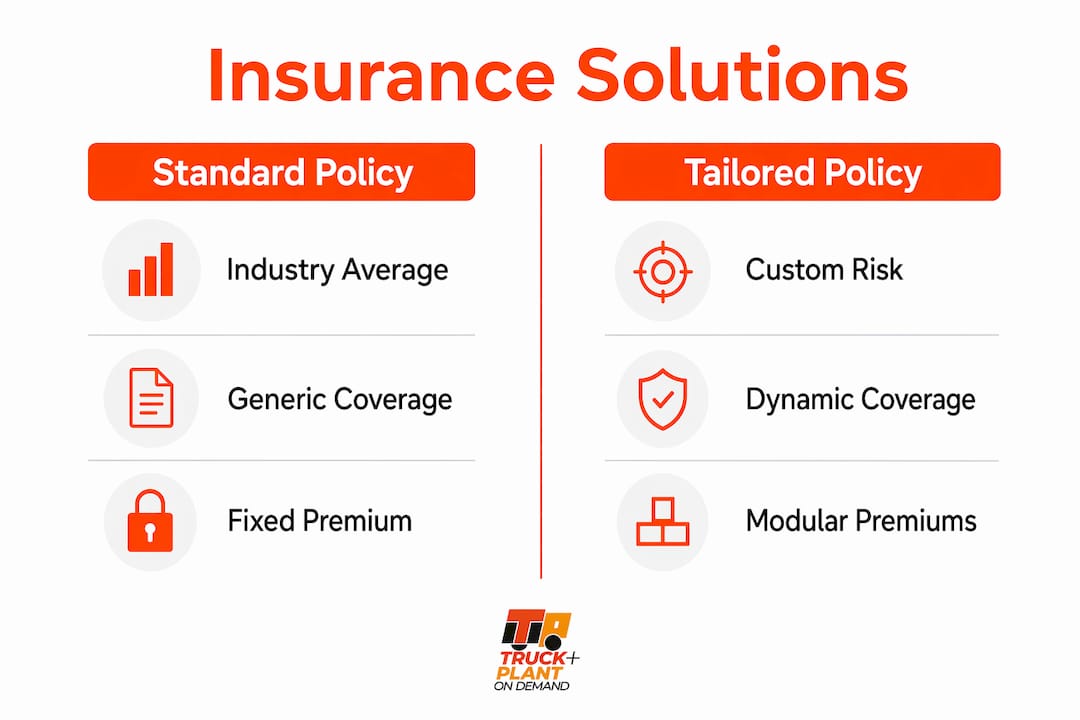
The table above makes the cost and protection case clearly. A tailored policy is not a premium product for large corporations. It is the more accurate product for any business whose operations do not match the industry average.
Core components of an effective tailored insurance solution
A genuinely customised policy is built from several distinct components working together. Understanding each one helps you evaluate whether a proposed solution is truly tailored or simply a rebranded standard product.
-
Detailed risk profiling. Before any coverage is designed, your insurer or broker should map your specific assets, routes, contract types, and seasonal patterns. For a civil engineering contractor, this means accounting for the difference between a road-building project in a remote area and an urban utility installation.
-
Modular coverage structure. Effective tailored policies allow you to activate or deactivate specific covers as your operations change. Plant machinery that is off-site for three months should not carry the same premium as machinery in active daily use.
-
Agreed value for specialised assets. Agreed Value coverage negotiates and formally records asset valuation upfront, preventing claim disputes and delivering predictable payouts. For a fleet of modified heavy vehicles or specialised yellow plant, this removes the single biggest source of post-claim conflict.
-
Premium optimisation. Industry analysts recommend a five-step optimisation hierarchy: eliminate duplicate coverage first, then right-size coverage limits, increase deductibles where your cash flow supports it, bundle policies for efficiency, and then compare the market. This sequence prevents the common mistake of shopping price before fixing coverage structure.
-
Ongoing policy reviews. A tailored solution is not a once-off exercise. Your risk profile changes with every new contract, every new vehicle, and every change in regulation. Scheduled reviews, at minimum quarterly for active fleets, keep your coverage aligned with your actual exposure.
Pro Tip: When evaluating insurers, ask specifically whether they have underwriters with direct experience in your sector. A broker who has never underwritten a civil engineering contract will apply construction averages that do not reflect your actual risk, regardless of how customised the policy appears on paper.
How to implement tailored insurance in transportation, construction, and civil engineering
Getting from a standard policy to a genuinely tailored one requires a structured approach. The following steps apply whether you are an owner-operator with two trucks or a contractor managing a mixed fleet of vehicles and plant.
-
Audit your current coverage against actual operations. Pull your existing policy schedule and map every item of cover against your real operational activity over the past 12 months. Identify cover that never triggered and assets that were undervalued. This audit is the foundation of any optimisation.
-
Classify your assets by risk category and usage frequency. Heavy plant that operates on active construction sites carries different liability and physical damage risk than vehicles used for site logistics. Separating these categories allows your insurer to price each accurately rather than averaging across your entire asset base.
-
Build flexibility into your policy structure. For businesses with seasonal contracts or project-based work, on-demand fleet insurance structures allow you to scale cover up or down as your operational footprint changes. Paying full premiums during a low-activity quarter is a direct and avoidable cost.
-
Use umbrella policies to manage catastrophic liability efficiently. The cost difference between a $2 million and a $10 million umbrella liability policy can be as little as $1,000 to $2,000 annually, while the protection difference is enormous. For civil engineering contractors with significant public liability exposure, right-sizing your umbrella limit is one of the highest-value decisions in your insurance strategy.
-
Review your coverage checklist before every major contract. A new project in a new geography, with new subcontractors or new equipment, changes your risk profile materially. Use a structured vehicle insurance checklist as a pre-contract trigger for policy review.
Pro Tip: Integrate your telematics and fleet management data directly into your insurance review process. Real-time data on vehicle usage, driver behaviour, and route patterns gives your broker concrete evidence to negotiate more accurate premiums rather than relying on industry averages.
What are the measurable benefits of tailored insurance for dynamic businesses?

The advantages of customised insurance are concrete and quantifiable, not theoretical. Businesses that move from standard to tailored coverage consistently report improvements across four dimensions.
Cost efficiency is the most immediate benefit. Eliminating duplicate coverage and right-sizing limits removes premium spend that was never providing protection. For a transport operator running 20 vehicles, even a 10% reduction in wasted premium across a fleet policy represents a material annual saving.
Improved risk alignment means your coverage actually responds when you need it. Agents who build coverage around real operational conditions rather than product availability produce policies that close the gaps standard products leave open. For construction businesses, those gaps often sit in areas like contract works cover, plant-in-transit liability, and third-party property damage on active sites.
Regulatory compliance is a growing driver of tailored coverage in 2026. South African transport and construction regulations impose specific minimum cover requirements that vary by contract type, vehicle class, and project scope. A tailored policy maps directly to those requirements rather than leaving compliance verification to the policyholder.
Long-term adaptability is the benefit that compounds over time. A modular policy structure means your coverage grows and contracts with your business without requiring a full policy replacement at each renewal. This continuity also builds a claims history that supports better pricing over time.
How technology and market trends in 2026 are shaping bespoke coverage solutions
The insurance market in 2026 is moving decisively toward data-driven personalisation. Health insurers are shifting toward personalised and preventive coverage models, and the same logic is reaching commercial lines. The direction of the market is clear: generic products are losing ground to coverage built around actual client data.
Several specific trends are reshaping what bespoke coverage solutions look like in practice:
-
AI-powered coverage analysis. AI-driven tools now analyse coverage adequacy, optimise premiums, and prepare businesses for claims proactively. For fleet operators, this means real-time identification of coverage gaps before they become claim disputes.
-
Modular and embedded insurance products. Insurers are building products where individual covers can be switched on or off without renegotiating the entire policy. This is the structural shift that makes on-demand models like Truckplant’s Truck & Plant On-Demand™ commercially viable at scale.
-
Rising premium pressure. An 8% premium increase is projected for 2026 and 2027 across commercial lines. This makes premium optimisation not a nice-to-have but a direct competitive necessity for businesses managing tight margins.
-
Telematics integration. Route data, driver scoring, and vehicle utilisation metrics are now feeding directly into underwriting models. Businesses that share clean telematics data can negotiate materially better rates than those relying on fleet-average assumptions.
“The businesses that will manage insurance costs most effectively in 2026 are those that treat their operational data as a negotiating asset, not just an internal management tool.”
Combining efficient route planning with telematics-linked insurance creates a compounding advantage: lower fuel costs, better driver behaviour scores, and lower insurance premiums from the same data set.
Key takeaways
Tailored insurance solutions deliver measurable cost and coverage advantages when built on accurate risk profiling, modular structures, and ongoing operational alignment.
| Point | Details |
|---|---|
| Tailored vs standard policies | Tailored policies price actual risk; standard policies apply industry averages that create gaps and waste. |
| Agreed value for specialised assets | Formally agreed asset valuations prevent claim disputes for modified vehicles and plant machinery. |
| Five-step premium optimisation | Eliminate duplicates, right-size limits, adjust deductibles, bundle, then compare market for best results. |
| On-demand flexibility | Modular cover structures allow businesses to scale insurance up or down as operational needs change. |
| Technology as a negotiating tool | Telematics and AI analysis give businesses concrete data to negotiate accurate premiums rather than averages. |
Why I think most businesses are still leaving money on the table
The most common mistake I see in transportation and construction insurance is treating the annual renewal as an administrative task rather than a strategic one. Businesses spend weeks negotiating equipment purchase prices and then accept their insurance renewal without a single question about whether the coverage still matches their operations.
The misconception that tailored coverage costs more than standard coverage is persistent and wrong. Right-sizing your limits, removing duplicate cover, and using agreed value for your specialised assets almost always produces a lower net premium than the standard product you replaced. The businesses that resist customisation are usually the ones paying the most for the least relevant protection.
The second mistake is underestimating how much your risk profile changes between renewals. A construction company that added three new subcontractors, moved into a new project type, or acquired a specialised piece of plant in the past year has a materially different risk profile than the one their current policy was written for. That gap is not the insurer’s problem at claim time. It is yours.
My advice is direct: treat your insurance review as a quarterly business process, not an annual paperwork exercise. The businesses I have seen manage this well integrate their insurance strategy with their asset management and contract pipeline. They know what they are insuring, why they are insuring it at that level, and what triggers a policy change. That discipline is worth more than any single policy feature.
— Coert
Cover that moves with your business
If your operations change month to month, your insurance should too. Truckplant’s Truck & Plant On-Demand™ is built specifically for commercial vehicle operators, construction companies, and civil engineering contractors who need cover that reflects what they are actually doing, not what they did last year.

You choose what to insure, when to insure it, and at what level. Whether you are an owner-operator with a single truck or a fleet manager running mixed commercial and plant assets, Truckplant gives you full control. No wasted premiums. No coverage gaps. Just cover that fits your business as it operates today. Explore fleet insurance for commercial vehicles and see how on-demand cover works in practice.
FAQ
What does defining tailored insurance solutions mean for a business?
Tailored insurance solutions are customised policies built around a business’s specific assets, risk profile, and operational patterns rather than industry-wide averages. For transportation and construction businesses, this means cover that adjusts as your fleet size, project scope, and liability exposure change.
How do tailored insurance plans save money compared to standard policies?
Tailored plans eliminate duplicate coverage, right-size liability limits, and remove premiums for assets not in active use. The five-step optimisation framework of eliminating duplicates, right-sizing, adjusting deductibles, bundling, and comparing the market consistently reduces net premium spend.
What is agreed value cover and why does it matter for plant and fleet assets?
Agreed value cover formally records the insured value of an asset upfront, preventing disputes at claim time. For specialised construction plant or modified commercial vehicles, this approach guarantees a predictable payout that reflects the asset’s actual replacement cost.
How often should a construction or transport business review its insurance cover?
A quarterly review is the recommended minimum for businesses with active fleets or project-based operations. Any material change, including new contracts, new assets, or new subcontractors, should trigger an immediate policy review rather than waiting for annual renewal.
What role does telematics play in custom insurance options for fleets?
Telematics data on vehicle usage, driver behaviour, and route patterns gives insurers concrete evidence to price risk accurately rather than applying fleet averages. Businesses that share clean telematics data consistently negotiate better premiums than those relying on assumed risk profiles.