


TL;DR:
- On-demand insurance offers South African fleet operators flexible coverage that adapts to changing operational needs, reducing wasted premiums. Proper preparation, including comprehensive documentation and digital tools, ensures seamless setup, verification, and ongoing management. This model enhances cost-efficiency, responsiveness, and risk management compared to traditional annual policies.
You pay the same premium every month regardless of whether your fleet is running flat out or sitting idle over the holidays. That single flaw in traditional annual policies costs South African fleet operators and construction businesses millions in wasted premiums every year. On-demand insurance allows businesses to adjust coverage as their needs change, improving operational flexibility in ways a fixed annual policy simply cannot match. This guide walks you through every practical step, from preparation to verification, so you can stop paying for cover you do not need.
Table of Contents
- Key requirements for on-demand fleet insurance
- Step-by-step guide to setting up on-demand insurance
- Verifying coverage and troubleshooting issues
- Expected outcomes and operational benefits
- Why flexible insurance beats annual policies for fleet operators
- Start your on-demand insurance journey with Truck & Plant On-Demand™
- Frequently asked questions
Key Takeaways
| Point | Details |
|---|---|
| Flexible coverage | On-demand insurance lets you scale fleet protection up or down whenever needs shift. |
| Cost savings | Switching to on-demand insurance reduces premiums by avoiding payment for unnecessary coverage. |
| Operational efficiency | Digital tools and automated policy updates streamline compliance and keep your business running safely. |
| Quick setup | You can activate and adjust your fleet insurance almost immediately with the right digital systems. |
Key requirements for on-demand fleet insurance
Now that we understand the potential of on-demand insurance, let’s look at what you’ll need to prepare before initiating your coverage.
Getting your on-demand insurance set up correctly starts well before you log into any platform. Missing a document or skipping an internal process check can cause delays, coverage gaps, or even claim disputes later. Being prepared is not just good practice. It is the difference between seamless cover and costly administration.
Before starting, make sure you have a solid grasp of fleet insurance terminology, since understanding terms like “declared value,” “cover type,” and “policy schedule” will help you configure your cover accurately from day one.
Documents and information you will need
- Fleet register: A complete, up-to-date list of all vehicles and plant machinery, including make, model, year, registration number, and current market value.
- Driver records: Valid driver’s licences, professional driving permits (PDPs) where applicable, and any endorsements or driving history records for each driver.
- Proof of ownership or finance agreements: If vehicles are financed, your financier may have specific insurance requirements that must be reflected in your cover.
- Operational compliance certificates: Roadworthiness certificates, cross-border permits, and any industry-specific certifications relevant to civil, construction, or transport operations.
- Claims history: Your previous insurer’s claims record for the past three to five years. This is often required to assess risk and set accurate premiums.
- Business registration and tax documents: Proof that your company is a registered legal entity operating legitimately within South Africa.
Understanding van insurance requirements is a useful reference point for smaller commercial vehicles in your fleet, since documentation needs are broadly similar across commercial vehicle types.

Digital tools needed for setup
| Tool or system | Purpose |
|---|---|
| Fleet management software | Tracks vehicle locations, usage hours, and maintenance schedules |
| Digital document storage | Secures and shares policy documents, licences, and certificates quickly |
| Online insurance portal | Activates, adjusts, and reviews cover in real time |
| Automated alert system | Notifies you of coverage lapses, renewal dates, and compliance deadlines |
| Telematics integration | Provides usage data to support accurate, usage-based premium calculations |
Having these tools in place before you start will make the setup process significantly faster. More importantly, they will help you manage your cover on an ongoing basis without relying on phone calls or manual paperwork.
Internal compliance checks
Run through the following before initiating cover:
- Verify all vehicles are roadworthy and that certificates are current.
- Confirm driver PDPs and licences are valid and correctly matched to vehicle categories.
- Check that your fleet register matches your operational reality. Vehicles that have been sold, written off, or added must all be reflected accurately.
- Review any contractual obligations with clients or financiers that specify minimum cover levels.
These checks protect you from underinsurance and ensure that when you do need to make a claim, your documentation is in order.
Step-by-step guide to setting up on-demand insurance
With requirements in place, let’s move to the actions that bring on-demand insurance online for your fleet.
Switching to on-demand insurance can reduce costs and improve transparency for fleet management. The process is more straightforward than most operators expect, provided you follow the steps in order.
The setup process
-
Compile your fleet register. Start with a verified, current list of all assets you want to insure. Include vehicles, trailers, and any yellow plant machinery relevant to your operations.
-
Choose your cover types. Decide which vehicles need comprehensive cover, which need third-party only, and whether you require goods-in-transit or road freight liability cover. Your needs may vary by asset and by contract.
-
Upload your documentation. Use the insurer’s digital portal to submit your fleet register, driver records, and compliance certificates. Digital submission speeds up the process considerably.
-
Set your coverage parameters. With on-demand insurance, you define when cover is active. Some operators run full cover during contract periods and reduce to third-party cover during off-season periods. This is where the real cost savings are made.
-
Review and authorise your policy schedule. Before activating cover, confirm that every vehicle is listed correctly, cover types are accurate, and premium calculations reflect your inputs.
-
Activate your cover. Once verified, activate cover for the required vehicles. On-demand platforms allow this instantly, so you are protected from the moment you confirm.
-
Set up automated alerts. Configure notifications for coverage renewals, expiry of driver licences, and any changes in your fleet composition that may require a cover update.
“The ability to adjust cover based on real-time operational needs is the single biggest advantage on-demand insurance offers over traditional annual policies. Use it actively, not just when you onboard.”
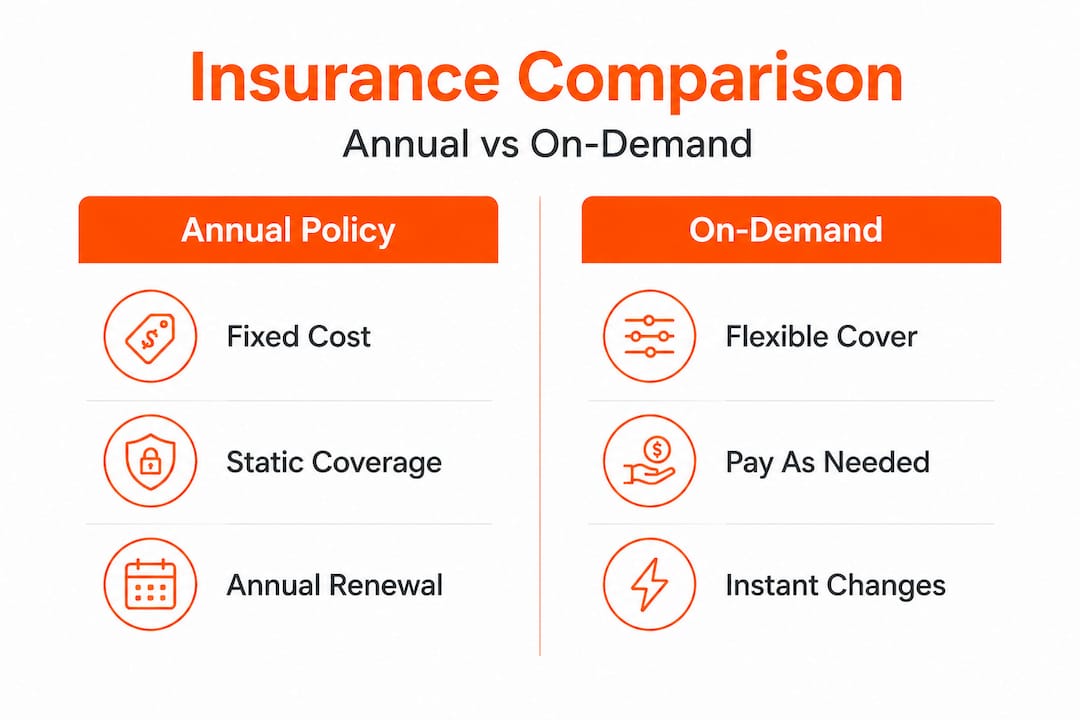
Annual vs on-demand insurance comparison
| Factor | Annual insurance | On-demand insurance |
|---|---|---|
| Premium flexibility | Fixed monthly premium | Adjusts to actual usage and cover needs |
| Coverage changes | Requires insurer approval and admin | Self-managed via digital portal |
| Cost during low-activity periods | Full premium still applies | Reduce cover and pay less |
| Response to fleet changes | Slow, often delayed | Immediate, real-time adjustments |
| Transparency | Limited | Full visibility via dashboard |
Common mistakes to avoid
Many operators make avoidable errors when transitioning to on-demand cover. Misreporting fleet changes is one of the most frequent. If you add a vehicle or remove one without updating your policy, you either carry uncovered assets or pay for assets you no longer own.
Another common mistake is failing to update driver records. If a driver’s licence expires or a PDP is not renewed and that driver is involved in an incident, your claim may be rejected.
You should also cut fleet insurance costs strategically rather than simply reducing cover across the board. Cutting cover on a high-value, high-risk asset to save a few hundred rand per month can cost you significantly more in the event of a loss.
Review the differences between annual vs on-demand insurance options carefully to understand which vehicles in your fleet are best suited to each approach. In some cases, a hybrid model works well.
Pro Tip: Review your coverage configuration after every major operational change, such as winning a new contract, adding seasonal drivers, or deploying assets to a new region. Your cover should reflect your current reality, not last quarter’s operations.
Verifying coverage and troubleshooting issues
Once your insurance is set up, verification and proactive troubleshooting will keep your business protected and efficient.
Setting up cover is only the first step. Verifying that it works correctly is equally important. On-demand insurance technologies provide real-time updates, helping businesses avoid gaps in coverage that could expose them to significant financial risk.
How to verify your coverage
- Log into your digital dashboard and confirm that every asset you intended to insure is listed and active.
- Cross-check your policy schedule against your fleet register to confirm no vehicles have been omitted or incorrectly classified.
- Test the adjustment function by making a minor, authorised change and confirming the update reflects immediately on your policy schedule.
- Confirm cover types per vehicle are correct. A construction vehicle being used on a live site has different risk exposure than a delivery truck and should be covered accordingly.
- Download and store a copy of your current policy schedule in your digital document management system.
Use a structured vehicle insurance checklist to ensure nothing is missed during your verification process. A checklist approach reduces human error and gives you a consistent audit trail.
Troubleshooting common issues
| Problem | Likely cause | Solution |
|---|---|---|
| Vehicle not showing as covered | Not added to fleet register or cover not activated | Update fleet register and activate cover immediately |
| Premium higher than expected | Incorrect vehicle category or cover type selected | Review classification and adjust via portal |
| Coverage lapse notification | Automated alert not configured or policy expired | Reactivate cover and set up expiry alerts |
| Claim query from insurer | Driver records or compliance docs outdated | Update documentation and resubmit to insurer |
Safety note on regulatory compliance
South African road transport regulations require specific minimum cover levels for commercial vehicles operating on public roads. Every time you update your on-demand cover, whether you are adding a vehicle, changing a driver, or adjusting cover type, you must confirm that your updated policy still meets these minimum requirements.
Working with logistics consultancy services can be useful for larger fleets that operate across borders or in multiple sectors, as compliance requirements can differ significantly by jurisdiction and cargo type.
Pro Tip: Set automated alerts for coverage gaps, licence expiry dates, and policy review milestones. Automated systems catch what manual checks miss, particularly in larger fleets where dozens of records need to be maintained simultaneously.
“Verification is not a once-off task. Build it into your monthly fleet management routine and you will rarely face a compliance or coverage problem that catches you off guard.”
Expected outcomes and operational benefits
Understanding the expected outcomes helps business owners see the value of their investment in on-demand insurance.
The operational benefits of on-demand insurance extend well beyond cost savings, though those savings are real and significant. Businesses leveraging on-demand insurance benefit from operational efficiencies and responsive coverage that annual policies simply cannot provide.
What you can expect after successful setup
- Reduced premium waste. You only pay for cover when assets are active and at risk. Idle equipment, off-season vehicles, and decommissioned assets no longer attract full premiums.
- Faster response to fleet changes. Whether you acquire a new tipper truck for a civil contract or stand down equipment between projects, your cover adjusts immediately without waiting for insurer approval.
- Improved cash flow management. Premiums that flex with your operations are easier to budget for than fixed annual costs, particularly for businesses with seasonal revenue cycles.
- Greater operational transparency. Digital dashboards give you a clear, real-time view of what is covered, what it costs, and when cover needs to be reviewed.
- Reduced administrative burden. Self-service platforms eliminate hours of back-and-forth with brokers for routine cover changes.
For businesses looking to further optimise fleet insurance spend, the combination of on-demand cover and active fleet management data creates genuine opportunities to reduce risk profiles over time, which translates into lower premiums.
The express delivery service sector offers a useful parallel. Businesses in that space have demonstrated that flexible, usage-based cover models reduce total insurance spend while maintaining full protection during peak operational periods.
Key insight: Operators who actively manage their on-demand cover, rather than setting it and forgetting it, consistently report better premium outcomes and fewer claim disputes than those who treat it like a traditional policy.
The shift is not just financial. It changes how you think about risk. When your cover reflects your actual operations, you become more aware of risk exposure and more proactive about managing it.
Why flexible insurance beats annual policies for fleet operators
Beyond the how-to, let’s reflect on the broader wisdom that can reshape your entire insurance strategy.
Here is an uncomfortable truth about annual fleet insurance: it was designed for a world where fleets were static, contracts were predictable, and operational change happened slowly. That world no longer exists for most South African fleet operators and construction businesses.
Annual policies create a structural mismatch. Your fleet is dynamic. It grows when you win contracts, shrinks when projects end, and changes character when you move between road transport and plant-intensive civil work. A policy that does not move with your business will always either over-insure or under-insure you. Neither outcome serves your interests.
The argument most commonly made in favour of annual policies is simplicity. You pay once, you are covered, you do not think about it. But that simplicity is an illusion. When a major operational change occurs and you have not updated your cover, that simplicity becomes a liability. Claims get disputed. Premiums do not reflect your risk. And you end up doing more administration to resolve problems than you would have spent managing a responsive on-demand policy.
On-demand insurance shifts the model. You are in control. Coverage decisions are made based on real operational data, not annual estimates that become outdated within weeks. The fleet insurance strategies that deliver the best long-term outcomes are the ones that treat insurance as an active business tool, not a passive annual expense.
Major fleet operators who have made this shift report not just cost savings but a fundamentally different relationship with risk. When you see exactly what you are paying for and when, you make better decisions about asset deployment, driver management, and contract bidding. Insurance becomes part of your operational intelligence, not just a compliance checkbox.
Start your on-demand insurance journey with Truck & Plant On-Demand™
If you’re ready to unlock the true power of flexible, on-demand fleet insurance, here is where to begin.
Truck & Plant On-Demand™ was built specifically for businesses like yours: civil, construction, and transport operators who need cover that keeps pace with their operations. You choose what to insure, when to insure it, and how. We handle the rest.
Explore our fleet insurance solutions for commercial vehicles across South Africa, get tailored truck insurance South Africa cover for your haulage and logistics operations, or protect your cargo and business exposure with our road freight liability insurance. Our team understands the construction and transport industries deeply and we are ready to configure cover that fits your business today, and adapts as it grows tomorrow.
Frequently asked questions
What is the difference between annual and on-demand fleet insurance?
Annual insurance locks coverage and premiums for a full year regardless of operational changes, while on-demand insurance enables businesses to adjust coverage in real time as needs change.
How quickly can I activate or adjust on-demand insurance for my fleet?
With the right digital tools, changes to coverage can be made instantly or within hours. Fleet insurance optimisation platforms allow immediate changes in coverage and cost control without waiting for manual insurer approval.
What documents are usually needed to set up on-demand insurance?
You typically need a current fleet register, valid driver records including licences and PDPs, roadworthiness certificates, proof of ownership or finance agreements, and your business registration documents.
Can on-demand insurance save my business money compared to annual policies?
Yes. Switching to on-demand models can significantly reduce fleet insurance costs by eliminating premiums for unused coverage during low-activity periods.
How do I ensure compliance with regulations using on-demand insurance?
Regular policy reviews and automated alerts help maintain compliance as your fleet composition changes. On-demand insurance technologies keep your cover aligned with current regulatory requirements after every update.