


Excess buy-down insurance reduces or removes the deductible you would otherwise pay on a covered claim, turning an unpredictable out-of-pocket shock into a known, manageable cost. It works either as an endorsement on your existing policy or as a standalone add-on, and it typically suits fleet operators, plant hire companies and property associations carrying high deductibles they cannot easily absorb.
TL;DR:
- Buy-down insurance is most beneficial for businesses with high deductibles they cannot fund immediately, especially fleets, plant hire, or property managers.
- It reduces out-of-pocket costs by covering the gap between the primary policy’s deductible and the total claim amount, without altering insurer payouts.
- Endorsements lower the existing deductible within one policy process, while buy-back policies require reimbursement steps that may delay cash flow.
- Fixed annual buy-down premiums suit stable exposure, whereas on-demand coverage offers more flexibility for seasonal or fluctuating operations.
- Carefully review policy wording, exclusions, and contractual obligations before purchasing to avoid gaps and unexpected delays during claim settlements.
Table of Contents
- What is excess buy down insurance and how does it work?
- Buy-down vs buy-back: which one actually applies to your claim?
- Who actually needs a buy-down policy?
- Which perils actually drive buy-down demand?
- What drives the price, and how do you judge a quote?
- How do you actually arrange the cover?
- Pros, cons and red flags before you sign
- Where an on-demand approach fits better than a fixed buy-down
- What I’d tell a fleet owner weighing this decision
- Get a fleet quote that flexes with your operations
- Sources
What is excess buy down insurance and how does it work?
Excess buy-down insurance is a specialised product, or endorsement, that lowers the amount you are responsible for paying before your primary policy responds to a loss. Brokers and underwriting managers in the local insurance market sell it specifically to ease the cashflow burden that lands on a business the moment a claim happens, according to a broker directory listing on excess buy-down UMAs.
There are two structural forms. An endorsement amends your primary policy directly, so your deductible simply reads lower on the schedule. A standalone policy sits alongside your main cover and pays out separately when a covered event triggers it. Both aim at the same outcome. Only the paperwork and the claims path differ.
Here’s how the mechanics play out on a typical claim:
- Your primary policy carries an excess on vehicle damage.
- You buy down a portion of that exposure through an endorsement or standalone policy.
- A covered accident happens, and repair costs come to a total amount.
- Your primary insurer settles the claim minus the full deductible, leaving you the shortfall.
- The buy-down cover pays part of that shortfall, reducing your actual out-of-pocket cost.
That gap between R50,000 and R15,000 is the entire point of the product. It does not change what your primary insurer pays out. It changes what comes out of your bank account.
Buy-down vs buy-back: which one actually applies to your claim?
Confusing these two terms costs businesses money and time at the worst possible moment, right when a claim is already in motion. They are not interchangeable, and the difference shapes how fast you get paid.
- Definition first. A buy-down endorsement rewrites the deductible on your existing primary policy. A buy-back is a separate policy from a second insurer that reimburses you for the deductible you already paid, according to a LegalClarity explainer on deductible endorsements.
- Claims flow differs sharply. With a buy-down, the lower deductible applies automatically inside one claim process. With a buy-back, you generally pay the full deductible first, then submit proof to the second insurer for reimbursement, which introduces a coordination step that can delay cash relief.
- Choose based on control over your primary policy. When your primary carrier won’t budge on the deductible, a buy-back from a second insurer bridges the gap without touching that contract, though LegalClarity notes this adds complexity at settlement time.
- Lenders and by-laws sometimes decide for you. Finance agreements on vehicles or plant, and body corporate rules for property, often specify a minimum deductible level or a particular product structure. Check the fine print before shopping quotes, not after.
If your priority is speed and simplicity, the endorsement route usually wins. If your primary insurer refuses any change to its own contract, a buy-back is your remaining option, coordination hassle and all.
Who actually needs a buy-down policy?
Not every business needs to buy down its excess. The decision comes down to one question: can you fund the deductible tomorrow, in cash, without disrupting operations? Practitioners who track claims trends note that rising deductibles are straining businesses precisely because many lack that immediate liquidity, a pattern flagged in Daily Investor’s coverage of South Africa’s insurance market.
Run through this checklist before you call a broker:
- Your standard deductible exceeds what you could pay from working capital within 48 hours.
- You run a fleet, a plant hire operation, or manage goods in transit with frequent, moderate-value claims.
- A lender or finance agreement requires a capped deductible as a condition of the loan.
- A property association’s by-laws mandate a specific excess ceiling for catastrophe perils.
- You have had more than one claim in the past two years and expect that pattern to continue.
If none of those apply and your claims history is thin, paying the standard deductible out of reserves is often cheaper over time than carrying an extra premium line.
Pro Tip: Before buying anything, check your loan or lease agreement for a clause dictating minimum deductible levels. Some lenders void favourable financing terms if you drop your excess below their required floor.
Which perils actually drive buy-down demand?
Three risk categories account for most buy-down business in the commercial space, and each has its own product shape.
Motor and hijack cover. Fleet vehicles carry theft and hijack deductibles that can run into tens of thousands of rand per incident. A motor excess reducer applies specifically to that line, often with a separate limit for hijack versus straightforward collision damage. Fleets running higher-risk routes tend to prioritise this over general excess cover.
Goods in transit (GIT). Cargo damaged or stolen mid-transport carries its own deductible structure, frequently calculated as a percentage of load value rather than a flat rand figure. Businesses moving high-value freight often pair a GIT buy-down with the kind of exposure review covered in a practical guide to moving insurance, since transit risk compounds quickly with distance and cargo type.
Wind, hail and catastrophe perils. Property and equipment policies frequently set catastrophe deductibles as a percentage of insured value, sometimes 1% to 5%, rather than a flat sum, and that percentage model is exactly what drives most demand for buy-down cover, according to the Property Insurance Coverage Law Blog. A deductible percentage on a high-value asset like a large yard of plant machinery can amount to a substantial sum that may be difficult to keep in reserve. Few businesses keep that sitting in reserve.
- Motor and hijack reducers: fixed rand-value reduction, priced per vehicle or fleet band.
- GIT buy-downs: often percentage-based, scaled to cargo value and route risk.
- Catastrophe buy-downs: convert a punishing percentage deductible into a flat, budgetable number.
Match the product to the peril that actually threatens your cashflow, not the one that sounds most alarming in a sales pitch.
What drives the price, and how do you judge a quote?
Underwriters price buy-down cover against a handful of variables, and understanding them stops you from either overpaying or under-insuring the gap.
- Size of the gap you’re closing. Reducing a R50,000 excess to R10,000 costs more than trimming it to R35,000, simply because the insurer absorbs more risk.
- Peril profile. Catastrophe and hijack exposures price higher than general collision damage, reflecting claim frequency and severity data the underwriter holds.
- Claims history. A fleet with three claims last year pays more to buy down the same gap than one with a clean record.
- Asset value and location. Plant machinery parked in a high-theft zone or a hail-prone region carries a steeper buy-down premium than the same asset elsewhere.
- Endorsement vs standalone pricing. Endorsements are typically priced as a percentage loading on your existing premium, while standalone buy-back policies are underwritten independently, which can mean materially different costs for closing the same gap, a distinction LegalClarity’s analysis draws out clearly.
Illustrative example only: say your fleet policy carries a R100,000 excess on a major loss event, and you want to buy that down to R20,000, closing an R80,000 gap. A carrier pricing that endorsement will weigh your claims history and asset risk profile, then quote a premium loading reflecting the R80,000 they now absorb. A fleet with no claims in three years might see a modest loading; one with frequent small claims will see a steeper one. There is no universal rate here, because the pricing genuinely depends on your specific risk data, not a fixed formula.
Reducing claims frequency through better risk controls, such as the telematics measures covered in Moto Watchdog’s guide to GPS fleet safety, can shift your negotiating position on renewal even after a buy-down is in place.
How do you actually arrange the cover?
Getting buy-down cover in place is a documentation exercise as much as an insurance one. Skipping steps here is how businesses end up with wording gaps that surface at the worst possible moment.
- Identify the exposure. Pull your current schedule and flag every deductible that exceeds your comfortable cash reserve, using a resource like a practical guide to insurance terminology if the wording itself is unfamiliar.
- Gather your documents. Brokers will want your current policy declarations, asset schedules, and a claims run-off report covering at least the past two to three years.
- Decide endorsement or standalone. Ask your primary insurer first whether they will endorse the existing policy; if they decline, a standalone buy-back from another underwriter becomes the fallback.
- Get exclusions in writing. Request explicit written confirmation of which perils the buy-down covers and which it excludes, matched against your primary policy’s own exclusions.
- Confirm timing and premium structure. Ask exactly when premium is due, whether it is billed annually or on a rolling basis, and how quickly cover activates once you sign.
- Bind and file. Once terms are confirmed, keep the endorsement or standalone policy filed alongside your primary schedule, since claims handlers will need both documents simultaneously.
Reviewing your entire renewal cycle against a structured fleet insurance renewal checklist at the same time you arrange a buy-down avoids duplicate paperwork later.
Pros, cons and red flags before you sign
Buy-down cover solves a specific cashflow problem, but it is not free of friction, and some of that friction only shows up when you actually file a claim.
The upside is straightforward: predictable out-of-pocket costs, protection against a large single loss draining working capital, and in many cases, compliance with a lender’s or association’s minimum deductible rule. The downside is an added premium line, a second contract to track, and, with buy-back structures specifically, a reimbursement process that depends on your primary insurer settling first.
Watch for these red flags before you commit:
- Exclusions that don’t mirror your primary policy’s covered perils, leaving a gap where neither insurer pays.
- “Pay after primary” clauses that delay your reimbursement until the main claim fully settles, sometimes weeks later.
- No clarity on the financial strength of a secondary buy-back carrier, which matters if that insurer runs into solvency trouble.
- Vague policy wording around what counts as a “covered event” for buy-down purposes specifically.
Reading the actual policy document matters more here than with most insurance products. A sample Excess Solutions policy from Rodel SA shows how indemnity for the basic excess gets structured on paper, and it’s worth comparing any quote you receive against that level of detail. Moneyweb’s consumer guide on the pitfalls of insurance excesses makes a similar point: buy-downs can be cost-effective, but insufficient wording and unexpected exclusions are the recurring trap.
Pro Tip: Ask your broker to walk through a hypothetical claim scenario line by line before you sign anything. If they can’t explain exactly who pays what and when, that’s your answer about whether the wording is clear enough.
Where an on-demand approach fits better than a fixed buy-down
A fixed annual buy-down premium makes sense when your exposure is steady. It makes less sense when your fleet size, hire volume or asset use fluctuates through the year, because you end up paying for a flat deductible reduction against exposure that isn’t flat at all.
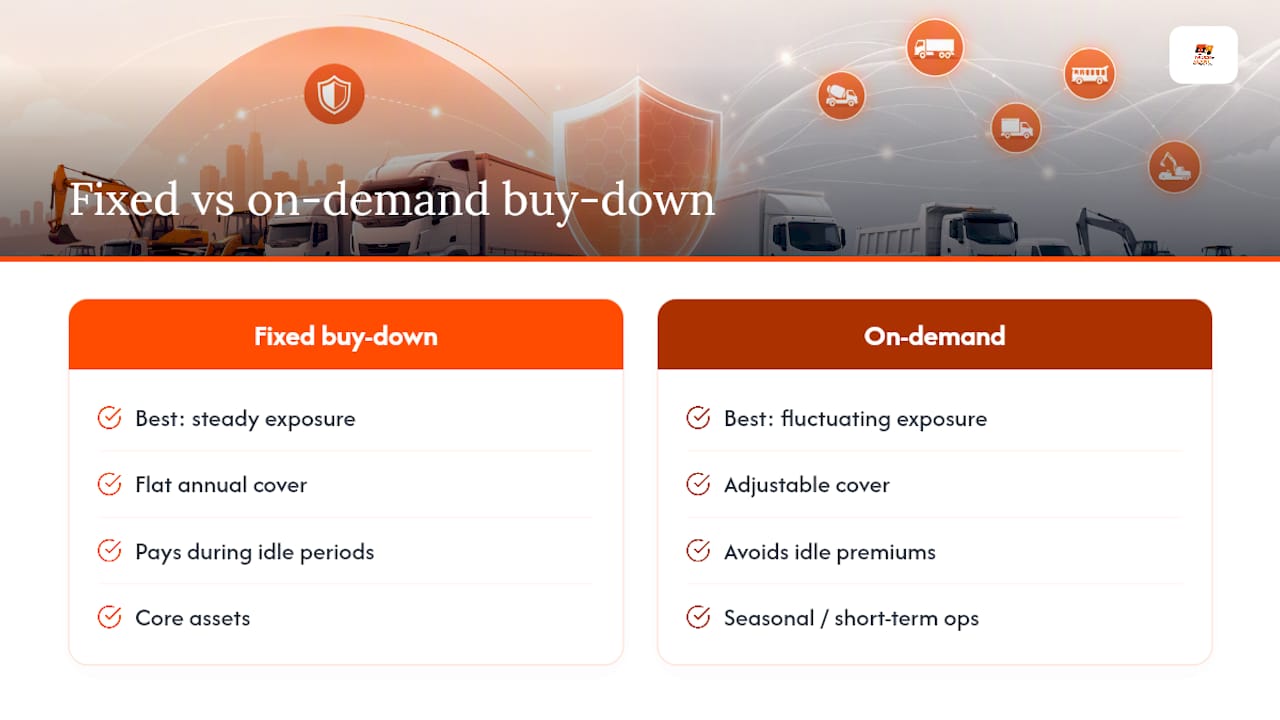
An on-demand insurance approach lets you control what’s insured, when, and for how long, adjusting cover as your operations change, rather than locking into one fixed structure for twelve months. For a plant hire business with seasonal peaks or a fleet operator running short-term contracts, that flexibility can complement a buy-down on your core assets while avoiding premium waste on equipment sitting idle. Reviewing exposure patterns through a resource like this commercial fleet risk guide helps clarify which assets genuinely need a fixed buy-down and which are better served by adjustable, on-demand cover. The right mix depends on how much of your fleet or equipment sits idle versus active through a typical year.
What I’d tell a fleet owner weighing this decision
The mistake I see most often is businesses treating the buy-down decision as a pure insurance question when it’s really a cashflow question first. If you can genuinely absorb your deductible from reserves without disrupting operations, the extra premium probably isn’t worth it. If you can’t, the maths usually favours buying down, even at a real cost, because one bad claim without that cushion can do far more damage than a year of premium payments.
Check lender agreements and any association by-laws before you shop quotes. I’ve seen businesses negotiate a great buy-down rate only to discover their finance agreement already mandated a specific structure they hadn’t accounted for. Sort the constraints first. Price the solution second.
— Coert
Get a fleet quote that flexes with your operations
If a fixed buy-down premium feels like the wrong fit for a fleet or plant hire operation with exposure that shifts month to month, An on-demand insurance model offers a different route to the same cashflow protection. Rather than committing to one static deductible structure for a full year, you adjust what’s covered and when, paying for the cover your operations actually need at any given time.

This suits owner-run businesses, construction fleets and large operators alike, since cover scales with how you’re actually working rather than a fixed annual assumption. If irregular hire cycles or seasonal fleet changes have made a standard excess buy-down feel like overkill some months and underkill in others, it’s worth comparing that against an adjustable structure. Visit the Truck & Plant fleet insurance page to request a tailored quote and see how the numbers compare against your current renewal.
Sources
- Excess Buy-Down Insurance Underwriting Managers (UMAs) in SA — Broker Directory
- Deductible buy-back and buy-down endorsements explained — LegalClarity
- What is Deductible Buy Down Insurance? A Basic Guide for Policyholders — Property Insurance Coverage Law Blog
- Excess Solutions policy (sample policy PDF) — Rodel SA