


Downtime insurance replaces the income you lose when your truck is out of service because of a covered event, such as a collision or fire. As the IRMI definition confirms, it is a business-interruption style indemnity that pays for loss of earnings when a tractor or trailer is unusable because of an insured peril. If you are an owner-operator or run a small fleet and your revenue stops the moment a truck stops, this cover is worth understanding before you need it.
Do these three things right now:
- Pull out your declarations page and confirm whether you have a loss-of-use, rental reimbursement, or downtime endorsement listed.
- Record today’s date, your average daily gross revenue, and the name of your insurer or agent in a note you can access from your phone.
- Locate your most recent load confirmations, rate confirmations, and driver logs, and store digital copies somewhere you can reach them from the roadside.
Key takeaways
Downtime insurance protects your income when a covered event takes your truck off the road, and the strength of your documentation determines whether that protection actually pays out.
| Point | Details |
|---|---|
| Check your declarations page now | Confirm whether you carry a loss-of-use, rental reimbursement, or downtime endorsement before a breakdown happens. |
| Know your two recovery paths | Your own endorsement pays faster; third-party liability recovery depends on the at-fault carrier accepting fault. |
| Daily benefit range | Common options run $100–$500/day; choose a cap that reflects your actual net daily loss or you absorb the gap. |
| Documentation decides the claim | Load confirmations, rate confirmations, driver logs, and timestamped photos are the evidence insurers require. |
| Truckplant on-demand option | Truck & Plant On-Demand™ lets you adjust cover to match operational exposure and manage claims digitally. |
Table of Contents
- What does downtime insurance actually cover?
- How downtime payments are triggered, calculated, and limited
- Why downtime claims are commonly denied
- Step-by-step documentation and claims checklist
- How to buy downtime coverage and what to ask your agent
- How to pursue downtime from the at-fault driver’s insurer
- On-demand and parametric options that change your downtime risk
- When to contact a lawyer or a downtime recovery firm
- What experienced owner-operators know about downtime cover
- Truck & Plant On-Demand™ covers your truck when you need it
- Sources
What does downtime insurance actually cover?
The term “downtime insurance” is informal. On a commercial truck policy you will see it named as truckers downtime, loss-of-use, loss of earnings, or a rental reimbursement endorsement. Larger programs may call it a business interruption rider for vehicles. All of these names describe the same core benefit: a daily cash payment when your truck cannot work.
Coverage typically attaches to your physical damage policy as an endorsement, though some specialty programs write it as a standalone policy. Newer on-demand insurance products from insurtech carriers can offer it as a usage-triggered rider activated and deactivated as your operational needs change.
Two payout structures exist. The traditional model is indemnity-style: the insurer calculates your actual lost income and pays a predetermined daily benefit up to a cap. The newer model is parametric or usage-triggered: a predefined event (a verified breakdown, a telematics signal, a repair-shop check-in) that automatically triggers payment at an agreed hourly or daily rate with no income calculation required. Parametric products pay faster and with less paperwork, but the trigger must match your actual loss event or you receive nothing.
How downtime payments are triggered, calculated, and limited
Two separate paths can put money in your pocket after a disabling event.
Path 1: Your own policy’s downtime endorsement. This is the faster, more predictable route. Once the covered peril is confirmed and the waiting period expires, your insurer pays the agreed daily benefit regardless of whether the at-fault party has been identified or accepts liability.
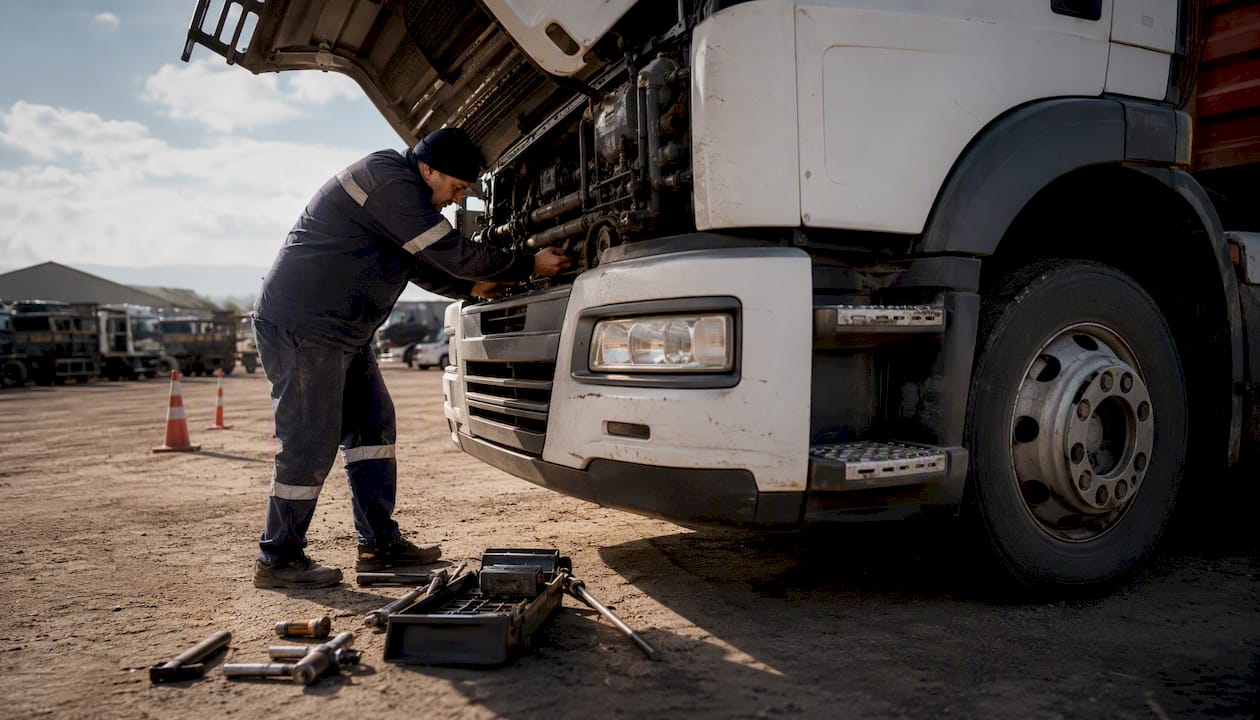
Path 2: Third-party liability recovery. If another driver caused the accident, their insurer owes you for lost income as part of the property damage claim. This path costs you nothing in premium, but it depends on the at-fault carrier accepting liability and agreeing on the revenue figure, which can take weeks or months.
How the daily benefit is calculated
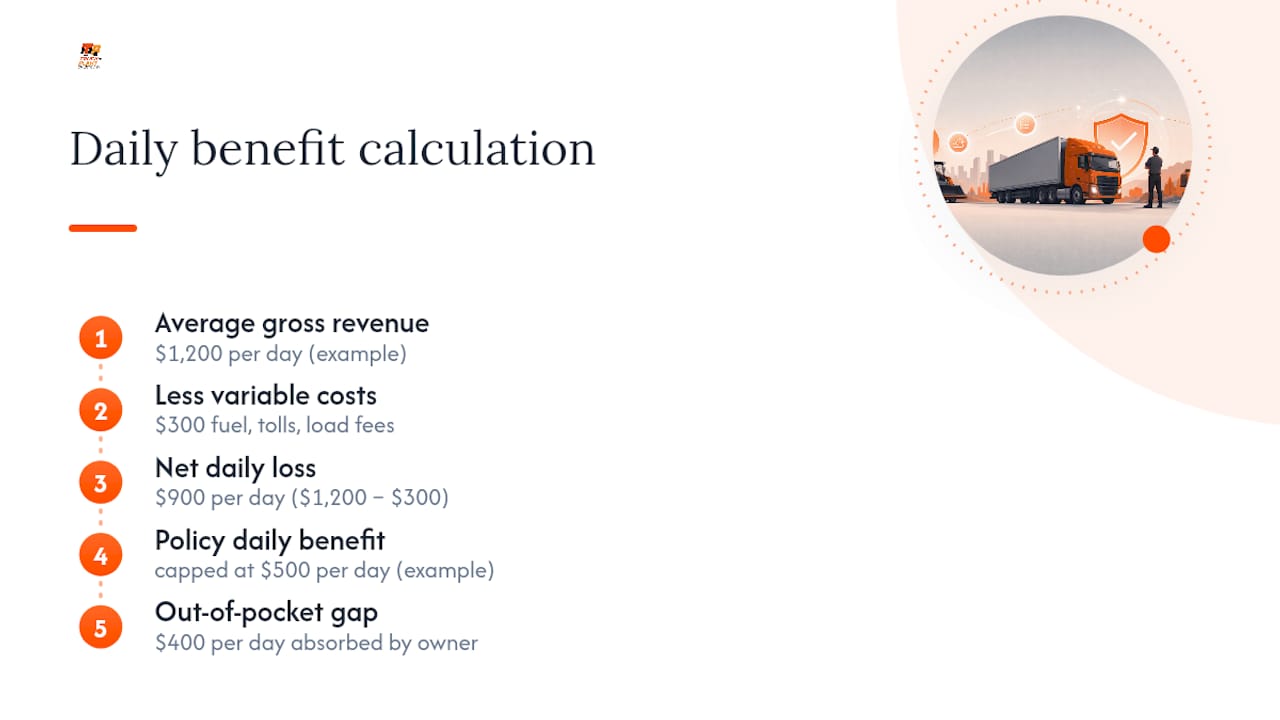
Insurers use a baseline revenue method. Start with your average gross daily revenue, then subtract the variable costs you are no longer incurring (fuel, tolls, driver wages if you hire out, load-specific fees). The result is your net daily loss. Rocky Transport’s owner-operator guide shows that common daily benefit options run from roughly $100 to $500 per day, with the waiting period typically set at 24–72 hours before payments begin.
One important warning on waiting periods: Great West Casualty’s physical damage program describes a structure where the waiting period does not begin until the carrier approves repairs, a repair facility is authorised, and repairs have actually started. In practice, that can add several days to your effective wait before a single dollar of downtime benefit is paid.
Example calculation. Your truck averages $1,200 gross per day. You subtract $300 in fuel, tolls, and load fees you are not spending. Your net daily loss is $900. If your policy caps the daily benefit at $500, you are absorbing $400 per day out of pocket. Choosing a higher daily benefit at policy purchase is far cheaper than discovering that gap after a breakdown.
Why downtime claims are commonly denied
Most denials trace back to one of four causes: an excluded peril, a process failure, missing documentation, or a sublimit the policyholder never noticed.
Common exclusions to know:
- Wear-and-tear and routine maintenance failures (a blown engine from deferred oil changes is almost always excluded)
- Pre-existing mechanical conditions known before the policy period
- Downtime caused by regulatory suspension, licence revocation, or compliance failure
- Weather delays or supply-chain disruptions that are not listed covered perils
- Downtime caused by your own neglect or failure to mitigate (parking a damaged truck for two weeks without seeking repairs)
Process traps that trigger denials:
- Missing the notification window your policy requires (often 24–72 hours after the event)
- Starting repairs without written authorisation from the insurer
- Submitting revenue claims with no contemporaneous records to back them up
- Failing to document mitigation steps (showing you tried to source a replacement vehicle or reroute loads)
Sublimits are a quieter trap. A policy may carry a $500/day benefit but cap total downtime payouts at $5,000 per event. If your repair runs three weeks, that cap is exhausted in ten days. Read the declarations page for both the per-day figure and the per-event maximum.
Pro Tip: Trigger language is where most surprises hide. As Embroker’s business interruption analysis shows, many policies tie payment to narrow trigger definitions. Ask your agent to read you the exact trigger clause, not just the marketing summary.
Step-by-step documentation and claims checklist
Strong documentation is the single most important factor in whether an insurer accepts your claimed lost income. Operational records, load confirmations, and rate confirmations carry more weight than a verbal account of what you were earning.
- Notify your insurer or agent immediately. Call within 24 hours of the event. Record the date, time, claim number, and the name of the representative you spoke with.
- Secure a police report or incident number if another vehicle was involved. This is required for third-party recovery and strengthens your own-policy claim.
- Photograph the truck and scene with timestamps active on your phone. Capture damage, road conditions, and any other vehicles.
- Get at least two written repair estimates from authorised facilities. Do not authorise repairs until your insurer confirms in writing.
- Open a physical or digital claim file and add every document as it arrives: repair orders, adjuster correspondence, tow receipts.
- Compile your revenue evidence. Pull the last 90 days of load confirmations, rate confirmations, driver logs, and invoices. GPS or ECM timestamps corroborate the logs.
- Calculate your daily loss using the baseline method: average gross daily revenue minus variable costs you are not incurring.
- Submit the full package to your insurer: claim form, revenue evidence, repair estimates, police report, and a written timeline of events.
- Follow up in writing every five business days. Keep a log of every call and email.
Pro Tip: Industry guidance on downtime documentation consistently points to timestamped photos and multiple contemporaneous records as the deciding factor in disputed claims. Keep a paper backup of your load confirmations in the cab, not just on an app.
The table below shows which document supports which part of the claim.
| Document | What it proves |
|---|---|
| Load confirmations / rate confirmations | Contracted revenue you lost |
| Driver logs (ELD or paper) | Hours and routes you were unable to run |
| Repair orders and estimates | Duration and cause of downtime |
| GPS / ECM timestamps | Corroborates log entries and breakdown location |
| Detention or layover logs | Additional consequential losses |
| Invoices (fuel, tolls, fees) | Variable costs to subtract from gross revenue |
How to buy downtime coverage and what to ask your agent
Add downtime coverage if any of these apply to you: your operation depends on a single truck, you carry a loan or lease on the vehicle, or a two-week breakdown would threaten your ability to pay fixed costs. If you have a strong cash reserve and can absorb three to four weeks of lost revenue, relying on third-party recovery alone may be a reasonable risk decision. Most owner-operators cannot.
When you speak to your agent or broker, ask these specific questions:
- What is the exact trigger language? Does the policy require physical damage, or does a mechanical breakdown also qualify?
- When does the waiting period clock start? Is it from the event, from the repair authorisation, or from when the shop actually begins work?
- What is the per-day benefit cap and the per-event maximum?
- How long is the maximum benefit period?
- Does the endorsement cover non-fault accidents where the at-fault party is uninsured?
- What documentation will you require to approve the daily benefit?
- Is the payout a cash payment to me, or does it reimburse specific costs?
Pricing depends on truck age, your annual revenue level, driving record, the waiting period you choose, and the daily benefit amount. A shorter waiting period costs more in premium but pays sooner. Choosing a 72-hour wait instead of a 24-hour wait can reduce your premium meaningfully while still covering the bulk of a serious repair event. For flexible premium approaches that let you adjust cover as your operations change, usage-based products are worth comparing alongside traditional endorsements.
How to pursue downtime from the at-fault driver’s insurer
When another driver caused the accident, their insurer owes you for lost income. Here is how to pursue it.
- Collect the at-fault driver’s insurance information, licence plate, and police report number at the scene.
- Document your losses from day one: load confirmations, rate confirmations, and a daily log of revenue you could not earn.
- Send a formal demand package to the at-fault carrier. Include your repair estimate, revenue evidence, daily loss calculation, and a clear statement of the number of days you were out of service.
- Follow up with the adjuster every week. Liability disputes and disagreements over repair duration are the two most common hold points. Put every conversation in writing.
- If your own insurer paid your downtime benefit first, subrogation applies. Your insurer will pursue the at-fault carrier to recover what it paid you. You may be asked to cooperate by providing documentation.
- If the at-fault carrier denies or low-balls the claim, you can negotiate directly, engage a contingency downtime recovery firm, or consult an attorney.
Subrogation is your insurer’s right to step into your shoes and recover from the at-fault party. It works in your favour: you get paid by your own insurer first, then your insurer chases the at-fault carrier. The practical benefit is speed. You are not waiting on a liability dispute to resolve before income replacement begins.
On-demand and parametric options that change your downtime risk
Traditional downtime endorsements work well for long repair events but can leave gaps for short outages. A 48-hour breakdown that falls inside a 72-hour waiting period pays nothing under a standard policy. Parametric and insurtech products were developed specifically to close that gap, using objective triggers and independent verification to pay hourly or daily without a full claims investigation.
How parametric downtime products work for truckers:
- A predefined trigger (telematics signal, repair-shop check-in, GPS stop duration) activates the payout automatically.
- Payment cadence is hourly or daily, often within 24–48 hours of the trigger.
- No income calculation is required; the agreed rate is fixed at purchase.
- Waiting periods can be as short as a few hours, making short outages financially recoverable.
Before buying a parametric or on-demand product, verify:
- How the trigger is confirmed and who verifies it (insurer, third-party data provider, or telematics platform).
- The insurer’s or MGA’s licensing status in your operating states.
- Geographic coverage limits (some products exclude certain corridors or states).
- The claims process if the trigger fires but the insurer disputes the event.
Traditional endorsements suit operations where breakdowns tend to be serious and multi-week. On-demand or parametric products suit owner-operators who need short-event protection and want to avoid paying a full-year premium for cover they may rarely use. The benefits of real-time insurance for fleets and plant include faster claims resolution and the ability to match cover to actual operational exposure rather than a fixed annual estimate.
When to contact a lawyer or a downtime recovery firm
Most straightforward downtime claims resolve without legal help. Bring in a specialist when you see these red flags:
- Disputed liability where the at-fault carrier denies responsibility or shares blame to reduce the payout.
- Multi-week claims where the at-fault insurer is stalling and your cash flow is at risk.
- Denial despite strong evidence on your own policy, which may indicate a bad-faith handling issue.
- Subrogation delays where your own insurer is slow to pursue the at-fault carrier and you are waiting on reimbursement of your deductible or uncovered losses.
Contingency downtime recovery firms specialise in collecting unpaid downtime from at-fault carriers. They work on a percentage of what they recover, so there is no upfront cost. They are most effective for clear-liability cases where the dispute is over the revenue calculation, not fault itself.
Attorneys handle larger liability disputes, bad-faith insurance claims, and cases where the at-fault carrier’s policy limits are insufficient. Expect hourly billing or a contingency arrangement depending on the case size. Either professional will ask for your full documentation package: load confirmations, driver logs, repair orders, and your daily loss calculation.
What experienced owner-operators know about downtime cover
The gap between what a policy promises and what it pays is almost always a documentation problem, not a coverage problem. Carriers who are denied or underpaid on downtime claims almost universally lack contemporaneous revenue records. A load confirmation from three months ago is worth more in a claim than a sworn statement about what you were earning.
The second lesson is about trigger language. Many owner-operators assume “loss-of-use” covers any situation where the truck is not moving. It does not. The trigger clause defines the covered perils precisely, and a mechanical breakdown caused by deferred maintenance is excluded in virtually every policy. Read the trigger clause before you buy, not after you file.
Checking your declarations page today costs you nothing. Discovering a gap after a two-week repair costs you the income you cannot recover.
Truck & Plant On-Demand™ covers your truck when you need it

Truck & Plant On-Demand™ gives owner-operators and small fleet owners a usage-based alternative to fixed annual premiums. You choose what to cover, when to cover it, and how much cover you need, and you pay only for the period you are actually exposed. That means no wasted premium during low-activity periods and full cover when your truck is working hardest.
The platform includes digital claims management, so you can notify, document, and track a claim without waiting on hold. Cover types include physical damage, machinery breakdown, and general business liability, with the ability to adjust your programme as your operations change.
Before purchasing, confirm that Truck & Plant On-Demand™ is licensed and available in your operating states, and compare the trigger language and waiting period against your current endorsement. To get a quote or speak with an agent about on-demand cover for your fleet, visit Truckplant today.
Sources
The sources below provide definitions, practical claim guidance, and context on newer coverage structures.
- truckers downtime insurance
- Downtime Insurance: Essential Coverage for Breakdowns | Rocky Transport Inc.
- How Downtime Insurance Became a Thing
- Cloud Outage Insurance Guide | Embroker
This article provides general information about downtime insurance and is not a substitute for advice from a licensed insurance professional. Confirm current policy terms, coverage availability, and licensing with a qualified agent or your state’s insurance department before making coverage decisions.