


The fastest way to manage seasonal cover is to stop insuring everything for twelve months and start matching your policy to actual utilisation, using on-demand insurance with scheduled activations, scheduled suspensions, and a 30-day lead time built into every trigger. That single shift, from static annual policies to usage-based cover, is what separates operators who bleed premium on idle machines from those who don’t.
Truck & Plant On-Demand™ was built around this exact model: you activate cover when an asset starts working and suspend it the moment it stops, rather than paying flat premiums regardless of use. Planning frameworks from the University of Maryland Extension reinforce a principle that translates directly into fleet management: define your purpose, define your window, and test any new process at small scale before rolling it out fleet-wide. Pair that with NRCS-style discipline around timing and termination, and you get a repeatable system rather than a guessing game.
Here’s what that looks like in practice:
- Review utilisation data for every truck, trailer, and machine at least 30 days before an expected seasonal shift.
- Classify each asset as continuous-cover or scheduled on/off cover based on how often it actually works.
- Run a small pilot, one depot or one vehicle group, before changing cover rules across the whole fleet.
- Document every activation and suspension decision so you have a clean audit trail if a claim ever falls near a transition date.
If you only do one thing this week, pull your utilisation logs and flag which assets have sat idle for more than 30 days. That’s the starting point for everything else in this guide.
Key Takeaways
Managing seasonal cover effectively means matching insurance activation and suspension to real utilisation data, using 30-day lead triggers and a documented, auditable process at every transition.
| Point | Details |
|---|---|
| Use on-demand cover | Match activation and suspension to actual utilisation instead of paying flat annual premiums. |
| Set 30-day lead triggers | Build lead time into every activation trigger to stay compliant and avoid gaps. |
| Document every transition | Photographs, utilisation logs, and written sign-offs protect you if a claim happens mid-transition. |
| Track four core KPIs | Monitor utilisation percentage, days insured vs. active, claims per insured-day, and premium per utilisation-hour. |
| Pilot before scaling | Test new cover processes on one depot or asset group before rolling out fleet-wide. |
| Truck & Plant On-Demand™ | Offers real-time adjustable cover and digital confirmations built for this exact activation/suspension workflow. |
Table of Contents
- How to manage seasonal cover: the quick checklist for this week
- Build a seasonal cover calendar: timelines, triggers and priorities
- Operational playbook: activate, suspend and document cover
- Cut premium waste and measure cost efficiency
- Three ways operators are running seasonal cover today
- How to choose an on-demand insurer or product
- Ongoing monitoring: KPIs and review cadence
- What actually trips operators up
- How Truck & Plant On-Demand™ fits into this playbook
- Sources
How to manage seasonal cover: the quick checklist for this week
You don’t need a full overhaul to start saving on premium. You need seven days of focused action.
Start by pulling utilisation data for every insured asset, cross referencing hours worked, kilometres driven, or hire-booking days against what you’re currently paying to insure. Flag anything sitting idle. Then call your insurer or log into your digital platform to confirm what documentation they’ll want before you activate or suspend cover, because insurers vary on this and getting it wrong mid-transition is where claims disputes start.
Your checklist for the week:
- Monday: Export utilisation logs for the past 60 days across all vehicles and machinery.
- Tuesday: Identify assets with utilisation below your threshold (most operators use 20% or lower as a dormancy flag).
- Wednesday: Confirm activation and suspension lead times with your insurer or platform.
- Thursday: Draft the internal sign-off process, who authorises a cover change and who records it.
- Friday: Run a single test case, one vehicle or one machine, through the full activation/suspension cycle.
Pro Tip: Test your new process on one depot or a single vehicle group first. The University of Maryland Extension’s planning guidance recommends exactly this approach: pilot small, observe the friction points, then scale once the process holds up under real conditions.
Minimum documentation your insurer will typically want at activation or suspension includes an updated asset valuation, current odometer or hour-meter reading, photographs showing condition, and a signed internal authorisation. Missing any of these at the point of transition is one of the most common reasons claims get delayed.

Build a seasonal cover calendar: timelines, triggers and priorities
A calendar turns seasonal cover from a reactive scramble into a planned operation. Start by mapping expected active periods for each asset class, because a compact excavator on a six-month civil contract behaves nothing like a tipper truck that only runs during harvest transport season.
Group your fleet into three categories:
- Continuous-use assets that work year-round and justify standing annual cover.
- Seasonal-peak assets active for defined windows, harvest transport, construction phases, holiday freight surges.
- Intermittent or hire-driven assets whose activity depends on bookings or contracts rather than a fixed calendar.
Once you know which bucket an asset sits in, assign triggers. Virginia’s NRCS technical guidance on seasonal planning windows makes a point worth borrowing directly: define your niches clearly, because vague windows produce vague triggers, and vague triggers get ignored.
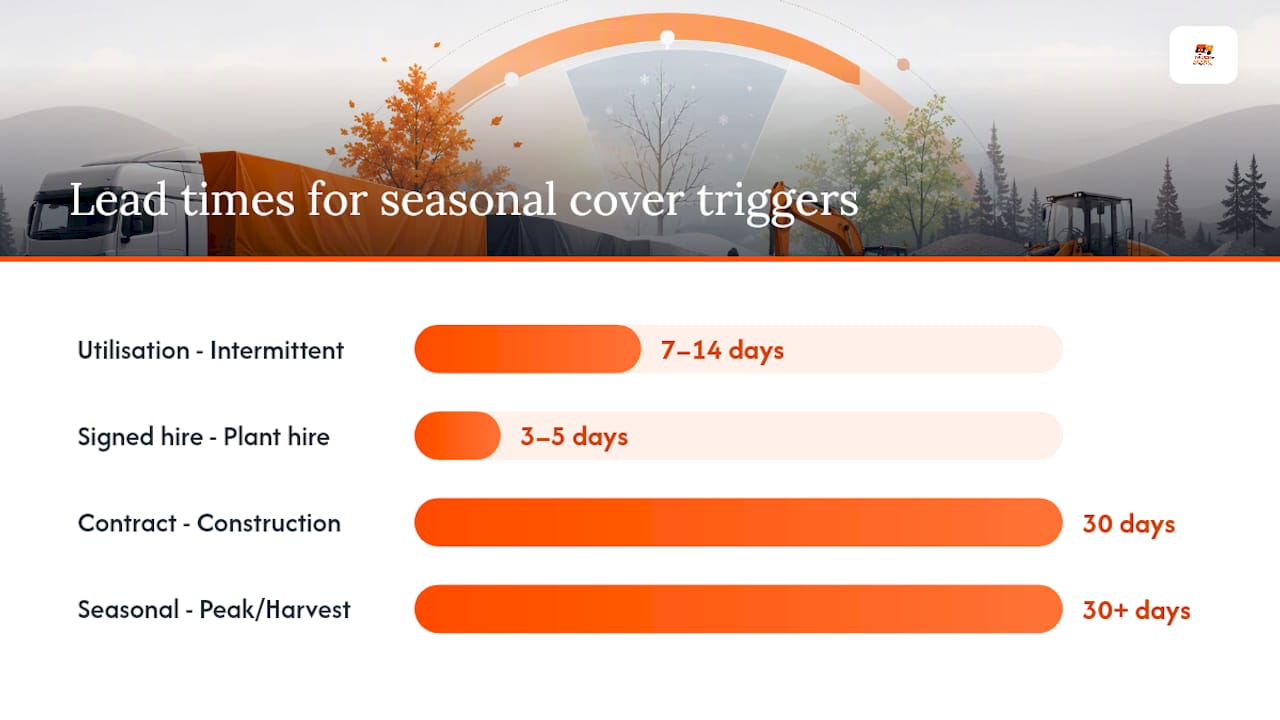
| Trigger Type | Recommended Lead Time | Applies To |
|---|---|---|
| Utilisation threshold crossed | 7 to 14 days | Intermittent-use vehicles |
| Signed hire agreement | 3 to 5 days | Plant hire equipment |
| Contract start/end date | 30 days | Construction machinery on fixed contracts |
| Known seasonal demand spike | 30+ days | Peak freight or harvest transport assets |
The PA 340 specification’s emphasis on planting “as early as feasible” and terminating “in a timely manner” maps onto insurance almost word for word: early planning and disciplined timing prevent the compliance gaps that show up when cover changes happen reactively instead of on a schedule.
Pro Tip: Build your calendar in quarters, not months. Review utilisation at the start of each quarter, notify your insurer of expected changes with 30 days’ notice, and reserve the final two weeks of each quarter purely for activation and suspension execution.
Operational playbook: activate, suspend and document cover
Getting the calendar right means nothing if the execution is sloppy. This is where most operators lose money, not in the planning, but in the handoff between “we decided to suspend cover” and “cover is actually suspended.”
Follow this sequence every time:
- Confirm the trigger has been met (utilisation drop, contract end, hire return) and log the date.
- Capture asset condition with photographs and a current odometer or hour-meter reading.
- Submit the change through your insurer’s digital platform or direct contact, specifying exact start or end dates.
- Get written confirmation of the new cover status, including any adjusted limits or exclusions for the transition period.
- File the confirmation alongside your internal authorisation and asset documentation.
- Set a review reminder for the next expected trigger point.
Documentation gaps are where claims fall apart. Keep a standing file for each asset containing:
- Photographs taken at every activation and suspension.
- Utilisation logs covering the 30 days before and after the change.
- Hire agreements or contract documents supporting the trigger.
- Maintenance records, since insurers may query condition if a claim arises near a transition date.
If you’re running short-term or scheduled cover, always confirm in writing exactly what limits and exclusions apply during that window. Short-term policies sometimes carry different terms than annual cover, and finding that out during a claim is the worst possible time. Truckplant’s own guide to seasonal insurance mechanics walks through how these confirmations typically work for fleets and plant hire.
Cut premium waste and measure cost efficiency
Here’s the calculation most fleet managers skip: gross premium exposure versus actual utilisation, measured asset by asset, not fleet-wide.
Say you’re paying annual premium on a compact loader that only works four months a year. Under a flat annual policy, you’re covering it for twelve months of risk to get four months of use. Switch that single asset to on-demand cover tied to its actual working window, and you eliminate roughly eight months of unnecessary premium exposure on that one machine alone. Multiply that across a mixed fleet with several seasonal or intermittent assets, and the gap between what you’re paying and what you’re actually using becomes the single biggest lever in your insurance budget.
Modelling research on timing sensitivity backs up why precision matters here. A crop simulation study focused on Eastern Nebraska found that small shifts in timing decisions materially changed outcomes, in that case, biomass and nitrogen dynamics. The underlying lesson applies directly to insurance timing: shaving even a week or two off an activation delay, or catching a suspension trigger late, compounds into real cost or real exposure over a season.
Build three things into your budgeting process:
| Budget Element | Purpose |
|---|---|
| Activation reserve | Covers the short admin window between trigger and confirmed cover |
| Transition contingency | Buffers against claims risk during activation/suspension periods |
| Monthly variance tracker | Flags unexpected premium creep or missed suspension triggers |
Operators who insure dormant equipment as if it were active are effectively locking up working capital in premiums for machines earning nothing. Getting activation and suspension timing right is what turns seasonal cover from a fixed cost into a variable one that tracks your actual operations. Truckplant’s breakdown of annual versus on-demand cover walks through this comparison in more detail.
Three ways operators are running seasonal cover today
The single-truck owner-operator running short-notice freight during peak retail season activates cover for two to three week windows tied directly to contract confirmations, rather than carrying annual cover for a truck that sits idle half the year. The trade-off: slightly more admin per activation, but a meaningfully smaller annual premium bill.
The plant hire business ties cover status directly to booking confirmations, syncing insurance activation with rental software so a machine is only insured for the exact duration of its hire agreement. This works particularly well when integrated digitally, since it removes the manual step of remembering to activate or suspend for every booking.
The large fleet operator splits assets into two tiers: high-exposure, high-value trucks stay on continuous cover year-round, while seasonal or backup machinery runs on usage-based cover tied to utilisation triggers. This hybrid approach concentrates premium spend where risk is highest and cuts it everywhere else.
- Small operator: fewer than 10 activations a year, minimal admin overhead.
- Plant hire: cover status changes weekly or even daily depending on booking volume.
- Large fleet: quarterly reviews with monthly exception checks for outlier assets.
How to choose an on-demand insurer or product
Not every “flexible” insurance product actually delivers flexibility. Before you commit, run your shortlist through this checklist:
- Activation lead time: How fast can cover actually go live once you request it? Same-day or next-day activation should be the baseline expectation for a genuinely digital product.
- Minimum term requirements: Does the policy force you into a minimum cover period even for a short seasonal window?
- Digital audit trail: Can you pull a clean record of every activation, suspension, and confirmation for compliance or claims purposes?
- Integration options: Does the product connect with rental or fleet management software you’re already using?
- Claims turnaround: What’s the actual process if a claim occurs during a transition period, not just during standard active cover?
Watch for red flags: notice periods longer than a few days for activation, unclear or repeated fees every time you toggle cover on and off, and insurers who can’t produce a digital confirmation on demand. Truckplant’s comparison of flexible fleet coverage options covers these evaluation criteria in more depth, and it’s worth cross-checking any provider you’re considering against warranty and maintenance obligations too. Fleet maintenance warranty guidance is a useful reference here, since gaps between warranty coverage and insurance exclusions often surface only when something breaks down mid-season.
Ongoing monitoring: KPIs and review cadence
Seasonal cover isn’t a set-and-forget system. Utilisation shifts, contracts end early, and weather changes plans. The fix is a small, disciplined set of KPIs reviewed on a fixed cadence.
Track these four numbers:
- Utilisation percentage per asset, updated monthly.
- Days insured versus days active, the gap here is your waste indicator.
- Claims per insured-day, which flags whether your risk profile is shifting.
- Premium per utilisation-hour, your true cost-efficiency metric.
| Review Type | Frequency | Focus |
|---|---|---|
| Operational check | Weekly | Confirm triggers, flag upcoming activations/suspensions |
| Finance review | Monthly | Track premium variance and utilisation gaps |
| Pre-season planning | Quarterly | Reassess asset tiers and update the seasonal calendar |
When a KPI moves outside your normal range, say utilisation on a “dormant” asset suddenly spikes, escalate it for manual review rather than waiting for the next scheduled check. Automating the routine triggers frees your team to focus on exactly these exceptions, which is where real risk tends to hide. Truckplant’s premium optimisation guidance has more detail on setting these thresholds.
What actually trips operators up
The single biggest mistake I see is treating seasonal cover as a one-time setup instead of a living process. Fleet managers build a solid calendar, activate cover correctly for the first season, and then let it run on autopilot. Six months later, half the triggers are outdated because contracts changed, a machine got redeployed, or a hire booking extended without anyone updating the insurance status.
The second mistake is weaker but just as costly: documentation gets sloppy exactly at the moments it matters most, during the activation and suspension windows themselves. A claim that happens three days into a new activation, or two days before a scheduled suspension, is where insurers scrutinise paperwork hardest. If your photographs, utilisation logs, and sign-offs aren’t airtight for those exact transition dates, you’re exposed regardless of how good your overall system is.
My priority order for anyone building this from scratch: automate the utilisation triggers first, lock in 30-day lead times second, and run the smallest possible pilot before touching your full fleet. Don’t try to convert every asset to on-demand cover in one move. Prove the process on one depot, fix what breaks, then scale.
Before your next peak season, check that you’ve got: updated utilisation data on every asset, confirmed lead times with your insurer, a documented sign-off process, and at least one completed pilot cycle behind you.
How Truck & Plant On-Demand™ fits into this playbook
Truck & Plant On-Demand™ is built for exactly the workflow this guide describes, real-time adjustable cover, short-term activation, and digital confirmations that give you an audit trail without paperwork chasing.

Every procurement criterion covered above maps directly onto how the product works. Activation lead times are built for speed rather than the multi-week waits common with traditional annual policies. Digital confirmations create the audit trail your documentation checklist demands. And because cover adjusts to what you’re actually running, you stop paying for equipment sitting idle between contracts or hire bookings.
If you’re managing a mixed fleet across trucks, trailers, and plant machinery, the practical next step is to run your own asset list against the tiering method described earlier, continuous cover for high-exposure assets, on-demand for the rest, and check what that split would look like under Truck & Plant On-Demand™. Get a quote based on your actual utilisation data rather than a flat annual estimate, and see where the gap between insured days and active days is costing you today.
Sources
- Nrcs
- Cover Crop Planning (FS-2024-0743) | University of Maryland Extension
- Virginia NRCS Cover Crop Planning Manual 1.0
- Optimizing Cover Crop Management in Eastern Nebraska: Insights from Crop Simulation Modeling