


TL;DR:
- Reviewing insurance policies is essential to identify coverage gaps and prevent claim denials for business risks. Business owners should systematically examine declarations, exclusions, limits, and endorsements regularly or after operational changes. A careful, structured review avoids costly mistakes and ensures coverage aligns with current business operations.
Reviewing policy coverage is the process of verifying your insurance details to confirm your business risks are adequately protected and coverage gaps are identified before a claim arises. For business owners in civil, construction, and transport, this is not a once-off admin task. A missed exclusion or an outdated limit can mean a denied claim on a R2 million excavator or a fleet of trucks. The industry standard framework treats every policy as three parts: limits, deductibles, and exclusions. Understanding all three together gives you a realistic picture of what your cover actually delivers.
How to review policy coverage: the key sections to focus on
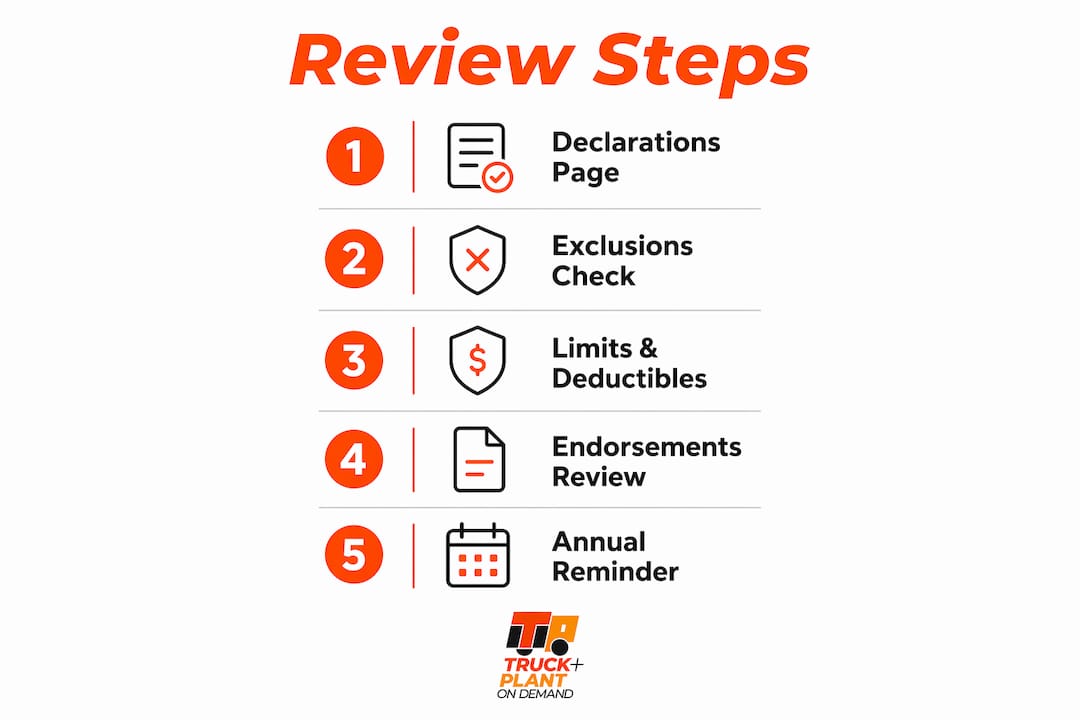
The declarations page is your starting point. Reviewing the declarations page takes about 10 minutes and gives you a summary of coverage types, limits, deductibles, and premiums in one place. Think of it as the index of your policy. Everything else in the document expands on what that page summarises.
Beyond the declarations page, four sections carry the most weight for commercial operators:
- Insuring agreements: These define what is covered and under what conditions. Read them carefully because they set the boundaries of protection before exclusions narrow them further.
- Exclusions: Exclusions define risks and situations not covered by your policy. For construction and transport businesses, this often includes environmental perils, specific operational risks, and mechanical breakdown. Exclusions are frequently more important than the coverage sections themselves because misunderstandings here cause the most common claim denials.
- Endorsements: These are amendments that modify your base policy. An endorsement can add cover for a specific vehicle type or remove cover for a risk your insurer no longer wants to carry. Never assume your base policy is unchanged at renewal without checking endorsements.
- Coverage limits: Per-occurrence limits cap single claim payouts, while aggregate limits cap total claims across the full policy period. A civil contractor running multiple sites simultaneously needs to understand both figures. Hitting your aggregate limit mid-year leaves you exposed for the rest of the period.
Pro Tip: Print or save the exclusions section separately. Read it alongside your list of active assets and operational risks. If you find a mismatch, flag it immediately for your broker.
Understanding limits, deductibles, and exclusions together gives a far more accurate picture of coverage strength than reading any one section alone. A policy with a high limit but a broad exclusion clause may offer less real protection than a policy with a lower limit and tighter terms.

Steps to assess your coverage systematically
A structured approach removes guesswork from the review process. Work through these steps in order:
- Obtain the current declarations page. Contact your insurer or log into their portal to confirm you have the latest version. Mid-term endorsements can override your original policy documents, so the copy in your filing cabinet may already be outdated.
- Verify named insured and asset details. Confirm that every vehicle, machine, and property listed matches your current fleet and operational footprint. A truck added six months ago that was never endorsed onto the policy is uninsured.
- Check coverage limits against current asset values. Equipment values change. A grader purchased three years ago at R800,000 may now cost R1.2 million to replace. If your limit has not moved, you are carrying the difference yourself.
- Review deductibles carefully. Percentage-based deductibles are common in transport and construction policies for wind, storm, or vehicle damage. A 5% deductible on a R3 million policy means R150,000 out of pocket before your insurer pays a cent. Know your number before a claim, not after.
- Read exclusions against your actual operations. Cross-reference every exclusion with your day-to-day risks. Flood exclusions matter if your sites are near rivers. Contractual liability exclusions matter if you sign indemnity agreements with clients.
- Check endorsements for additions and removals. List every endorsement and confirm whether it adds or limits cover. A fleet insurance terminology guide can help you decode the language if endorsement wording is unclear.
- Create a one-page summary. Note every question, anomaly, or gap you find. Bring this list to your next broker meeting. A written record protects you and keeps the conversation focused.
Pro Tip: Set a calendar reminder to run this review annually and immediately after any major operational change, such as adding vehicles, entering a new contract, or expanding into a new region.
For transport operators managing logistics risk management, this step-by-step approach also feeds directly into broader risk mitigation planning. Coverage gaps and operational risks are two sides of the same coin.
What mistakes do business owners make when reviewing insurance policies?
Most coverage problems are not caused by bad policies. They are caused by owners who did not read their policies carefully enough. These are the most common errors:
- Assuming cover means full protection. A policy that covers “vehicle damage” may exclude damage caused during loading, off-road use, or driver negligence. The word “cover” means nothing without the limit and exclusion context around it.
- Skipping the exclusions section. Most policyholders rely on coverage sections alone without reading definitions and exclusions. Narrowly defined terms like “mechanical breakdown” or “accidental damage” can drastically limit what you can claim.
- Confusing the limit with replacement cost. Your policy limit is not automatically equal to what it costs to replace an asset today. Inflation, supply chain delays, and import costs all push replacement values up. If your limit was set three years ago, it may already be insufficient.
- Not updating the policy after operational changes. Adding a new excavator, taking on a subcontractor, or starting work in a new province all change your risk profile. A policy that does not reflect those changes may not respond to a claim arising from them.
- Choosing cover based on premium alone. A lower premium often signals weaker terms, higher deductibles, or broader exclusions. The insurance compliance guide for transport operators makes clear that regulatory minimum cover is rarely sufficient for commercial operations.
- Missing duties after loss conditions. Failure to notify your insurer promptly after a loss, or failing to mitigate further damage, can result in automatic claim denial regardless of your coverage limit. These conditions are buried in the policy but carry full legal weight.
How do you keep coverage aligned with your business over time?
A single review is not enough. Your business changes, and your cover must change with it. These practices keep your policy current:
- Schedule annual reviews at renewal. Annual reviews and updates protect against gaps caused by asset or operational growth. Renewal is the natural moment to renegotiate limits and endorsements.
- Review after every major change. New contracts, new equipment, new sites, or new drivers all warrant a mid-term policy check. Do not wait for renewal if your risk profile has shifted significantly.
- Use insurer portals to confirm current documents. Your broker or insurer portal holds the authoritative version of your policy. Paper copies in a drawer may not reflect recent changes.
- Consult your broker on limits and endorsements. A broker who specialises in civil, construction, or transport can identify gaps that a generalist might miss. Ask specifically about endorsements available for your industry.
- Track regulatory changes. South African transport and construction regulations evolve. A change in compulsory third-party requirements or environmental liability rules can create a coverage gap overnight if your policy does not keep pace.
- Build an audit trail. Document every review, every question asked, and every change made. This record protects you in a dispute and helps your broker advise you more accurately over time. The fleet insurance renewal guide for 2026 provides a practical framework for structuring this process.
Key takeaways
Reviewing your policy coverage thoroughly, using a structured checklist of limits, deductibles, exclusions, and endorsements, is the most reliable way to avoid claim denials and underinsurance in commercial operations.
| Point | Details |
|---|---|
| Start with the declarations page | It summarises coverage types, limits, deductibles, and premiums in one place. |
| Exclusions define real protection | Read exclusions against your actual operations to find gaps before a claim does. |
| Check deductibles in detail | Percentage-based deductibles in transport and construction can mean large out-of-pocket costs. |
| Update cover after every change | New assets, contracts, or regions change your risk profile and require a policy update. |
| Build a written review record | Document every review and change to protect yourself in disputes and improve future advice. |
What I have learned from reviewing policies in heavy industries
The most expensive mistake I see business owners make is treating their insurance policy as proof of cover rather than a contract to be read. A policy document is a legal agreement, and the insurer will hold you to every word of it, including the words that limit what they owe you.
Exclusions are where claims go to die. I have seen transport operators denied on claims for vehicle damage because the incident occurred during a loading operation that fell outside the policy’s definition of “in transit.” The cover existed on paper. The exclusion made it irrelevant. Reading exclusions carefully is not paranoia. It is the only way to know what you actually own.
Technology has made this easier. Insurer portals now give you access to your current policy documents in real time, which removes the old problem of working from an outdated copy. Use that access. Log in before your renewal meeting, not after a claim.
The cost-benefit calculation is straightforward. The time spent on a thorough annual review is measured in hours. The cost of a denied claim or an underinsured asset is measured in hundreds of thousands of rands. There is no version of this where skipping the review makes financial sense.
— Coert
Truckplant’s on-demand cover for commercial fleets
Reviewing your policy is only half the work. The other half is making sure your cover actually fits how your business operates, not how it operated when you first signed up.
Truckplant’s Truck & Plant On-Demand™ insurance is built for civil, construction, and transport businesses that need cover to move with their operations. You choose what to insure, when to insure it, and how. You only pay for cover when you need it. Whether you run a single truck or a large mixed fleet, Truckplant gives you full control over your cover without locking you into a fixed monthly premium that does not reflect your actual risk. Get a quote or speak to the team about tailored fleet solutions designed for your industry.
FAQ
What is the first step in reviewing an insurance policy?
Start with the declarations page. It summarises your coverage types, limits, deductibles, and premiums and takes about 10 minutes to review.
Why do insurance claims get denied despite having cover?
Claims are most often denied because of exclusions, missed duties after loss conditions, or coverage limits that do not match the actual loss. Reading exclusions carefully before a claim arises is the best prevention.
How often should a business review its insurance policy?
Review your policy annually at renewal and immediately after any major operational change, such as adding vehicles, taking on new contracts, or expanding into new areas.
What is the difference between per-occurrence and aggregate limits?
A per-occurrence limit caps the payout on a single claim. An aggregate limit caps total payouts across the full policy period. Both figures matter for businesses running multiple sites or vehicles simultaneously.
What are percentage-based deductibles and why do they matter?
Percentage-based deductibles calculate your out-of-pocket cost as a percentage of total coverage rather than a flat amount. On a large commercial policy, this can result in a significantly higher deductible than most business owners expect.