


TL;DR:
- Proper preparation and organized documentation prevent claim delays and ensure smooth payouts.
- Prompt notification, accurate details, and complete evidence are crucial for efficient claim processing.
- Understanding your policy and building internal processes provide a competitive advantage in insurance claims.
A delayed insurance claim can freeze your cash flow at the worst possible moment. Imagine your excavator is damaged on site, your truck is off the road after an accident, and your insurer is waiting on documents you haven’t gathered yet. Every day without a payout is a day your business absorbs the cost. For civil, construction, and transport operators, this isn’t a hypothetical. It’s a real operational risk. The good news is that a structured, prepared approach to submitting claims changes everything. This guide walks you through exactly what to prepare, how to submit, what to avoid, and what to expect once your claim is in.
Table of Contents
- What you need before you start
- Step-by-step guide to submitting an insurance claim
- Common mistakes and how to avoid them
- What happens after you submit your claim
- Our take: Efficiency beats speed in insurance claims
- Get on-demand cover that works for your claims process
- Frequently asked questions
Key Takeaways
| Point | Details |
|---|---|
| Prepare in advance | Organize required documents and assign a claims contact ahead of any incident. |
| Follow clear steps | Use a structured, step-by-step approach for accurate and prompt claim submission. |
| Avoid common mistakes | Double-check forms for errors and supply all requested details to prevent processing delays. |
| Know what to expect | Understanding the post-submission process and typical timelines helps manage expectations and responses. |
What you need before you start
Once you understand why claims can make or break your business continuity, let’s gather what you’ll need before starting your insurance claim. Preparation is not optional. It’s the difference between a smooth payout and a frustrating back-and-forth with your insurer.
Start by identifying your key policy details. You’ll need your policy number, the exact type of cover you hold, and the contact details for your insurer’s claims department. Understanding your insurance policy types before an incident occurs puts you in a far stronger position when it matters most.
Here are the standard documents you’ll need to submit most commercial vehicle or plant machinery claims:
- Policy number and schedule confirming your active cover
- Incident details including date, time, location, and a clear description of what happened
- Photographs or video footage of the damage or scene
- Police report if theft, hijacking, or a third-party accident is involved
- Repair estimates or invoices from an approved service provider
- Driver or operator details including licence copies if applicable
- Witness statements where available
Knowing where to find these documents under pressure is just as important as having them. Use this quick reference:
| Document | Where to find it |
|---|---|
| Policy schedule | Insurer portal or email records |
| Police report | Nearest SAPS station or e-services portal |
| Repair estimate | Approved panel beater or equipment repairer |
| Driver licence copy | HR file or driver’s personal documents |
| Incident photos | Mobile phone or site camera footage |
| Witness statement | Collected at scene or via follow-up contact |
Designate one person in your business as the claims point of contact. This person owns the process from start to finish, which prevents miscommunication and missed deadlines. Following a solid insurance checklist ensures that having all documents ready before submitting speeds up claim approvals significantly.
Pro Tip: Create a centralised digital folder, shared with your claims point of contact, that stores all policy documents, driver records, and incident report templates. Update it every time your fleet or cover changes.
Step-by-step guide to submitting an insurance claim
With your documents and contacts assembled, you’re ready to navigate the submission process step by step. A structured approach prevents the most common reason claims stall: missing or inconsistent information.
Following a sequence of steps helps avoid missing critical details in claim submissions, which is especially important when managing multiple vehicles or pieces of equipment across different sites.
- Review your policy. Confirm what is covered, what the excess is, and whether the incident falls within your cover terms. This avoids surprises during the assessment.
- Notify your insurer immediately. Most policies require prompt notification. Delays in reporting can give insurers grounds to reduce or reject your claim. Contact your insurer the same day the incident occurs.
- Gather and submit your documents. Use the checklist from the previous section. Submit everything together rather than in pieces to avoid back-and-forth delays.
- Communicate with your claims adjuster. Once assigned, your adjuster is your primary contact. Respond to their requests quickly and keep records of every interaction.
For businesses using on-demand insurance, it’s worth confirming that the specific vehicle or equipment was active on cover at the time of the incident before you submit.
Here’s how digital and paper submission methods compare insurance options in practice:
| Factor | Digital submission | Paper submission |
|---|---|---|
| Processing speed | Faster, often same day | Slower, 3 to 5 business days |
| Tracking | Real-time status updates | Limited visibility |
| Error rate | Lower, with validation prompts | Higher, manual handling |
| Document storage | Automatic and searchable | Manual filing required |
For construction and civil operators, include site-specific details such as project name, contract number, and the role of the equipment at the time of the incident. Transport operators should note route details, load type, and any relevant logbook entries.
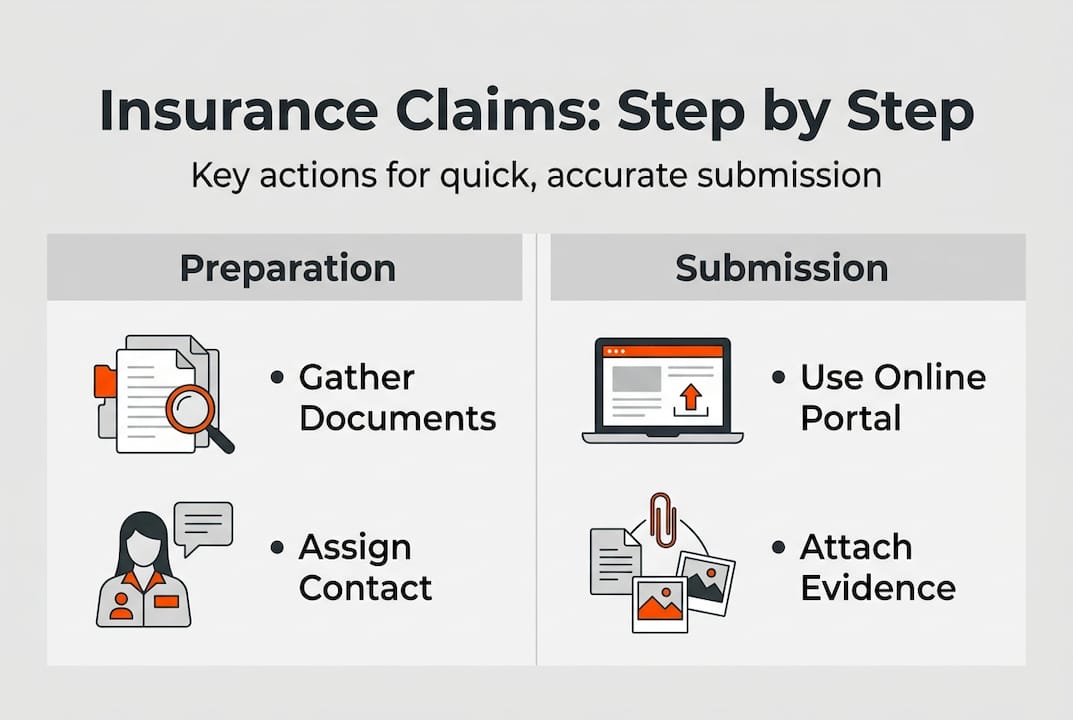
Pro Tip: Use your insurer’s app or online portal where available. Digital submissions are tracked, timestamped, and less likely to be lost or delayed in the process.

Common mistakes and how to avoid them
Even the best-prepared claims can go wrong if common pitfalls are not avoided. Knowing what trips up other operators gives you a clear advantage.
Incorrect or incomplete information is a leading cause of claim delays, and it’s entirely preventable with the right preparation.
Here are the most frequent errors that delay or derail claims in the civil, construction, and transport sectors:
- Late submission: Waiting days or weeks to notify your insurer after an incident. Most policies have strict reporting windows.
- Missing documents: Submitting a claim without photos, police reports, or repair estimates forces your adjuster to request them separately, adding days to the process.
- Vague incident descriptions: Writing “vehicle was damaged” instead of providing a precise account of what happened, where, and how.
- Incorrect driver or vehicle details: Submitting the wrong registration number or an unlicensed driver’s details can trigger a full review.
- Failing to follow up: Assuming your claim is progressing without checking in regularly.
- Not understanding your excess: Being surprised by the excess amount can delay agreement on the payout.
Claims with missing or incomplete information take significantly longer to resolve. Operators who submit complete, accurate documentation from the start consistently experience faster outcomes.
Communication with your insurer during the claims process matters as much as the initial submission. If your adjuster requests additional information, respond within 24 hours. Keep a written record of every call, email, and document exchange. Staying across current insurance trends also helps you anticipate what insurers are scrutinising more closely in 2026.
What happens after you submit your claim
Once you’ve sent off your claim, here’s what you can expect during the evaluation process. Understanding the post-submission process can reduce anxiety and help set realistic expectations for your business planning.
Here’s the typical sequence after submission:
- Claim receipt and acknowledgement. Your insurer confirms receipt, usually within 24 to 48 hours. You’ll receive a claim reference number. Keep this for all future correspondence.
- Investigation and review. Your claims adjuster assesses the incident details, reviews your documents, and may arrange an independent assessment of the damage. For large equipment or fleet claims, this can involve a site visit.
- Decision or request for more information. The insurer either makes a decision or requests additional documentation. This is the most common point of delay, so respond promptly.
- Payout or rejection. If approved, the payout is processed according to your policy terms. If rejected, you’ll receive written reasons and information on how to dispute the decision.
Most major insurers resolve 80% of straightforward claims within 14 days. Complex claims involving significant damage, third parties, or disputed liability can take longer. Knowing your fleet insurance terms before this stage helps you interpret the insurer’s communications accurately.
If your claim is taking longer than expected, escalate through the correct channel. Start with your adjuster, then request a supervisor review if needed. Keep all escalation requests in writing. Understanding your insurance cover types also clarifies what dispute resolution options are available under your specific policy.
Our take: Efficiency beats speed in insurance claims
After breaking down the claims process, here’s our unfiltered perspective on what really drives claim success.
Many business owners assume that submitting quickly is the priority. In practice, a rushed submission with gaps in documentation creates more delays than a thorough one submitted a few hours later. Speed matters, but accuracy matters more.
The operators who consistently get the best outcomes are not the ones who move fastest. They’re the ones who have built internal processes that make claims straightforward every time. They have designated contacts, organised records, and a clear understanding of their cover. When an incident happens, they’re not scrambling. They’re executing.
Policy literacy is a real competitive advantage. Knowing exactly what your cover includes, what your excess is, and what your reporting obligations are means you never lose a claim to a technicality. We’ve seen businesses lose valid claims simply because they didn’t understand their own policy.
Our advice: treat your insurance checklist insights as a living document. Review it when your fleet changes, when you take on new contracts, and at every policy renewal. Proactive businesses get paid. Reactive ones wait.
Get on-demand cover that works for your claims process
If you’re ready to enhance your insurance experience, consider solutions designed for claims simplicity and speed.
At Truck & Plant On-Demand™, we’ve built our cover around the realities of civil, construction, and transport operations. That means clear policy terms, straightforward claims support, and the flexibility to adjust your cover as your business changes.

Whether you need truck insurance solutions for a single vehicle or smart fleet insurance across a large operation, we tailor cover to your actual needs. You only pay for what you use. And when you need to claim, you’ll have the structure and support to do it right. Explore on-demand cover today and take control of your insurance from submission to resolution.
Frequently asked questions
What should I do immediately after an incident before submitting a claim?
Document the scene, gather evidence, and contact your insurer before moving any vehicles or equipment. Gathering immediate evidence supports smoother claims and protects your position from the start.
How long does it usually take for an insurance claim to be processed?
Most claims in the transport and construction industries are resolved within 14 to 21 days, depending on complexity. Simple, well-documented claims are typically resolved faster.
What documents are essential for submitting an insurance claim?
Always include your policy number, incident details, photos, and supporting invoices or police reports. Including correct documentation reduces delays and prevents unnecessary follow-up requests from your adjuster.
Can I submit claims digitally and is it faster than paper?
Yes, digital submissions are usually processed faster and reduce errors compared to paper claims. Most insurers now offer online portals or apps that provide real-time tracking of your claim status.
Who should I contact for status updates on my claim?
Reach out to your assigned claims adjuster or the customer service line provided in your insurance documents. Always reference your claim number when following up to ensure your query is directed correctly.