


TL;DR:
- Suspending insurance involves formally pausing coverage during inactivity without full cancellation, helping businesses avoid costly lapses and premium increases.
- Proper suspension requires meeting specific insurer and regulatory requirements, including government filings and written confirmation, to ensure legal validity and cost savings.
Suspending insurance cover is defined as a formal pause or modification of your policy that reduces or halts coverage during periods of inactivity, without triggering a full cancellation. For businesses in the civil, construction, and transport sectors, knowing how to suspend insurance cover correctly is the difference between saving money and facing costly coverage lapses, fines, or inflated future premiums. Whether you are storing a fleet of commercial vehicles between contracts, parking yellow plant machinery during a project gap, or taking a transport asset off the road temporarily, the process follows specific insurer and regulatory requirements that you must meet before any pause takes effect.
What options exist for suspending insurance cover?
Suspension differs fundamentally from cancellation. Suspension keeps the policy active with limited or paused billing, while cancellation creates a coverage lapse with lasting premium impacts. Understanding this distinction is the foundation of any cost-saving strategy for fleet operators and plant owners.
The four main options available to you are:
- Comprehensive-only coverage: You strip liability, collision, and other active-use covers, retaining only comprehensive cover for theft, fire, and weather damage. This is the most practical option for stored vehicles and parked plant machinery. Premiums drop significantly while the asset remains protected against non-operational risks.
- DMV or vehicle registry suspension: In jurisdictions like the United States and Canada, you surrender your licence plates to the relevant authority and file a Planned Non-Operation or Affidavit of Non-Use. Many states require insurance on registered vehicles, so surrendering plates is the legal method to remove liability coverage without incurring a lapse penalty.
- Policy endorsements: Ontario, Canada uses OPCF 16 and OPCF 17 forms to formally suspend and reinstate coverage. These endorsements are attached to your existing policy and define the exact suspension and reinstatement dates, making them the cleanest paper trail available.
- Full cancellation: This is the option to avoid. Cancelling your policy entirely flags your record in insurer databases and increases future premiums when you reapply. For commercial fleets, this can affect your entire book of vehicles, not just the one you intended to take off cover.
| Option | Best for | Cost saving | Key risk |
|---|---|---|---|
| Comprehensive-only | Stored vehicles and plant | Moderate | Asset still exposed to liability if moved |
| DMV/registry suspension | Personal and light commercial | High | Requires plate surrender and paperwork |
| Policy endorsement (OPCF 16/17) | Canadian jurisdictions | Moderate to high | Jurisdiction-specific availability |
| Full cancellation | None recommended | Short-term only | Coverage lapse, higher future premiums |
Pro Tip: Never assume your insurer will automatically reduce your premium when a vehicle sits idle. You must formally request a suspension or coverage modification in writing.
What prerequisites must you meet before pausing coverage?

Meeting the right conditions before you request a temporary insurance suspension protects you from penalties and ensures the pause is legally valid. Insurers rarely process suspensions retroactively, so preparation before the inactivity period begins is non-negotiable.
The standard prerequisites are:
- Zero outstanding premium balance. Suspensions require your account to be in good standing. Any unpaid premiums will block the request and may trigger cancellation instead.
- Minimum inactivity period. Most insurers set a threshold of 30 to 45 days of non-use before allowing a suspension or coverage modification. Shorter gaps are generally not eligible.
- Government documentation. Depending on your jurisdiction, you may need to file a Planned Non-Operation form or an Affidavit of Non-Use with your DMV or vehicle registry before the suspension is recognised by law.
- Proof of reason. Insurers typically require documented evidence of why the asset is inactive. Accepted reasons include storage, military deployment, extended project shutdown, or seasonal non-use. A signed storage agreement or project pause notice from a site manager is sufficient in most cases.
- Lender notification. If your vehicle or plant is financed or leased, your lender must be informed. Lenders require full coverage on financed vehicles, and dropping to reduced cover without their consent is a breach of your finance agreement.
- Prior insurer contact. You must notify your insurer before the inactivity begins, not after. Waiting until the vehicle has already been parked for two weeks and then requesting a backdated suspension is almost never approved.
Pro Tip: If your asset is stored at a third-party facility, get a dated receipt or storage contract. This document serves as your proof of reason and strengthens your suspension application considerably.
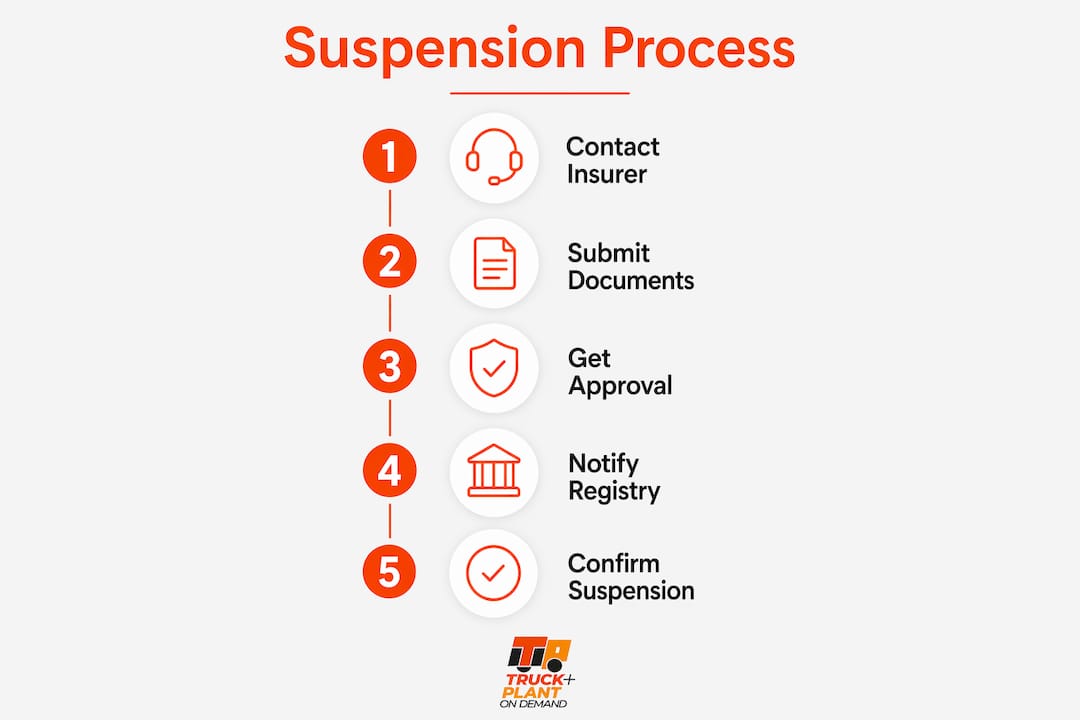
How to execute the suspension process step by step
Once you have confirmed eligibility, the execution process follows a clear sequence. Skipping any step creates gaps that can invalidate the suspension or delay reinstatement.
- Contact your insurer directly. Call or email your broker or insurer and state that you want to formally suspend or modify cover on a specific asset. Confirm which suspension options are available under your policy and jurisdiction.
- Complete the required forms. Your insurer will issue the relevant endorsement or suspension form. In Ontario, this is the OPCF 16. In South Africa and other jurisdictions, your insurer will have an equivalent internal form. Complete it accurately, including the intended suspension start date and estimated reinstatement date.
- File government paperwork. If your jurisdiction requires a Planned Non-Operation filing or plate surrender, complete this simultaneously with your insurer request. Failure to file non-operation paperwork with the relevant authority can result in fines and registration suspension, even if your insurer has already processed the pause.
- Obtain written confirmation. Written confirmation from your insurer must specify the suspension start date, the terms of any remaining cover, and the reinstatement process. Do not accept verbal assurances. File this document with your asset management records.
- Set a reinstatement reminder. Mark your calendar at least 10 business days before the suspension end date. Reinstatement often requires a new form, a premium payment, and in some cases a fresh vehicle inspection. Missing this window can cause a coverage gap that functions identically to a lapse.
- Notify relevant parties. Inform your site manager, fleet coordinator, or logistics team of the suspension dates so no one moves or operates the asset while it is off cover.
| Step | Action | Document required |
|---|---|---|
| 1. Contact insurer | Request suspension options | Email or call record |
| 2. Complete forms | Sign endorsement or suspension form | OPCF 16 or equivalent |
| 3. File with authority | Submit non-operation paperwork | DMV form or registry filing |
| 4. Receive confirmation | Obtain written suspension terms | Insurer confirmation letter |
| 5. Plan reinstatement | Set reminder and prepare payment | Reinstatement form |
Pro Tip: Keep a dedicated folder, physical or digital, for each suspended asset. Include the confirmation letter, government filing receipt, and reinstatement deadline. This takes five minutes to set up and saves hours of dispute resolution later.
Common mistakes that derail insurance cover suspension
The most damaging errors in the suspension process are not technical. They are procedural oversights that create legal and financial consequences long after the asset returns to service.
- Treating suspension as cancellation. A major misconception is that policyholders can stop payments without coverage consequences. Lapses are flagged in insurer databases and cause higher future premiums. Always request a formal suspension, not a cancellation.
- Skipping government filings. DMV involvement is non-negotiable in many jurisdictions. Failure to file a Planned Non-Operation leads to fines regardless of what your insurer has agreed to. The insurer agreement and the government filing are two separate obligations.
- Relying on verbal promises. If your broker says “don’t worry, we’ve noted it on the system,” that is not sufficient. Verbal promises commonly lead to reinstatement errors and coverage disputes. Written confirmation is your only protection.
- Ignoring lender requirements. Dropping cover on a financed excavator or truck without notifying the finance house is a contract breach. The lender can force-place insurance on the asset at a rate far higher than your original premium.
- Missing reinstatement deadlines. Strict observance of reinstatement deadlines preserves policy benefits and avoids full reapplication cycles. A missed deadline can mean losing your no-claims history and starting a new policy from scratch.
“The single most common error we see is operators assuming that parking a vehicle automatically reduces their premium. It does not. The insurer continues billing until you formally request a change. By the time the operator notices, they have paid months of unnecessary premiums and the suspension window has closed.” — Industry broker observation
Special considerations for civil, construction, and transport assets
Commercial fleets and yellow plant machinery carry additional complexity that private vehicle owners do not face. The complexities of transport insurance are amplified when suspension is involved, because the financial stakes per asset are higher and the regulatory environment is more demanding.
Key considerations for your sector include:
- Loan and lease restrictions. Finance agreements on commercial vehicles and plant almost universally require full coverage for the duration of the loan. Suspending cover without lender approval is a default event under most agreements. Engage your finance provider before you engage your insurer.
- Fleet-wide premium impact. A coverage lapse on even one vehicle in a managed fleet can affect the risk profile of the entire book. Insurers assess fleet risk collectively, and a lapse record on one asset can push up renewal premiums across all vehicles.
- High asset value during inactivity. A parked R3 million excavator or a stored heavy haulage truck is not a low-risk asset simply because it is not moving. Theft, vandalism, and weather damage are real risks during storage. Dropping to comprehensive-only cover, rather than full suspension, is often the more prudent choice for high-value plant.
- On-demand insurance as an alternative. For operators who need genuine flexibility, on-demand fleet insurance structures allow you to activate and deactivate cover at the asset level, removing the need for formal suspension processes entirely. This is particularly relevant for civil and construction businesses with irregular project cycles.
- Logistics continuity. The role of insurance in transport operations extends beyond the vehicle itself. A suspended vehicle that is accidentally dispatched without cover exposes the operator to unlimited third-party liability. Operational controls must match the insurance status of every asset in the fleet.
Key takeaways
Suspending insurance cover correctly requires formal insurer notification, government filings where applicable, written confirmation of terms, and strict reinstatement planning to avoid coverage lapses and premium penalties.
| Point | Details |
|---|---|
| Suspension vs cancellation | Suspension keeps your policy active; cancellation creates a lapse and raises future premiums. |
| Prerequisites matter | Pay all outstanding premiums and meet the 30 to 45 day minimum inactivity threshold before applying. |
| Government filings are separate | Filing with your DMV or vehicle registry is a legal obligation independent of your insurer agreement. |
| Written confirmation is mandatory | Always obtain a signed confirmation letter specifying suspension dates and reinstatement terms. |
| Sector-specific rules apply | Financed assets, high-value plant, and commercial fleets face additional lender and regulatory restrictions. |
Why I treat suspension planning as an asset management discipline
From my experience working with fleet operators and plant owners, the businesses that handle insurance suspension well are the ones that treat it as part of their asset management process, not as a reactive cost-cutting measure. They schedule suspension reviews at the same time they schedule maintenance windows. They keep a suspension checklist in their fleet management system alongside service records.
What I find most operators get wrong is the timing. They wait until the asset has been sitting idle for six weeks before calling their broker. By then, they have already paid for cover they did not need, and the retroactive suspension request is almost always declined. The cost of that delay, across a fleet of ten vehicles, is not trivial.
The other observation I would share is that the businesses most exposed to lapse risk are those with financed assets and high staff turnover. When the person who manages insurance changes, the reinstatement deadline often gets missed. Building the reinstatement date into a shared calendar system, not just one person’s inbox, is a simple operational fix that prevents a genuinely expensive problem.
My recommendation is to treat every suspension as a two-part transaction: the pause and the reinstatement. Plan both before you execute either. The cost-benefit calculation only works in your favour if the reinstatement goes smoothly.
— Coert
Flexible cover for inactive assets with Truckplant
If the suspension process feels like more administrative work than the cost saving justifies, there is a better model available.

Truckplant’s Truck & Plant On-Demand™ fleet insurance is built specifically for civil, construction, and transport operators who need cover that moves with their business. You activate cover when an asset is in use and deactivate it when it is not. There are no formal suspension forms, no government filings, and no reinstatement deadlines to track. You pay for what you use, and you control it directly. Whether you manage a single tipper truck or a mixed fleet of plant and commercial vehicles, Truckplant gives you the flexibility to match your cover to your actual operations, not a fixed annual schedule.
FAQ
What does it mean to suspend an insurance policy?
Suspending an insurance policy means formally pausing or reducing your coverage for a defined period without cancelling the policy entirely. The policy remains active, but billing is reduced or halted and certain covers are temporarily removed.
How long does a vehicle need to be inactive before I can suspend cover?
Most insurers require a minimum inactivity period of 30 to 45 days before approving a suspension or coverage modification. Shorter periods are generally not eligible for formal suspension.
What happens if I just stop paying my premiums instead of suspending?
Stopping payments without a formal suspension triggers a coverage lapse. Lapses are recorded in insurer databases and result in higher premiums when you reapply for cover, sometimes across your entire fleet.
Do I need to notify the DMV or vehicle registry when suspending cover?
In many jurisdictions, yes. Filing a Planned Non-Operation or surrendering your licence plates is a separate legal obligation from your insurer agreement. Failing to file with the relevant authority can result in fines and registration suspension.
Can I suspend cover on a financed or leased vehicle?
Not without lender approval. Finance and lease agreements typically require full coverage for the duration of the contract. Dropping or suspending cover without notifying your lender is a breach of the finance agreement and can trigger forced insurance placement at a higher rate.