


TL;DR:
- Insurance agility allows fleet operators to pay only for active, variable assets, reducing costs. It enables real-time policy adjustments based on actual usage, improving risk management and claim handling. Effective governance and data integration are essential for successful on-demand insurance deployment.
Insurance agility is the single most important operational lever available to commercial fleet operators and plant or tool hire companies right now. It converts variable activity — seasonal surges, rental turnover, idle assets — into cover and cost that move with your business, not against it. Earnix and Duck Creek both frame this as a strategic necessity: risk changes faster than traditional insurance products can respond, and the gap costs operators real money. The immediate action is straightforward: audit your utilisation patterns this quarter and identify the first policy element to shift to on-demand, typically hourly or daily cover for your highest-variance assets.
Why this matters for your operation:
- Static premiums charge you the same rate whether a truck runs 12 hours a day or sits idle for three weeks.
- Plant hire businesses face rental turnover that can change risk exposure daily, yet most policies reset monthly at best.
- Truck & Plant On-Demand™ by Truckplant is built specifically for this: pay for cover when you need it, adjust it when you don’t.
Pro Tip: Start your agility audit with your top 10% highest-variance assets. These are the ones where idle-premium waste is greatest and where on-demand cover delivers the fastest payback.
Table of Contents
- What does insurance agility actually mean for fleets and plant hire?
- Why insurance agility matters for commercial fleets and plant hire
- How is insurance agility delivered in practice?
- What KPIs should fleet and hire operators measure?
- What risks come with moving to agile insurance?
- How do you implement agile insurance in your fleet or hire business?
- How should you evaluate on-demand insurance partners?
- How does Truck & Plant On-Demand™ deliver insurance agility?
- Key takeaways
- The real lesson from agile insurance implementations
- Truckplant’s on-demand cover: built for fleets and plant hire
- Useful sources and further reading
What does insurance agility actually mean for fleets and plant hire?
Insurance agility is on-demand, usage-based, and configurable cover that updates in near real time. It is not a workaround or a manual endorsement process. Those create technical debt and slow every future change.
The four core components that define a genuinely agile insurance model are:
- On-demand cover — activate and deactivate cover at the asset level, triggered by operational events.
- Usage-based pricing — premiums tied to actual hours, miles, or hire days rather than a fixed monthly rate.
- Automated policy lifecycle — issuance, endorsement, and expiry handled by rules, not by manual processing.
- Centralised governance and audit trail — every change is logged, explainable, and compliant.
“Flexibility in insurance technology means breaking free from rigid systems. It represents the freedom to adapt products, pricing, and processes with minimal cost and disruption.” — WTW
Duck Creek’s Intelligent Core framework captures this precisely: product and pricing changes should happen through configuration, continuously, not through slow rebuild cycles that take months to execute.

Why insurance agility matters for commercial fleets and plant hire
The operational reality of fleet and plant hire is inherently variable. Seasonality, project-based utilisation, rental turnover, and temporary jobsites mean your risk exposure shifts week to week. A static annual premium cannot reflect that.
The business case for insurance flexibility rests on three concrete pressure points:
- Idle-premium waste: You pay full cover on assets that are parked, off-hire, or awaiting maintenance. For a fleet of 50 vehicles with 20% average idle time, that waste compounds quickly.
- Loss ratio exposure: Misaligned cover — either over- or under-insured relative to actual activity — distorts your loss ratio and makes accurate risk pricing impossible.
- Downtime cost amplification: When a claim occurs on an asset that was inadequately covered because the policy hadn’t been updated, recovery costs spike. Agile cover closes that gap automatically.
Earnix identifies decisioning gaps — not just legacy systems — as the primary cause of slow insurer response to evolving risk. For fleet operators, that translates directly into premiums that lag your actual operational state. WTW reinforces this: moving from static premiums to models that reflect real-time activity turns volatility into a managed cost rather than an uncontrolled loss.
How is insurance agility delivered in practice?
Agility is primarily a decisioning problem. The technology components that make it work are:
- Telematics and OEM data feeds — real-time location, ignition state, and utilisation signals that trigger policy events.
- Rental and hire management system integration — hire start/stop events automatically endorse or expire cover without manual intervention.
- Analytics and pricing engines — live data feeds into underwriting rules so premiums adjust to reflect actual risk, not historical averages.
- Automated policy decisioning — rules-as-configuration, not custom code, so changes deploy in hours rather than months.
“Intelligence is trapped outside slow cores unless the core can execute decisions dynamically.” — Duck Creek
Governance is where many implementations fail. McKinsey recommends cross-functional teams with embedded agile governance to reduce handovers and improve time-to-market. For fleet operators, that means requiring your insurance partner to provide auditable decision trails, human-in-the-loop controls for edge cases, and regulatory alignment built into the platform, not retrofitted later.
Pro Tip: When evaluating platforms, ask specifically whether governance rules are configured in the system or coded externally. Configuration-first means your team can adjust rules without an IT project. External code means months of delay every time your operations change.
What KPIs should fleet and hire operators measure?
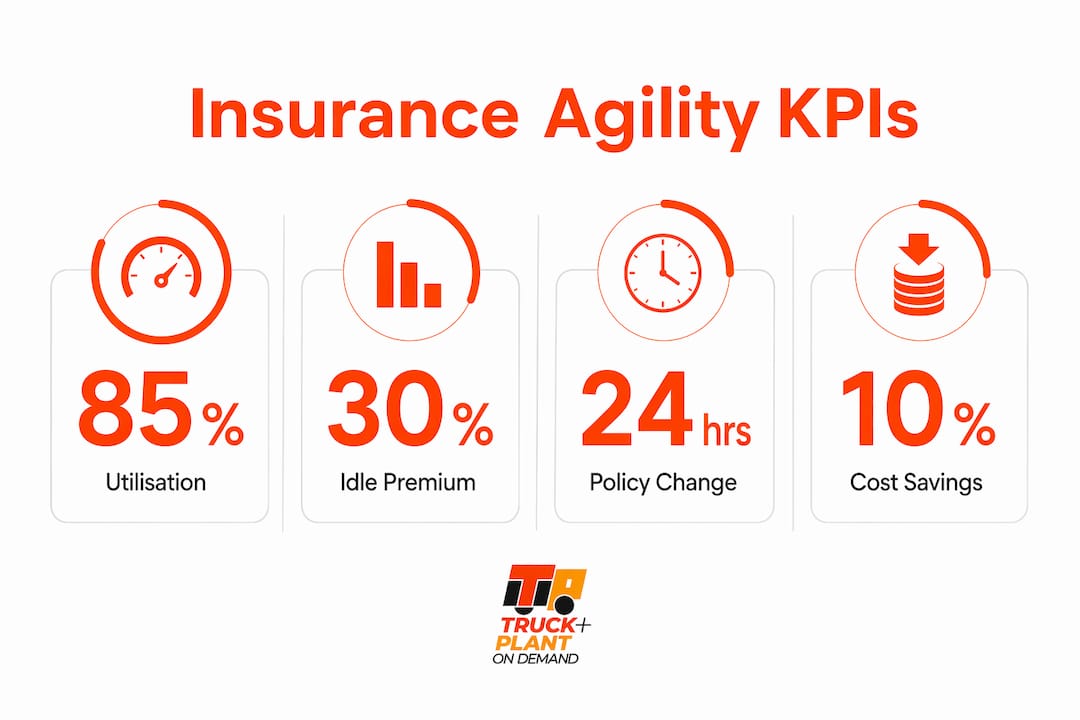
Agility delivers measurable outcomes. The benefits of real-time insurance show up across four areas: lower idle-premium waste, reduced cost per job, faster claims handling, and improved cashflow through pay-for-use.
| KPI | Definition | Decision threshold |
|---|---|---|
| Utilisation rate | Active hours ÷ total available hours per asset | Below average signals idle-premium waste |
| Premium per hour/mile | Total premium ÷ active operating hours or miles | Rising rate signals misalignment with usage |
| Time-to-change cover | Minutes from operational trigger to policy update | Over an hour indicates manual bottleneck |
| Loss ratio | Claims paid ÷ premiums earned | Above target triggers cover-level review |
| Claims cycle time | Days from first notice of loss to settlement | Benchmark against digital-first peers |
Track these monthly during a pilot. Premium per hour is the fastest indicator of whether your on-demand model is actually aligned to operations. If it rises while utilisation holds steady, your pricing engine needs recalibration.
What risks come with moving to agile insurance?
Agility creates new failure modes if governance is not embedded from the start. The most common risks are:
- Fraud and misuse: On-demand activation creates opportunities to back-date cover or activate after an incident. Mitigate with timestamped audit logs and automated fraud-signal detection.
- Governance gaps: Speed without oversight creates compliance exposure. Rules must be configured in the platform, not managed manually.
- Data privacy and consent: Telematics data collection requires clear consent frameworks and data handling policies aligned to applicable regulations.
- Technical debt: Custom integrations that bypass the core platform create fragility. Configuration-first architecture prevents this.
“Decisioning gaps — not just legacy systems — are the primary cause of slow insurer response to evolving risk.” — FinTech Global / Earnix
The red flags to watch for in any vendor implementation: no policy audit logs, slow change cycles measured in weeks rather than hours, and manual endorsement processes that require human sign-off for routine operational changes.
How do you implement agile insurance in your fleet or hire business?
McKinsey advises starting with a single front-runner team and scaling based on learnings. For fleet and plant hire, that translates into three phases:
- Phase 1 (weeks 1–8): Discovery. Map asset types, utilisation patterns, and integration points. Identify telematics data availability and rental software compatibility. Define your governance requirements.
- Phase 2 (months 2–4): Pilot. Configure on-demand cover for a subset of assets, typically your 10–20 highest-variance units. Set governance rules, activate KPI tracking, and measure against baseline.
- Phase 3 (months 4–12): Scale. Expand coverage across the fleet, automate the full policy lifecycle, and refine pricing signals based on pilot data.
| Phase | Timeline | Key cost drivers |
|---|---|---|
| Discovery | Weeks 1–8 | Internal resource time, data audit |
| Pilot | Months 2–4 | Integration setup, governance configuration |
| Scale | Months 4–12 | Premium model adjustments, change management |
The setup process for on-demand fleet insurance is most efficient when you start with clean utilisation data. If your telematics or rental system data is incomplete, fix that in Phase 1 before configuring any pricing rules.
How should you evaluate on-demand insurance partners?
The vendor checklist that matters most for fleet and plant hire operators:
- Configuration-first rule engine: Can product and pricing rules be changed without custom code?
- Real-time integration capability: Does the platform support API and webhook connections to your telematics and rental management systems?
- Auditable governance: Are all policy changes logged with timestamps, user IDs, and decision rationale?
- Transparent pricing engine: Can you see how premiums are calculated at the asset level?
- Digital claims management: Is first notice of loss and claims tracking handled through a portal, not by phone and email?
“Agile reduces time-to-market for customer-facing products and improves business outcomes when governance is aligned.” — Project Management Formula
The scoring priority for most fleet operators: speed of change first, governance second, integration effort third. A platform that changes cover in minutes but has no audit trail is a compliance liability. A platform with perfect governance but a six-week change cycle defeats the purpose entirely.
Ask every vendor: what is your SLA for executing a policy change after an operational trigger? The answer should be measured in minutes, not days.
How does Truck & Plant On-Demand™ deliver insurance agility?
Truck & Plant On-Demand™ is Truckplant’s on-demand, pay-for-use insurance product built specifically for commercial vehicles, trucks, trailers, plant machinery, and tool hire equipment. It meets the core requirements of an agile insurance model:
- Real-time cover adjustments: You activate, adjust, or deactivate cover at the asset level, aligned to your actual operational state.
- Rental software integration: For tool hire businesses, hire start and stop events connect directly to policy lifecycle automation.
- Digital claims portal: Claims are managed online, reducing cycle time and eliminating paper-based bottlenecks.
- Additional cover options: Group personal accident, environmental liability, machinery breakdown, and general business liability are available alongside core vehicle and plant cover.
“You choose what you want to insure, when you want to insure it, and how you want to insure it.” — Truckplant, Truck & Plant On-Demand™
A plant hire operator running a mixed fleet of excavators and telehandlers, for example, can activate cover only on assets dispatched to active jobsites, deactivate cover on units in the yard awaiting service, and track premium per hire day in real time. The result is premium spend aligned to revenue-generating activity, with no waste on idle assets.
Key takeaways
Insurance agility converts variable fleet and plant hire operations into aligned, on-demand cover that reduces idle-premium waste, improves loss ratios, and accelerates claims resolution.
| Point | Details |
|---|---|
| Audit utilisation first | Map your highest-variance assets before configuring any on-demand cover. |
| Configuration beats custom code | Require a rules-based platform so cover changes deploy in minutes, not months. |
| Track premium per hour | This single KPI reveals whether your pricing is aligned to actual operational activity. |
| Governance is non-negotiable | Audit logs, timestamped changes, and fraud controls must be built in from day one. |
| Truckplant’s on-demand model | Truck & Plant On-Demand™ delivers real-time adjustable cover for fleets and plant hire with digital claims management. |
The real lesson from agile insurance implementations
The conventional wisdom says the hard part of insurance agility is the technology. After working through how these implementations actually play out, the harder part is governance design. Operators who rush to activate on-demand cover without embedding audit trails and fraud controls create new liabilities faster than they eliminate old ones.
The operators who get the most out of agile insurance are the ones who treat it as an operational discipline, not a product feature. They start with a small, well-instrumented pilot on their highest-variance assets, measure relentlessly against the KPIs that matter (premium per hour, time-to-change cover, loss ratio), and only scale after the governance model is proven.
One practical observation: the biggest time-waster in early pilots is incomplete telematics data. If your rental management system or fleet tracking platform cannot reliably signal hire start and stop events, your policy automation will break at the worst moments. Fix the data pipeline before you configure the insurance rules.
Truckplant’s on-demand cover: built for fleets and plant hire
Paying a fixed monthly premium on assets that sit idle much of the time is a straightforward cost problem with a straightforward solution. Truckplant’s Truck & Plant On-Demand™ gives fleet operators and plant hire businesses full control: activate cover when assets are deployed, adjust it when operations change, and pay only for the cover you actually use.
Whether you run a small owner-operated truck fleet or a large civil construction equipment pool, Truckplant tailors cover to your operational reality. Fleet insurance on-demand is available now, alongside dedicated plant hire cover for equipment and tool hire businesses. Contact Truckplant to discuss a pilot for your highest-variance assets and see the premium alignment in your first billing cycle.
Useful sources and further reading
- Duck Creek: The new standard for carrier agility — Technical and strategic case for configuration-first insurance cores. Recommended for technical teams evaluating platforms.
- FinTech Global / Earnix: Insurance agility crisis — Analysis of decisioning gaps as the root cause of agility failure. Useful for leadership making the business case.
- McKinsey: Scaling agility in insurance — Operating model guidance for phased agile rollout. Recommended for operations leaders planning implementation.
- WTW: Building insurance resilience through strategic flexibility — Framework for aligning pricing to real-time operations. Useful for finance and risk teams.
- Project Management Formula: Agile in insurance — Practical governance and delivery guidance for agile insurance projects.
- Truckplant blog: Optimise fleet insurance premiums — Practical guidance on reducing premium waste for fleet operators.
- Truckplant blog: Insurance trends for commercial fleets — Industry context and emerging technology influences on fleet insurance.
- Truckplant blog: Fleet insurance analytics — Integrating analytics with pricing and underwriting decisions.