


TL;DR:
- On-demand insurance offers pay-per-use coverage that activates based on actual asset deployment, reducing costs for operators. The market is rapidly expanding, driven by digital technology that enables instant policy management and tailored coverage. Businesses should carefully verify providers and actively monitor system integration to maximize savings and ensure coverage adequacy.
On-demand insurance is defined as a pay-per-use coverage model that activates and deactivates based on actual asset use, replacing fixed annual premiums with project-specific or time-bound policies. The industry impact of on-demand insurance is now measurable: the global market was valued at approximately $110.62 billion in 2025 and is projected to reach $173.72 billion by 2034, with a compound annual growth rate of 5.20%. For construction, transport, and civil engineering operators, this shift is not theoretical. It changes how you budget, how you deploy assets, and how you manage risk on active projects.
The model works through digital platforms and data-driven underwriting that issue policies in real time, removing the friction of traditional broker-led processes. API integration connects your operational systems directly to underwriting engines, so coverage follows your equipment and vehicles rather than a calendar. Truckplant’s Truck & Plant On-Demand™ was built on exactly this premise: you pay for cover when you need it, and you change it when your operations change.

How on-demand insurance reshapes cost structures for fleets
Fixed annual premiums create a structural problem for fleet operators and plant machinery owners. You pay the same amount every month, regardless of whether your trucks are running five days a week or sitting idle during a contract gap. On-demand insurance eliminates premiums paid during idle periods by activating coverage only for specific projects or time increments.
The financial effect is direct. Consider a civil engineering contractor with ten pieces of yellow plant. During a three-week site shutdown, a traditional policy charges the same premium as during peak deployment. An on-demand model charges nothing for idle assets. That difference compounds across a year of variable project schedules.
The operational benefits extend beyond cost reduction:
- Cash flow alignment: Insurance becomes a variable expense tied to revenue-generating activity, not a fixed overhead that runs regardless of output.
- Asset-level control: You insure each vehicle or machine individually, activating cover only when that asset is deployed.
- Project-specific cover: Short-term contracts get short-term policies. A two-week haulage job does not require a 12-month commitment.
- Reduced administrative burden: Digital activation replaces broker calls and paperwork, cutting the time between asset deployment and active cover.
Shifting insurance from a fixed overhead to a variable, usage-related expense is the core financial advantage for operators in these sectors. The savings are real, and they scale with the size of your fleet.
Pro Tip: Integrate your insurance activation directly with your asset deployment schedule. When a vehicle or machine is booked for a job, trigger the cover at the same time. This removes the risk of deploying an uninsured asset and eliminates premiums on equipment that is not working.
What technology makes instant on-demand insurance possible?
The speed of on-demand insurance depends entirely on the technology behind it. API-integrated underwriting platforms compress policy lifecycle times from days or weeks to mere seconds. That compression is what makes real-time coverage adjustments possible for active fleets and construction sites.
The technology stack that enables this works in four layers:
- API-connected underwriting: Your operational software sends asset data directly to the insurer’s underwriting engine. The engine calculates risk and issues a policy without human intervention.
- Cloud-based policy management: Policies are stored, activated, and deactivated in the cloud. You access them through a web portal or mobile app, with no physical documentation required.
- Telematics and IoT data inputs: GPS trackers, engine sensors, and load monitors feed real-time usage data into the risk calculation. This means your premium reflects actual operating conditions, not a generic vehicle category.
- Automated scaling: When you add a vehicle to a job or remove one from active duty, the system adjusts coverage automatically. No calls. No forms. No delays.
For transport operators managing large, dynamic fleets, this automation removes a significant administrative load. API-first platforms embedded within operational workflows allow automatic toggling of coverage that correlates exactly to asset usage, markedly reducing premium leakage and administrative delays.
Pro Tip: Choose an insurance platform that connects directly with your existing fleet management or job scheduling software. The tighter the integration, the less manual intervention you need, and the lower your risk of coverage gaps.
How does on-demand insurance compare to traditional insurance models?
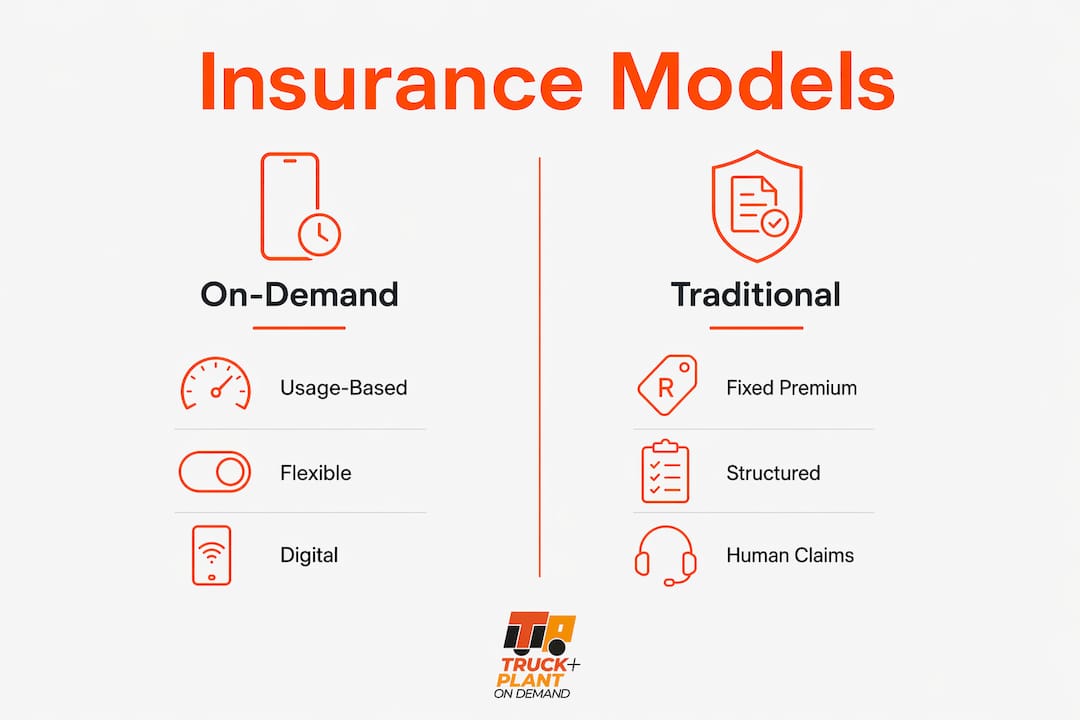
The comparison between on-demand and traditional insurance is not simply about price. It is about the structure of coverage and how claims are handled when something goes wrong.
On-demand insurance offers relevant coverage tailored to specific high-risk operational tasks, in contrast to traditional policies that may cover irrelevant risks. A traditional blanket policy for a mixed fleet covers every vehicle for every risk, whether or not that risk applies to each asset. An on-demand policy covers the right asset for the right risk at the right time.
The trade-off appears in claims handling. Traditional insurers provide superior human-led claims handling for complex, contested liability claims. On-demand providers, which operate on lean, app-based models, may lack experienced adjusters for high-value industrial disputes. For a straightforward collision claim, the digital process is fast and efficient. For a contested third-party liability claim involving a R5 million excavator, the absence of an experienced human adjuster can slow resolution significantly.
| Feature | On-demand insurance | Traditional insurance |
|---|---|---|
| Premium structure | Variable, usage-based | Fixed, annual |
| Policy activation | Instant, digital | Days to weeks |
| Coverage precision | Task and asset specific | Broad, blanket cover |
| Complex claims handling | Limited human support | Full adjuster involvement |
| Idle period cost | None | Full premium applies |
| Flexibility | High | Low |
A hybrid insurance approach balances traditional coverage for complex, high-value claims with on-demand flexibility for routine operations. Many experienced fleet operators use this combination. They maintain a traditional policy for catastrophic liability exposure and layer on-demand cover for day-to-day asset deployment. You can read more about the practical trade-offs in this on-demand vs traditional fleet cover comparison.
What practical steps can business owners take to implement on-demand insurance?
Implementation requires more than signing up for a digital platform. You need to verify the provider, integrate the system, and monitor it actively.
- Verify financial strength ratings: Business owners should check the AM Best rating or equivalent financial stability rating of any on-demand carrier. Cloud-native underwriting models do not always carry the capital reserves of established traditional insurers. A provider that cannot pay a large claim is not a provider worth using.
- Automate insurance triggers: Connect your insurance activation to your operational workflow. When an asset is assigned to a job in your management system, the cover should activate automatically. This removes human error from the process.
- Monitor policy activation metrics: Track which assets are covered, for how long, and at what cost. This data identifies premium leakage, where cover runs longer than necessary, and coverage gaps, where assets are deployed without active policies.
- Check regulatory and licensing requirements: South African transport and construction regulations specify minimum cover requirements. Confirm that your on-demand policy meets the Road Accident Fund Act and any sector-specific liability thresholds before deployment.
- Pilot before full rollout: Start with a subset of your fleet or a single project. Measure the cost difference, test the claims process, and identify integration issues before committing your entire operation.
Pro Tip: Run a three-month pilot on a defined project with five to ten assets. Compare the total insurance cost against what you would have paid under your existing annual policy for the same period. The numbers will tell you exactly what the model is worth for your operation.
For a detailed implementation framework, the guide on setting up on-demand fleet insurance covers the practical steps in full.
Industry trends and future outlook for on-demand insurance
The market trajectory for on-demand insurance in construction, transport, and civil engineering is steep. The North American market alone is forecast to grow from $8.7 billion in 2026 to $57.72 billion by 2035, driven by gig economy demand and digital regulatory reform. That growth rate reflects how quickly businesses across sectors are moving away from fixed-term policies.
| Trend | Impact on construction, transport, and civil engineering |
|---|---|
| Gig economy expansion | Demand for micro-duration cover for short-term contracts and subcontractors |
| Embedded insurance | Cover integrated directly into equipment rental and fleet management platforms |
| Telematics-driven pricing | Premiums calculated from real usage data, rewarding safe and efficient operators |
| Regulatory sandboxes | Faster product approvals enabling new cover types for emerging risks |
| Asia-Pacific adoption | Regulatory sandboxes and telematics in Asia-Pacific signal broader global adoption patterns |
The importance of insurance in transportation is growing alongside these market shifts, particularly as logistics and haulage operators face new liability exposures from automated and connected vehicles. Embedded insurance, where cover is built directly into equipment rental agreements or fleet management software, is the next significant development. When you rent a crane or a tipper truck, the insurance activates as part of the transaction. No separate policy. No separate process.
Key takeaways
On-demand insurance reduces total insurance costs for construction, transport, and civil engineering operators by eliminating premiums on idle assets and aligning cover precisely with operational activity.
| Point | Details |
|---|---|
| Cost structure shift | Insurance moves from fixed overhead to variable expense tied directly to asset deployment. |
| Technology dependency | API integration and telematics are required for real-time policy activation and accurate pricing. |
| Claims handling gap | Complex, high-value claims may need traditional insurer support alongside on-demand cover. |
| Provider due diligence | Always verify financial strength ratings before committing to a cloud-native on-demand carrier. |
| Pilot before full deployment | Test on a defined project subset to measure real savings and identify integration issues first. |
My view on on-demand insurance after years in this industry
The most common mistake I see business owners make is treating on-demand insurance as a direct replacement for their entire traditional policy. It is not. It is a tool for a specific job, and like any tool, it works best when you use it for the right task.
The misconception that on-demand cover is less comprehensive than traditional cover is understandable but wrong. Precise, task-specific coverage removes irrelevant risk exposure. That is not a weakness. That is the point. You are not paying to cover risks that do not apply to your operation on a given day.
Where I have seen operators get into trouble is in two areas. First, they underestimate the complexity of claims on high-value plant. A digital platform is excellent for processing a straightforward claim quickly. It is less equipped to manage a contested liability dispute involving a R10 million piece of equipment and three parties. Second, they skip the financial strength check on the provider. A new cloud-native insurer with no track record and no disclosed capital reserves is a risk you do not need to take.
The operators who get the most from on-demand insurance are the ones who integrate it tightly with their operational systems and monitor it actively. They know exactly which assets are covered at any given time, what it costs, and what the claims process looks like before they need it. That level of control is what the model is designed to deliver. Use it that way, and the savings are real and consistent.
— Coert
Truck & Plant On-Demand™: cover that moves with your business
Truckplant built Truck & Plant On-Demand™ specifically for operators in civil, construction, and transport who cannot afford to pay for cover they do not need. The model is straightforward: you choose what to insure, when to insure it, and how. Your premium reflects your actual operations, not a fixed calendar.
Whether you run a single tipper or a mixed fleet of commercial vehicles and yellow plant, Truckplant’s on-demand fleet insurance gives you full control. Activate cover when assets are deployed. Deactivate when they are not. No wasted premiums. No rigid annual commitments. For operators who want to see exactly how the cost savings work in practice, the guide on fleet insurance savings breaks it down by fleet type and usage pattern.
FAQ
What is on-demand insurance in simple terms?
On-demand insurance is a pay-per-use model that activates cover only when an asset is in use, replacing fixed annual premiums with project-specific or time-bound policies issued instantly through digital platforms.
How does on-demand insurance work for construction fleets?
You activate cover for each vehicle or machine when it is deployed on a job and deactivate it when the job ends. The policy is issued in seconds through an API-connected platform, and your premium reflects only the active period.
What are the main on-demand insurance benefits over traditional cover?
The primary benefits are eliminating idle-period premiums, aligning insurance costs with revenue-generating activity, and gaining asset-level control over what is covered and when.
What are the challenges of on-demand insurance for high-value claims?
On-demand providers typically operate lean, app-based models with limited human adjuster capacity. Complex, contested liability claims involving high-value plant or vehicles may require the support of a traditional insurer with experienced claims staff.
How fast is the on-demand insurance market growing?
The North American market is forecast to grow from $8.7 billion in 2026 to $57.72 billion by 2035. The global market carries a 5.20% CAGR through 2034, with North America growing significantly faster than the global average.