


An insurance API for rentals is a programmable interface that lets a rental platform request short term, usage based cover and verify that cover in real time, right at checkout or dispatch. You need one when your business requires instant policy verification, cover that starts and stops with each rental, and billing that scales automatically with usage rather than sitting on a flat annual premium.
TL;DR:
- Real-time policy status checks must return within one second to avoid disrupting rental flow and manual override needs.
- Integration requires careful planning, especially for handling retries, event mapping, secure webhooks, and thorough sandbox testing before production deployment.
- Usage-based pricing relies on consistent telematics data from devices, smartphone sensors, or OEM APIs, with normalization essential for accurate premiums.
- Billing models typically include per hour or day, flat per session, or hybrid approaches, but clear, itemized charges are crucial to prevent disputes and build trust.
- Partnering with a system like Truck & Plant On-Demand™ offers immediate, usage-based cover without building infrastructure, suitable for fleets of all sizes.
Table of Contents
- How does an insurance API for rentals actually work?
- Integration checklist: what engineering teams need to plan for
- What data powers usage-based rental pricing?
- How should you structure billing for usage-based cover?
- Security, data governance and staying on the right side of regulation
- How do you roll out an insurance API integration without breaking production?
- Where Truck & Plant On-Demand™ fits this integration pattern
- How do rental insurance API providers compare?
- What do successful rental insurance API integrations look like in practice?
- Practitioner perspective: common pitfalls and tradeoffs
- Get started with Truck & Plant On-Demand™
- Sources
- FAQ
How does an insurance API for rentals actually work?
At its core, an insurance API for rentals connects your rental platform to an insurer’s systems through a small set of endpoints that handle the entire policy lifecycle. Instead of a phone call or a PDF certificate, your system makes a request and gets a machine-readable answer in milliseconds.
Most implementations expose four functional layers:
- Quote — calculates premium based on asset type, hire duration, and risk inputs
- Bind/issue — activates the policy the moment a rental begins
- Policy status — confirms active cover instantly, useful at checkout or when dispatching a fleet vehicle
- Certificate delivery and claims intake — generates proof of cover and opens a claim without paperwork
API integrations let platforms embed quoting, underwriting, policy issuance, and claims intake directly into the transaction flow, turning insurance into a real time check rather than a back office task.
For plant hire and commercial vehicle operators, the practical question is latency. If a customer is standing at a counter or a dispatcher is releasing a truck, the policy status check needs to return in under a second. Anything slower breaks the rental flow and pushes staff back toward manual overrides, which defeats the purpose of automating rental property insurance API checks in the first place.
Integration checklist: what engineering teams need to plan for
Before you write a single line of integration code, map out the operational boundaries. Rental insurance integration projects fail more often from missed edge cases than from bad code.
- Secure your credentials — set up key rotation schedules and confirm sandbox access before touching production data.
- Respect rate limits — insurers throttle quote and bind calls differently; build retry logic that backs off rather than hammering the endpoint.
- Map every event — rental start, extension, early return, and incident each need a distinct API call, and each must be idempotent so a retried request never double bills or double issues a policy.
- Design webhooks properly — a bind request should return a provisional token immediately so checkout isn’t blocked, then update to a final “issued” status once the insurer confirms.
- Test before you trust — run sandbox scenarios for cancellations, mid rental upgrades, and failed payments, then pilot with a small subset of your fleet before scaling.
Pro Tip: Build your webhook listener to expect duplicate events. Insurers retry failed deliveries, and if your system isn’t idempotent, a single rental could generate two policies or two invoices.
Teams building this from scratch often underestimate the operational monitoring piece. You need dashboards that flag stalled issuance, not just failed API calls.
What data powers usage-based rental pricing?
Usage based pricing depends entirely on the quality and consistency of the telemetry feeding it. The choice of data source shapes both your cost structure and how granular your premiums can get.
- Dedicated telematics devices offer the richest data (speed, impact events, location) but add hardware cost and installation time to every asset.
- Smartphone sensors are cheap and fast to deploy but less consistent, since accuracy depends on the driver’s phone and app usage.
- OEM connected APIs pull data straight from the vehicle or machine’s onboard systems, avoiding extra hardware but requiring data share agreements with manufacturers.
Telematics models vary significantly between insurer collected devices, OEM partnerships, and open ecosystem APIs, and each comes with its own integration timeline and standardisation burden.
Whichever source you choose, the underwriting model needs consistent fields: distance or time logged, precise timestamps, and flagged exceptions like harsh braking or impact events. Because different vendors format this data differently, most rental operators build a translation layer that normalises telemetry into a single schema before it reaches the insurer’s API. Truckplant’s own guidance on optimizing fleet insurance premiums with telematics data covers this translation problem in more depth.
How should you structure billing for usage-based cover?
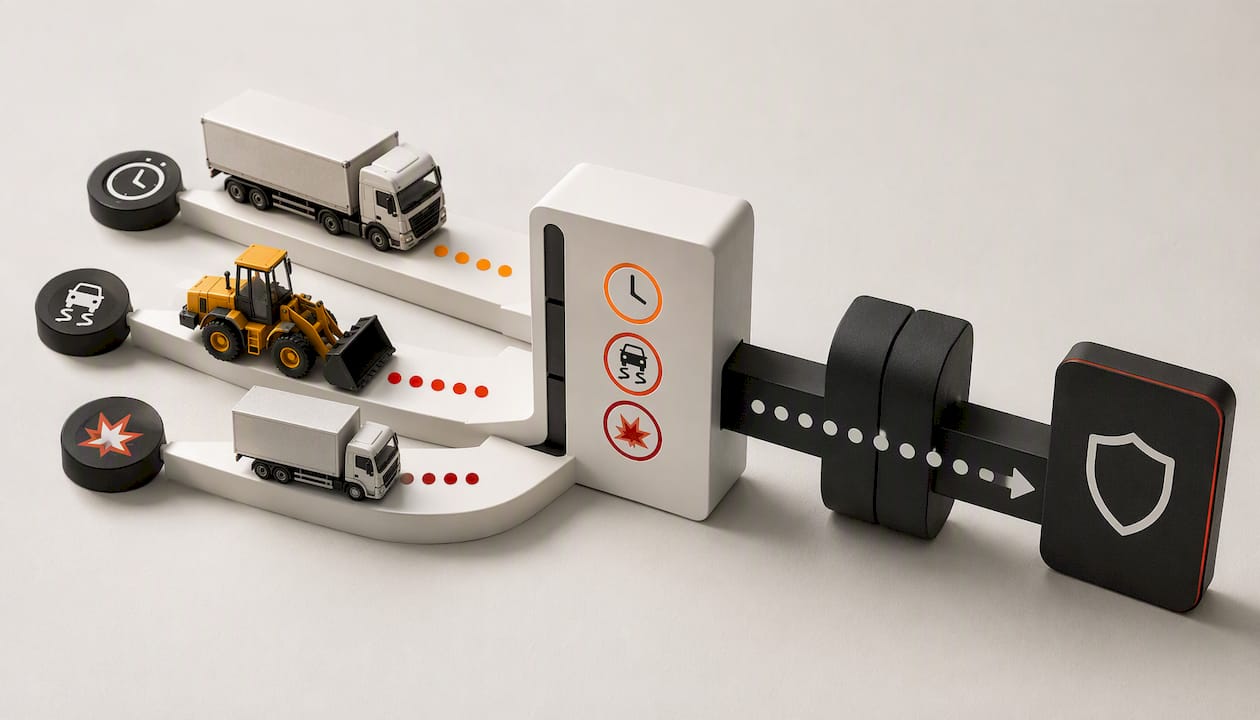
Metered insurance billing generally follows one of three patterns: per hour or per day charging tied directly to rental duration, a flat per session fee regardless of length, or a hybrid that blends a base rate with usage top ups.
- Per hour/day metering suits short plant and tool hires where duration varies widely
- Flat per session fees work for predictable, fixed length rentals
- Hybrid models cap volatility while still rewarding light usage
Usage based insurance relies on telematics and connected data, and modern payment platforms now support metered billing that converts telemetry directly into premium calculations without manual reconciliation.
Billing volatility is the single biggest UX risk in this model. Unclear charge mapping between usage events and invoices drives disputes and churn. If a customer can’t see why their bill jumped from one rental to the next, they stop trusting the platform. Show itemised charges in real time and consider pre-authorisation caps during your first billing cycles.
Security, data governance and staying on the right side of regulation
Store only the telemetry fields your underwriting model actually needs, and record consent plus retention windows for every data point you collect. Regulators increasingly expect rental platforms to justify why they hold driver or operator behavioural data, not just that they hold it.
Secure every webhook endpoint with signed requests, and keep audit logs for every policy issuance and every claim event. This isn’t optional paperwork. If a claim is disputed months later, you need a verifiable trail showing exactly when cover was active and what data triggered the premium.
Before you issue a single policy programmatically, confirm your insurance partner is properly licensed for the markets you operate in. An API integration doesn’t change the underlying legal requirement that whoever underwrites the risk must be authorised to do so where your customers are hiring equipment.
How do you roll out an insurance API integration without breaking production?
Rushing an insurance rental property integration straight to full fleet coverage is how billing errors and issuance failures reach real customers. A staged rollout catches problems while the blast radius is still small.
- Confirm feasibility first — verify your insurance partner’s licensing covers your markets and that sandbox access actually mirrors production behaviour.
- Run a contained pilot — pick a small, representative slice of your fleet, set an error budget, and reconcile every transaction manually against the insurer’s records.
- Train frontline staff — dispatchers and counter staff need a fallback process for the moment an API call fails.
- Scale deliberately — once reconciliation checks stay clean, automate dispute handling and expand observability before opening the integration to your full fleet.
Track issuance latency, billing reconciliation error rate, and claims frequency as your core KPIs. If issuance latency creeps up as volume grows, that’s usually the first sign your architecture needs a queuing layer rather than direct synchronous calls.
Where Truck & Plant On-Demand™ fits this integration pattern
Truck & Plant On-Demand™ was built around the exact buyer job this article describes: on-demand, usage based cover for commercial fleets and plant hire businesses that don’t want to pay a flat premium for equipment sitting idle. Rather than building underwriting and claims infrastructure from scratch, operators can plug into a system already designed for real time cover adjustments.
- Cover that switches on and off with actual business operations, not a fixed annual term
- Digital claims handling instead of paper based processes
- Flexibility for owner run businesses through to large fleet operators
Truckplant’s post on insurance agility for fleets explains why on-demand cover fits operational reality better than annual policies, and setting up on-demand fleet insurance walks through practical cost benefits. If your engineering team lacks the resources to build and maintain claims and underwriting infrastructure, partnering with a managed on-demand provider is almost always faster than building in-house.
How do rental insurance API providers compare?
Providers building insurance solutions for rentals generally fall into three categories, and each suits a different stage of business maturity.
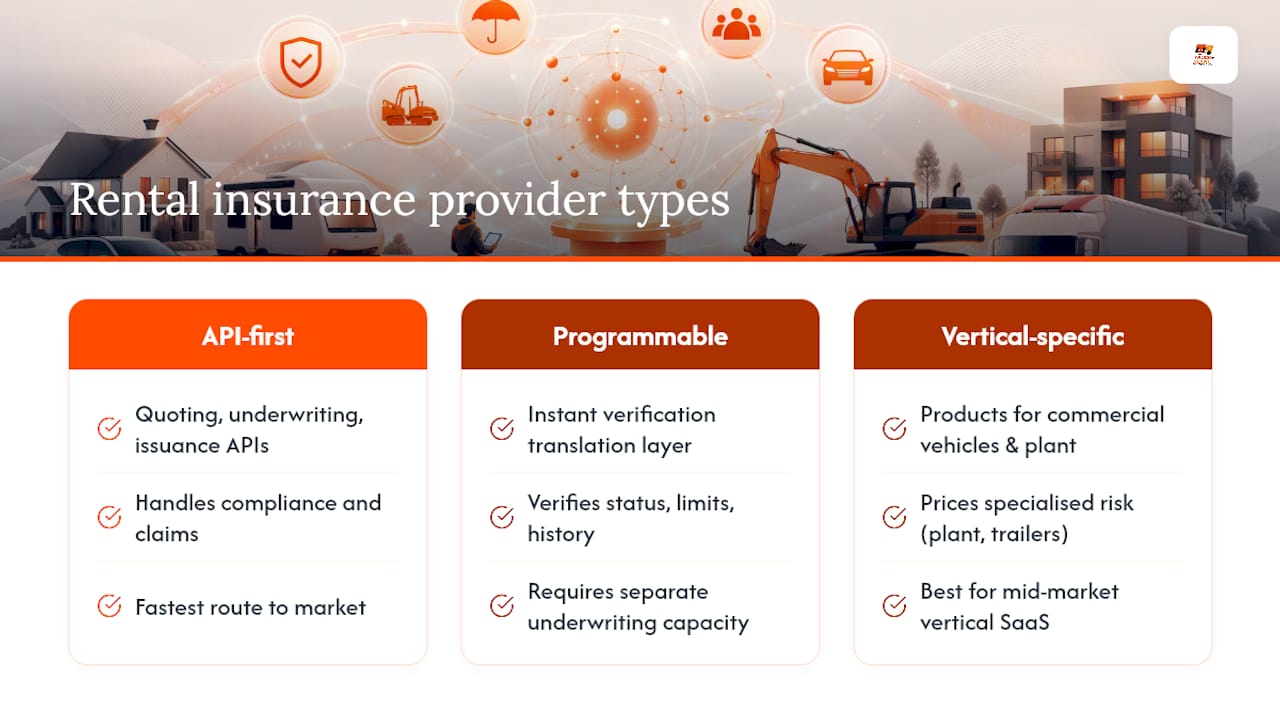
API-first insurtech platforms expose quoting, underwriting, and issuance endpoints while handling compliance and claims behind the scenes. This model lets partners integrate policy lifecycle functions without rebuilding core insurance systems, which makes it the fastest route to market for most rental operators.
Programmable insurance utilities focus narrowly on turning slow manual verification into instant checks. These translation layers verify policy status, coverage limits, and history in real time, reducing the administrative overhead of manual document review, though they typically require you to source underwriting capacity separately.
Vertical specific insurers, like Truckplant, build products specifically for commercial vehicles and plant machinery rather than adapting a generic consumer template. This matters more than it sounds. Embedded insurance is spreading into mid-market vertical SaaS, including equipment rental, precisely because generic insurance products often misprice specialised risk like yellow plant machinery or heavy commercial trailers.
For engineering teams evaluating rental property insurance API options, the real differentiator isn’t the API surface, which tends to look similar across providers. It’s whether the underwriting model actually understands construction, civil, and transport risk, or whether it’s a car insurance template with a different label. A partner integration guide like Nomora’s car rental system integration overview is useful for general architecture patterns, but the underwriting logic underneath still needs to match your asset class.
What do successful rental insurance API integrations look like in practice?
The clearest precedent for embedding insurance at the point of rental comes from micromobility. E-bike and scooter rental operators have embedded insurance directly into the rental transaction, charging per minute or per trip rather than requiring riders to hold separate annual policies. That pattern, cover that turns on exactly when the asset is in use and off the moment it’s returned, generalises directly to plant and tool hire, where equipment sits idle for large stretches of the year.
For commercial vehicle and construction equipment operators, the equivalent case is a fleet business that shifts from a single annual policy covering every truck and excavator, whether in use or parked, to automated real time verification tied to actual dispatch events. Operators report that replacing manual certificate checks with automated policy verification removes a recurring administrative bottleneck at the point where equipment changes hands, which is exactly where delays are most costly.
The pattern that repeats across these examples is simple: insurance stops being a background annual cost and becomes a line item tied directly to when an asset is earning money. That shift only works when the API layer is fast enough not to interrupt the transaction and transparent enough that the customer trusts the charge they’re seeing.
Practitioner perspective: common pitfalls and tradeoffs
The mistake I see most often isn’t technical. It’s assuming customers will accept a bill they can’t trace back to a specific rental event. Show itemised charges in the UI from day one, and offer pre-authorisation caps during rollout rather than after complaints start.
Test your rare edge cases in sandbox long before go-live, and watch webhook reliability closely; a missed retry on policy issuance is far more damaging than a slow quote. Build your support playbooks and feature flags before you need them, not after a billing dispute forces your hand.
— Coert
Get started with Truck & Plant On-Demand™
One alternative to building this integration from scratch allows you to plug into a system that provides real time, usage based cover for commercial vehicles and plant machinery designed for the relevant risk profile.

You keep control over what gets covered and when, without carrying a flat premium for equipment that spends half the year parked. Whether you’re running a single truck or coordinating a mixed fleet across construction and transport, the setup process starts with a conversation about your current cover and where the gaps sit. Get a quote or talk to the team through the Truck & Plant On-Demand™ page and see what a usage based policy would look like against your current premiums.
Sources
- Usage based insurance | Stripe
- Usage based insurance – leveraging interoperability in the era of connected vehicles | Telematics Wire
- Usage-based billing guidance | Salesforce
FAQ
What is an insurance API for rentals?
It’s a programmable interface that lets a rental platform request, issue, and verify short term, usage based insurance policies in real time, without manual paperwork.
How does rental insurance API integration handle billing?
Billing typically meters charges by hour, day, or session, converting telematics or duration data directly into premium calculations through automated payment systems.
Do I need telematics hardware to use usage-based rental cover?
No. You can start with session or time based metering using smartphone sensors or OEM connected APIs, then move to dedicated telematics hardware as your data needs grow.
Is Truck & Plant On-Demand™ suitable for plant and tool hire businesses?
Yes. It’s built specifically for on-demand, usage based cover across commercial vehicles, trailers, and plant or tool hire equipment, letting operators adjust cover as operations change.
What’s the biggest risk in rolling out usage-based rental insurance?
Billing volatility and unclear charge mapping are the most common causes of customer disputes, so transparent, itemised billing UI is essential from the first pilot onward.