


TL;DR:
- Effective insurance budgeting involves risk assessment, regular renewal planning, and Total Cost of Risk analysis to control costs and ensure adequate coverage. Businesses must update operational data with growth and maintain disciplined practices such as requesting multiple quotes and building a sinking fund to optimize expenses. Treating insurance as a strategic variable rather than a fixed expense enables companies in civil, construction, and transport sectors to better manage risks and reduce costs.
The insurance budgeting process is defined as the strategic planning, allocation, and management of insurance expenses to maintain adequate coverage while controlling costs across your business operations. For civil, construction, and transport businesses, this process is not optional. Fleet expansions, new contracts, and shifting risk profiles mean your insurance costs change constantly. A disciplined approach to insurance expenses planning keeps cash flow stable, prevents coverage gaps, and gives you real negotiating power with insurers. The industry standard framework includes risk assessments, policy audits, the three-quote rule, and Total Cost of Risk (TCOR) analysis.
What are the essential steps in an effective insurance budgeting process?
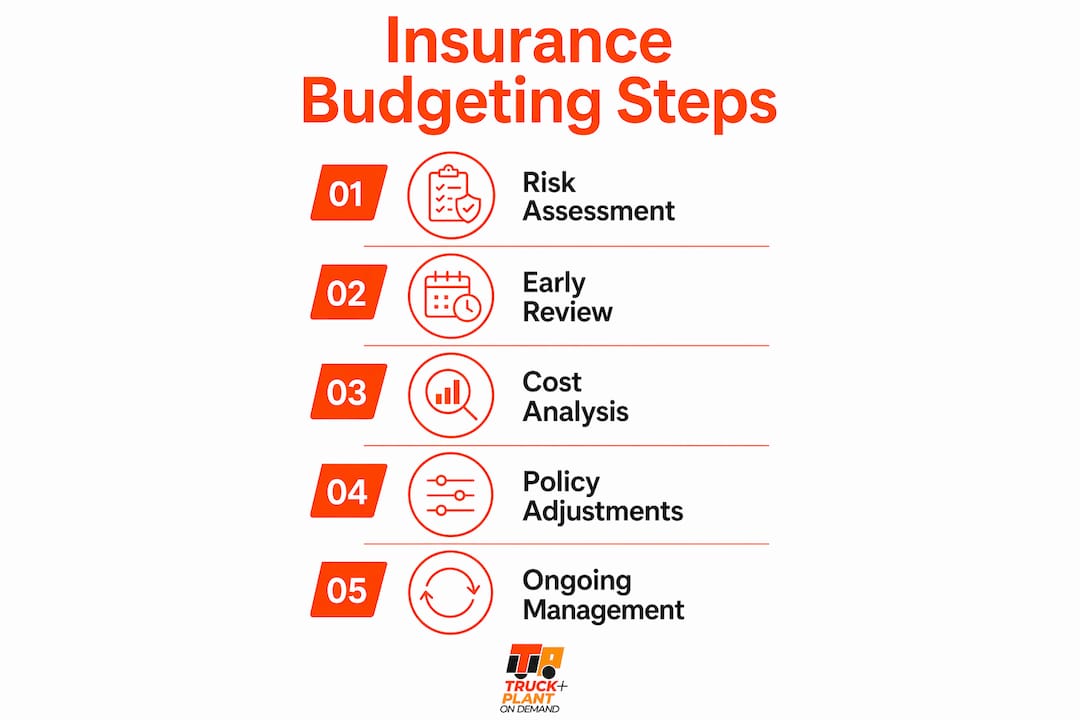
A structured insurance budgeting process follows five clear steps. Each one builds on the last, and skipping any of them creates gaps that cost you money or leave you exposed.
-
Assess your risk and exposure. Start by mapping every operational risk specific to your industry. A civil contractor carries different exposure than a long-haul transport operator. Identify your fleet size, project values, subcontractor relationships, and geographic spread. This baseline determines what cover you actually need.
-
Conduct a full policy inventory. Pull every active policy and review coverage limits, exclusions, and renewal dates. Look for duplicated cover, outdated valuations, and limits that no longer match your current operations. Many businesses carry policies that made sense three years ago but are now redundant.
-
Collect at least three competing quotes. Requesting three quotes before renewal saves businesses an average of $400–$900 per policy portfolio annually. That saving is not accidental. It reflects the competitive pressure that multiple quotes create. Contact independent brokers and direct insurers separately to get a genuine spread of pricing.
-
Budget for deductibles, premium fluctuations, and mid-year audits. Premiums are not the only cost. Deductibles, audit adjustments, and endorsements add up. Build a buffer of 10–15% above your base premium estimate to absorb these variables without disrupting cash flow.
-
Establish a sinking fund or structured payment schedule. Dividing annual premiums into monthly transfers builds a reserve that prevents cash flow shocks at renewal. Paying annually from that reserve can also secure discounts of 3–8% compared to monthly payment plans.
Pro Tip: Start your renewal review in Q1, even if your policies renew mid-year. Early reviews give you time to gather data, compare options, and negotiate from a position of strength rather than urgency.
How do you analyze insurance costs and find savings?
Insurance cost analysis goes beyond comparing premium quotes. The most effective framework is Total Cost of Risk, or TCOR. TCOR includes premiums, deductibles, retained losses, and indirect costs such as lost productivity and administrative time. A policy with a lower premium but a high deductible may cost more in practice than a slightly more expensive policy with better terms.

The table below shows how deductible choices and discount strategies affect your real annual cost.
| Scenario | Annual Premium | Deductible | Annual Discount Applied | Estimated Real Cost |
|---|---|---|---|---|
| Base policy, monthly payment | R120,000 | R5,000 | None | R125,000 |
| Increased deductible | R105,000 | R15,000 | None | R120,000 |
| Annual payment, bundled | R110,000 | R5,000 | 8% | R101,200 |
| Bundled + increased deductible | R95,000 | R15,000 | 12% | R83,600 |
Bundling policies, increasing deductibles, and paying premiums annually can lower total insurance costs by up to 25%. That figure reflects the combined effect of insurer discounts and reduced administrative costs. The key is to model each scenario against your actual claims history before committing to a higher deductible.
A clean, data-backed safety record also reduces underwriting risk and increases your negotiating power. Insurers price risk based on the information you give them. Accurate, well-organised data on safety programmes, incident rates, and fleet maintenance tells a better story than a file full of gaps.
Pro Tip: Run an annual policy audit using updated operational data, including current payroll figures, fleet details, and property values. Outdated data leads to inaccurate premiums and weakens your position at renewal.
How does business growth affect your insurance budget?
Failing to update insurance budgets for operational growth leads to redundant coverage or exposure gaps. This is one of the most common and costly mistakes in insurance budget management. A transport business that adds ten vehicles to its fleet without adjusting its policy limits is underinsured. A construction company that wins a major new contract without reviewing its public liability limits is exposed.
Key operational changes that require an immediate insurance budget review include:
- Revenue growth above 15%. Higher revenue often means larger contracts, more equipment, and greater liability exposure. Your coverage limits should reflect your current turnover, not last year’s figures.
- Fleet expansion or new equipment purchases. Each new vehicle or piece of plant machinery adds to your insurable asset base. Review your fleet coverage limits every time you add to the fleet.
- New contracts with specific insurance requirements. Many civil and construction contracts specify minimum coverage levels. Failing to meet these requirements can void a contract or leave you personally liable.
- Entry into new geographic areas. Operating in new regions introduces different risk profiles, regulatory requirements, and insurer pricing structures.
- Investment in safety programmes. Documented safety investments reduce your risk profile. Feed this data into your next renewal to negotiate better rates.
For construction and transport businesses, insurance should be treated as a variable cost linked to project and fleet timelines, not a fixed expense. This mindset shift changes how you plan. Instead of rolling over last year’s budget, you build each year’s insurance plan from your current operational reality.
What are the most common insurance budgeting mistakes?
Most insurance budgeting errors fall into a small number of predictable patterns. Recognising them is the first step to avoiding them.
- Treating insurance as a fixed cost. Premiums change based on claims history, market conditions, and your own operations. Budgeting a flat figure year after year guarantees you will either overpay or be underinsured.
- Ignoring claims patterns. Your claims history directly affects your premium at renewal. Businesses that track claims data throughout the year can address trends before they become expensive underwriting problems.
- Missing renewal deadlines. Leaving renewals on autopilot leads to paying outdated or higher rates. Insurers do not reward passive clients. Scheduling mandatory reviews 30–60 days before renewal gives you time to negotiate or switch providers.
- No sinking fund in place. Without a dedicated reserve, large annual or semi-annual premium payments create cash flow pressure. This pressure often forces businesses to accept unfavourable payment terms or defer necessary coverage upgrades.
- Failing to update operational data. Maintaining updated operational data including payroll, fleet details, and property values is critical for underwriting accuracy. Stale data produces inaccurate quotes and weakens your negotiating position.
Pro Tip: Set a calendar reminder 60 days before each policy renewal date. Use that window to pull your claims data, update your operational figures, and contact at least two alternative brokers for comparison quotes.
What tools and practices support ongoing insurance budget management?
Effective insurance budget management does not happen at renewal time alone. It requires year-round discipline and the right tools in place.
| Tool or Practice | Purpose | Frequency |
|---|---|---|
| Dedicated sinking fund account | Accumulate monthly reserves for premium payments | Monthly transfers |
| Spreadsheet or accounting tracker | Monitor actual vs. budgeted insurance spend | Monthly review |
| Renewal calendar with alerts | Prevent missed deadlines and autopilot renewals | Set annually, reviewed quarterly |
| Claims data log | Track incident patterns and inform underwriting | Updated after each incident |
| Independent broker review | Gather competitive quotes and market intelligence | Annually, minimum |
| Quarterly budget check-in | Reassess coverage against current operations | Every quarter |
Beyond the tools, the practice that makes the biggest difference is integrating insurance budgeting into your overall financial planning cycle. Insurance is not a separate line item to be reviewed once a year. It connects directly to your cash flow, your risk exposure, and your ability to win contracts. Businesses that treat it as part of their broader financial strategy consistently outperform those that manage it reactively.
Independent brokers play a specific role here. They access multiple insurers and can identify pricing anomalies that a direct insurer relationship would never surface. For fleet insurance cost control, a broker with sector-specific experience in civil, construction, or transport is worth the time to find. Pair their market knowledge with your own clean data, and you have a strong foundation for every renewal negotiation.
Key takeaways
A disciplined insurance budgeting process requires risk assessment, proactive renewal planning, TCOR analysis, and regular operational data updates to control costs and maintain adequate coverage.
| Point | Details |
|---|---|
| Start with risk assessment | Map your actual exposure before setting any budget figure or requesting quotes. |
| Use TCOR, not just premiums | Factor in deductibles, retained losses, and indirect costs to measure true insurance spend. |
| Apply the three-quote rule | Request at least three competing quotes to save an average of $400–$900 per portfolio annually. |
| Build a sinking fund | Monthly reserves prevent cash flow pressure and can secure annual payment discounts of 3–8%. |
| Review before every renewal | Schedule mandatory reviews 30–60 days before renewal to negotiate from a position of strength. |
Why insurance budgeting deserves a seat at the strategy table
I have worked with enough civil contractors, fleet operators, and construction managers to know that insurance budgeting is almost always treated as an afterthought. The finance team sets a number based on last year’s spend, the operations team signs off without question, and the broker gets a call two weeks before renewal. That cycle is expensive.
The businesses I have seen manage insurance costs most effectively share one habit: they treat insurance as a strategic variable, not a fixed overhead. They track their claims data the way they track fuel costs. They review their coverage limits every time they win a significant new contract. They know their TCOR figure and they use it in conversations with brokers.
The uncomfortable truth is that most businesses are either overpaying for cover they do not need or underinsured for risks they have not mapped. Both outcomes are avoidable. The solution is not complicated. It requires discipline, accurate data, and the willingness to spend two hours per quarter reviewing your position rather than waiting for renewal to force the conversation.
If you manage a fleet or operate plant machinery, the on-demand model changes the calculation entirely. Paying for cover only when assets are active removes the structural inefficiency of fixed premiums on idle equipment. That is not a theoretical saving. It is a direct reduction in your TCOR. Start there, and build your budgeting process around what your operations actually require.
— Coert
Take control of your insurance costs with Truckplant
Truckplant built Truck & Plant On-Demand™ specifically for businesses in the civil, construction, and transport industries that are tired of paying fixed premiums for cover that does not match their operations. With on-demand cover, you choose what to insure, when to insure it, and how much cover you need at any given time.

This model directly supports a leaner insurance budgeting process. You stop paying for idle assets, you align premiums with actual operational activity, and you maintain full control over your coverage at every stage of the year. Whether you run a single truck or a large mixed fleet, Truckplant tailors cover to your business. Explore on-demand fleet insurance and see how much you could save by paying only for the cover you actually use.
FAQ
What is the insurance budgeting process?
The insurance budgeting process is the structured planning, allocation, and review of insurance expenses to maintain adequate coverage while controlling costs. It includes risk assessment, policy audits, quote comparison, and sinking fund management.
How often should i review my insurance budget?
Review your insurance budget at least once per quarter and conduct a full renewal review 30–60 days before each policy expiry date. Operational changes such as fleet growth or new contracts require an immediate review outside this schedule.
What is total cost of risk and why does it matter?
Total Cost of Risk (TCOR) includes premiums, deductibles, retained losses, and indirect costs such as lost productivity. Focusing on TCOR rather than premiums alone gives you a more accurate picture of what insurance actually costs your business.
How can i reduce my insurance premiums without losing coverage?
Bundling policies, increasing deductibles, and paying annually can reduce premiums by up to 25%. Maintaining a clean safety record and accurate operational data also strengthens your position at renewal.
What is a sinking fund in insurance budgeting?
A sinking fund is a dedicated account where you transfer a fixed amount each month to cover your annual or semi-annual premium payments. It prevents cash flow pressure at renewal and can qualify you for annual payment discounts of 3–8%.