


TL;DR:
- Insurance for emerging industries protects rapidly evolving sectors from risks excluded by traditional policies. Clear, affirmative coverage and access to the E&S market help businesses address gaps in AI, digital assets, cyber threats, and more. Preparing detailed risk schedules and reviewing policies regularly reduce underinsurance and claim disputes.
Insurance for emerging industries is specialized coverage designed to protect businesses operating in rapidly evolving sectors such as AI, fintech, biotech, and digital assets, addressing risks that traditional policies routinely exclude. The industry term for this category is “non-standard risk insurance,” and it sits largely within the Excess and Surplus (E&S) market. If you run a business in one of these sectors, your standard commercial policy almost certainly has gaps you do not know about. Understanding those gaps, and how to close them, is the most practical thing you can do for your business right now.
What is insurance for emerging industries?
Insurance for emerging industries is coverage built for business models and technologies that did not exist when most standard policy wordings were written. Traditional admitted insurers price risk using historical loss data. When that data does not exist, they either exclude the exposure or remain silent on it entirely.
Silent coverage policies do not explicitly include or exclude emerging technology risks. That ambiguity becomes a serious problem at claim time, when insurers argue the loss falls outside the policy’s intent. Affirmative coverage, by contrast, explicitly names the technology or risk in the policy definitions, removing the dispute before it starts.
Frameworks like NIST’s AI Risk Management Framework and ISO 31000 give risk managers a structured way to identify and document these exposures. Insurers who understand these frameworks are better positioned to price them accurately. If your broker cannot reference either standard in a conversation about your cover, find a broker who can.
What are the unique insurance risks faced by emerging industries?
Emerging industries carry risk profiles that standard commercial policies were never designed to handle. The categories below represent the most common coverage gaps business owners encounter.
AI liability is the fastest-growing exposure. 88% of organizations now use AI in at least one business function, yet most of their policies are silent on AI-related losses. That means a decision made by an AI system that causes financial harm to a third party may not be covered at all.
- Digital asset exposure: Crypto holdings, tokenized assets, and blockchain-based transactions carry theft, fraud, and volatility risks that property and crime policies rarely address.
- Cyber threats: Ransomware, data breaches, and system outages affect every tech-dependent business. Standalone cyber policies exist, but many business owners rely on inadequate endorsements buried in their general liability cover.
- Parametric event risk: Extreme weather, seismic activity, or grid failures can halt operations without causing physical damage. Traditional business interruption cover requires physical loss as a trigger, which leaves parametric events uninsured.
- Biotech and space economy risks: Clinical trial liability, satellite failure, and launch indemnity are highly specialized exposures that require bespoke underwriting.
Fintech businesses face a compounding problem. They carry technology errors and omissions (E&O) risk, financial services regulatory risk, and cyber risk simultaneously. A single incident can trigger claims across all three lines. Standard policies rarely cover more than one of them.
Pro Tip: Map every technology your business relies on, including third-party platforms, and ask your broker to confirm in writing whether each one is covered or excluded under your current policy.
How do specialized insurance solutions address these emerging risks?
The E&S market is the primary mechanism for insuring risks that admitted carriers will not touch. E&S carriers are not bound by state-filed rates and forms, which gives them the flexibility to write bespoke wordings for novel exposures. Demand for E&S capacity in emerging risk categories is growing strongly in 2026, driven by admitted carriers tightening their appetite.

Affirmative AI liability programs
The first dedicated affirmative AI liability program in the US market launched in 2026, developed by Mayflower and Hadron. It explicitly covers AI-driven decisions, outputs, and errors within the policy wording. This is a direct response to the coverage gap created by silent policies. The program covers technology E&O, media liability, and AI-specific third-party claims in a single structure.
Purpose-built cover for digital infrastructure
Purpose-built insurance now exists for AI compute facilities and Bitcoin mining operations. Coverage includes GPUs, mining rigs, power systems, and cooling infrastructure, with worldwide capacity available up to $600 million and beyond. This kind of cover did not exist five years ago. Its emergence reflects how quickly the E&S market responds when a new asset class reaches critical mass.
Integrated financial lines policies
ALPHA is a consolidated investment management policy that combines multiple financial lines including professional liability and management liability into a single structure. For frontier industry investors and operators, this reduces the risk of coverage gaps between policies and simplifies the claims process. The trend toward integrated policies reflects a broader recognition that emerging industry risks do not fit neatly into single-line categories.
Pro Tip: Ask your insurer whether your policy is “affirmative” or “silent” on each technology you use. If they cannot answer clearly, treat the exposure as uninsured until confirmed otherwise.
What practical steps can you take to secure appropriate cover?
Securing the right cover for a non-standard risk business requires preparation that most business owners skip. These steps give you the best chance of getting accurate terms quickly.
-
Build a technical risk schedule. Detailed risk schedules that include equipment lists, power and cooling infrastructure details, and operational risk controls lead to better underwriting terms and faster policy placement. Underwriters price what they understand. Give them the information they need.
-
Audit your existing policies for silent coverage. Read every exclusion in your current policies. Look specifically for phrases like “arising from automated systems,” “digital assets,” or “algorithmic decisions.” These are signals that the policy is silent or exclusionary on your core business activities.
-
Engage a specialist broker. General commercial brokers rarely have access to the E&S markets where emerging risk cover lives. A specialist broker with experience in your sector can access carriers and wordings that a generalist cannot. Ask any broker you consider to name the E&S carriers they place business with regularly.
-
Evaluate policies for affirmative language. Before binding any policy, confirm that your specific technologies and business activities are named in the coverage definitions, not just absent from the exclusions. Absence from exclusions is not the same as affirmative cover.
-
Consider consolidating risk lines. Holding separate policies for cyber, E&O, management liability, and property creates gaps at the boundaries between policies. Integrated structures like ALPHA reduce that boundary risk. Ask your broker whether a consolidated policy makes sense for your risk profile.
Pro Tip: Request a coverage confirmation letter from your insurer that lists each technology or activity you rely on and confirms whether it is covered, excluded, or silent. This document is useful both for internal governance and for due diligence with investors.
What are the latest trends shaping emerging sector cover in 2026?
The insurance market for emerging industries is moving faster in 2026 than at any point in the past decade. Four trends are reshaping what cover looks like and what it costs.
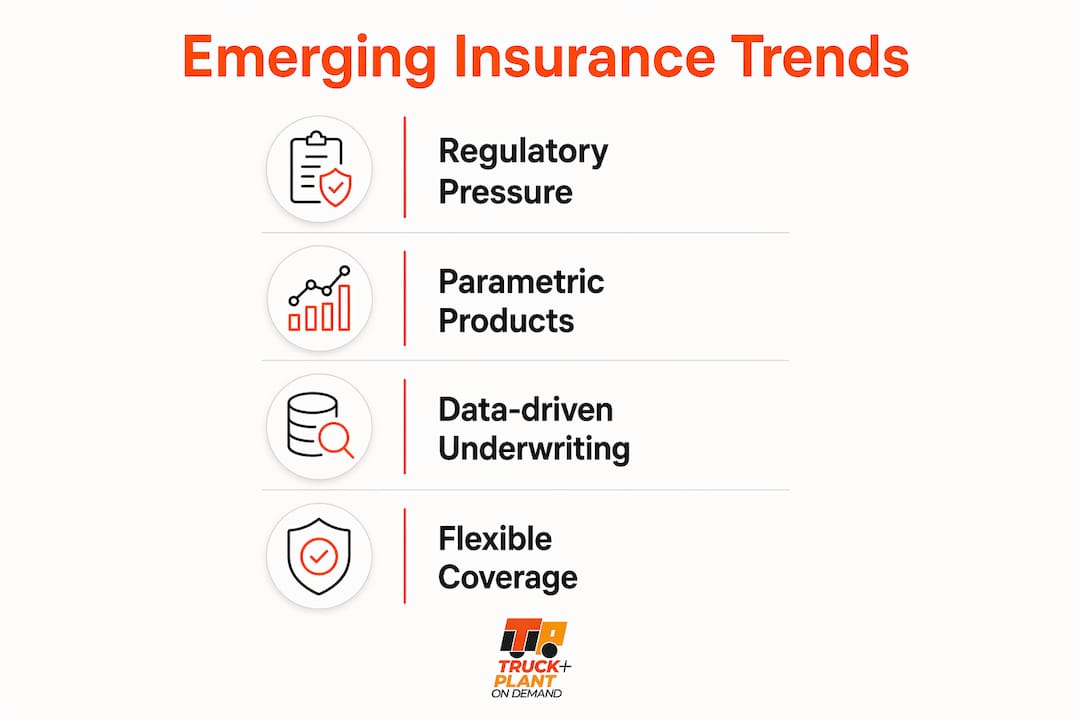
Regulatory pressure on AI disclosure. SEC disclosure requirements for AI and emerging risks are increasing personal director and officer liability. That is driving demand for affirmative AI liability programs as a risk management tool, not just an insurance product. Directors who cannot demonstrate they have addressed AI risk exposure face personal liability under these rules.
Growth of parametric products. Parametric insurance pays out based on pre-defined triggers rather than proof of loss. A temperature threshold, a seismic reading, or a grid outage event triggers payment automatically. For businesses that suffer losses without physical damage, this is a material improvement over traditional business interruption cover.
Data-driven underwriting. E&S carriers are using real-time operational data to price emerging risks more accurately. Businesses that can share clean data on their operations, loss history, and risk controls get better terms. Those that cannot are priced conservatively.
On-demand and flexible cover structures. The insurtech sector is producing policy structures that allow businesses to adjust cover as their operations change. This is particularly relevant for transport and logistics operators using new technologies, where the risk profile shifts with each new route, vehicle type, or cargo category. You can read more about how 2026 insurance trends are affecting commercial fleets specifically.
Key takeaways
Emerging industry businesses that rely on silent coverage policies face uninsured losses at claim time. The most effective protection combines affirmative policy language, E&S market access, and a detailed technical risk schedule prepared before underwriting begins.
| Point | Details |
|---|---|
| Silent vs. affirmative cover | Affirmative policies name your technologies explicitly, removing claim disputes before they start. |
| E&S market access | The Excess and Surplus market provides the flexibility to cover risks admitted carriers will not write. |
| Technical risk schedules | Detailed equipment and operational schedules lead to better terms and faster policy placement. |
| Integrated policy structures | Consolidated policies like ALPHA reduce coverage gaps between separate risk lines. |
| On-demand flexibility | Flexible cover structures let you adjust your insurance as your operations and risk profile evolve. |
Why I think most emerging industry businesses are underinsured right now
I have watched business owners in fast-moving sectors make the same mistake repeatedly. They buy a standard commercial policy, assume it covers their operations, and only discover the gaps when a claim is declined. The insurer points to a silent exclusion. The business owner points to a premium they paid in good faith. Neither argument wins cleanly, and the dispute takes months to resolve.
The uncomfortable truth is that most standard policies were written for businesses that existed before 2015. They were not designed for AI-driven decision systems, GPU farms, or tokenized asset portfolios. Buying one of those policies for a 2026 business is like fitting a 1990s engine into a modern vehicle. It might run, but it will not perform under pressure.
What actually works is transparency with your insurer before you bind cover. Share your technical risk schedule. Name every system you rely on. Ask directly whether each one is covered or excluded. That conversation is uncomfortable, but it is far less uncomfortable than a declined claim.
The complexities of transport insurance illustrate this well. Logistics operators using AI-powered routing or autonomous vehicles face the same silent coverage problem as a fintech startup. The technology is new. The policy wording is old. The gap between them is where losses happen.
Review your cover every time your business adopts a new technology or enters a new market. Do not wait for renewal. The risk changes faster than the renewal cycle.
— Coert
Truck & Plant On-Demand™ cover for dynamic operations
If your business operates commercial vehicles or plant machinery in the civil, construction, or transport sectors, your insurance needs change as your operations do. Truckplant’s Truck & Plant On-Demand™ cover is built on exactly that premise. You choose what to insure, when to insure it, and how. You only pay for the cover you actually need, not a fixed premium that ignores how your fleet operates month to month. Whether you run a single truck or a large mixed fleet, Truckplant tailors cover to your current operational reality. For businesses navigating the freight insurance options available in a changing market, that flexibility is a real advantage.
FAQ
What is insurance for emerging industries?
Insurance for emerging industries is specialized coverage for businesses in rapidly evolving sectors such as AI, fintech, biotech, and digital assets. It addresses risks that traditional admitted insurance policies exclude or remain silent on.
What does “silent coverage” mean in an insurance policy?
A silent policy neither explicitly includes nor excludes a specific risk, such as AI liability. This creates ambiguity at claim time and often results in disputed or declined claims.
Why is the E&S market important for emerging industry businesses?
The E&S market provides underwriting flexibility that admitted carriers cannot match. E&S carriers write bespoke policy wordings for novel risks and are not bound by state-filed rates and forms.
What is affirmative AI liability coverage?
Affirmative AI liability coverage explicitly names AI systems, outputs, and decisions within the policy’s coverage definitions. It removes the ambiguity of silent policies and reduces the risk of claim disputes for businesses that rely on AI.
How can I prepare my business for emerging risk underwriting?
Prepare a detailed technical risk schedule that lists your equipment, systems, and operational risk controls. Transparent disclosure before underwriting leads to better policy terms and faster placement.