


TL;DR:
- Operating without adequate insurance exposes subcontractors to potentially catastrophic costs from claims and incidents. Core coverage like general liability, workers’ compensation, and commercial auto is essential, with ongoing certificate management and endorsement review critical to proper protection. Proper understanding and management of wrap-up programs and on-demand cover help control expenses while ensuring comprehensive risk coverage.
Working without the right insurance for subcontractors is not a calculated risk. It is a direct exposure to costs that can end your business in a single incident. A third-party injury on a job site, a damaged piece of equipment, or a disputed contract clause can result in claims that no savings account can absorb. Yet many subcontractors continue operating with gaps in their cover, often because the options feel overwhelming or the costs seem unjustifiable. This guide cuts through that confusion and gives you a clear, practical breakdown of what cover you need, what the compliance landscape looks like, and how to manage costs without leaving yourself exposed.
Table of Contents
- Key takeaways
- Insurance for subcontractors: the cover you need
- Certificates of insurance: beyond the paperwork
- OCIP vs CCIP: what wrap-up programs mean for you
- Managing cost without cutting cover
- My take on insurance as a subcontractor
- How Truckplant can cover your operation
- FAQ
Key takeaways
| Point | Details |
|---|---|
| Core cover is non-negotiable | General liability, workers’ comp, and commercial auto form the baseline for any subcontractor operating on a construction site. |
| COIs require ongoing management | A Certificate of Insurance collected once is not enough. Policy expiry dates and endorsements must be tracked continuously. |
| Additional insured wording matters | The difference between “arising out of” and “caused by” in an endorsement can determine whether a claim pays out or is disputed. |
| Wrap-up programs have gaps | OCIP and CCIP programs do not cover commercial auto or off-site work, so you must maintain separate policies for those exposures. |
| On-demand cover saves money | Paying only for cover when you need it aligns your premiums with your actual working schedule, reducing unnecessary spend. |
Insurance for subcontractors: the cover you need
The construction site is one of the highest-risk working environments in any industry. As a subcontractor, you carry a specific slice of that risk, and your insurance needs to reflect that precisely. Here are the core policies every subcontractor should have on their radar.
-
General liability insurance. This is your first line of defence against third-party claims for property damage or bodily injury. General liability costs vary significantly by trade, ranging from around $400 per year for low-risk operations to $15,000 or more annually for high-risk trades like roofing. Your premium reflects your trade, your turnover, and your claims history.
-
Workers’ compensation. Workers’ comp requirements differ by jurisdiction. In many cases, subcontractors are not legally required to carry it, particularly if they work alone. But operating without it means any on-site injury comes directly out of your pocket, covering medical costs, lost wages, and potential long-term disability payments.
-
Commercial auto insurance. If you drive a bakkie, truck, or any vehicle to a job site and use it for work purposes, your personal vehicle policy will not cover an accident that happens during that work. Commercial auto cover is a separate policy requirement and a common compliance gap.
-
Tools and equipment insurance. Your angle grinder, generator, compressor, or excavator are revenue-producing assets. Theft, accidental damage, and breakdown are real risks on any active site. Tools and equipment cover protects those assets so one stolen toolbox does not derail your cash flow.
-
Professional indemnity (errors and omissions). If your work involves any element of design, specification, or advice, professional indemnity for subcontractors becomes relevant. A structural calculation error or a poorly specified material can trigger a claim that general liability will not touch.
Pro Tip: When you request quotes for subcontractor liability insurance, always disclose your full scope of work. Misclassifying your trade, even unintentionally, can result in a claim being declined because the risk was not properly underwritten.
Certificates of insurance: beyond the paperwork
A Certificate of Insurance (COI) is more than a formality. It is a live snapshot of your coverage at a specific point in time. COIs typically display your general liability limits, workers’ compensation, auto liability, policy numbers, effective dates, your insurer’s name, and any additional insured status. General contractors will require one before you set foot on site, and for good reason.
The problem is that many subcontractors treat a COI as a once-off document. You hand it over at the start of a project and assume the box is ticked. But policies expire, limits change, and endorsements shift. Best practices for COI verification require matching legal entity names, confirming policy effective dates, and checking that all required lines of cover appear on the certificate. A COI that lapses mid-project is no COI at all.
The additional insured endorsement is where things get particularly complex. When a general contractor requires you to name them as an additional insured on your policy, the exact wording of that endorsement determines the scope of protection they receive. And this is not a minor technicality.
Additional insured endorsements differ widely in wording and coverage scope. Some cover liability “arising out of” your work, while others cover liability “caused, in whole or in part” by your acts or omissions. Courts have repeatedly treated these as materially different, and the distinction has driven significant litigation in construction disputes.
The practical takeaway is that misalignment between contracts and endorsements is one of the most common and costly sources of disputes in construction. Before you sign any subcontract, review what endorsement wording your insurer provides and confirm it matches what the contract demands. If there is a gap, fix it before the project starts, not after a claim is filed.
- Verify that your COI lists the correct legal name of the party requiring cover.
- Check that your endorsement wording aligns with the specific contract language.
- Confirm expiry dates and set a calendar reminder before any policy lapses.
- Request updated certificates immediately whenever you renew or change a policy.
Pro Tip: Ask your broker to provide a summary of your endorsement wording in plain language. If they cannot explain it clearly, that is a signal to ask harder questions.
OCIP vs CCIP: what wrap-up programs mean for you
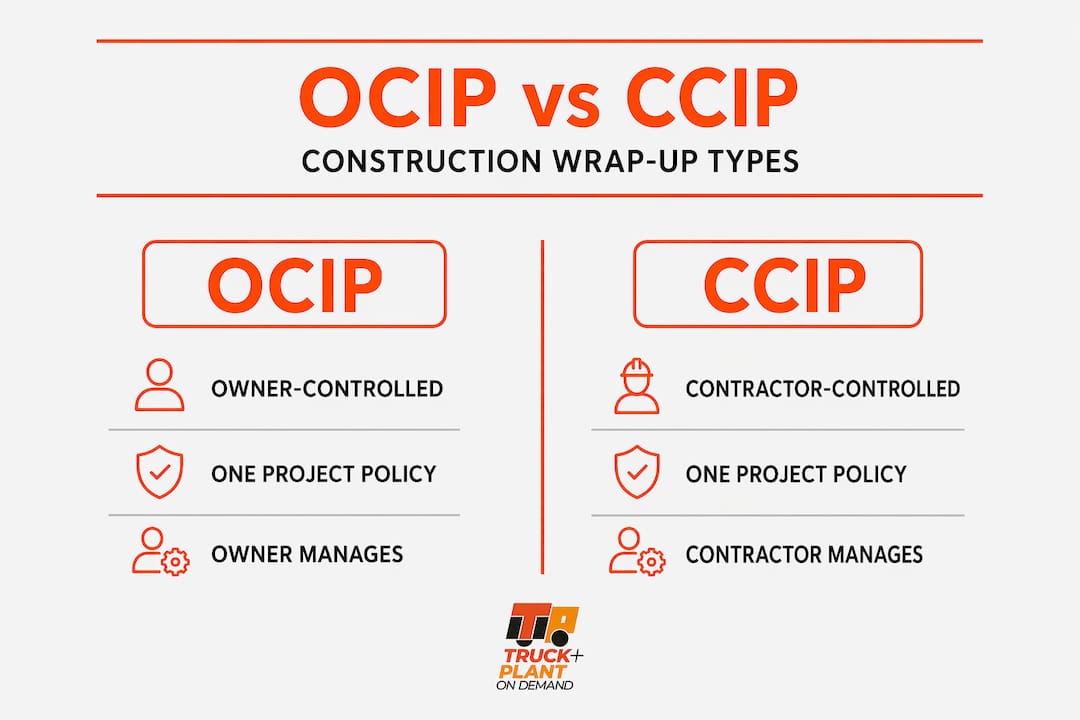
On larger construction projects, you may encounter a wrap-up insurance program. These consolidate cover for all parties on a project under a single policy, and they are structured in one of two ways.
| Feature | OCIP (Owner-Controlled) | CCIP (Contractor-Controlled) |
|---|---|---|
| Who administers it | Project owner | General contractor |
| Typical covers included | CGL, excess liability, workers’ comp | CGL, excess liability, workers’ comp |
| Commercial auto included | No | No |
| Off-site work covered | No | No |
| Cost savings for subs | Potential premium reduction | Potential premium reduction |
| Sub compliance obligation | Provide COIs for excluded covers | Provide COIs for excluded covers |
Wrap-up programs consolidate coverage to pool risks and reduce coverage gaps across a project, but they require careful administrative management. As a subcontractor enrolled in a wrap-up, you may be able to reduce some of your own policy costs for the duration of that specific project. That is the upside.
The downside is what they do not cover. Wrap-ups typically exclude commercial auto and any work performed off the project site. That means your vehicles, your off-site fabrication work, and your professional liability exposure remain entirely your responsibility. You also need to provide separate COIs for these excluded coverages, and you must verify that your own policy includes an exclusion endorsement for the enrolled project to avoid paying for double cover.
If you are bidding on a wrapped project, get clarity upfront on what is and is not included. Confirm the exact project address and scope that the wrap-up covers. Then work with your broker to adjust your own policy accordingly for the duration of that project.
Managing cost without cutting cover
Controlling your insurance spend as a subcontractor does not mean finding the cheapest policy. It means paying accurately for the risk you actually carry. These steps help you do that.
-
Classify your work correctly. Insurance premiums are calculated on class codes. If your work spans multiple trades or you have changed your primary activity, an incorrect class code means you are either overpaying or underinsured. Review this annually with your broker.
-
Manage your experience modification rate (EMR). Your EMR reflects your claims history relative to the industry average. A good safety record and low claim frequency reduce your EMR and, directly, your workers’ comp premiums. Investing in on-site safety protocols is one of the highest-return activities for a subcontractor from a cost perspective.
-
Align coverage limits with contract demands. Some contracts require $2 million in general liability; others require $5 million. Carrying a $1 million limit when your contract demands $2 million is a compliance failure. Carrying $5 million when every contract only needs $1 million is a waste. Match your limits to your actual work.
-
Use on-demand cover for flexible operations. If your workload fluctuates between busy seasons and quiet periods, on-demand insurance options allow you to scale cover up or down based on what you are actually doing. You stop paying fixed premiums for risks that are not active.
-
Review and update your COIs after every renewal. When your policy renews, every COI you have issued becomes outdated. Work with your broker to reissue all active certificates immediately, and confirm that endorsements still match open contract requirements.
Pro Tip: Bundle your construction insurance options where possible. Many insurers offer package pricing for subcontractors that combines general liability, tools cover, and commercial auto at a lower combined premium than buying each separately.
My take on insurance as a subcontractor
I have watched subcontractors go into projects confident in their ability to deliver, only to hit a dispute or an injury claim that their policy did not actually cover. And almost every time, the gap was not because they had no insurance. It was because the insurance they had did not match what they thought they had.

The additional insured issue is the one I see trip people up most consistently. You hand over your COI, the contractor names it, and everyone moves on. But six months later, when a claim arises, the endorsement wording is the first thing a lawyer examines. “Arising out of” and “caused by” might look like synonyms in normal conversation. In a courtroom, they are not.
The other pattern I have seen is subcontractors treating wrap-up enrollment as a reason to cancel their own policies. That is a serious mistake. The wrap-up covers you on that specific site for that specific scope. The moment you drive off site or do work adjacent to the project, you may be in an uninsured exposure. Keep your own cover active and coordinate the overlap carefully.
My advice: treat your insurance like a live document, not a filing cabinet item. Review it when you take on a new contract, when your fleet changes, when your team grows, and when any project terms shift. Proactive management is the only way to make sure you are genuinely protected, not just technically insured.
— Coert
How Truckplant can cover your operation
If you are managing a construction fleet, yellow plant machinery, or tools of trade, Truckplant’s Truck & Plant On-Demand™ was designed for exactly your situation. You pay only for cover when you need it, and you can adjust your cover in real time as your contracts change. No locked-in premiums for cover you are not using.
Whether you need fleet cover for commercial vehicles or protection for your tools and plant equipment on active sites, Truckplant gives you control over what you insure, when you insure it, and how much you spend. You can also access tool of trade cover tailored to the construction and civil sectors. Get a quote today and build a policy that matches your actual operation.
FAQ
What insurance does a subcontractor need?
Most subcontractors need general liability, workers’ compensation, commercial auto, and tools or equipment cover at a minimum. Professional indemnity applies if your scope includes design or specification work.
How much does subcontractor liability insurance cost?
General liability for subcontractors ranges from around $400 per year for low-risk trades to $15,000 or more annually for high-risk work like roofing, depending on trade classification, turnover, and claims history.
What is an additional insured endorsement?
It is a provision added to your policy that extends certain liability protections to another party, usually a general contractor. The exact wording determines the scope of that protection and must align with your contract requirements.
Do wrap-up programs replace a subcontractor’s own insurance?
No. Wrap-up programs like OCIP and CCIP cover on-site general liability and workers’ comp for enrolled subcontractors, but they exclude commercial auto and off-site work. You must maintain separate cover for those exposures.
How often should a subcontractor update their COI?
You should reissue COIs every time your policy renews or changes. At a minimum, verify that all active project certificates match your current policy details, including endorsements and expiry dates, at least every six months.