


Laid up fleet cover is a reduced insurance arrangement for trucks, trailers, and plant machinery that are stationary and out of active service. The moment you know a vehicle or machine will sit idle for weeks, your first move should be to notify your insurer and prepare a lay-up plan, or switch to a flexible option like Truck & Plant On-Demand™. Most insurers apply a rule requiring a minimum period of consecutive inactivity before qualifying for a laid-up return.
Here’s what to do right now:
- Confirm your policy’s laid-up terms and notification window with your broker or insurer.
- Draft a basic lay-up plan covering location, security, and maintenance.
- Decide whether standard laid-up cover or on-demand cover suits your operating pattern better.
Key Takeaways
Laid-up fleet cover only pays off when fleet managers document the lay-up formally, respect insurer notification windows, and match coverage tiers to actual storage risk.
| Point | Details |
|---|---|
| Confirm the inactivity threshold | Most insurers require a minimum period of inactivity before considering a premium return. |
| Notify insurers early | Report lay-up status within the required window, commonly 30 days, to protect eligibility for returns. |
| Build a lay-up plan | Document storage location, security measures, maintenance schedule, and a responsible contact. |
| Treat reactivation as high-risk | Insurers often request inspection reports and maintenance logs before confirming cover on return to service. |
| Consider on-demand cover | Truck & Plant On-Demand™ lets fleets adjust cover levels directly instead of filing discretionary laid-up return applications. |
Table of Contents
- What is laid-up fleet cover and how does it differ from being idle?
- What are the eligibility rules and how are premium returns calculated?
- What do insurers require before they’ll honour laid-up cover?
- How do you secure a laid-up premium return without breaching cover?
- How risky is reactivation and what should you check first?
- What happens if you don’t comply with laid-up cover requirements?
- How does laid-up cover compare to standard fleet insurance on cost?
- Why on-demand cover changes the lay-up calculation
- Get on-demand cover built for South African fleets
- Frequently asked questions
- Sources
What is laid-up fleet cover and how does it differ from being idle?
A truck parked over a quiet weekend isn’t “laid up” in the insurance sense. Laid up means an asset is formally taken out of active operation, with no cargo onboard, no scheduled trips, and stored in a location your insurer knows about and, ideally, has approved. That distinction matters because insurers price risk based on use, not just ownership, and moving from active to laid-up status shifts you into a different risk category entirely.
Motor fleet policy summaries typically offer several tiers once an asset qualifies as laid up. RSA’s motor fleet policy summary lists options such as “Laid Up Fire and Theft” and “Laid Up Fire, Theft and Accidental Damage,” each reducing scope while premiums drop accordingly.
Common tiers include:
- Fire and theft only: the leanest option, covering catastrophic loss but nothing else.
- Fire, theft, and accidental damage: broader protection, useful if the asset sits somewhere with foot traffic or shared storage.
- Limited liability: keeps you compliant with third-party obligations without paying for comprehensive cover you don’t need.
The trade-off is real. Drop to fire-and-theft-only and a forklift reversing into your parked trailer becomes your problem, not the insurer’s.
What are the eligibility rules and how are premium returns calculated?
Most insurers require that an asset be stationary for a sufficiently long consecutive period, excluding arrival and departure days, before they consider a premium return. Gard’s Rule 22 sets this benchmark for laid-up returns, and most South African commercial insurers follow a similar logic even outside marine markets.
The 30-day threshold isn’t a formality. Fall short by even a few days and most insurers won’t prorate anything, treating the whole period as standard active cover.
Several things can invalidate a lay-up claim before it starts:
- Cargo or equipment left onboard during the “laid up” period.
- The asset being subject to arrest, detention, or a continuing responsibility obligation under the policy.
- Failure to notify the insurer within the required window.
Even when you tick every box, premium returns are typically discretionary rather than automatic. Insurers prorate based on their own formulas and residual risk assessment, not a fixed refund table. Don’t budget for a return before your insurer confirms one in writing.
What do insurers require before they’ll honour laid-up cover?
Insurers won’t take your word that a truck is parked and forgotten. They want proof, and they want it early.
- Notify promptly. Most insurers expect notice at or near the start of lay-up within a specific notification window, so don’t wait until filing for a return to mention it.
- Submit a lay-up plan. This should cover the storage location’s security level, who holds responsibility for the asset, a maintenance schedule, and preservation steps like corrosion inhibitors or battery care.
- Keep compliance current. Underwriters expect roadworthiness certificates, licensing, and permits to stay valid during lay-up, or documented proof you agreed a suspension with them directly.
- Assign a responsible contact. Someone needs to be named and reachable if the storage site is compromised or an inspection is requested.
Skuld’s guidance on distressed-market lay-up makes the point plainly: insurers treat lay-up as an altered risk, not an absence of risk, and a well-documented plan is what separates a smooth claim from a rejected one.
Pro Tip: Photograph the storage location and the asset itself on the day lay-up begins, then again monthly. Insurers respond far better to a dated photo log than a verbal assurance that “nothing’s changed.”

Reviewing your risk assessment checklist before lay-up starts saves you from scrambling to reconstruct records after the fact.
How do you secure a laid-up premium return without breaching cover?
Getting a premium return or reduced rate isn’t complicated, but it does reward people who treat it as a process rather than an afterthought.
Before lay-up begins:
- Inspect the asset and record its condition with photos and a written checklist.
- Drain fluids or apply preservation treatments where the manufacturer or insurer recommends it.
- Choose a secure, insurer-acceptable storage location, ideally one with restricted access or monitoring.
Once the asset is stationary:
- Notify your insurer within their required window, in writing.
- Submit the laid-up return application within the timeframe they specify.
- Retain every photo, log entry, and maintenance record until the asset is reactivated and any claim is settled.
A few tactics consistently lower costs without risking your cover:
- Match the coverage tier to actual exposure. Fire and theft only makes sense in a locked yard; go broader for anything stored where third parties could cause accidental damage.
- Use short-term or on-demand cover for assets that cycle between active and idle status rather than negotiating a new laid-up clause every time.
- Time lay-up to coincide with planned maintenance windows so you’re not paying storage and service costs twice.
How risky is reactivation and what should you check first?
Reactivation, not the lay-up period itself, is where most claims actually happen. Industry write-ups on lay-up risk consistently flag reactivation as the highest-risk phase, because engines, hydraulics, and electrical systems degrade quietly while idle, and problems only surface once the asset is back under load.
Insurers commonly ask for evidence before confirming cover resumes in full:
- A survey or inspection report from a qualified mechanic or engineer.
- Maintenance logs covering the lay-up period.
- Confirmation that certifications and licensing lapsed, if at all, were formally agreed with the insurer.
A short reactivation checklist covers most of the risk: run a full pre-start inspection, test braking, electrical, and hydraulic systems under light load before returning to normal duty, and renew any certification that expired during storage. A reliable repair partner for pre-start diagnostics catches the corrosion and seal failures that a visual check alone misses.
What happens if you don’t comply with laid-up cover requirements?
Skipping the paperwork on laid-up cover doesn’t just cost you a premium return. It can void the cover entirely.
The most common failure is misrepresentation, whether deliberate or careless. If you tell your insurer an asset is laid up but it’s actually being used for short trips or emergency callouts, that inconsistency can invalidate the policy outright, leaving you exposed for any incident that occurs during that period. Insurers investigate claims involving laid-up assets more closely than standard claims, precisely because the reduced premium creates an incentive to under-declare activity.
Missing notification deadlines carries its own penalty. If your policy requires notice within 30 days of lay-up starting and you notify on day 45, don’t expect a return covering the missed window, and don’t assume the insurer will backdate anything. The same applies at the other end: file your laid-up return application after the asset returns to service and the claim window has closed, and you likely forfeit the return regardless of how well you documented everything else.
There’s a compliance risk too. If a laid-up truck’s licensing or roadworthiness certification lapses without insurer sign-off, you may find yourself both uninsured and operating outside regulatory requirements the moment that asset moves again, even for a test drive. The fix costs nothing: tell your insurer before lapses happen, not after.
How does laid-up cover compare to standard fleet insurance on cost?
Standard fleet insurance prices risk for an asset that’s driving, hauling, or operating daily, which means the premium reflects road risk, operational wear, and third-party exposure at full intensity. Laid-up cover strips most of that exposure out, so the premium drops, sometimes substantially, but the trade-off is coverage scope.
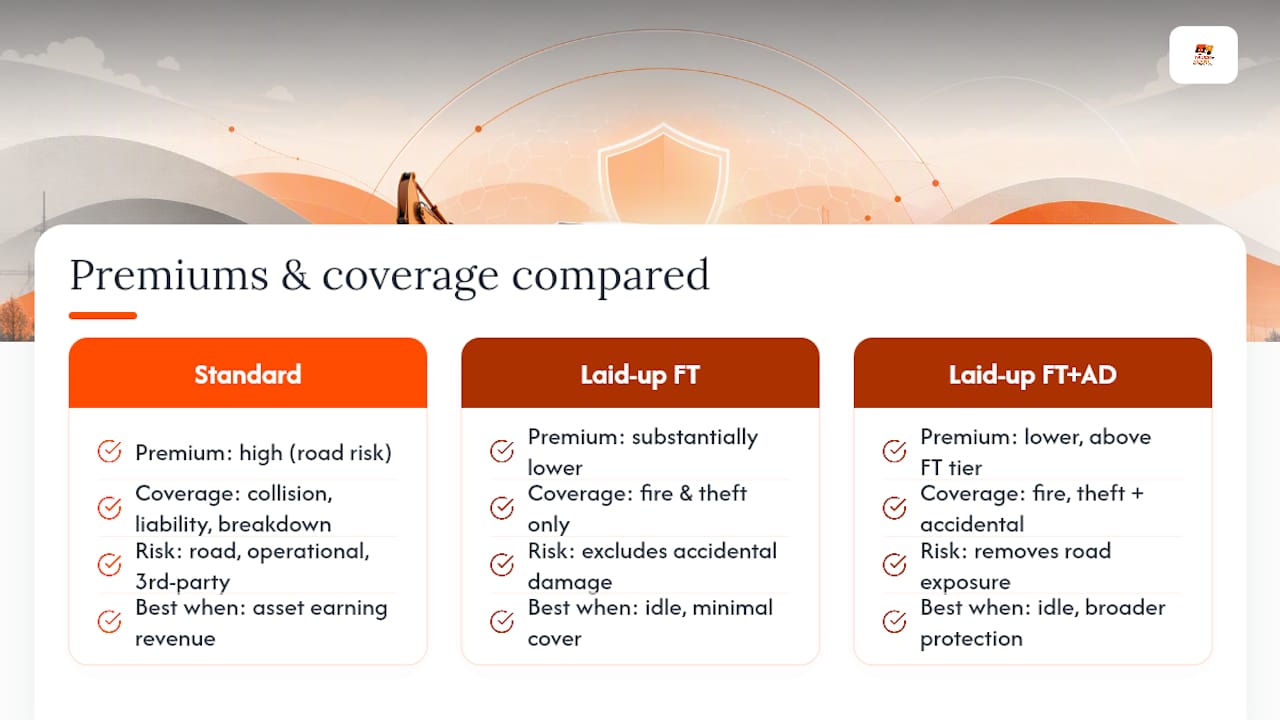
A truck on standard cover is protected for collision, third-party liability, and often mechanical breakdown while it’s earning revenue. The same truck under a fire-and-theft-only laid-up tier loses that breadth entirely; if someone breaks a window or a falling object dents the bodywork, you’re paying out of pocket unless you selected the broader fire, theft, and accidental damage tier.
The real cost comparison isn’t laid-up versus standard in isolation. It’s laid-up versus paying full standard premiums for an asset earning nothing. A truck sitting idle for two months while still on full standard cover is pure premium waste, since you’re paying for road risk on a vehicle that hasn’t left the yard. That’s the calculation that makes laid-up cover, or better still, on-demand cover you can toggle without renegotiating a laid-up clause, the financially sound choice for any fleet with predictable idle periods.
Why on-demand cover changes the lay-up calculation
Most fleet managers don’t lose money on laid-up assets because the concept is confusing. They lose money because switching between active and laid-up status through a traditional insurer means paperwork, waiting periods, and often a phone call to a broker who’s slow to respond.
Truck & Plant On-Demand™ was built around exactly this friction point. When an asset goes idle, whether that’s a grader between contracts or a delivery truck during a slow season, you adjust cover directly rather than filing a laid-up application and hoping the return gets approved. On-demand, usage-based models remove much of the administrative delay that makes standard laid-up returns feel like a bureaucratic gamble.
The conventional wisdom treats lay-up as a once-a-year event tied to seasonal shutdown. In practice, most fleets have assets going idle and active on a rolling basis all year, and a policy structure built for one annual lay-up event doesn’t fit that reality.
Get on-demand cover built for South African fleets
Truck & Plant On-Demand™ gives you a way out of the laid-up return paperwork cycle entirely. Instead of applying for a discretionary refund weeks after an asset goes idle, you adjust your cover the moment operations change, and pay only for the protection level your truck or plant actually needs that month.

The product supports pay-for-use premiums, digital activation, and tiered coverage options that scale from fire-and-theft-only up to full protection, all without a call to a broker or a 30-day waiting period. Whether you’re managing a fleet of delivery trucks, hired-out plant machinery, or construction equipment that cycles between sites and storage yards, you set the cover level to match reality. Check your options and request a tailored quote through the fleet insurance page to see how adjustable cover compares to what you’re paying now.
Frequently asked questions
What is the minimum period an asset must be inactive to qualify for laid-up cover?
Most insurers require a defined minimum period of inactivity, excluding the arrival and departure days, before considering the asset eligible for a laid-up premium return.
Can I still get a laid-up return if I forget to notify my insurer on time?
Rarely. Notification windows, often 30 days from the start of lay-up, are treated strictly, and missing them commonly voids the return for that period even if every other requirement was met.
Does laid-up cover protect against theft while an asset is in storage?
Yes, if you select the fire and theft tier or broader. The base tier alone won’t cover accidental damage, so choose fire, theft, and accidental damage if the storage site has any foot traffic or shared access.
What documents should I keep during a lay-up period?
Photographic evidence of the asset and storage site, a signed security or watch log, maintenance and preservation records, and written confirmation of your lay-up notification to the insurer.
Is switching to on-demand cover better than applying for a laid-up return?
For fleets with assets that move between active and idle status frequently, on-demand cover avoids the discretionary approval process and administrative delay tied to traditional laid-up return applications.
Sources
- UKC05702A Motor Fleet Policy Summary Apr 26 (RSA)
- Premiums and Calls – Rule 22: Laid-up returns | Gard
- Lay-up cover: helping owners in a distressed market – Skuld
- LAY UP – Insurance risks, considerations & premium return | Pacific Intermediaries & Consultants