


A midterm fleet policy change is any amendment you make to an active fleet insurance policy before renewal, covering vehicle additions, removals, or wording adjustments. The moment you know a change is coming, notify your insurer or broker in writing and hold off on using any new vehicle until you have confirmed cover. Expect three things next: a cost adjustment, a processing timeline, and an updated endorsement or certificate.
TL;DR:
- Insurers process vehicle additions or removals faster when complete data is submitted through their portal, with processing time typically measured in a few business days.
- Costs for midterm adjustments include a prorated premium change and an administration fee, which vary depending on the policy’s billing structure and timing of the request.
- Cover for a vehicle attaches only after formal insurer acceptance, making written confirmation essential before putting a vehicle on the road to ensure valid coverage.
- Maintaining a detailed, timestamped record of all MTAs helps verify exactly when vehicles were added or removed, reducing disputes later.
- Frequent vehicle turnover benefits from on-demand insurance’s real-time adjustments, which eliminate delays and reduce administrative costs compared to traditional annual policies.
Table of Contents
- How to add or remove a vehicle mid-policy
- What do midterm fleet policy changes cost?
- When do midterm changes actually take effect?
- Documentation and audit trail: what insurers expect for MTAs
- Insurer wording changes and what they mean for cover
- How insurers evaluate MTAs: the data that moves the needle
- Differences in midterm change processes among major insurers
- Regulatory and compliance considerations for midterm fleet policy changes
- Publisher perspective: on-demand cover and the mid-term workflow
- How Truck & Plant On-Demand™ handles your mid-term changes
- Sources
- FAQ
How to add or remove a vehicle mid-policy
Getting a vehicle added or removed cleanly comes down to preparation. Insurers process requests faster when you arrive with complete data rather than a partial description of what changed.
Before you contact your insurer or broker, gather:
- Vehicle registration number and VIN
- Driver licence details and the named driver assignment
- Intended vehicle use and operating radius
- Estimated value or replacement cost
- Date the vehicle enters or leaves the fleet
Submit through your insurer’s portal where one exists. Portal submissions create a timestamped audit trail, route automatically to underwriting, and typically process faster than email requests, which sit in a queue and rely on someone manually keying in the details. Broker submission still works well for complex fleets or non-standard vehicles, where a conversation catches issues a form cannot.
Removing a vehicle requires its own evidence: a signed disposal or handover form, the return date, and confirmation the vehicle is off the road or sold. Without that paperwork, insurers may keep charging premium on a vehicle you no longer operate.
The safest operational rule is simple: no new vehicle goes on the road until you have written confirmation of cover. A phone call promising “you’re covered from today” is not evidence at claims stage. Get it in writing.
Pro Tip: Keep a running spreadsheet of every mid-term request with the date submitted, the date confirmed, and who approved it internally. When an auditor or claims handler asks “when did this vehicle actually attach to the policy?”, that log answers it in seconds.
What do midterm fleet policy changes cost?
Every mid-term adjustment, or MTA, is priced on a two-part model: the prorated premium movement for the remaining policy period, plus an administration fee for processing the change. Adding a higher-value vehicle mid-term increases premium; removing one generates a partial refund, usually calculated from the date insurers confirm the removal, not the date you stopped using the vehicle.
How you pay depends on how the policy was set up at inception:
- Monthly instalment policies typically fold the adjusted premium into the next scheduled payment.
- Broker-invoiced policies often bill the MTA fee separately, on receipt of the endorsement.
- On-demand or usage-based policies adjust the charge in near real time, tied to when cover actually starts.
Invoicing timing genuinely varies by how insurers structure MTA billing, so confirm the mechanics with your broker before assuming a monthly figure. If you run a fleet with frequent vehicle turnover, batching multiple MTAs into a single request or agreeing a pre-authorised change band with your insurer cuts down on repeated admin fees and keeps your monthly costs predictable.
When do midterm changes actually take effect?
Most insurers process a standard MTA within a few business days, confirming attachment through an endorsement or a reissued certificate of insurance. Treat the certificate date, not the request date, as the moment cover actually attaches.
Renewal timing complicates this. If you submit an MTA close to your renewal date, some insurers will fold the change into the new policy wording rather than endorsing the expiring one, which can shift how the change is priced or worded.
- Confirm which policy period your change attaches to if you’re within 30 days of renewal.
- Ask whether your insurer applies new wording changes to new business immediately but delays them for existing renewals, as some insurers explicitly stage this rollout.
- Request written confirmation of the effective date whenever a change lands near a renewal cycle.
Documentation and audit trail: what insurers expect for MTAs
Claims handlers and auditors both want a clean paper trail showing exactly when a vehicle attached to or left your policy, and who authorised it. Build the evidence pack as you go, not after a claim forces you to reconstruct it.
- The written change request itself, with a timestamp
- Vehicle identity: registration and VIN
- Signed handover or disposal form for removals
- Driver assignment record tied to the vehicle
- Photos of the vehicle at handover, where relevant
Digital portals help here because they log submitter identity and timestamp automatically, but the audit trail is only as good as your own fleet system. Reconciling your fleet management register against the insurer’s policy schedule regularly matters because a mismatch between what your telematics shows and what the insurer has on file is a common trigger for disputed claims.
Insurer wording changes and what they mean for cover
Insurers periodically update policy wording, and the edits are rarely cosmetic. Watch for:
- Harmonised vehicle definitions that reclassify how certain plant or commercial vehicles are treated
- Explicit acceptance clauses, meaning a new exposure only attaches once the insurer formally accepts the schedule change, not from the date you submitted it
- Updated certificate language that changes what counts as evidence of cover
The acceptance clause matters most in practice. If your policy wording requires insurer acceptance before cover attaches, using a vehicle the moment you submit the request, rather than the moment you get confirmation, leaves you exposed with no cover behind you. Where standard wording would leave a genuine gap for your fleet’s specific operations, ask your broker to request a tailored endorsement rather than assuming the general wording stretches to cover it. A clear glossary of terms like endorsement, schedule, and exposure acceptance is worth keeping on hand, since fleet insurance terminology shifts faster than most fleet managers track.
How insurers evaluate MTAs: the data that moves the needle
Underwriters weigh vehicle class, driver history, utilisation patterns, and maintenance records when deciding how to price or accept an MTA. Fleets that can show proactive maintenance and active risk management tend to get faster, cleaner approvals.
This is where fleet technology has shifted the underwriting conversation. Fleetio reports that AI-driven maintenance workflows cut shop time by an average of 2.5 hours per repair, and a significant portion of fleets on the platform now use AI to prioritise repair work, a pattern insurers read as evidence of active risk management rather than reactive fixing. Fleetio’s expanded AI Service Advisor has assessed over $1.4 billion in maintenance spend in beta, returning assets to service faster and creating a stronger maintenance record to hand an underwriter. Separately, Webfleet’s Fleet Insights and Asset Management 360 consolidates vehicle and non-powered asset data into one register, which reduces the admin overhead of proving what you actually own and operate. Wialon’s move toward hardware-free OEM data access is pushing the same direction: fewer discrepancies between what your telematics shows and what your insurer’s schedule says.
- Maintenance logs with timestamps and cost data
- Telematics trip summaries showing actual utilisation
- Driver scorecards where available
Pro Tip: Send your maintenance and telematics summary alongside the MTA request itself, rather than waiting for the insurer to ask. It signals a fleet that manages risk actively, and that often shortens the underwriting review.
If you want a wider view of how these technology shifts are reshaping insurer expectations, it’s worth a read before your next renewal conversation.
Differences in midterm change processes among major insurers
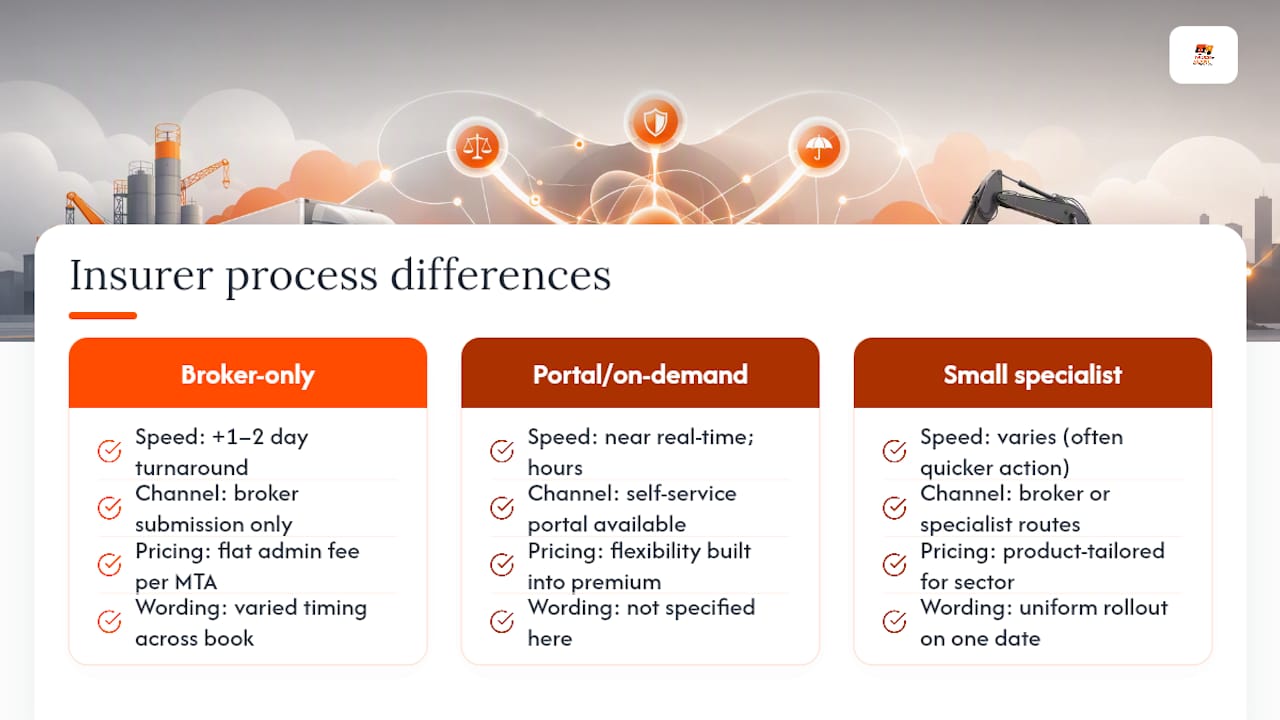
No two insurers handle MTAs identically, and the gaps show up most in speed, channel, and pricing structure. Some insurers process every change through a broker only, with no direct digital portal for fleet managers, which adds a day or two of turnaround compared with a self-service system. Others offer real-time portal submission where a vehicle addition attaches within hours once documentation is complete.
Pricing structure varies just as much. Traditional annual policies tend to charge a flat administration fee per MTA regardless of how minor the change is, which punishes fleets with frequent vehicle turnover. On-demand and usage-based insurers, by contrast, build the cost of flexibility into the product itself, adjusting premium as vehicles are added or removed rather than treating each change as a separate billable event.
Wording harmonisation timelines differ too. Larger insurers with multiple product lines often roll wording updates out to new business first and apply them to renewals later, creating a period where two fleets with near-identical cover are technically operating under different terms. Smaller or specialist insurers, including those built around commercial vehicle and plant machinery, tend to apply wording changes uniformly across the book at a single date, which reduces this kind of inconsistency but can mean less flexibility in how quickly a bespoke wording request gets actioned.
The practical takeaway: ask your insurer directly how they sequence wording changes and what channel they use for MTAs before you need to make one urgently.
Regulatory and compliance considerations for midterm fleet policy changes
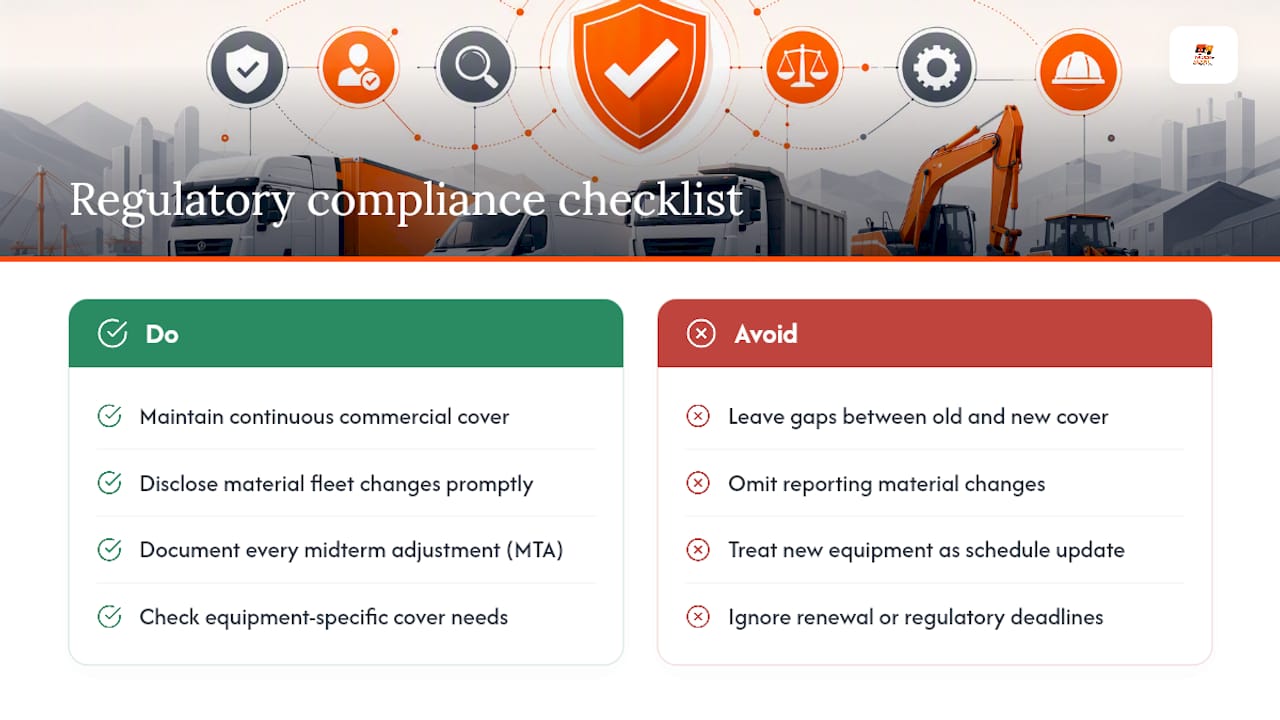
Fleet insurance sits inside a compliance framework that goes beyond the policy document itself. Vehicles used commercially generally require continuous cover under South African motor vehicle regulations, and a gap between removing old cover and confirming new cover exposes the operator to both financial and legal risk if an incident occurs during that window.
Compliance obligations extend to accurate disclosure. Insurers rely on the information in your fleet schedule to price risk correctly, and material changes, such as a shift in vehicle use, operating radius, or driver profile, that go unreported can affect claims validity later. This is precisely why documentation discipline around every MTA matters as much for regulatory exposure as for cost control.
Fleets operating mixed commercial vehicles and plant machinery also need to check whether specific equipment triggers separate regulatory cover requirements, such as machinery breakdown or environmental liability, that a standard vehicle policy doesn’t address. A midterm change that adds a new class of equipment, not just a new vehicle, often needs its own compliance check rather than a simple schedule update.
Keep a compliance calendar alongside your MTA log: renewal dates, wording change effective dates, and any regulatory deadlines tied to vehicle categories in your fleet. It’s a small administrative habit that prevents a much larger dispute later.
Publisher perspective: on-demand cover and the mid-term workflow
On-demand insurance removes much of the friction described above by aligning premium timing with actual vehicle use, rather than forcing every change through a prorated adjustment on an annual contract. It suits fleets with variable vehicle counts best; it’s less useful if your fleet size barely changes year to year, where annual cover may remain the simpler choice.
— Coert
How Truck & Plant On-Demand™ handles your mid-term changes
Traditional annual fleet policies force every vehicle addition or removal through the prorated premium and admin fee cycle described earlier, with turnaround times that depend on your insurer’s processing queue. Some on-demand insurance approaches allow adjustments to cover in real time as your fleet changes, rather than submitting a request and waiting for an endorsement to catch up with what’s already happened on the ground.

Some on-demand insurance products allow control over what is insured, when, and for how long, directly and digitally, without negotiating a separate MTA fee for every change. That’s the practical advantage for fleet managers juggling frequent vehicle turnover or seasonal plant hire. If your current renewal cycle is making every mid-term adjustment feel heavier than it needs to be, review the Truck & Plant On-Demand™ fleet insurance page and see how on-demand cover would handle your next vehicle change.
This article is general information, not a substitute for advice from a qualified financial advisor. Consult a qualified financial professional about your own circumstances before acting on anything here.
Sources
- Fleetio press: first half of 2026
- Webfleet unveils new fleet analytics and asset management solutions
- Fleetio expands AI Service Advisor
FAQ
How long does a midterm fleet policy change take to process?
Most insurers confirm a standard MTA within a few business days, though portal submissions with complete documentation often process faster than email or paper requests.
What are the 5 pillars of fleet management relevant to insurance?
Common frameworks group fleet management around vehicle acquisition, maintenance, driver management, compliance, and cost control, all of which feed the data insurers use to assess mid-term changes.
How do I keep track of vehicles across a large fleet for insurance purposes?
Reconcile your fleet management or telematics register against the insurer’s policy schedule regularly, since mismatches between the two are a leading cause of disputed claims.
What key trends are shaping fleet management heading into 2026?
AI-driven maintenance workflows, consolidated telematics and asset registers, and on-demand insurance products like Truck & Plant On-Demand™ are all reducing the friction and cost of mid-term fleet adjustments.
Do I need written confirmation before using a newly added vehicle?
Yes. Cover typically attaches only once the insurer formally accepts the schedule change, so using a vehicle before receiving written confirmation leaves you without evidence of cover if an incident occurs.