


SASRIA does cover fleet vehicles, but only for material damage caused by defined peril events such as strikes, riots, civil commotion and terrorism. It is never a standalone policy. It rides on top of your existing commercial motor cover, and it excludes standard theft or third-party liability in almost every scenario. Before you assume your trucks are protected, pull your SASRIA certificate and motor schedule and check vehicle categories and declared values line by line.
TL;DR:
- SASRIA covers damage caused only by specific events like strikes, riots, civil unrest, and terrorism, excluding theft, accidents, or third-party liability.
- Proper declarations of vehicle categories, values, accessories, and electric or hybrid identification are essential for claims to be valid during incidents.
- Updating and verifying SASRIA-related documentation, including certificates and schedules, must be an ongoing process, especially for fleet changes.
- Claims are often denied if looting occurs without a direct link to a defined event or if long-term storage is not declared, making accurate reporting crucial.
- Flexible insurance options like Truck & Plant On-Demand help manage SASRIA exposure more effectively during operational shifts and off-hire periods.
Table of Contents
- What SASRIA cover for fleets actually includes
- How SASRIA attaches to your fleet policy and how rating works
- Where fleet claims get denied: looting, storage and liability gaps
- How to check and document SASRIA cover for your fleet
- What to do immediately after an incident affecting your fleet
- Why on-demand cover closes the gaps SASRIA leaves open
- How Truckplant helps you manage SASRIA exposure without the admin headache
- Sources
- FAQ
- An honest read on where fleets actually get caught out
What SASRIA cover for fleets actually includes
SASRIA is a state-owned insurer built to indemnify material damage arising from a narrow list of Defined Events: strikes, riots, civil commotion, public disorder, and terrorism. That is the entire trigger list. A pothole, a hijacking, or a workshop fire will never activate a SASRIA claim, no matter how large your fleet is.
“Material damage” under the SASRIA motor policy 2026 covers the vehicle itself, its accessories, and spare parts carried for operational use. Electric vehicles qualify too, provided they are correctly scheduled with the insurer. Road risk (a truck damaged while driving through a riot zone) and static risk (a bus torched in a depot) are both included, as long as the peril fits the defined list.
Third-party liability sits outside this cover in almost all cases. SASRIA is a state-owned insurer that provides specialised cover for material damage caused by defined peril events, not a liability shield for your fleet’s interactions with the public. There are narrow exceptions where third-party damage links directly to a covered own-damage claim under road risk, but treat that as the exception, not the rule.
What to check on your schedule:
- Which Defined Events are listed and whether terrorism is included alongside strikes and riots.
- Whether every vehicle, not just your newest trucks, appears on the SASRIA-linked schedule.
- Whether accessories and spare parts carried on board are separately noted.
- Whether any electric or hybrid vehicles in your fleet are scheduled correctly for SASRIA purposes.
How SASRIA attaches to your fleet policy and how rating works
SASRIA cover cannot exist without an underlying short-term commercial motor policy. Industry practice confirms that SASRIA is added to an insurer’s existing motor policy rather than sold on its own. If your fleet lapses on its main cover, the SASRIA add-on lapses with it.
Rating depends on vehicle classification. SASRIA groups vehicles into categories, light commercial (GVM under 3,500kg), heavy commercial (GVM 3,500kg and above), buses, and mobile plant, and premiums shift based on both the category and your fleet’s total declared value. That structure comes straight from the SASRIA updated rates schedule, and misclassifying a single heavy truck as light commercial can distort your premium and complicate a claim later.
A few administrative realities catch fleet managers off guard:
- SASRIA certificates typically carry annual deadlines; insurers have flagged a late-November cutoff in past circulars, so track renewal dates closely.
- Circulars issued periodically adjust rates and reporting requirements; your broker should be forwarding these, not filing them.
- Annexures attached to your policy show exactly which rate table applies to each vehicle category, so ask for them by name rather than accepting a summary.
Where fleet claims get denied: looting, storage and liability gaps
Three misunderstandings cause more denied SASRIA claims than almost anything else, and all three are avoidable with the right declarations.
- Looting only counts when it follows a defined event. A warehouse broken into overnight is ordinary theft. The same warehouse looted during a riot, with the looting a direct consequence of that riot, is a SASRIA matter. DLA Piper’s guidance on public unrest claims makes clear that the causal link to a Defined Event is what separates a valid claim from a rejected one.
- Incidental storage is fine; deliberate long-term storage is not, unless declared. A truck parked overnight mid-route falls under normal transit allowances. A trailer mothballed in a yard for three months needs separate declaration, because SASRIA’s underwriting guidance treats extended storage as a different risk profile entirely.
- Third-party liability stays excluded in nearly every case. SASRIA will not step in to cover damage your driver causes to someone else’s property or vehicle. The rare exceptions apply only where third-party damage is tied directly to a covered own-damage event under road risk, and even then, insurers apply this narrowly.
How to check and document SASRIA cover for your fleet
Start by requesting three documents from your broker or insurer: your SASRIA certificate, your full motor policy schedule, and the annexures showing which rate category and value apply to each vehicle. Without these three, you cannot verify anything.
For every vehicle on the schedule, confirm:
- The correct category code (light commercial, heavy commercial, bus, or mobile plant).
- The declared value matches current replacement cost, not a figure from three years ago.
- Registration details are accurate and accessories or EV status is noted where relevant.
Then ask your broker directly what counts as “incidental” storage under your specific policy, since transit and storage time allowances vary by insurer rather than following one industry-wide rule. Ask what evidence they expect if a Defined Event hits your yard overnight.
Pro Tip: Keep a rolling log of vehicle movements, parking locations and security arrangements. Insurers increasingly treat documented operational practices, not just the policy wording, as the deciding factor in whether a claim gets paid.
What to do immediately after an incident affecting your fleet
- Secure the site first. Get people safe, then photograph every damaged vehicle before anything is moved or repaired.
- Log vehicle movements and note exactly which units were on-site, in transit, or off-hire at the time.
- Notify your broker or insurer within the timeframe your policy specifies, then let them handle the formal SASRIA notification.
- Gather your SASRIA certificate, motor schedule, and any security or incident reports before your insurer asks for them.
- Once the dust settles, revisit your declared values and vehicle categories with your broker. An incident is the moment misclassifications surface.
Why on-demand cover closes the gaps SASRIA leaves open
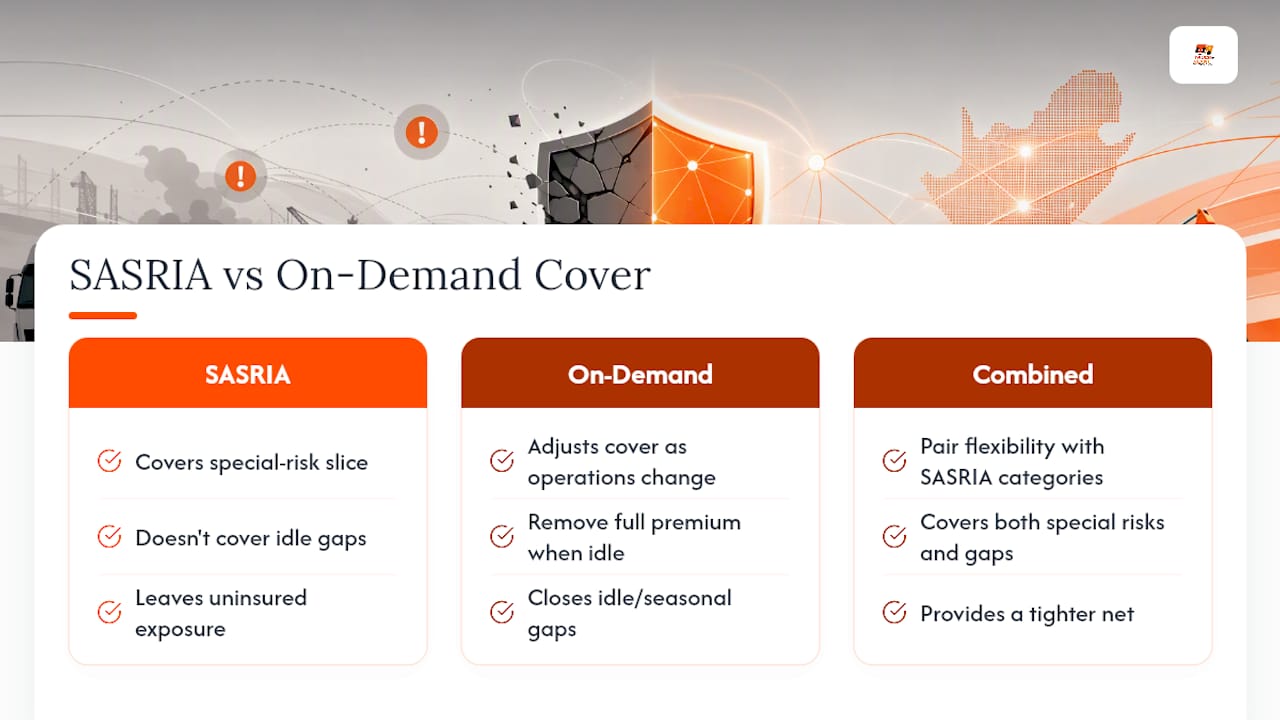
SASRIA handles the special-risk slice of your fleet’s exposure. It does nothing for the gaps that open up when a truck sits idle between contracts, a hired excavator rotates on and off your books, or a seasonal fleet scales up for three months a year. Those windows are where uninsured exposure actually accumulates.
Truck & Plant On-Demand™ is built around adjusting cover as your operations change, which means a vehicle coming off hire or a plant unit sitting idle doesn’t have to carry a full premium while it earns nothing. Pairing that flexibility with correctly declared SASRIA categories gives operators a tighter net than either product manages alone.
How Truckplant helps you manage SASRIA exposure without the admin headache
Traditional fleet cover locks you into a fixed premium regardless of how many trucks are actually on the road this month. Truckplant’s Truck & Plant On-Demand™ Insurance works differently: you adjust cover as your fleet size and usage change, so idle vehicles or off-hire plant don’t sit there costing you money.

That flexibility matters directly for SASRIA administration. Correctly declared values and vehicle categories are what keep a SASRIA claim valid, and a policy that adjusts in real time makes it far easier to keep those declarations current instead of discovering a gap only after an incident. Truckplant’s digital claims handling and no named-driver requirement also cut down the paperwork that typically slows fleet managers down when categories change mid-year.
If your fleet includes hired plant, seasonal vehicles, or units that rotate in and out of active use, visit the Fleet Insurance page to see how cover adjusts to your operations, or get in touch to talk through your current SASRIA declarations before your next renewal.
FAQ
What is covered under SASRIA?
SASRIA covers material damage to insured property, including fleet vehicles, caused by Defined Events: strikes, riots, civil commotion, public disorder and terrorism. It does not cover ordinary theft, accident damage, or third-party liability in most circumstances, since SASRIA is a specialised material-damage insurer, not a general liability provider.
What are the current SASRIA rates?
Rates depend on vehicle category and declared fleet value, with separate tables for light commercial, heavy commercial, buses and mobile plant. The exact figures are set out in the SASRIA updated rates schedule, and your broker should apply the current version rather than an outdated annexure.
Is it compulsory to have insurance on a financed car?
Financiers typically require comprehensive motor insurance as a condition of the finance agreement, though this is a lender requirement rather than a SASRIA rule. SASRIA cover itself is optional and only relevant once you already carry an underlying motor policy, since it cannot exist as a standalone product.
What are the regulations governing SASRIA insurance?
SASRIA operates under its own policy wording and underwriting guidance, which set out Defined Events, vehicle categories, and conditions for indemnity. Insurers and brokers must follow the current SASRIA motor policy and periodic circulars covering certificate deadlines and rate updates.
Does SASRIA cover hired or rented plant equipment in a fleet?
SASRIA can cover hired plant equipment for material damage from Defined Events, provided it is correctly scheduled under an underlying policy. Fleet operators using flexible cover such as Truckplant’s on-demand model often find it easier to keep hired units correctly declared as they rotate in and out of active use.
An honest read on where fleets actually get caught out
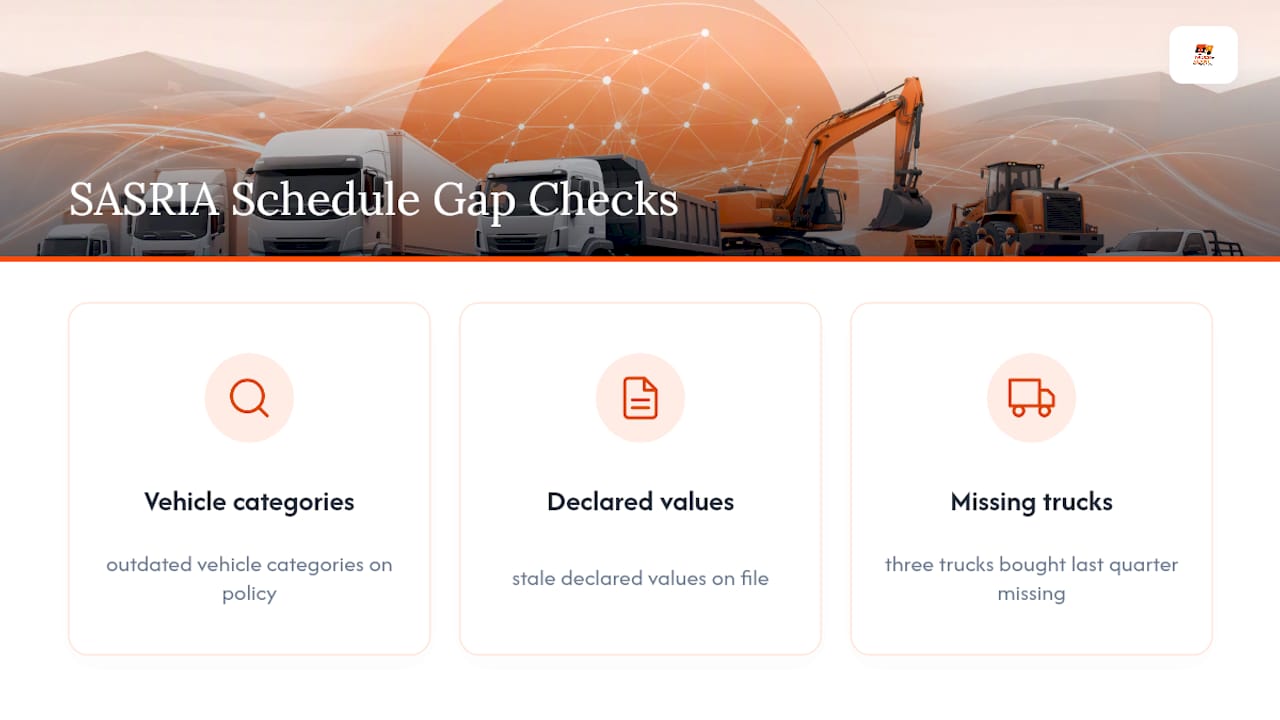
Most fleet managers assume SASRIA is either fully in place or entirely absent, and that binary thinking is what causes claim disputes. The real risk sits in the middle: a policy that technically has SASRIA attached but carries outdated vehicle categories, stale declared values, or a schedule missing three trucks bought last quarter.
The conventional advice tells operators to “check their SASRIA cover annually.” That’s not wrong, but it misses the harder truth: annual reviews miss the vehicles that come and go between review dates. A hired excavator on-site for six weeks, a bakkie added mid-contract, a trailer sold in March, these are the assets that fall through the cracks because nobody updates the schedule until renewal.
What actually protects a fleet is treating SASRIA declarations as a living document tied to operational changes, not a once-a-year compliance task. Pair that discipline with cover that flexes as your fleet composition shifts, and you close the gap between what your policy says on paper and what’s actually parked in your yard on any given day.
— Coert